
Abortion: Our Bodies, Their Lies, and the Truths We Use to
Jessica Valenti
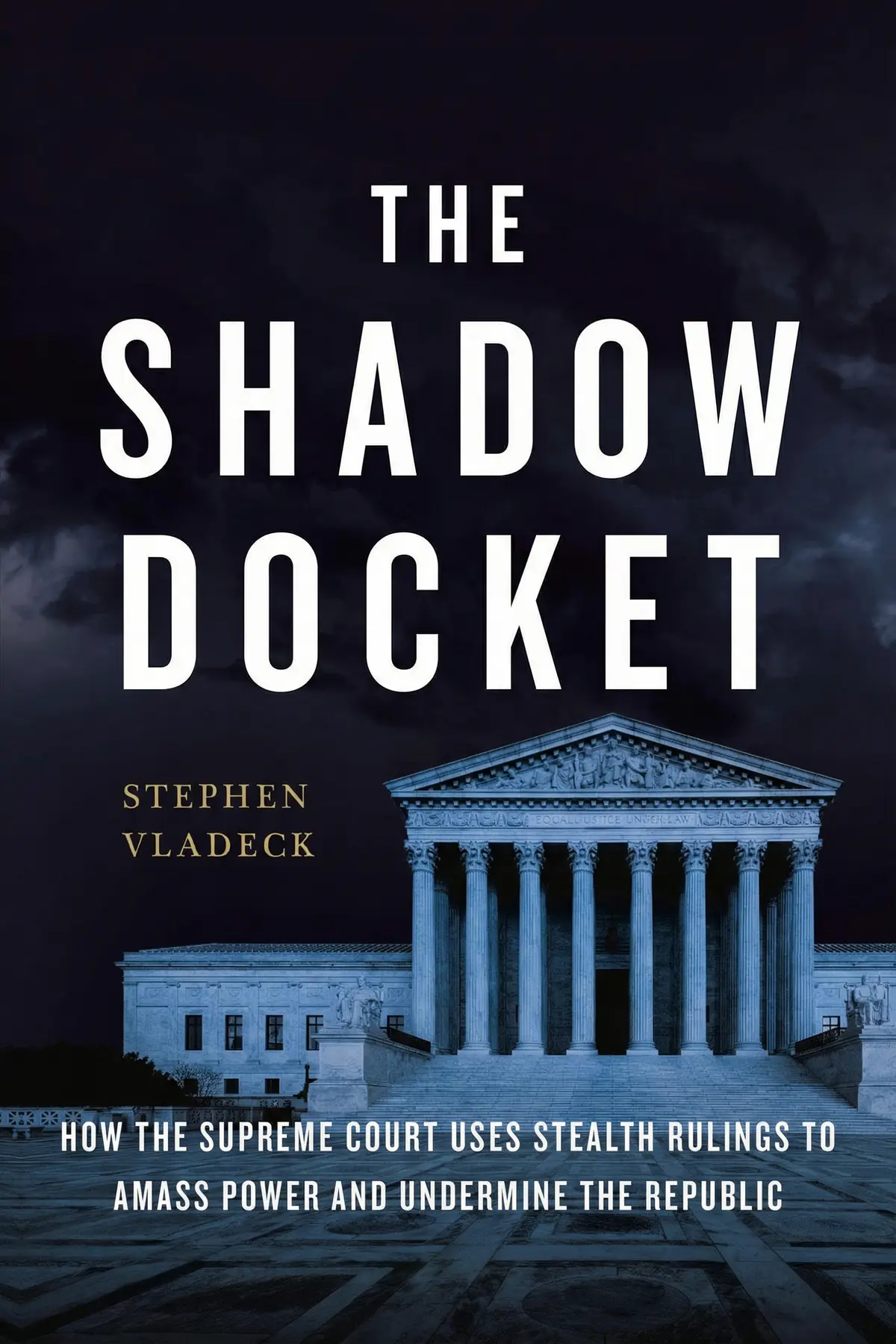
Stephen Vladeck exposes how the U.S. Supreme Court increasingly uses secretive, unexplained "shadow docket" rulings to reshape American law, bypass traditional transparency, and exert significant political influence without public scrutiny.
2 min 00 sec
Every summer, the American public braces for a series of landmark decisions from the highest court in the land. We’ve grown accustomed to this rhythm: the heavy anticipation in June, the flurry of news reports, and the dense, multi-page opinions where justices explain their reasoning in excruciating detail. This is the Supreme Court we think we know—the public-facing institution that engages in rigorous debate and eventual transparency. But there is a second, parallel version of the Court that operates almost entirely in the dark. It doesn’t hold oral arguments, it rarely provides explanations for its decisions, and its rulings often arrive in the middle of the night without any signatures attached.
In his deep dive into the American judicial system, Stephen Vladeck calls this the “shadow docket.” While it might sound like something out of a legal thriller, the shadow docket is a very real and increasingly powerful tool that the Supreme Court uses to bypass the traditional legal process. It used to be a place for boring, technical housekeeping—routine extensions or procedural stay orders. However, as Vladeck meticulously argues, that has changed. In the last decade, this shadowy side of the Court has been weaponized to make sweeping changes to the law of the land, affecting everything from how we vote to who can enter the country.
Over the course of this summary, we will pull back the curtain on this secretive practice. We’ll look at how the Court has transitioned from a model of deliberation to a model of “stealth” rulings. We will explore the massive surge in emergency orders that occurred during the Trump administration and how those orders allowed policies to stand even when lower courts found them illegal. We’ll also examine the way the shadow docket is reshaping our elections, often favoring specific political outcomes under the guise of procedural consistency. Finally, we’ll discuss the long-term danger this poses to the Court’s own authority. By the end, you’ll see that what happens in the shadows may be just as important as the high-profile cases that dominate the headlines.
2 min 35 sec
Uncover the vast differences between the Supreme Court’s public decisions and the anonymous, unexplained orders that actually make up the majority of its work.
2 min 11 sec
Learn why the mid-2010s marked a turning point, transforming routine court procedures into a powerful tool for ideological change.
2 min 26 sec
Examine how the executive branch and the Supreme Court collaborated to fast-track policies by bypassing lower court scrutiny.
2 min 20 sec
Explore the subtle legal doctrine that has allowed the Court to influence elections by preventing lower courts from correcting illegal voting rules.
2 min 24 sec
Discover why the lack of transparency in shadow docket rulings is causing internal friction and threatening the Supreme Court’s long-term power.
1 min 23 sec
The rise of the shadow docket represents a fundamental shift in the American judicial landscape. What was once a quiet, administrative necessity has become a powerful tool for exerting political influence and reshaping the law without the burden of transparency or public accountability. By using emergency orders to implement controversial policies and protect restrictive voting rules, the Supreme Court has created a system where major decisions are made in the dark, often without explanation or signatures. This isn’t just a concern for lawyers or legal scholars; it’s a concern for every citizen who believes in the rule of law.
As Stephen Vladeck has shown, the legitimacy of the Supreme Court is its most valuable asset, and that asset is being squandered. When the Court bypasses the traditional merits process, it abandons the deliberation and transparency that give its decisions moral weight. The path forward requires bringing these shadow rulings back into the light of day. It requires a return to a Court that explains itself, that respects the traditional legal process, and that understands its power is not absolute. If the Court continues to govern through stealth, it risks a future where it is no longer seen as a fair arbiter of justice, but as just another partisan actor in a divided nation. The throughline is clear: for the republic to thrive, the law must be clear, predictable, and, above all, visible to the people it governs.
The United States Supreme Court is often viewed through the lens of its major, public rulings—the ones preceded by months of briefing and oral arguments. However, Stephen Vladeck reveals that the vast majority of the Court’s work happens in the dark. This book explores the "shadow docket," a collection of procedural orders and emergency rulings that, while often anonymous and unexplained, have a profound impact on everything from immigration policy to election integrity. Vladeck argues that since the mid-2010s, the Court has shifted away from using this docket for routine housekeeping and toward making major substantive changes to the law. By examining the surge of emergency requests during the Trump administration and the use of the "Purcell Principle" in election cases, Vladeck illustrates how these stealth rulings undermine the rule of law. The promise of this book is to bring these hidden mechanisms into the light, explaining how they threaten the Court’s institutional legitimacy and why every citizen should be concerned about the rise of policy-making without public explanation.
Stephen Vladeck is the Chair of Federal Courts at the University of Texas School of Law. He has argued more than a dozen cases before the Supreme Court, and his work has appeared in legal journals such as the Harvard Law Review and the Yale Law Journal. He is currently a Supreme Court analyst for CNN.
Listeners find this work both captivating and accessible, highlighting its thorough research and sharp historical insights. Furthermore, the prose earns positive marks, with many considering the material essential and deserving of their time. However, listeners express differing views regarding the author’s narrative approach.
Ever wonder why major laws change overnight without a single public hearing or a written explanation? This book finally pulled back the curtain for me on what’s actually happening behind those marble pillars in D.C. Honestly, the realization that ninety percent of decisions happen in total secrecy is terrifying because it removes the accountability we expect from a democracy. Vladeck’s writing is surprisingly punchy for a law professor, making it feel less like a textbook and more like a high-stakes political thriller. I loved the way he dissected the Texas abortion ban stays, showing exactly how the process was manipulated to avoid public scrutiny. It made me look at the news differently every time a 'stay' or 'injunction' is mentioned now. This is easily the most important thing I’ve read this year, regardless of where you sit on the political aisle. Everyone needs to understand how the 'shadows' are affecting our everyday lives.
Show moreWow. This book is a massive eye-opener that should be required reading in every high school civics class. Vladeck pulls no punches as he illustrates how the Supreme Court is essentially 'legislating from the bench' through these secretive, unreasoned orders. I had no idea that so many life-altering decisions were being made without the public ever seeing the arguments or knowing which justices voted which way. The narrative style is fast-paced and clear, stripping away the legalese to show the raw power dynamics at play. It’s a chilling look at the erosion of institutional legitimacy. If you value the Constitution, you need to read this immediately.
Show moreFinally got around to reading this, and I can say the hype is absolutely justified. Vladeck meticulously dismantles the notion that the Shadow Docket is just a boring administrative necessity. He shows, case by case, how it has been weaponized to change the law of the land without the 'annoyance' of public accountability. Personally, I found his analysis of the Kavanaugh and Barrett opinions to be the strongest part of the book because he uses their own logic to highlight the Court's internal inconsistencies. The prose is accessible and the pacing is excellent, making a potentially dry subject feel urgent and relevant. It’s a bold defense of the traditional 'Merit Docket' and the transparency that used to define the American judiciary. This isn't just for lawyers; it’s for anyone concerned about the future of our democracy and the integrity of its highest institutions.
Show morePicked this up after seeing the author on the news, and I couldn’t put it down. It is a brilliant, necessary critique of how our judicial system has started operating in the dark. Vladeck explains the shift from the transparent 'Merit Docket' to the secretive 'Shadow Docket' with such clarity that even someone with no legal background can follow along perfectly. I was shocked to learn about the late-night rulings that stay major laws without a single word of explanation from the justices. The book is well-researched, engaging, and frankly, quite alarming in its conclusions about the loss of judicial accountability. It’s not just a political rant; it’s a data-driven look at how the rules of the game have changed without us noticing. Five stars for making such a complex topic so digestible and compelling for the average reader.
Show moreStephen Vladeck provides a masterclass in legal accessibility with this deep dive into the Court’s procedural maneuvers. I was particularly struck by how he contrasts the 'Merit Docket' with these unsigned, unreasoned orders that often come out in the middle of the night. To be fair, while the scholarship is undeniably rigorous, the tone occasionally leans into a sense of alarmism that might alienate a more conservative reader. Still, the breakdown of how the 'Emergency Docket' has evolved from a rare necessity into a standard operating tool is absolutely vital for any citizen to grasp. Vladeck manages to take dense jurisdictional concepts and turn them into a gripping narrative about institutional power. Even if you don't agree with every policy conclusion he implies, the historical data regarding the surge in these rulings since 2017 is hard to ignore. It’s a necessary look at why transparency matters in the highest court of the land.
Show moreAfter hearing so much buzz about this on legal podcasts, I finally dove into the full text. Vladeck does a phenomenal job explaining how the Court has pivoted away from the traditional model of oral arguments and lengthy, signed opinions. Look, the book is incredibly well-researched, and it manages to make the nuances of federal jurisdiction actually interesting to a layperson. I found the sections on the COVID-era religious liberty cases particularly enlightening because they showed the inconsistent application of these 'emergency' rules. While the prose is engaging, some chapters feel a bit repetitive as he hammers home the same points about transparency across different case types. Nevertheless, the incisive history provided here is essential for understanding the modern SCOTUS. It’s a compelling argument for why the Court needs to return to the light and explain its reasoning more clearly. A solid four stars for clarity and historical depth.
Show moreThe Shadow Docket is an important work that sheds light on a corner of the legal system that most Americans completely ignore. Vladeck’s history of how we got here—from the early days of the Court to the current explosion of emergency filings—is incredibly incisive and well-documented. Not gonna lie, some of the legal theory can get a bit dense, but he always brings it back to how these rulings affect real people on the ground. My only minor gripe is that he occasionally treats the 'shadow' nature of these rulings as proof of bad intent, rather than exploring alternative explanations in more depth. That said, his argument for increased transparency is hard to disagree with if you care about the Court's long-term standing. It’s an engaging read that prompted a lot of reflection on how much power we allow nine unelected individuals to wield in private.
Show moreDirect and insightful, this book offers a crucial perspective on the procedural evolution of the Supreme Court. As someone who works in the legal field, I appreciated the way Vladeck highlights the erosion of 'stare decisis' through these summary orders. The chapter on the historical landmarks was particularly strong, providing a context that is often missing from contemporary news cycles. To be fair, he does have a clear point of view, but he backs it up with an impressive array of empirical evidence and case law. The writing style is professional yet accessible, avoiding the trap of being overly academic while still maintaining intellectual rigor. It serves as a powerful call for the Court to return to its traditional role of providing reasoned, public justifications for its power. Definitely worth the read for anyone interested in the mechanics of American government.
Show moreAs someone who follows Supreme Court jurisprudence closely, I found this volume to be a bit of a mixed bag. On one hand, Vladeck is incredibly thorough in documenting the timeline of the Shadow Docket’s expansion and its departure from historical norms. However, the truth is that the author’s progressive leanings are so pervasive that they sometimes obscure the actual legal mechanics he’s trying to critique. He spends a lot of time dismantling Justice Alito’s defenses of the practice but gives very little space to the legitimate logistical hurdles the Court faces with an exploding emergency caseload. For a law professor, the lack of a balanced counter-argument felt like a missed opportunity to win over a wider audience. If you can filter out the partisan rhetoric, there is a wealth of historical information here that is worth your time. Just be prepared for a narrative that feels more like an indictment than a neutral analysis.
Show moreNot what I expected from a respected legal scholar. While Vladeck certainly knows his facts, the book is so heavily slanted toward a liberal worldview that it ceases to be a serious work of history. He paints every use of the emergency docket as a sinister power grab rather than a necessary response to the frantic pace of modern litigation. Frankly, his 'narrative' relies way too much on his own assumptions about what goes on behind closed doors during private conferences. It feels more like a collection of his Twitter threads than a balanced academic critique of court procedure. I was hoping for a nuanced discussion of reform, but instead, I got a partisan hit piece that ignores the valid reasons for procedural efficiency. If you're looking for an objective look at the Supreme Court, look elsewhere. This is designed to confirm existing biases rather than educate.
Show moreJessica Valenti
Yanis Varoufakis
Yuval Noah Harari

Jacinda Ardern
Pankaj Mishra
James Comey
Anthony Pratkanis


AUDIO SUMMARY AVAILABLE
Get the key ideas from The Shadow Docket by Stephen Vladeck, plus 5,000+ more titles in English and Thai.







