
18 min 23 sec
The Social Contract
An exploration of how legitimate political authority arises from the collective agreement of citizens, arguing that true freedom is found only when people govern themselves through the pursuit of the common good.
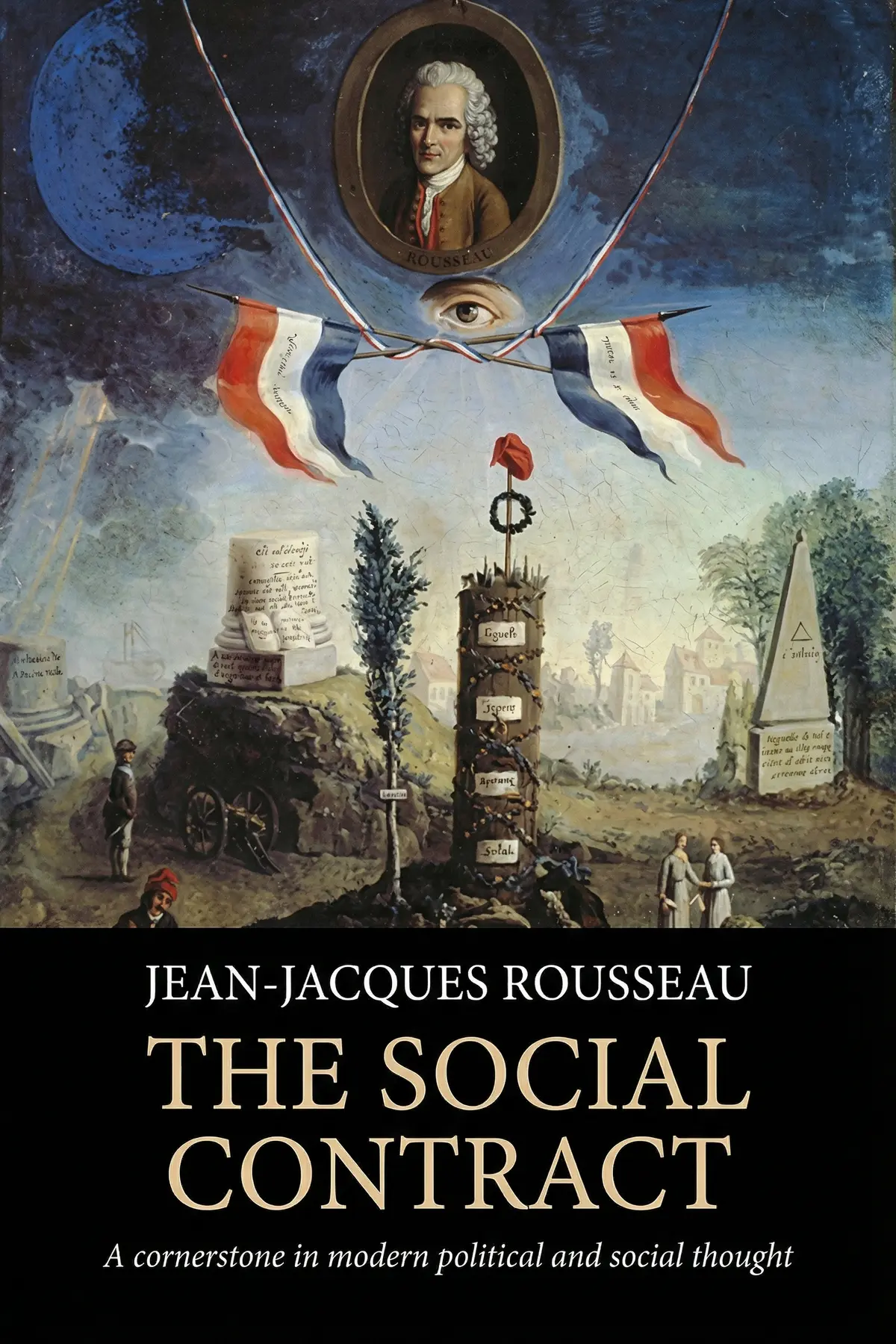
Table of Content
1. Introduction
1 min 53 sec
Imagine for a moment the world as it stood in 1762. Most of Europe was under the thumb of absolute monarchs—rulers who claimed their power came from divine right or sheer hereditary luck. Into this world stepped Jean-Jacques Rousseau with a book so radical it was burned in cities like Geneva and Paris. That book was The Social Contract, and its opening words still echo through the halls of history: “Man is born free, but he is everywhere in chains.”
This provocative statement wasn’t just a complaint about the tyrants of his era; it was a fundamental question about the very nature of human society. If we are naturally born to be free, how did we end up in a world of laws, taxes, and police? And more importantly, can those “chains” ever be made legitimate? Rousseau’s throughline is clear: a society is only valid if it is built on the free consent of its people.
Today, we live in a world that claims to have solved these problems. We have elections, constitutions, and parliaments. But Rousseau would likely look at our modern world with a skeptical eye. He would notice that while we vote, we rarely participate. We outsource our thinking to representatives and our security to institutions, often choosing the comfort of the sidelines over the messy, demanding work of self-determination. In this exploration, we are going to look at why Rousseau believed that active, direct participation is the only thing that keeps a state from rotting from the inside out. We will see how humans transitioned from creatures of instinct to beings of morality, why he was so captivated by the ancient Romans, and why he believed that for a state to survive, it needed a shared spirit that bordered on the religious. Let’s dive into the foundational ideas that shaped the modern world and see what they still have to teach us about being citizens today.
2. The Necessity of Consent in Political Authority
2 min 27 sec
Discover why power alone never grants a ruler the right to lead and why a state’s only true foundation is the voluntary agreement of its people.
3. The Transformation from Animal Instinct to Human Morality
2 min 40 sec
Explore the profound shift that occurs when humans move from the isolation of nature into the shared responsibilities of a community.
4. The Concept of the General Will and True Sovereignty
2 min 20 sec
Learn how the collective voice of the people becomes the only legitimate power in a nation, overriding the whims of any single ruler.
5. The Difference Between Making Law and Executing It
2 min 31 sec
Understand why the people must decide the laws, while a separate, carefully chosen group should be responsible for carrying them out.
6. The Essential Role of Direct Participation
2 min 10 sec
See why Rousseau believed that for a republic to survive, citizens must physically show up and engage in the political process.
7. The Power of Civil Religion and Shared Values
2 min 24 sec
Uncover why Rousseau believed a state needs more than just laws to stay united—it needs a shared spirit that binds the hearts of its citizens.
8. Conclusion
1 min 58 sec
As we wrap up our journey through Jean-Jacques Rousseau’s masterpiece, we are left with a vision of political life that is both inspiring and demanding. The Social Contract reminds us that our freedom is not a gift from a government, but a power that resides within us as a collective. We’ve seen that legitimacy can only be found in consent, that our transition into society is what makes us moral beings, and that the General Will must always be our North Star.
Rousseau’s ideal state—a republic of active, engaged citizens who prioritize the common good over private gain—might feel like a distant dream in our complex, modern world. However, the core truth of his work remains as vital as ever: democracy is not a spectator sport. When we retreat into our private lives and let others pull the levers of power, we are essentially inviting the return of the “chains” he so famously described.
The throughline of this work is a call to responsibility. If you want to live in a free state, you have to be a citizen in the fullest sense of the word. So, what can you do with this knowledge? The actionable advice here is to shrink your focus. While national politics can feel overwhelming and out of reach, local governance is where Rousseau’s ideas can truly breathe.
Take an interest in your town hall meetings, your local school boards, or your neighborhood associations. These are the modern versions of the Roman assemblies Rousseau loved so much. Engage in the debates that shape your immediate community. By participating in these smaller “social contracts,” you are practicing the very civic virtues that keep a republic alive. Remember, the state is only as strong as the commitment of the people who comprise it. In the end, the social contract is a promise we make to each other every single day: that we will strive to be more than just individuals, and that together, we will remain free.
About this book
What is this book about?
This summary dives into the profound political philosophy of Jean-Jacques Rousseau, specifically focusing on his landmark work regarding the origins of societal structure and the legitimacy of government. It addresses the fundamental tension between individual liberty and the necessity of communal law, proposing that a state only has a right to exist when its citizens have freely consented to its authority. Listeners will journey through the shift from the impulsive state of nature to the moral state of civil society. The narrative explores why Rousseau favored direct participation over representation, his views on different forms of government, and his controversial stance on the role of religion in maintaining civic unity. Ultimately, it offers a vision of a republic where the people are the true sovereign power, providing a framework for understanding modern democratic responsibilities and the importance of active civic engagement.
Book Information
About the Author
Jean-Jacques Rousseau
Jean-Jacques Rousseau was a Genevan philosopher, writer, and composer living in 18th-century Europe. He made important contributions to multiple disciplines, including musicology and theory of education, but is most remembered today for his works of philosophy and political theory. His other notable works include Discourse on Inequality and On the Origin of Languages. In 1794, Rousseau’s body was interred in the Panthéon in Paris as a national hero.
Ratings & Reviews
Ratings at a glance
What people think
Listeners find this to be a superb experience, with one mentioning that it has been a mandatory text for hundreds of years. Furthermore, they value the deep philosophical insights, as one listener characterizes it as vital to grasping contemporary political thought. The author’s prose also earns praise from listeners.
Top reviews
Maja
Few works of political philosophy have left me feeling as conflicted yet intellectually stimulated as this one. It is easy to see why Rousseau is considered required reading for anyone trying to understand the evolution of modern governance. His prose is surprisingly accessible and full of those sharp, quotable observations that stick in your mind long after you close the cover. While I struggled with his dismissal of representative democracy, his exploration of how we transition from a state of nature to a civil society is masterful. You can feel the weight of history in every sentence, especially the haunting opening regarding man being born free but living in chains. Whether you agree with his conclusions or find them terrifying, the sheer influence of this treatise makes it an essential addition to any library. It’s a wonderful read that challenges your assumptions about what it means to be a citizen in a collective.
Show moreSupaporn
Picked this up during a trip through the Swiss Alps, which turned out to be the perfect setting for Rousseau’s musings on small republics. There is something incredibly stirring about his vision of citizens meeting in a public assembly to decide their own fates directly. Looking at the decentralized nature of modern Switzerland, you can see how his ideas about local sovereignty have survived the centuries. Rousseau writes with a passion that is often missing from contemporary political science, making the text feel alive and urgent rather than historical. I particularly appreciated his insistence that no man has natural authority over another and that all legitimate power must be based on a covenant. It’s a beautiful, idealistic work that reminds us that the state should serve the people, not the other way around. Even the more controversial sections on state religion didn't dampen my appreciation for his revolutionary spirit.
Show moreEllie
This book is quite literally the foundation of the modern world, for better or worse, and it demands your full attention. It’s easy to see why this inspired the cry of 'liberty, equality, fraternity' during the French Revolution, though it also explains why that movement ended in terror. Rousseau’s focus on the people as the source of all legitimate power was a radical departure from the 'Divine Right of Kings' prevalent in his era. His writing style is elegant and forceful, making complex ideas about the body politic feel accessible to the average reader. There is a reason this has been required reading for centuries; it addresses the core questions of our existence as social animals. Whether you see him as a champion of democracy or a father of totalitarianism, you cannot ignore the impact of his words. It’s a five-star masterpiece of rhetoric and theory.
Show moreTariq
Ever wonder where our modern concepts of sovereignty actually come from? This foundational text explores the delicate balance between the legislative and executive powers with a precision that clearly influenced the American founding fathers. I was particularly struck by how Rousseau distinguishes between the people as a sovereign body and the government as a mere intermediary. His preference for small, direct democracies like the ancient Greek city-states makes for a fascinating, if somewhat impractical, thought experiment. The book is short and moves quickly, avoiding the dense jargon that often plagues 18th-century philosophy. Even when I disagreed with his stance on private property or civil religion, I couldn't deny the brilliance of his rhetorical style. It’s a foundational piece of political theory that forces you to reckon with the sacrifices we make to live together.
Show moreAdam
To be fair, I expected a dry, dusty academic treatise, but Rousseau’s writing is surprisingly sharp and aphoristic. He has a genuine talent for turning a phrase, and many of his observations about the nature of law and possession are still strikingly poignant. He argues that the social state is only truly advantageous when everyone possesses something and nobody has too much. This perspective on wealth inequality feels like it could have been written this morning rather than over two centuries ago. While I found his dismissal of English-style representative government a bit harsh, his logic is consistent and challenging. It’s not a long book, so you can easily finish it in an afternoon, but you will likely be thinking about it for weeks. If you want to understand the roots of modern political thought, this is absolutely essential reading that remains surprisingly fresh.
Show moreJan
As someone who values individual liberty above all else, reading about the 'general will' felt like a cold shower. Rousseau suggests that we must give up all our individual rights to the community to truly be part of the sovereign body. This total surrender of the self to the collective is a tough sell, yet his arguments are so logically constructed that they are hard to dismiss. The book is remarkably easy to understand, which only makes some of his more radical suggestions feel more dangerous. He moves from the family unit to the state with a confidence that is both impressive and a little frightening. I found myself constantly arguing with the text, which is perhaps the mark of truly great philosophy. It is a wonderful read for anyone who enjoys being intellectually challenged by a thinker who isn't afraid to follow his ideas to their extreme.
Show moreNoah
After hearing about Rousseau for years in history classes, I finally decided to dive into the source material to see what the fuss was about. The truth is, while the writing is fluid and the concepts are presented clearly, I found the 'general will' to be a deeply unsettling concept. Rousseau argues that anyone who refuses to obey the collective must be 'forced to be free,' which sounds like a blueprint for modern authoritarianism. To be fair, his critiques of inequality and the corruption of the wealthy are still incredibly relevant today. However, the lack of protection for individual dissenters makes this a difficult pill to swallow for a modern liberal reader. It’s certainly eye-opening and provides a necessary context for the French Revolution, but I left feeling more wary of his ideal state than inspired by it.
Show moreWichai
The chapter on civil religion is where I started to lose my patience with the author's logic and his vision for society. While Rousseau begins with a beautiful call for human liberty, he quickly pivots to a system where the state demands absolute spiritual and physical obedience. Frankly, it is hard not to draw a straight line from some of these passages to the more terrifying regimes of the 20th century. He wants a consensus so perfect that it essentially requires the silence of any dissenting voices. I give it three stars because the historical importance is undeniable and the writing is technically excellent, but the content is deeply problematic. It’s like turning over a rock and seeing all the nasty things hiding underneath. It’s a necessary read for perspective, but don't expect to walk away feeling comforted.
Show moreChai
Not what I expected from a man who is credited with inspiring modern democracy across the globe. While the opening chapters on the illegitimacy of slavery and the origins of society are brilliant, the later sections on government structure feel contradictory. Rousseau seems to hate the idea of representatives, yet he admits his version of direct democracy can’t really work in a large nation. This leaves us with a theory that is beautiful on paper but largely impractical for the world we actually inhabit. I also found his praise of Sparta over Athens to be a bit telling regarding his preference for discipline over intellectual diversity. Gotta say, it’s a fascinating historical document that captures the tension of the Enlightenment perfectly, but it's not the guidebook for freedom I thought it would be. Still, the prose is excellent and worth the time.
Show moreKomsan
Frankly, I found the core arguments here to be dangerously idealistic at best and downright tyrannical at worst. Rousseau talks a big game about freedom, yet he creates a system where the state has absolute power over life and death if it is deemed 'expedient.' The idea that a prince can tell a citizen to die and they should comply is an absolute nightmare of political theory. I understand this was a reaction to the monarchies of his time, but his solution seems just as oppressive as the problem he is trying to solve. The writing is clear and the book is short, which are the only reasons I am giving it two stars instead of one. It is a must-read only so you can recognize these dangerous patterns of thought when they reappear in modern politics. In my experience, those who promise total equality through total state power usually deliver the latter without the former.
Show moreReaders also enjoyed
A Warning
Miles Taylor
A Guide to the Good Life: The Ancient Art of Stoic Joy
William B. Irvine
Abolish Rent: How Tenants Can End the Housing Crisis
Tracy Rosenthal
A Little History of Philosophy
Nigel Warburton
AUDIO SUMMARY AVAILABLE
Listen to The Social Contract in 15 minutes
Get the key ideas from The Social Contract by Jean-Jacques Rousseau, plus 5,000+ more titles in English and Thai.
- 5,000+ titles
- Listen as much as you want
- 7-day free trial
- Cancel anytime







