
20 min 19 sec
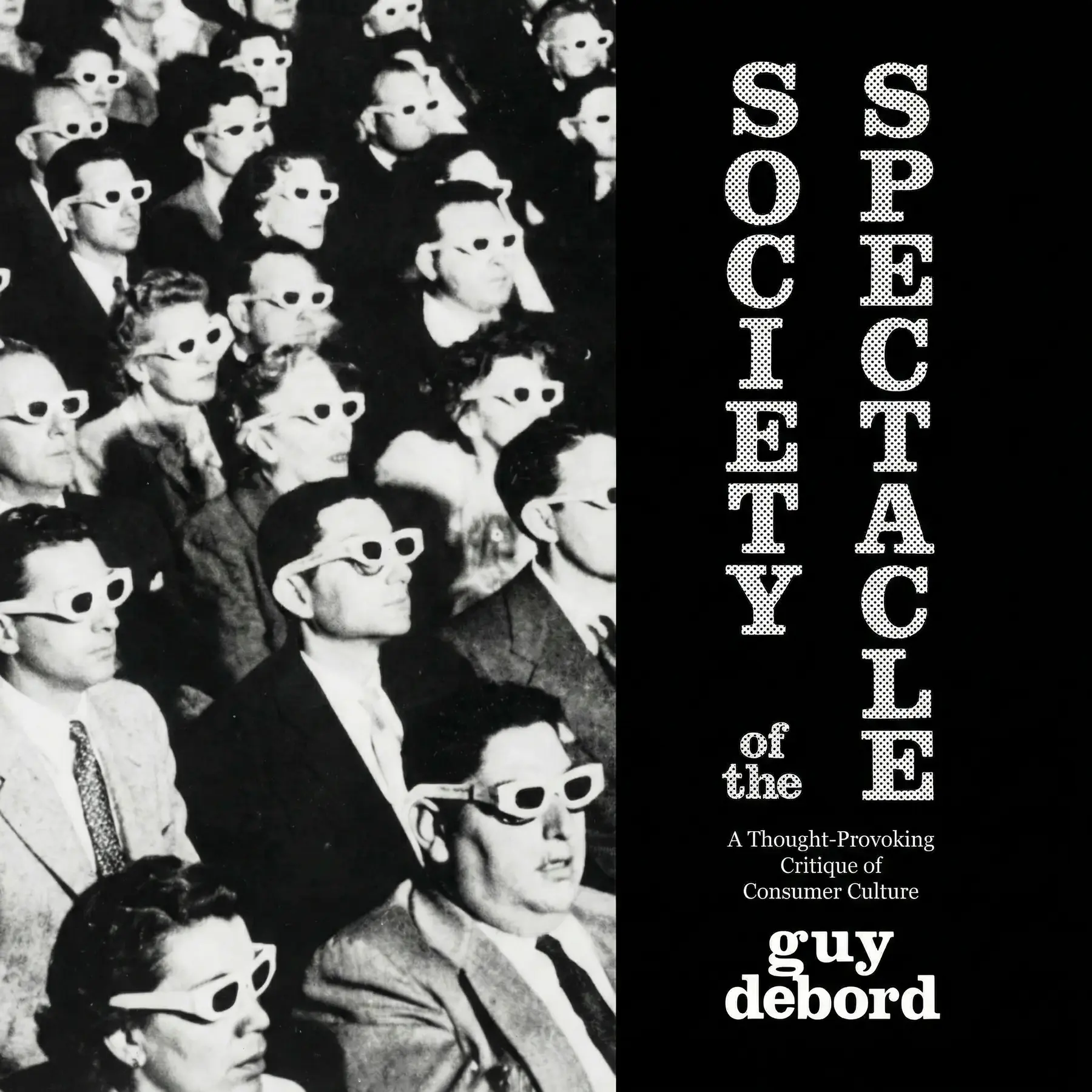
The Society of the Spectacle
By Guy Debord
Explore Guy Debord’s radical critique of how media and consumerism transform real life into a mere show, alienating individuals and replacing authentic human connections with a relentless parade of empty images.
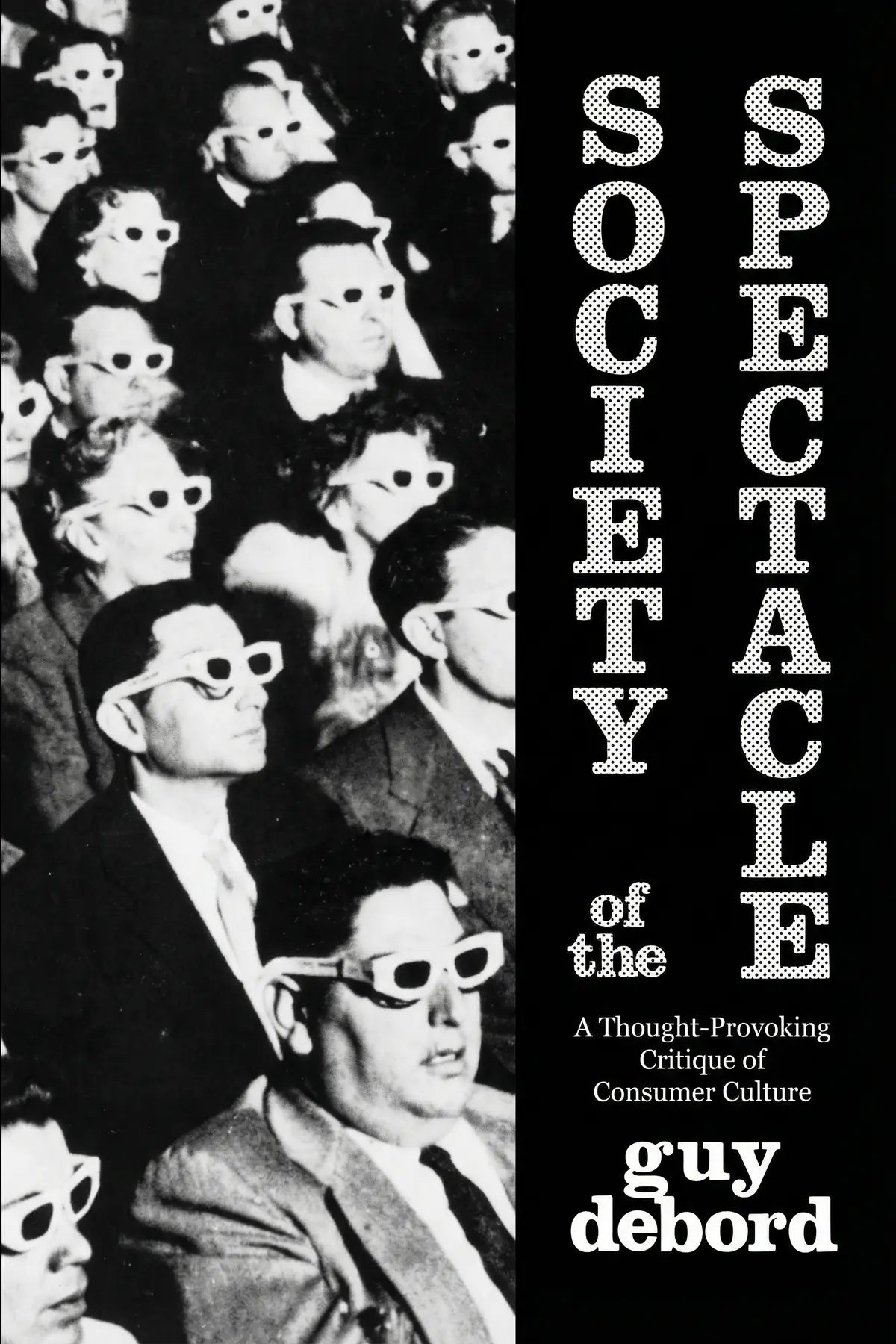
Table of Content
1. Introduction
1 min 49 sec
Imagine for a moment that your entire life is being played back to you on a screen, but as you watch, you realize you aren’t the one living it. You’re simply an observer of your own existence. This unsettling sensation is at the heart of Guy Debord’s masterpiece, a work that feels perhaps even more relevant today than it did when it first shook the foundations of social theory in the late 1960s. We live in an era where we are constantly told that we are more ‘connected’ than ever, yet many of us feel a profound sense of distance—from our work, from our neighbors, and even from ourselves. Debord provides the vocabulary for this feeling, calling it ‘the spectacle.’
The spectacle is more than just television, social media, or advertising. It is a fundamental shift in how human beings relate to one another. It is the moment where ‘being’ was replaced by ‘having,’ and then ‘having’ was replaced by ‘appearing.’ In this throughline, we will explore how our daily reality has been hijacked by representations, turning us from active participants in our lives into passive consumers of a grand, orchestrated performance. We’ll look at how this phenomenon reshapes our cities, our time, and our very sense of history.
By the end of this journey, you’ll see the world through a different lens. You’ll begin to notice the invisible walls the spectacle builds around us and, more importantly, you’ll understand the stakes of the game. This isn’t just about media criticism; it’s about reclaiming the richness of life that exists beneath the surface of the image. So, let’s step behind the curtain and examine the machinery that keeps the spectacle running, starting with the fundamental way our experiences are being traded for illusions.
2. The Shift from Lived Experience to Representation
2 min 25 sec
Discover how the fundamental nature of human existence has transitioned from active participation to passive observation through a world mediated by images.
3. The Spectacle as a Social Relation
2 min 05 sec
Learn why the spectacle is not just a collection of media images, but a complex web of social relationships that governs how we interact with the world.
4. The Commodity as the Absolute Ruler
1 min 58 sec
Explore the evolution of the commodity from a simple object of use to a totalizing force that dictates every aspect of modern social life.
5. Urbanism and the Architecture of Isolation
2 min 01 sec
Uncover how the design of our cities and physical spaces is used to reinforce the spectacle and keep individuals separated.
6. The Illusion of Travel and the Packaging of Adventure
2 min 03 sec
See how the spectacle turns the world into a series of identical destinations, stripping away the true meaning of exploration.
7. The Role of the Celebrity as a Pseudo-Hero
1 min 54 sec
Examine why celebrities are the ultimate tools of the spectacle, representing a level of ‘living’ that the rest of us can only watch.
8. The Erasure of History and the Perpetual Present
1 min 57 sec
Discover how the spectacle distorts our sense of time, trapping us in a cycle of ‘newness’ that prevents us from learning from the past.
9. The Materialization of Ideology
2 min 03 sec
Learn how the spectacle represents the final stage of ideology, where abstract ideas become the physical reality of our world.
10. Conclusion
2 min 04 sec
As we conclude our look at *The Society of the Spectacle*, it’s worth reflecting on the world around us. We are surrounded by a sea of images, from the palm of our hand to the billboards in our streets. It is easy to feel overwhelmed, to feel that the spectacle is an unstoppable force that has successfully colonized every part of our lives. But Debord’s work is not a message of despair; it is a call to awareness.
The throughline of our exploration has been the loss of authentic life to the world of appearances. We’ve seen how our relationships are mediated by images, how our cities are designed for isolation, and how our time is stolen and sold back to us as entertainment. We’ve seen how celebrities act as placeholders for our own lived experiences and how the spectacle erases our history to keep us in a state of passive ‘newness.’
However, the very fact that the spectacle must work so hard to maintain this illusion is a sign of its fragility. The spectacle depends on our participation; it requires us to stay in our seats and keep watching. The moment we begin to seek authentic connections, the moment we reclaim our time for ourselves, and the moment we start to look at the world with a critical, historical eye, the cracks in the spectacle begin to show.
The actionable takeaway here is to cultivate ‘situations’—moments of authentic, unmediated life. It might be as simple as a conversation without a screen in sight, a walk through a city without a destination, or a project that serves no economic purpose other than the joy of creation. By recognizing the ‘spectacular’ for what it is—a hollow representation—we can begin to move back toward ‘being.’ The show is ongoing, but you don’t have to be just an audience member. You can step off the stage and back into the real world. The first step is simply to stop watching the spectacle and start seeing the life that lies beyond it.
About this book
What is this book about?
The Society of the Spectacle is a seminal work of social theory that investigates the transition from a society of 'having' to a society of 'appearing.' Guy Debord argues that in modern life, authentic social relations have been replaced by a mediation of images. This 'spectacle' is not just a collection of media but a systematic way of organizing society that encourages passivity, isolation, and the commodification of every human experience. The book promises to strip away the illusions of the modern world, helping listeners understand how urban design, celebrity culture, and the economy work together to keep us in a state of perpetual spectatorship. By dissecting the way time and history are distorted, Debord offers a pathway to recognizing our own alienation and suggests the possibility of reclaiming a more genuine, lived existence beyond the screen and the storefront.
Book Information
About the Author
Guy Debord
Guy Debord is critically acclaimed for his incisive analysis of modern society's relationship with media and consumer culture. As a key figure in the Situationist International movement in the 1960s, Debord's work profoundly influenced contemporary art and political theory. His writings, including Comments on the Society of the Spectacle and other essays, continue to be pivotal in understanding the complexities of how media and spectacle shape public consciousness and societal structures.
Ratings & Reviews
Ratings at a glance
What people think
Listeners find the material clear and perceptive, with one listener calling it a must-read for post-modern thinkers. Furthermore, they appreciate the work's legacy; one listener identifies it as a classic of libertarian Marxism, and another notes its relevance across history. The book also receives praise for its under $5 price point and its pacing. However, the translation quality is negatively reviewed, with several listeners describing it as awful.
Top reviews
Taweesak
Fifty years later, Debord’s manifesto remains a chillingly accurate map of our mediated existence. This foundational text of libertarian Marxism argues that life has moved from 'being' to 'having,' and finally into 'appearing.' While the pacing is surprisingly brisk, the numbered theses demand slow, careful digestion to fully grasp how the commodity has colonized social life. Frankly, the way he deconstructs the 'diffuse' versus 'concentrated' spectacle provides a framework that feels more relevant in the age of Instagram than it did in 1967. Some might find the prose dense, but the clarity of his vision regarding human alienation is undeniable. It’s a rewarding challenge for anyone trying to understand the invisible forces shaping our desires.
Show moreCharles
Debord predicted everything about our current digital nightmare long before the first tweet was ever sent. This is a classic of libertarian Marxism that manages to be both poetic and ruthlessly analytical regarding the state of modern production. The concept of the 'spectacle' isn't just about media; it’s the total mediation of social life through commodities. I found the short, numbered format very helpful for stopping and reflecting on each point, even if some of the Hegel-inspired logic took a few passes to click. To be honest, it’s one of those rare books that makes you look at a billboard or a TV screen and feel a physical sense of repulsion. It’s essential reading for anyone who wants to stop being a passive consumer and start living directly again.
Show moreJames
To be fair, you need a decent grasp of Hegel and Marx to fully appreciate the linguistic gymnastics Debord is performing here. Once you get into the rhythm of his detournment, however, the book opens up like a dark flower of political theory. He masterfully explains how the 'world beyond' of religion has been brought down to earth and embedded in the commodity form. The writing is stylish and profound, demanding that the reader elevate their own thinking to meet the text halfway. I found the section on 'pseudo-community' particularly haunting given how we interact on the internet today. It’s a brilliant, brief, and bruising critique of the late-capitalist circus that we call a society.
Show moreSuthee
The spectacle is the sun that never sets over the empire of modern passivity. This book is a masterpiece of political writing that often feels more like a long, angry poem than a traditional sociology text. Guy Debord manages to capture the feeling of being 'had' by the system in a way that feels incredibly visceral. Not gonna lie, it took me a few attempts to get past the first chapter because the prose is so packed with meaning. However, once you understand his vocabulary, the world starts to look very different—and much more transparent. It’s a crystal-clear view of how culture is manufactured for our consumption. A must-read for any post-modern thinker or frustrated citizen.
Show moreYuki
Picked this up for less than five bucks on a whim, and it might be the most influential thing I’ve read all year. Debord explores how our relationships are mediated by images, creating a world where we are merely spectators of our own lives. The pacing is actually quite tight for a philosophy book, though you’ll definitely want a dictionary or a background in Marx to get the most out of it. It’s frankly disturbing to see how he predicted the way we’d eventually use social media to perform our identities. While the prose can be a bit 'swanky' and abstract, the core message about the colonization of human life by commodities is powerful. This is a must-read for anyone feeling unfulfilled by the constant cycle of consumerism.
Show moreEnd
This isn’t your typical beach read, but it’s an absolute classic for a reason. Truth is, the book deals with very heavy themes of alienation and commodity fetishism that can be quite discouraging if you’re not in the right headspace. Debord’s style is sharp and uncompromising, though I have to agree with other reviewers that the translation quality can be a real hit-or-miss experience. Despite the occasionally dense vocabulary, the insights into how the spectacle pacifies the public are incredibly sharp. It’s a thin volume that packs more weight than most five-hundred-page sociology texts. If you want to understand why modern life feels so hollow despite the abundance of products, start here.
Show moreSienna
Watching the latest political circus on the news reminded me of this text, so I finally decided to finish it. Personally, I think the most striking part is how Debord identifies that both capitalism and state socialism function as spectacles meant to distract the masses. The book is short and cheap, but the mental cost of working through his theories is quite high. You can see the roots of modern culture-jamming and movements like Adbusters on almost every page. My only gripe is that the translator seems to have struggled with the original French nuances, making some passages unnecessarily opaque. Still, the relevance of his critique of 'appearing' vs 'having' hasn't aged a single day since 1967.
Show moreKoi
As someone interested in culture-jamming and art history, I found this to be an indispensable guide to the Situationist International. Debord’s focus on how images literally mediate our fundamental understanding of reality is astonishingly disciplined. He doesn’t waste time on the basics of alienation but instead explores the psychological consequences of living in a world of representations. It’s a very direct translation, which means some of the original French flavor is lost, but the core ideas remain potent. While some statements ring truer than others, the overall effect is a total deconstruction of the 'mental environment' we inhabit. It’s a challenging read that rewards patience and a critical eye.
Show moreHarper
Is it a masterpiece or just a mess of pretentious jargon? To be fair, this particular translation feels incredibly clunky, often obscuring the revolutionary points Debord is trying to make with needlessly circular phrasing. I appreciated the price point being so accessible, but the actual labor of reading through his detournment of Marx and Hegel was exhausting. There are moments of staggering insight where the spectacle of modern consumption is laid bare, yet these are buried under layers of academic posturing. If you are a post-modern thinker, you probably consider this essential, but the average reader might find it a bit too detached from reality. It’s an important historical document that suffers from its own stylistic choices.
Show moreViroj
Look, I really tried to engage with this, but I eventually realized the author is writing for an intellectual 1% rather than the masses he claims to support. The numbered statements are often so paradoxical that they cross the line from profound to performative nonsense. Take his claim about the spectacle being both united and divided—it sounds deep until you realize it provides no actionable way to live. The translation I bought was also quite poor, making an already difficult text feel like a total chore to finish. I enjoy a mental challenge, but I value clarity above all else, and Debord seems to intentionally avoid it. It’s a tragedy because his ideas on alienation are actually quite compelling when they aren't hidden behind a Gallic sphinx act.
Show moreReaders also enjoyed
A Guide to the Good Life: The Ancient Art of Stoic Joy
William B. Irvine

A Biography of Loneliness: The History of an Emotion
Fay Bound Alberti
A Little History of Philosophy
Nigel Warburton
A Force for Good: The Dalai Lama's Vision for Our World
Daniel Goleman
A Theory of Justice
John Rawls


AUDIO SUMMARY AVAILABLE
Listen to The Society of the Spectacle in 15 minutes
Get the key ideas from The Society of the Spectacle by Guy Debord, plus 5,000+ more titles in English and Thai.
- 5,000+ titles
- Listen as much as you want
- 7-day free trial
- Cancel anytime







