
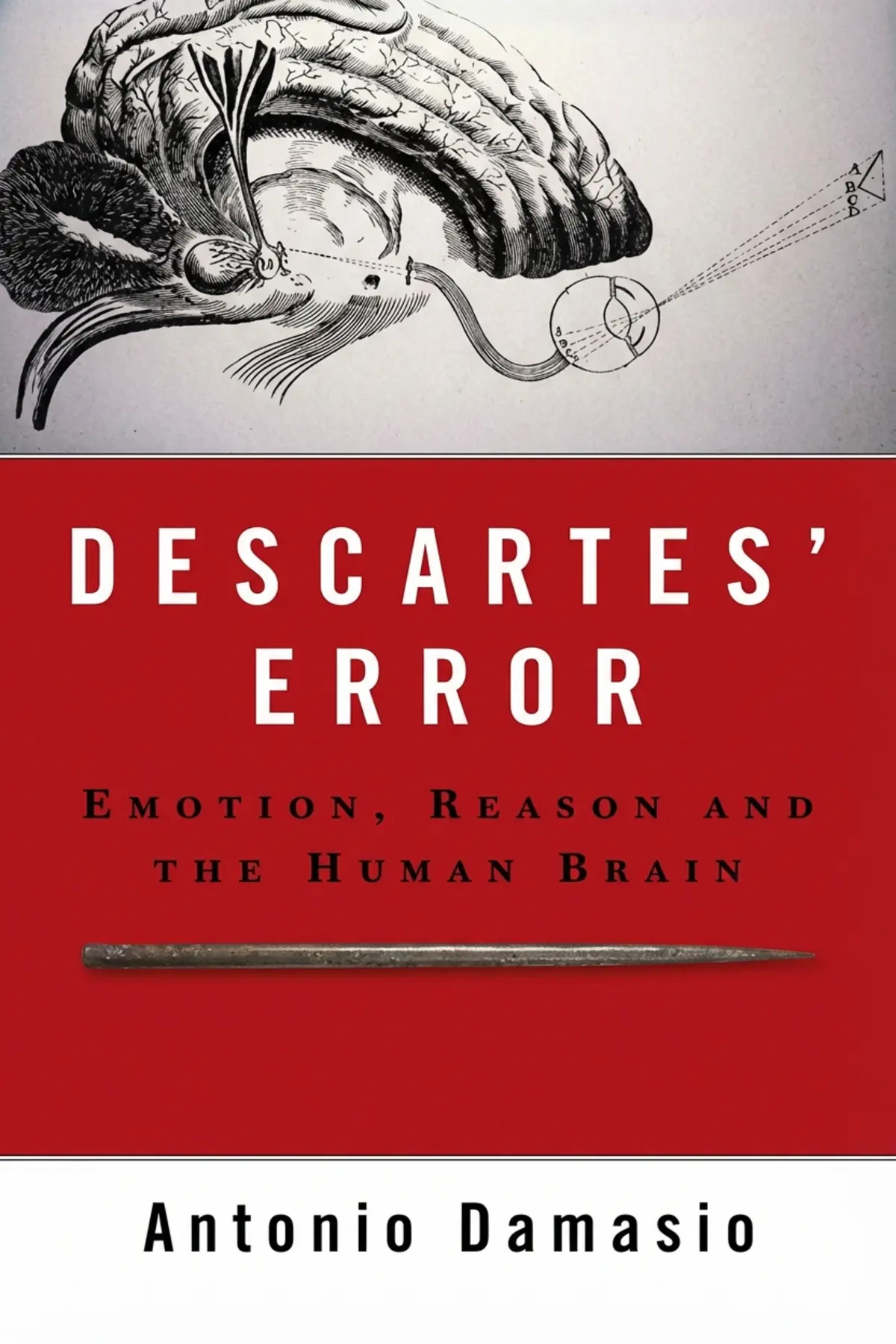
Descartes’ Error: Emotion, Reason and the Human Brain
Antonio Damasio
Explore how biological feelings, rooted in the ancient drive for survival, shaped human consciousness and sparked the creation of art, religion, and complex culture throughout history.
1 min 40 sec
When we look at the sweep of human history, we are often struck by the brilliance of our species. We point to the architectural marvels of the ancient world, the intricate compositions of classical music, and the technological leaps that allowed us to step foot on the moon. Usually, we tell ourselves a specific story about how these things came to be: that we are uniquely rational creatures, and our superior intellect allowed us to conquer nature and build civilization. We treat feelings as a sort of colorful garnish—something that makes life interesting, but ultimately secondary to the cold, hard logic of the human brain.
But what if that narrative is fundamentally backward? What if the ‘strange order’ of our development is actually the reverse of what we’ve been told? In this exploration of Antonio Damasio’s work, we are going to challenge the idea that thinking came first. Instead, we’ll look at the compelling evidence that feelings are the true engines of human innovation.
From the simplest bacteria to the most complex human societies, there is a throughline: the struggle for life to maintain itself. This biological imperative didn’t just keep us alive; it forced us to invent. Every poem, every political system, and every scientific breakthrough can be traced back to the basic, visceral experiences of pain, pleasure, and the drive for equilibrium. By the end of this journey, you’ll see that we aren’t just thinking beings who feel; we are feeling beings who have learned to think in service of those feelings. Let’s dive into how this biological reality shaped the very fabric of human culture.
2 min 01 sec
What if our greatest inventions weren’t the result of pure logic? Discover why feelings like hunger and pain are the secret catalysts behind every major human advancement.
2 min 05 sec
Explore the ancient biological principle that governs every living thing, from the tiniest cell to the most complex human, driving us toward a state of thriving balance.
2 min 05 sec
Think social skills require a high-functioning mind? Reconsider everything you know as we look at the complex cooperative behaviors of brainless bacteria.
2 min 04 sec
Tracing the moment when life went from mechanical to conscious. Discover the two critical biological ingredients that allowed us to finally feel.
2 min 16 sec
How does your brain turn nerve signals into a ‘picture’ of the world? Learn how internal maps of our own bodies became the very thing we call feelings.
1 min 58 sec
Why isn’t life just neutral data? Discover how ‘valence’ colors our entire experience, making some things feel wonderful and others unbearable.
2 min 01 sec
What does it mean to be the audience of your own thoughts? Learn how subjectivity and affect combine to create the ‘movie’ playing inside your head.
2 min 20 sec
Can a biological system designed for small tribes survive in a globalized world? Uncover why our ancient instincts often clash with the modern age.
1 min 55 sec
In our journey through the ‘strange order’ of things, we have seen a profound shift in how we understand our own humanity. We began by questioning the assumption that intellect is the sole driver of our species. What we discovered instead is that feelings are not an evolutionary afterthought. They are the primary architects of everything we value.
We’ve seen how the ancient drive for homeostasis—the quest for life to thrive—moved from the simple, brainless cooperation of bacteria to the complex mental mapping of the early nervous system. We’ve explored how our internal maps of our own bodies became the feelings that now color every moment of our conscious lives. And we’ve recognized that our entire culture, from the most ancient religions to the latest scientific breakthroughs, is essentially a sophisticated tool for managing those feelings and maintaining our biological balance.
The throughline of this story is that our emotions and our intellect are not enemies; they are partners in the business of living. However, as we move further into a hyper-rationalized, technological future, we must be careful not to lose touch with the biological roots of our well-being. We cannot simply logic our way into happiness, because happiness is a state of the body, not just a conclusion of the mind.
The takeaway is clear: to build a better world, we must respect the ancient biological laws that govern us. We should listen to our feelings not as distractions, but as vital information about our state of being. By aligning our creative intelligence with our homeostatic needs, we can move toward a culture that doesn’t just produce amazing things, but also truly supports the thriving of the human spirit. Remember that you are, first and foremost, a living, feeling organism. Everything else—your thoughts, your achievements, and your dreams—grows from that fundamental truth.
For generations, we have credited the heights of human achievement—our science, our masterpieces, and our intricate legal systems—to the raw power of human intellect. We view ourselves as thinking machines that happen to feel. Antonio Damasio turns this perspective on its head, suggesting that our feelings are not just side effects of our intelligence, but the very foundation upon which it was built. This exploration traces the history of life from single-celled organisms to modern societies, revealing that the drive for biological balance, or homeostasis, is the true architect of culture. By understanding that our emotions and consciousness emerged to solve the problems of living, we gain a new perspective on why we create, why we suffer, and how our ancient biological instincts struggle to keep pace with the hyper-connected, modern world we have constructed.
Antonio Damasio is the David Dornsife Professor of Neuroscience, Psychology and Philosophy at the University of Southern California. He also serves as the director of the school’s Brain and Creativity Institute. His research focuses on the biological processes underlying emotions, feelings, and consciousness. He is the acclaimed author of several books, including Descartes’ Error, The Feeling of What Happens, Looking for Spinoza, and Self Comes to Mind.
Antonio Damasio
Listeners find the work intellectually stimulating; one listener mentions its strong grounding in biological science, while many others describe it as an excellent, engaging, and approachable read. The caliber of the prose is praised, and listeners value the intriguing case studies and thorough narrative organization. They appreciate how the book examines emotions, with one listener specifically noting the detailed analysis of feelings and their impact on health. Reactions regarding word quality are mixed among listeners.
Deeply informed by biological science, this book offers a radical departure from the gene-centered view of evolution that has dominated the field for decades. Damasio makes a compelling case for 'metabolism-first,' suggesting that the drive for homeostasis is what actually birthed our complex cultural systems. By centering the narrative on the preservation of life rather than just the replication of code, he provides a much-needed update to the modern evolutionary synthesis. The way he traces the lineage of feelings from simple bacteria to human artistic expression is nothing short of brilliant. While the prose can be dense, the payoff is a profound understanding of how our internal biological states dictate the external world we build. It is a wonderful read for anyone interested in the intersection of thermodynamics and the human soul.
Show moreEver wonder why we feel the way we do about our social structures and the civilizations we inhabit? Damasio argues that it all comes back to the same drive that keeps a bacterium alive: the need to maintain a steady, flourishing internal state. This book is a wonderful read that challenges the idea of the mind as a detached computer, instead placing it firmly within the context of the body’s chemistry. I was particularly fascinated by his use of non-English sources, which provided a breath of fresh air compared to the usual insular nature of Anglophone science writing. The way he describes 'valence' as the defining element of affect helped me understand my own moods in a much more biological, less abstract way. It’s a deep, rewarding dive into the very core of what it means to be a living, feeling creature.
Show moreAfter hearing so much about the metabolism-first vs. gene-first debate, I found this to be an essential piece of the puzzle. Damasio’s writing is evocative and deeply humane, treating the human condition as a beautiful, albeit strange, extension of simple biological processes. He beautifully explains how the 'valence' of our feelings—the simple sense of whether we are doing well or poorly—serves as the foundation for all human creativity and conflict. The connection he draws between Spinoza’s philosophy and modern neurobiology is particularly elegant and adds a layer of depth often missing from modern science books. While it requires some patience to get through the more technical sections, the overall message is incredibly life-affirming. It is a thorough examination of the feelings that make us human and how they continue to shape our collective future.
Show moreFinally got around to reading Damasio’s latest and the central thesis regarding homeostasis as the engine of culture is genuinely thought-provoking. He manages to weave a comprehensive narrative that links the behavior of single-celled organisms to the complex legal and artistic frameworks of modern humanity. I particularly appreciated the discussion on 'valence,' the idea that our feelings are essentially a real-time monitor of our biological health and survival prospects. There are moments where the leaps he makes feel a bit sloppy or unsupported, particularly when he moves away from hard neuroscience into social commentary. However, as an exploration of how our bodies and minds are a single, interconnected entity, it’s an incredibly valuable piece of work. It’s not an easy read, but the insights into the biological roots of our feelings are well worth the effort.
Show moreAs someone who spends a lot of time thinking about the intersection of biology and sociology, Damasio’s exploration of the 'strange order' of evolution was fascinating. He flips the script by suggesting that feelings—not just cold logic or genetic blueprints—are what guided the development of human culture. The idea that our social systems are essentially scaled-up versions of cellular homeostasis is a powerful one that helps explain our constant drive for progress. I did find some of his criticisms of transhumanism a bit short-sighted, as he seems to rule out the possibility of artificial life far too quickly. Nevertheless, the book is engaging and provides a wealth of interesting case studies that keep the narrative moving. It’s a solid four-star read for anyone who enjoys big-picture science books that aren't afraid to get a little bit philosophical.
Show moreDamasio succeeds in weaving a comprehensive narrative that links single-celled organisms to the complex cultural artifacts of modern humanity. His focus on 'metabolism-first' theories is a great update to the gene-centered models we usually see in popular science. I found the sections on how the nervous system regulates our internal 'conatus'—our striving to preserve life—to be particularly insightful and well-grounded in biological reality. Look, the book isn't perfect; it can be quite wordy and some of the transitions between biology and culture are a bit abrupt. But the core argument that our feelings are the primary messengers of our biological health is something everyone should consider. It’s a thought-provoking read that definitely changed how I view the relationship between my body and my conscious mind.
Show moreTo be fair, the first half of this book is an absolute masterclass in how feelings evolved as a feedback mechanism for our internal states. Damasio is at his best when describing the 'homeostatic imperative' and how it drives every living thing to seek a state of wellness. However, things went south for me in the second half when he began dismissing artificial intelligence based on a very shallow understanding of algorithms. He claims that because AI doesn't have a biological body, it can never truly 'feel' or possess consciousness, which feels more like prejudice than scientific fact. He ignores the possibility that a sufficiently complex simulation could eventually capture the nuances of a physical system. It’s a strange leap to take for someone who is usually so grounded in materialism. A mixed bag that is half brilliant and half frustratingly insular.
Show moreNot what I expected from a neuroscientist of this caliber, especially when the discussion veers into the realm of artificial intelligence and transhumanism. Damasio argues that because digital systems lack a homeostatic imperative, they can never truly be conscious, which feels like a very narrow definition of 'mind.' He essentially claims that the substrate of life is magical and cannot be replicated, an argument that felt more emotional than scientific to me. That being said, the first few chapters on the evolution of the nervous system are quite strong and offer some great insights into his earlier work. Truth is, I preferred his previous books which felt more focused on clinical observations rather than these sweeping, sometimes sloppy, philosophical claims. It’s okay if you’re a die-hard fan, but probably not the best place to start with his work.
Show moreI was a massive fan of Descartes’ Error, so I approached this with high hopes, but unfortunately, it felt like being trapped in a room with a philosophy professor who refuses to get to the point. The writing has shifted from the clear, academic tone of his earlier work to something far more cumbersome and, frankly, self-congratulatory. He spends a vast amount of time redefining homeostasis to mean almost anything that contributes to 'flourishing,' which makes the term feel like a meaningless catch-all. By the time I reached the chapters on human culture, the logic felt so stretched that I was left with a resounding sense of 'so what?' It’s disappointing to see such a rational thinker lapse into this kind of vague, Victorian-style prose. I found it seriously boring and lacking the predictive power I expected from a scientist of his stature.
Show moreThe prose here is cumbersome and remarkably self-congratulatory for a work that essentially redefines 'homeostasis' until the word loses all original meaning. I felt like I was being cornered at a party by a blowhard who loved the sound of his own voice but had forgotten his original train of thought. He takes the startlingly simple idea that life wants to keep living and tries to turn it into a grand theory of everything, including the rise of the arts and the justice system. The result is a book that is repetitive, slow, and ultimately teaches the reader very little about actual neuroscience. If you’re looking for the clear-eyed, rational thinker who wrote Descartes’ Error, you won’t find him here. It’s a tedious slog through philosophical musings that lack any real predictive power or scientific rigor.
Show more
Deborah Gruenfeld
Lisa Kaltenegger
Anthony Pratkanis
AUDIO SUMMARY AVAILABLE
Get the key ideas from The Strange Order of Things by Antonio Damasio, plus 5,000+ more titles in English and Thai.







