
24 min 42 sec
Descartes’ Error: Emotion, Reason and the Human Brain
Descartes’ Error challenges the traditional divide between emotion and reason, revealing that our feelings are not obstacles to logic but essential components for making rational decisions and navigating the world.
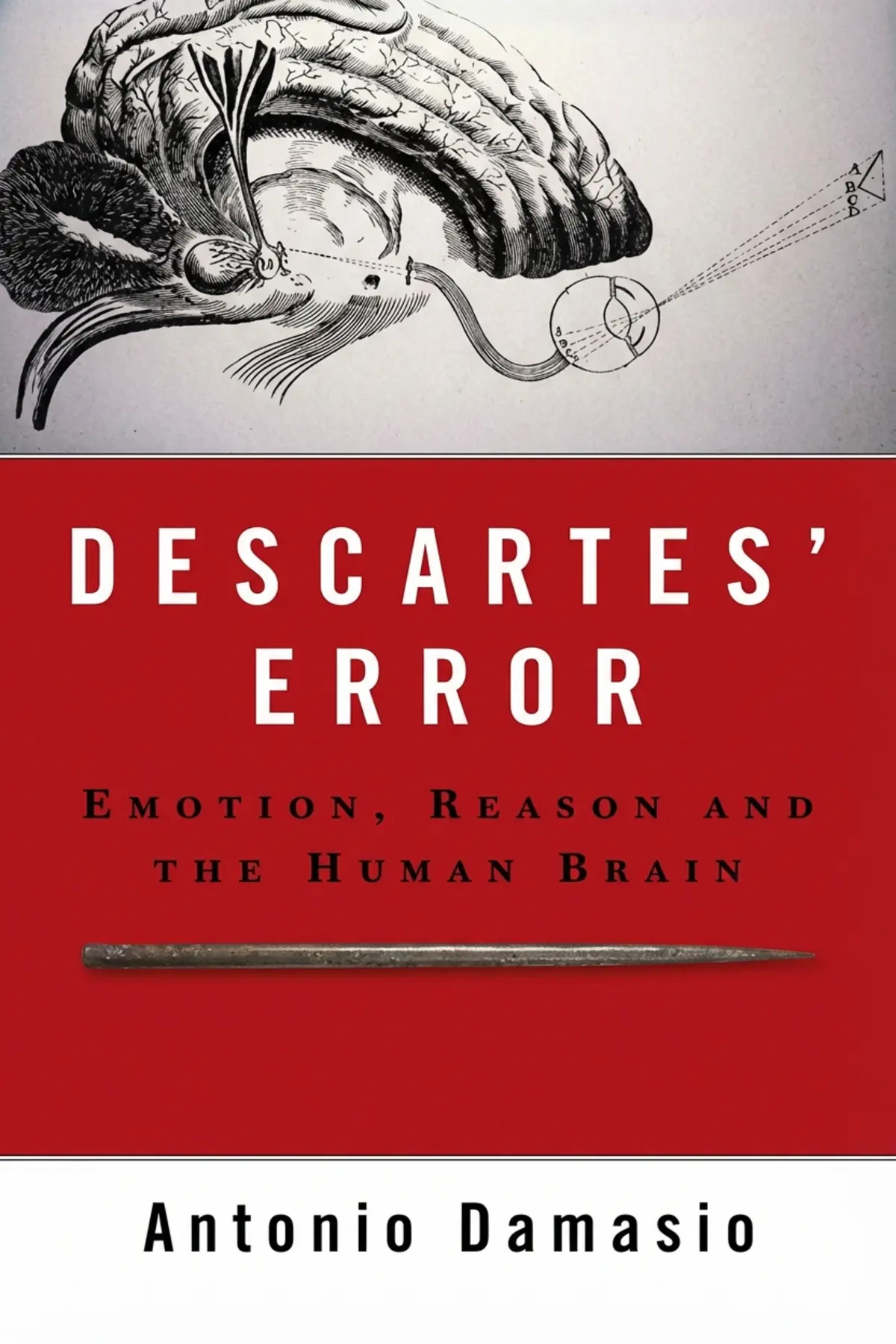
Table of Content
1. Introduction
2 min 23 sec
Imagine for a moment that you are standing in a courtroom. In this space, the judge is meant to be the personification of pure, cold logic. Every decision is based on a calculated assessment of facts, precedents, and statutes. Emotions, in this setting, are seen as the enemy—something that clouds judgment, introduces bias, and leads to error. This image of the ‘rational judge’ is more than just a legal ideal; it is a foundational pillar of Western thought. It stems from a long-standing belief that our minds are separate from our bodies and that our intellect is separate from our feelings. This perspective is most famously associated with the philosopher René Descartes, and while the idea of a ‘ghost in the machine’ has been officially debunked by modern science, the underlying sentiment remains. We still tend to view emotions as primitive, impulsive forces that must be conquered by the superior power of reason.
But what if this entire framework is based on a fundamental misunderstanding? What if the very thing we blame for our poor choices is actually the secret ingredient that makes good choices possible in the first place? In the pages that follow, we are going to explore a groundbreaking perspective that suggests our emotions are not the adversaries of logic, but its indispensable partners. Without the ability to feel, the ability to think rationally actually begins to crumble.
We will trace the history of this ‘dualism’—the split between mind and body—and see why it has persisted for so long. Then, we will dive into the fascinating world of neuroscience to see how that theory holds up under the lens of modern research. We will follow the journeys of individuals who, through tragic accidents or illness, lost the capacity to experience emotion while keeping their logical intelligence perfectly intact. Their stories reveal a startling truth: when the emotional part of the brain is damaged, life doesn’t become more logical. It becomes unmanageable.
Through this exploration, we will weave together the brain, the body, and the mind into a single, unified web. We’ll learn about specific regions of the brain that act as bridges between our physical sensations and our conscious thoughts. By the time we reach the end of this journey, you will see your own decision-making process in a completely different light, understanding that to be truly reasonable, one must first be capable of feeling.
2. Reverse Engineering the Brain Through Injury
2 min 15 sec
How can a broken brain teach us about a healthy one? Discover the investigative logic behind experimental neuropsychology and why lesions are the keys to unlocking mental mysteries.
3. The Transformation of Phineas Gage
2 min 30 sec
A freak accident involving a railroad spike and a construction foreman changed the course of neuroscience forever. Explore the strange case where a man survived his death but lost his soul.
4. The Modern Case of Elliot
2 min 45 sec
What happens when a successful professional loses his ability to feel? Meet Elliot, the man who could pass any IQ test but couldn’t choose which pen to use.
5. The Neural Network of Rationality
2 min 29 sec
Reason doesn’t live in a single corner of the brain. Learn about the complex web of regions that must work together to help you navigate a simple day.
6. Emotions as Essential Information
2 min 08 sec
We often view emotions as distractions, but what if they are actually data? Discover why your body’s physical shifts are the brain’s way of giving you a heads-up.
7. The Difference Between Primary and Secondary Emotions
2 min 13 sec
Not all feelings are created equal. Learn the difference between the ‘hardwired’ reactions we share with animals and the complex social feelings we learn over a lifetime.
8. The Agony of the Infinite Choice
2 min 05 sec
Why can choosing a restaurant feel impossible when you’re tired? See how Elliot’s struggle with a simple appointment reveals the flaw in pure logic.
9. The Somatic Marker Hypothesis
2 min 14 sec
What if your ‘gut feeling’ is actually a sophisticated biological shortcut? Discover the theory that explains how our bodies help us think.
10. The End of Dualism
1 min 56 sec
The ghost is out of the machine. Explore the final implications of a unified mind and body and what it means for our understanding of human nature.
11. Conclusion
1 min 44 sec
As we close this exploration of Antonio Damasio’s work, we are left with a powerful new vision of the human experience. The old divide between the ‘cool’ intellect and the ‘hot’ passions has been replaced by a realization that they are part of the same biological fire. We have seen through the tragic examples of Phineas Gage and Elliot that when we lose our ability to feel, we don’t become more rational; we become less human. We lose the compass that allows us to navigate the social and personal world.
The throughline of this journey is simple but profound: reason depends on emotion. Our bodies are not just the vehicles for our minds; they are the source of the very signals that make our minds useful. The somatic markers—those gut feelings and physical nudges—are the unsung heroes of our daily lives. They allow us to make choices, form bonds, and plan for a future that matters to us.
So, what can we take away from this? Perhaps the most actionable advice is to stop viewing your emotions as obstacles. The next time you face a difficult decision and feel a ‘tightness in your chest’ or a ‘spark of excitement,’ don’t immediately dismiss it as irrational. Instead, recognize it for what it is: your brain processing a lifetime of experience and body-states into a single, high-speed signal. To live a truly reasonable life, you must embrace the fact that you are a physical being. Your mind and your body are one. Descartes was wrong, but in understanding his error, we find the path to a much deeper understanding of our own nature. Trust your reason, but never forget to listen to your heart—not just as a metaphor, but as a biological necessity.
About this book
What is this book about?
For centuries, Western philosophy and science have operated under the assumption that the mind and body are distinct entities and that reason functions best when stripped of messy emotions. Antonio Damasio’s work turns this concept on its head. By examining the lives of individuals who suffered specific types of brain damage, Damasio illustrates how the loss of emotional capacity leads to a catastrophic breakdown in the ability to make even the simplest life decisions. This book provides a fascinating journey into the neural pathways that connect our physical states to our highest thoughts. It promises to reshape your understanding of how you think, feel, and choose. You will discover that the 'gut feeling' we often dismiss as irrational is actually a sophisticated biological signal that allows the brain to process complex social and personal information. By the end, the rigid separation between the logical mind and the feeling body dissolves, replaced by a holistic view of human consciousness where reason and emotion are inextricably linked.
Book Information
About the Author
Antonio Damasio
Antonio Damasio is a professor of psychology, philosophy, and neurology at the University of Southern California, where he is also the Director of the Brain and Creativity Institute and holds the David Dornsife Chair in Neuroscience. His previous books include The Feeling of What Happens, Looking for Spinoza, Self Comes to Mind, and The Strange Order of Things, all of which have been critically acclaimed and taught at universities around the world. He has been the recipient of the Grawemeyer Award, the Asturias Prize in Science and Technology, and the Signoret Prize, among many other distinctions.
Ratings & Reviews
Ratings at a glance
What people think
Listeners view this title as a premier work within the neuroscience field and find it intellectually stimulating, especially regarding its examination of how feelings and logic interact. Opinions on content quality are varied; some appreciate the detailed illustrations, whereas others feel the core argument gets buried under irrelevant details. There is disagreement among listeners about whether the work covers too many subjects; additionally, while some characterize the prose as well-crafted, others label it as disjointed. Perspectives on the book’s depth and worth are also split, as some judge it sufficiently technical for experts while others do not, and some find it immensely beneficial while others believe it is not worth the energy required to finish.
Top reviews
Bunyarit
Ever wonder why you can't make a decision when you're feeling numb? Damasio’s exploration of the intersection between emotion and logic is absolutely revolutionary. The story of Phineas Gage is haunting, serving as a perfect anchor for the more technical neurobiology sections that follow later. To be fair, some chapters require a bit of mental heavy lifting, especially if you aren’t used to academic jargon. However, the payoff is a profound shift in how you view the 'rational' mind. It turns out that without our feelings to guide us, we aren't hyper-logical robots; we're actually quite dysfunctional. This book is essential for anyone interested in why the 'cogito ergo sum' perspective is fundamentally flawed. It's not just about the brain—it's about the whole organism. A masterpiece of scientific inquiry.
Show morePete
As someone who has always been skeptical of the Stoic ideal of pure reason, Damasio’s work felt like a breath of fresh air. He demonstrates through tragic case studies that a person without emotion isn't an 'Ideal Rational Being' but rather a social deviant unable to function in society. The way he integrates the fragility and singularity of the human organism into the scientific narrative is quite moving. Truth is, the book gets very technical in the second half, but the insights into the Phineas Gage case are the best I've ever read. It’s a brilliant guide for those studying cognitive science who want to understand the evolutionary roots of our decision-making. We separate the brain from the body for convenience, but Damasio reminds us they are one.
Show moreTantipat
Wow, this was a transformative read that fundamentally altered how I perceive my own decision-making processes. Damasio is a brilliant writer, even if he takes the scenic route to get to his points. I loved how he challenged the 'rationalist' schools by showing that logic alone is insufficient for effective interpersonal relationships. The distinction between the micro and macrostructures of the brain was a bit blurry, but the overall scope of the work is massive. Personally, I found the chapter on emotions and feelings to be the highlight, emphasizing our inherent finitude and complexity. It’s a book that demands your full attention, but it pays dividends in how you understand the human condition. Highly recommended for anyone who wants to dive deep into the philosophy of mind.
Show moreGiulia
Not what I expected, but in the best way possible. I thought this would be a dry philosophy text, but it's actually a deep dive into the very fabric of what makes us human. Damasio argues that feelings are not just a 'nuisance' to logic, but the very engine that allows logic to function in the real world. The descriptions of patients with prefrontal damage were eye-opening and truly helped me understand the stakes of his research. I'll admit, there are moments where the data feels overwhelming, but the central metaphor always eventually pulls you back in. It’s a terrific overview of the science that reminds us to 'feel those feels' because logic alone is a recipe for social alienation. This is the kind of book that stays with you long after you close it.
Show moreNikolai
Finally got around to reading this classic, and it’s easy to see why it changed the landscape of neuroscience. Damasio’s somatic marker hypothesis provides a compelling bridge between our biological regulation and our self-aware consciousness. The book transitions from a very readable start into something much more complex and academic, which might put some people off. Look, the level of detail regarding brain circuitry is impressive, even if it feels a bit disjointed at times during the later chapters. I particularly enjoyed the discussion on how the prefrontal cortex acts as a mediator for our innate regulatory circuits. It’s a bit of a marathon, but the realization that our 'reasoning' is inherently tied to our physical state is worth the effort. A foundational text for the embodied mind.
Show moreElena
Picked this up after hearing it cited in dozens of other psychology books, and it lived up to the hype for the most part. Damasio makes a strong case for the 'embodied' mind, showing that our higher cognitive functions are built on a foundation of basic biological regulation. Some of the asides are a little rough and can feel a bit disconnected from the main argument, but the core thesis remains solid. It’s interesting to see how the prefrontal cortex mediates between our innate circuits and our self-aware logic. While it’s true that the writing can be a bit prolix, the scientific case studies are thorough and easily accessible. It’s a significant resource for understanding why we are more than just 'brains in a vat.' Definitely a must-read for the neuro-curious.
Show moreNatalie
After finishing this, I'm left with a profound appreciation for the complexity of the human organism. Damasio’s assessment of evolutionary psychology is fascinating, although I have some skepticism regarding his claims about genetics. The book starts out with a great hook but becomes significantly more academic as it progresses, which might be a hurdle for some. Gotta say, the way he uses the Phineas Gage case to illustrate the necessity of emotion for rational behavior is masterfully done. He doesn't just present a screed against Descartes; he provides a necessary scientific context for why the dualistic view fails. Even if the prose feels a bit 'European' and wordy, the value of the information is undeniable. It’s a solid 4-star read that bridges the gap between science and philosophy.
Show moreMia
This book is quite a dense slog, even for someone with a passing interest in cognitive science. While the thesis—that emotion is vital to reason—is fascinating, Damasio’s writing style often gets in its own way. He tends to barf data onto the page without always tying it back to the central metaphor, making the middle section feel like a chore. Frankly, if you aren't familiar with neuroanatomy, you might find yourself lost among the various cortical regions and neural circuits. It’s a seminal work, sure, but it lacks the economy and clarity of writers like Dawkins. I appreciate the scientific rigor, but I wish the delivery was a bit more accessible for the layman reader. It’s worth reading for the insights, but be prepared to work for them.
Show moreAmelia
I'm struggling to see why this is considered a masterpiece of science communication. The first few chapters are engaging enough, but then Damasio descends into a rabbit hole of technical descriptions that feel almost unreadable. In my experience, a good popular science book should distill complex ideas, not just dump raw data on the reader without a clear map. The central point—that logic needs emotion—is made early on and then repeated ad nauseam without much progression. It’s a very taxing read that requires a university-level understanding of neurobiology to fully appreciate. If you’re a specialist, you’ll likely find the rigor sufficient, but for the average reader, it’s a bit of a mess. I respect the research, but the presentation is just too rambling for my taste.
Show moreMilk
The title of this work is actually quite ironic because the author seems to fall into the exact same dualistic traps he claims to be 'correcting.' I found the text to be a frustrating repetition of 17th-century philosophy disguised as modern neurobiology. Damasio spends far too much time on anecdotal evidence and not enough on the actual philosophical errors Descartes committed. Not gonna lie, the prose is incredibly prolix and feels like a massive generalization of European intellectualism that favors length over functionality. It’s a very dry read that fails to point out any errors Descartes actually made in a meaningful way. I wouldn't recommend this to anyone looking for a sharp, concise critique of Rationalism. It’s an overhyped piece of academic fluff that was a total chore to finish.
Show more
Readers also enjoyed
A Short History of Nearly Everything
Bill Bryson
A Thousand Brains: A New Theory of Intelligence
Jeff Hawkins
A Liberated Mind: How to Pivot Toward What Matters
Steven C. Hayes
Acting with Power: Why We Are More Powerful Than We Believe
Deborah Gruenfeld
AUDIO SUMMARY AVAILABLE
Listen to Descartes’ Error in 15 minutes
Get the key ideas from Descartes’ Error by Antonio Damasio, plus 5,000+ more titles in English and Thai.
- 5,000+ titles
- Listen as much as you want
- 7-day free trial
- Cancel anytime







