
A Life Decoded: My Genome: My Life
J. Craig Venter
Explore the captivating history of neuroscience through the lens of legendary medical cases. Discover how traumatic injuries and strange neurological conditions revealed the inner workings of the human mind and its resilient structures.
1 min 47 sec
Imagine for a moment that you are trying to understand the inner workings of a highly sophisticated computer, but you are forbidden from opening its casing while it is running. For the vast majority of human history, this was the exact challenge facing anyone curious about the human brain. The three-pound mass of gray matter responsible for every thought, emotion, and movement was locked away in a literal bone vault. Today, we live in an era where non-invasive scans can show us the flickering lights of neural activity in real-time, but that luxury is a very recent development in our species’ timeline. Before the advent of the MRI or the CT scan, the only way to learn about the healthy brain was to observe the broken one.
This journey into the history of neuroscience is a collection of stories about individuals who were transformed by trauma, madness, or disease. It is a chronicle of how localized damage to the brain produced very specific, sometimes bizarre changes in behavior, which in turn allowed doctors to map which parts of the brain do what. We will see how a king’s fatal jousting accident paved the way for scientific autopsies, how a construction worker’s personality was altered by an iron rod, and why some people can literally lose the ability to recognize their own mothers while still seeing perfectly well. Through these tales of tragedy and scientific grit, we gain a profound appreciation for the intricate, specialized, and highly adaptive nature of the mind. By looking at what happens when the brain’s delicate systems fail, we begin to understand the throughline of our own consciousness and the biological foundation of what makes us human.
2 min 12 sec
Discover how a tragic accident in a royal tournament changed the course of medical history by proving that post-mortem exams could reveal the brain’s hidden secrets.
2 min 26 sec
Explore the three-tiered organization of the human brain, from the ancient survival centers at the base to the sophisticated thinking cap on top.
2 min 12 sec
Take a microscopic look at the cells that build our reality and learn how a lack of support can lead to total mental collapse.
2 min 15 sec
Learn how the brain’s cells talk to each other across tiny gaps and how the mind rewires itself to overcome the loss of a sense.
2 min 30 sec
Step into the specialized centers of the brain where faces are recognized and movements are tracked, and see what happens when these systems fail.
2 min 07 sec
Uncover the vital link between our emotional core and our rational planning centers through the stories of two men whose lives were upended by brain damage.
1 min 57 sec
Discover how the brain uses the bloodstream to send long-distance messages that regulate everything from our height to our deepest impulses.
2 min 07 sec
Explore the strange malfunctions that can happen even in a healthy brain, from the terror of sleep paralysis to the effects of hidden vitamin deficiencies.
2 min 10 sec
Take a tour of the brain’s storage system and learn why remembering how to ride a bike is completely different from remembering what you had for breakfast.
2 min 11 sec
Deconstruct the myth of the ‘right-brained’ artist versus the ‘left-brained’ accountant and discover how the two halves of the brain actually cooperate.
2 min 14 sec
Explore the boundaries of the human soul as we look at bizarre conditions that can make a person feel like they are dead or that their own hand belongs to someone else.
1 min 46 sec
The history of the human brain is a testament to the fact that we often learn the most from what is broken. Through the centuries, the field of neuroscience has moved from the superstitious casting away of the brain to the detailed mapping of its most microscopic functions. We have seen that the brain is not a single, solid entity, but a vibrant, interconnected community of specialized regions. From the ancient survival centers of the brainstem to the sophisticated planning of the frontal lobes, every millimeter of our neural tissue plays a role in constructing the reality we inhabit.
What these stories of trauma and recovery ultimately reveal is a dual truth: the brain is both incredibly fragile and remarkably resilient. A tiny clot or a single missing vitamin can unravel a personality or erase a lifetime of memories. Yet, at the same time, the brain possesses an astonishing ability to adapt, rewiring itself to ‘see’ with ears or finding ways to maintain a sense of self even when the past is lost. As we continue to study the ‘dueling’ forces within our own heads—logic versus emotion, the left brain versus the right—we gain more than just medical knowledge. We gain a deeper understanding of the biological foundations of human nature. The quest to understand the mind is the brain’s ultimate attempt to understand itself, and while many mysteries remain, the journey through our own history shows just how far we have come in illuminating the darkness within the skull. The most important takeaway is to marvel at the complexity you carry with you every day; your brain is a masterpiece of evolution, constantly working behind the scenes to create the miracle of you.
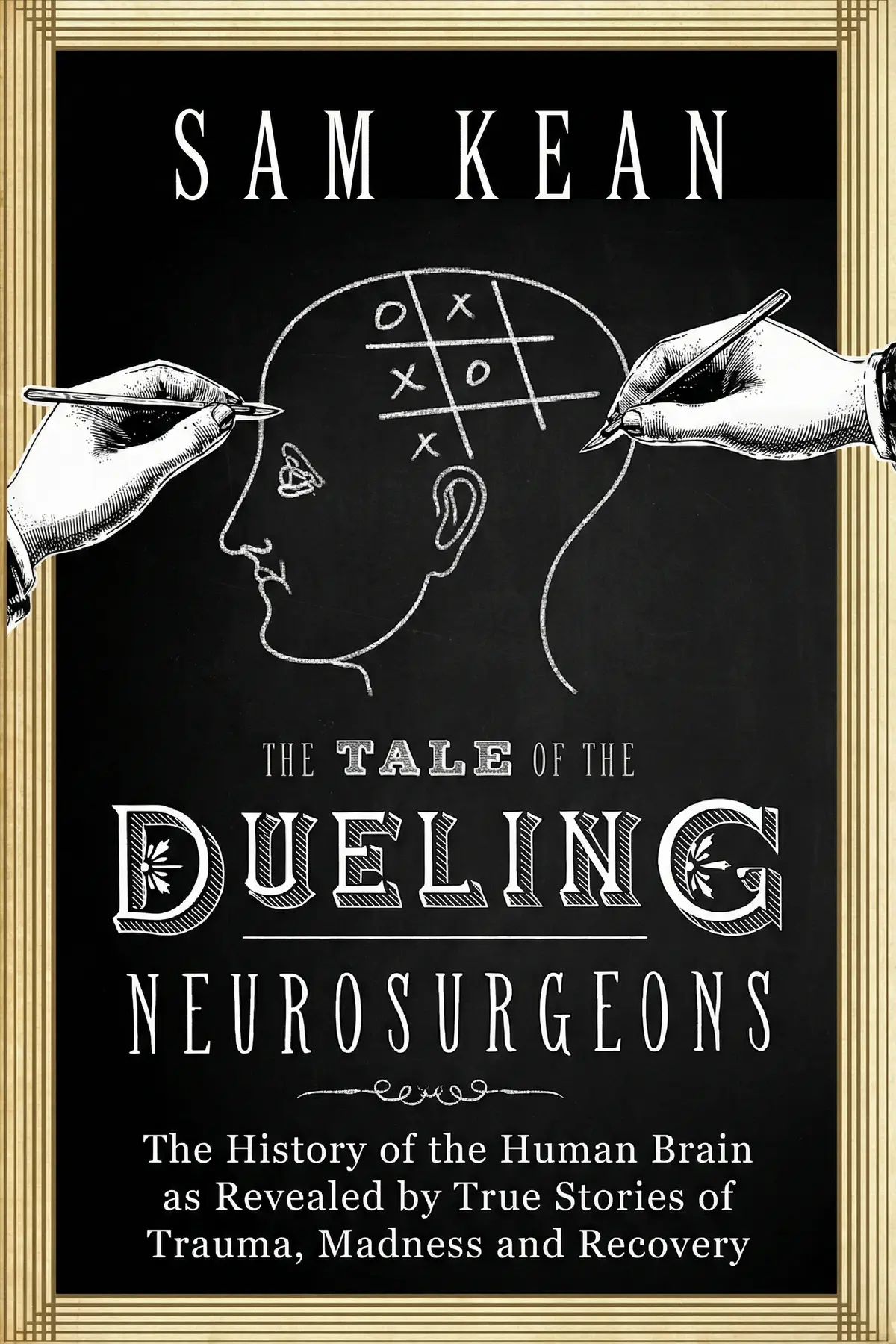
The Tale of the Dueling Neurosurgeons offers a deep dive into the fascinating and often gruesome history of how we came to understand the most complex organ in the known universe. For centuries, the brain remained a black box, its functions hidden behind the solid bone of the skull. This changed not through elegant experiments, but through the misfortunes of kings, workers, and patients whose brains were altered by accidents or disease. By observing how these individuals changed—losing their ability to recognize faces, speak clearly, or even control their own limbs—early pioneers of medicine began to map the cerebral landscape. This summary guides you through the evolution of brain science, from the first daring autopsies to modern insights into memory and consciousness. You will learn about the delicate balance between the rational frontal lobes and the emotional limbic system, the chemical dance of neurotransmitters, and the surprising ways the brain can rewire itself after losing a sense. It is a journey through trauma and recovery that ultimately reveals the profound elegance of our neural architecture and the enduring mystery of the human self.
Sam Kean is an acclaimed science writer whose work has appeared in prominent publications such as the New York Times, Psychology Today, and various scientific journals. He is best known for his ability to weave complex scientific concepts into engaging historical narratives. Kean is also the author of the bestsellers The Disappearing Spoon and The Violinist’s Thumb, which explore chemistry and genetics through a similarly storytelling-driven approach.
Listeners find the book both intriguing and enjoyable, noting its high-quality brain science and the author’s knack for highlighting gripping narratives about everyday folks. The prose is considered exceptional, and listeners value the consistent sense of humor found throughout. In addition, the work offers a stellar historical look at the field of neurology that listeners find very accessible to follow.
Sam Kean has a rare gift for making neuroanatomy feel like a series of interconnected mystery novels rather than a dry textbook. I was particularly struck by his description of the motor and sensory cortices as 'parallel pieces of bacon'—a visual I will never be able to unsee when I look at a breakfast plate. Beyond the clever metaphors, the book provides a deep, localized survey of how specific brain regions like the hippocampus and the occipital lobe actually function. It moves effortlessly from the cellular level of neurons to the massive, life-altering consequences of a single lesion. The writing is accessible but never feels like it's talking down to the reader. If you’ve enjoyed works by Oliver Sacks or Bill Bryson, this belongs on your shelf. It’s a perfect bridge for someone who wants to understand the 'why' behind the human experience without getting lost in impenetrable medical jargon.
Show moreEver wonder how your brain processes visual data or why some people suddenly lose the ability to recognize their own family members? Kean explores these bizarre world of brain lesions with a perfect balance of empathy and scientific curiosity. The stories of C.K., who couldn't tell food from non-food, and Elliott, who lost his ability to make decisions after frontal lobe surgery, are poignantly told. These aren't just 'medical oddities' to Kean; they are the keys to understanding our very identity. I loved how the book explained the fusiform facial area and how specialized our brains are for social interaction. The diagrams and photos helped clarify the more complex neuro-circuitry without slowing down the narrative flow. It’s a thought-provoking look at how fragile our sense of 'self' truly is. After finishing this, I have a newfound respect for the three-pound lump of gray matter sitting inside my skull.
Show moreAfter hearing the basic story of Phineas Gage a dozen times in various podcasts, I wasn’t sure I needed another retelling, yet Kean found a way to make it fresh and deeply informative. He provides so much more context than the usual 'man gets head poked by metal, becomes mean' summary. The book’s exploration of how trauma leads to discovery is both captivating and tragic. I was especially gripped by the chapters on presidential assassins and how their autopsies provided some of our first real clues into brain decay and its link to behavior. Kean has a great eye for these types of captivating stories about ordinary people caught in extraordinary medical circumstances. The way he explains the transition from the occipital lobe to the parietal and temporal lobes for visual processing was the first time that concept actually clicked for me. It’s a brilliant, entertaining, and highly educational piece of popular science.
Show moreClive Wearing’s case has always haunted me, but seeing it placed within the broader context of the limbic system and memory storage was a revelation. Kean characterizes Wearing's condition as a 'loss of moment-to-moment consciousness,' which is such a poignant way to describe the horror of amnesia. This book is full of these kinds of sharp, insightful observations that make the science feel deeply personal. I also loved the section on phantom limbs and the blind Royal Navy lieutenant who used echolocation. It’s amazing to see how the brain can rewire itself and find new ways to perceive the world after a major loss. The history of neurosurgery is often dark and unethical, but Kean doesn't shy away from those difficult questions of informed consent. This is a thought-provoking, enthralling read that I’ve already recommended to three different people this week. Absolute five stars.
Show moreFinally got around to this one and it’s easily the most digestible book on the brain I’ve ever encountered. Kean manages to take a subject that is usually terrifyingly complex and turns it into a series of 'scientific yarns' that are as entertaining as they are informative. I loved the simple diagrams and the inclusion of rebuses; they really helped break up the text and keep the energy high. The book's serious message about the fragility of identity really hit home for me—if our memories can be so easily distorted or erased by a few damaged neurons, what does that say about the 'self'? It’s a philosophical journey as much as a scientific one. From cannibals in Papua New Guinea to Civil War veterans, the range of cases is staggering. If you're looking for a logical stepping stone after reading something like 'My Stroke of Insight,' this is exactly what you need.
Show moreStarting with a high-stakes jousting accident involving King Henri II, this book quickly reveals itself to be much more than a collection of medical trivia. Kean uses the 'dueling' surgeons of the title as a gateway to explore the history of how we mapped the human mind. The structure is brilliant, breaking the brain down into five broad sections that cover everything from basic motor control in the cerebellum to the complex emotional processing of the limbic system. I found the section on visual recognition and the 'two-circuit' theory of data processing to be the most enlightening part of the whole read. To be fair, some of the historical animal experiments mentioned are pretty revolting and hard to stomach, which is the only reason I’m not giving it a full five stars. However, the way Kean weaves these tragic case studies with modern neuroscience theory is masterful and kept me turning pages late into the night.
Show morePicked this up after reading 'The Disappearing Spoon' and I'm happy to report that Kean brings the same witty, approachable energy to the field of neurology. This book is an excellent primer for anyone curious about how brain damage helps us map the healthy mind. He does a great job explaining the localized vs. decentralized debate, showing how scientists eventually pinned down specific duties to specific lobes. Personally, I found the chapters on the corpus callosum and the 'split-brain' experiments to be the highlight of the volume. My only minor gripe is that the timeline gets a bit muddled because the book is organized more by brain structure than by chronological history, which led to a few 'wait, when did this happen?' moments. Still, the prose is top-tier, and the humor actually helps the complex biological concepts stick. It’s the kind of science book that makes you feel smarter without requiring you to have a PhD to finish it.
Show moreThe 'dueling' aspect of the title is a bit of a lure, but the actual substance of the book is a masterclass in neuroanatomy for the layperson. Kean avoids the trap of 'new phrenology' by emphasizing that while areas are localized, they are part of incredibly complex feedback loops. I particularly enjoyed the deep dive into the somatosensory cortex and the body maps our brains maintain. It’s fascinating to learn how a tiny physical change—a tumor, a spike, or a bullet—can completely rewrite a person's personality. While I agree with other reviewers that the treatment of religious figures felt a bit dismissive and Euro-centric, the core science and the historical narrative of the surgeons themselves are excellently handled. It’s a fast-paced read that manages to cover a lot of ground without ever feeling like a lecture. Definitely worth a look if you're interested in the history of medicine.
Show moreWhile the information here is undeniably fascinating, I have to admit that the descriptions of historical neurosurgery and the lack of ethical standards in early experiments were a bit much for my stomach. The 'Tale' is definitely anecdotal, but some of those anecdotes are incredibly gruesome. I also felt that the narrative voice was a bit too 'chirpy' considering the tragic circumstances of the patients being discussed, like Clive Wearing or those suffering from Capgras syndrome. Truth is, I was hoping for more modern clinical analysis and a little less emphasis on 16th-century jousting accidents and centuries-old medical blunders. It’s a well-researched book, and Kean is clearly a talented communicator, but the tone felt slightly off for me at times. If you’re squeamish about surgical details or find 'wacky' science writing a bit distracting, you might struggle with this one more than the average reader seems to.
Show moreLook, I wanted to love this, and for the most part, I did, but the 'chirpy' narrative voice sometimes felt slightly at odds with the tragic nature of the brain injuries being discussed. I am a lot more interested in the anecdotes themselves than the long-winded explanations of glia and synapses that fill the gaps between stories. In my experience, writers like Oliver Sacks handle the 'human' side of these disorders with a bit more grace. To be fair, Kean is trying to write a popular science book for a broad audience, and he succeeds at making it digestible, but I found myself skimming the more technical neuro-circuitry sections to get back to the people. It’s a solid 3-star read for me—interesting enough to finish, but I’m not sure I’d go out of my way to recommend it over other more 'soulful' neurology books.
Show moreJ. Craig Venter
Carl Zimmer
Bill Bryson
Jeff Hawkins

Lisa Kaltenegger

AUDIO SUMMARY AVAILABLE
Get the key ideas from The Tale of the Dueling Neurosurgeons by Sam Kean, plus 5,000+ more titles in English and Thai.







