

18 min 36 sec
The Upward Spiral: Using Neuroscience to Reverse the Course of Depression, One Small Change at a Time
By Alex Korb
Discover how the complex circuitry of the human brain can be redirected from a downward slide of depression into an upward spiral of happiness through small, scientifically-backed lifestyle adjustments.
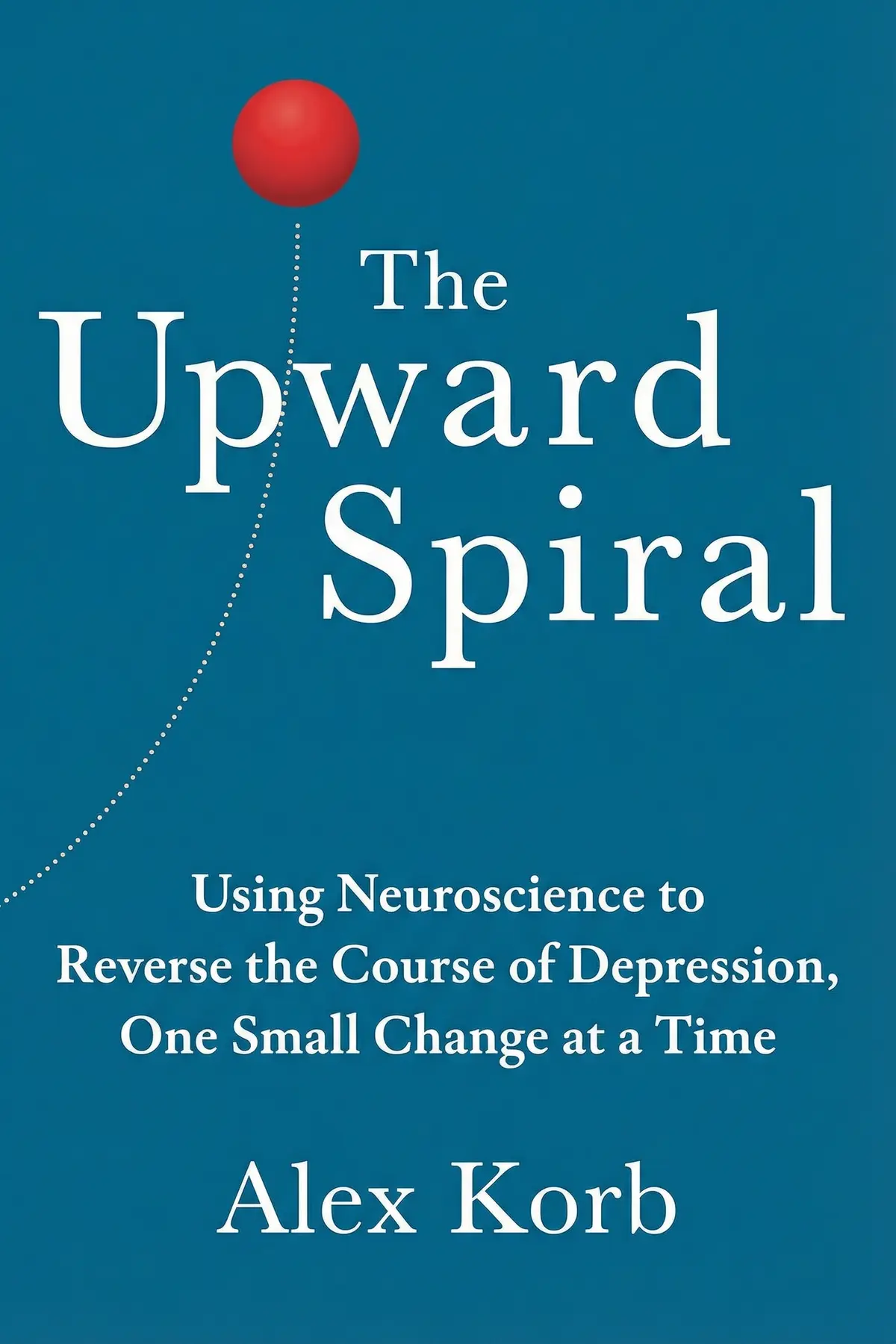
Table of Content
1. Introduction
1 min 41 sec
Imagine your mood as a physical path you are walking. On a good day, the terrain is flat and manageable. But for many, life can start to feel like a steep, slippery descent into a dark canyon. This is the downward spiral of depression. It’s a state where every negative thought makes the next one more likely, and every moment of exhaustion makes it harder to do the very things that might help you feel better. You might find yourself wanting to retreat, to hide under the covers and let the world pass you by. When you’re in that state, it’s not just ‘in your head’—it’s in the very wiring of your brain.
In this summary of The Upward Spiral, we are going to explore the neurobiological mechanics behind these low points. We will see that depression isn’t necessarily a sign that something is broken, but rather a sign that certain brain circuits are communicating in a way that creates a negative loop. The good news is that the same architecture that allows for a downward spiral also supports an upward one.
We’ll look at how the different regions of your brain—from the ancient emotional centers to the modern thinking centers—interact with one another. We’ll discover why worry and anxiety are two sides of the same coin, and how your habits can either lock you into sadness or pave the way for recovery. Most importantly, we’ll discuss how small, intentional actions can shift your brain chemistry, releasing the ‘feel-good’ signals that help you climb back out. Through the lens of neuroscience, we will find that you don’t need a massive life overhaul to start feeling better; you just need to start a new kind of momentum. Let’s dive into how the brain works and how you can start your own upward spiral today.
2. The Brain's Internal Conflict
2 min 17 sec
Explore the biological tug-of-war between your emotional centers and your logical mind, and discover how their communication breakdown fuels the cycle of depression.
3. The Interplay of Worry and Anxiety
2 min 14 sec
Uncover the subtle but powerful difference between worrying in your mind and feeling anxiety in your body, and how they combine to trap you.
4. The Trap of Negative Salience and Habits
2 min 14 sec
Discover why a depressed brain is biologically inclined to ignore the good and cling to bad habits, and how dopamine plays a role in this struggle.
5. Physical Movement as a Neurochemical Reset
2 min 07 sec
Learn how even the smallest amount of exercise can act as a powerful antidepressant by targeting your brain’s chemistry on three different levels.
6. The Psychology of Choice and Goals
2 min 14 sec
Understand why making any decision, even a small or imperfect one, can provide instant neurological relief and start your climb upward.
7. The Architecture of Restful Sleep
2 min 02 sec
Explore the vital link between sleep and emotional regulation, and how ‘sleep hygiene’ can become your foundation for a better mood.
8. Gratitude and the Power of Connection
2 min 05 sec
See how practicing gratitude and seeking physical or social connection can trigger the release of oxytocin, the brain’s natural antidote to anxiety.
9. Conclusion
1 min 42 sec
As we have seen, depression is not a life sentence or a permanent character flaw; it is a state of being where the brain’s complex circuits have become stuck in a self-reinforcing downward loop. By understanding the neuroscience of the prefrontal cortex and the limbic system, we can see why we feel the way we do. We can understand why we worry, why we lose our motivation, and why we feel so disconnected. This understanding is the first step toward change because it removes the burden of shame.
The core message of the upward spiral is that while you may not be able to change your entire life overnight, you can change one small thing today. Whether it’s making a single ‘good enough’ decision, taking a five-minute walk, or writing down one thing you are grateful for, each small action acts as a nudge to your brain’s chemistry. These nudges add up. They start to release the dopamine, serotonin, and oxytocin that your brain has been missing. Over time, these small shifts create a new momentum—one that carries you out of the darkness and back into the light.
However, it is also important to remember that you don’t have to do this alone. While these self-help strategies are powerful tools, professional support from a therapist or counselor is often a vital part of the process. Think of it like any other complex project: if you were building a house, you’d consult an architect. If you are rebuilding your mental health, there is no shame in consulting an expert. The upward spiral is a journey of a thousand tiny steps. By starting with just one, you are already on your way to a more resilient and joyful version of yourself.
About this book
What is this book about?
The Upward Spiral explores the neuroscientific underpinnings of depression, framing it not as a simple chemical imbalance, but as a complex interaction of brain circuits that have become trapped in a self-reinforcing loop of negativity. Neuroscientist Alex Korb explains how the 'thinking' brain and the 'feeling' brain can often work at cross-purposes, leading to cycles of worry, anxiety, and lethargy. The promise of the book is that while a downward spiral is easy to fall into, it is also possible to trigger an upward spiral. By making tiny, manageable changes in areas like physical activity, sleep hygiene, decision-making, and social interaction, individuals can alter their brain chemistry. These small shifts release neurochemicals like dopamine and serotonin, which gradually recalibrate the brain’s circuits toward resilience and joy. This summary provides a practical roadmap for anyone looking to understand the biological machinery of their mood and take back control one step at a time.
Book Information
About the Author
Alex Korb
Alex Korb, PhD, is a dedicated neuroscientist who began his academic journey at Brown University before earning his doctorate at UCLA. He continues his deep dive into the brain's mysteries as a post-doctoral researcher at UCLA. Beyond the lab, Korb serves as a scientific consultant, lending his expertise to pharmaceutical and biotech firms in their efforts to develop new treatments and technologies.
Ratings & Reviews
Ratings at a glance
What people think
Listeners find that this book effectively translates intricate neuroscience into reachable, practical advice for managing anxiety and depression. They mention that the lucid descriptions of brain chemistry are empowering, as one listener noted that understanding the biological processes helped them stop feeling responsible for their symptoms. Furthermore, listeners value the daily strategies shared, such as emphasizing sleep and aiming for "good enough" rather than perfection. Many also agree that the author's clear analogies make the book an ideal resource for both individuals struggling with low moods and family members who want to provide better support.
Top reviews
Ivan
Wow. This was exactly what I needed to stop the self-blame spiral. Alex Korb explains the brain's circuitry in a way that actually makes sense, showing that depression isn't a character flaw but a series of biological feedback loops. I found the section on how the prefrontal cortex and limbic system interact to be particularly enlightening, as it provided a physical map for my internal chaos. By understanding the 'why' behind my lethargy, I felt empowered to try the 'how' of his suggestions. The idea of an 'upward spiral' is so much more motivating than the usual 'just think positive' advice we always get. To be fair, some of the analogies are a bit simplified, but for a brain-fogged reader, that’s actually a blessing. It’s practical, evidence-based, and compassionate. This is a must-read for anyone feeling stuck in the dark.
Show moreThitima
Ever wonder why the simplest tasks feel like climbing Everest when you’re down? Korb dives into the neuroscience of why we get stuck and, more importantly, how to nudge the needle back toward health. I’ve struggled with perfectionism for years, and his emphasis on 'good enough' decision-making has been a total game-changer for my daily anxiety. Instead of agonizing over the perfect choice, I’m learning to just make a choice to get the dopamine flowing again. The writing is accessible and doesn't feel like a dry textbook, though it's clearly backed by solid research. Look, it’s not a magic cure-all, but the actionable steps like gratitude and improving sleep hygiene are presented with enough biological context to make them actually feel worth doing. Highly recommend for anyone feeling unmotivated. It changed my perspective on my own brain chemistry.
Show moreUraiwan
The chapter on sleep was a total eye-opener for me. I never realized how much my disrupted circadian rhythm was fueling my negative thought loops until I saw the data Korb presented. This book doesn't just tell you what to do; it explains the neural mechanics behind every habit, which honestly makes the 'upward spiral' feel achievable rather than like wishful thinking. I’ve started implementing the small wins he suggests—like more sunlight and intentional gratitude—and I can feel the momentum shifting. The prose is clear and engaging, making complex concepts like neurotransmitter function surprisingly easy to grasp. It’s rare to find a science-heavy book that feels this personal and supportive. If you're tired of Hallmark platitudes and want real, evidence-based strategies, this is the one to pick up. It really helps you stop beating yourself up.
Show morePrae
Finally got around to reading this after a recommendation from my therapist, and I wish I’d started it months ago. The way Korb breaks down the paralysis of procrastination through the lens of the dorsal striatum was a lightbulb moment for me. In my experience, most books just tell you to 'do it,' but this one explains why your brain is resisting and how to bypass that resistance with tiny, manageable shifts. The concept of creating an upward spiral by just making one small decision is incredibly liberating. It’s written with a sense of empathy that you don’t always get from PhDs, and it never feels like he's talking down to you. This book has become a manual I keep on my nightstand for those days when the fog starts rolling back in. Practical, smart, and deeply encouraging.
Show moreJib
After hearing my brother struggle with 'the blues' for years, I bought this to try and understand what he was going through. It really helped me get past my thick skull and realize that he can't just snap out of it. The biological explanation of how the brain gets stuck in a downward loop was incredibly clarifying. It gave us a shared language to talk about his symptoms without him feeling like it was a personal failure. We’ve even started doing some of the suggested activities together, like short walks, and the difference is visible. Not gonna lie, some of the science parts took a second reading, but the author does a great job of bringing it back to real-world applications. It’s an essential read for anyone supporting a loved one with depression. It replaces judgment with genuine understanding.
Show moreAlice
I'm genuinely impressed by how Alex Korb manages to bridge the gap between clinical research and daily self-help. Most books in this genre are either too fluffy or too dense, but this strikes a perfect balance. The prose is sharp and the deployment of analogies makes the function of the hypothalamus or the anterior cingulate cortex feel like common sense. I found the section on the power of physical touch and social interaction particularly compelling, as it explains the neurochemical rewards we miss out on when we isolate ourselves. It’s a very smart book for smart people who are tired of being told to 'just be happy.' It respects the reader's intelligence while offering very simple, low-barrier-to-entry tasks that can actually change your brain's chemistry over time. A rare find in the mental health space.
Show moreSupaporn
A total life-changer for me. I was skeptical about another 'habit' book, but seeing the actual brain science behind why my thoughts were spiraling downward helped me forgive myself. It’s not just a book; it’s a toolkit for survival. I’ve started using the gratitude exercises and the decision-making tips, and I’m finally sleeping through the night for the first time in years. The author makes you feel like you’re in the driver’s seat of your own biology. It’s empowering, clear, and immensely practical. If you feel like you’re drowning in a downward spiral, please buy this. It provides the ladder you need to start climbing back up, one small rung at a time. Thank you, Dr. Korb! This should be required reading for anyone struggling with their mental health.
Show moreSomsri
As someone who has lived with chronic depression for over a decade, I’ve read my fair share of self-help, but this one stands out for its scientific grounding. It serves as an excellent primer on brain structures like the amygdala and how they contribute to our moods. Frankly, some of the advice felt a bit basic—we all know exercise and sleep are important—but Korb explains why they matter at a chemical level, which makes them easier to prioritize. I did find a few of the metaphors a little condescending at times, as if the author was worried he'd lose the reader, but the core information is solid. It’s a great resource for family members too, as it helps bridge the gap between 'just get over it' and understanding the biological reality. A solid four stars for the clarity and the focus on evidence.
Show moreAndrei
Not what I expected from a neuroscience book, in a good way. It’s much more practical than theoretical. While the text is a bit repetitious at times—he really hammers home the same points about gratitude and sleep—it actually helps the information stick when you're feeling scattered. Personally, I appreciated the focus on 'good enough' because my perfectionism often leads to total shut-down. The author’s tone is generally encouraging, though he occasionally over-simplifies complex genetic factors. Despite that, the 'upward spiral' framework is a brilliant way to conceptualize recovery. It makes the mountain feel like a series of small, manageable hills rather than an impossible climb. It’s a solid read that offers tangible hope through science. It helped me realize that small changes actually matter in the long run.
Show morePong
Picked this up hoping for deep insights into glutamate and newer research, but it ended up being a bit too elementary for my needs. The truth is, if you’ve already spent years studying your own mental health, you might find the 'exercise and be social' advice a little repetitive. I also had some reservations about his claim that depressed brains don't look different on MRIs, which seems to contradict other studies I’ve read. That being said, Korb is a good writer and his analogies make the material very digestible for someone just starting their journey. It’s a decent introductory text, especially for friends or family trying to understand a loved one’s struggle. Just don’t expect groundbreaking neuro-innovation if you’re already well-versed in the field. It’s helpful, but definitely a 'Depression 101' level guide.
Show moreFeatured in
Readers also enjoyed


Alcoholics Anonymous
Alcoholics Anonymous World Services

A Liberated Mind: How to Pivot Toward What Matters
Steven C. Hayes


ADHD an A-Z: Figuring It Out Step by Step
Leanne Maskell
AUDIO SUMMARY AVAILABLE
Listen to The Upward Spiral in 15 minutes
Get the key ideas from The Upward Spiral by Alex Korb, plus 5,000+ more titles in English and Thai.
- 5,000+ titles
- Listen as much as you want
- 7-day free trial
- Cancel anytime







