


17 min 44 sec
The WEIRDest People in the World: How the West Became Psychologically Peculiar and Particularly Prosperous
Explore how the Western Church's medieval marriage laws transformed human psychology, breaking down ancient tribal structures and accidentally paving the way for the unique individualism and prosperity of the modern Western world.
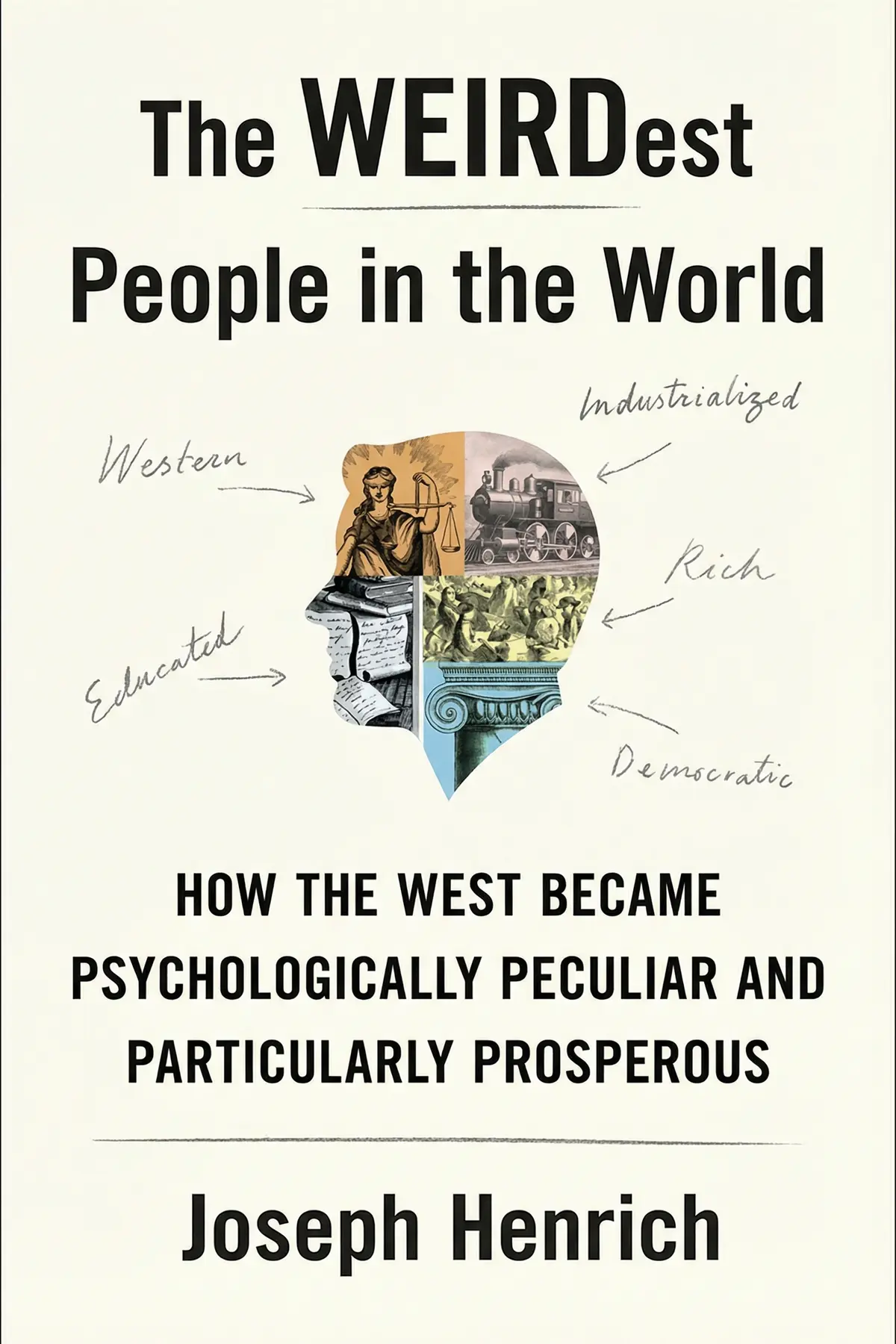
Table of Content
1. Introduction
1 min 46 sec
In the year 597, a missionary named Augustine of Canterbury arrived in England with a mission to convert the Anglo-Saxons. During his time there, he sent a series of frantic letters back to Rome, seeking guidance from Pope Gregory I. These weren’t questions about grand theology or the nature of the soul; they were surprisingly mundane questions about sex, family, and marriage. Could a man marry his stepmother? How far apart did cousins need to be before they could wed? Could two brothers marry two sisters?
While these questions might seem like trivial clerical details from a distant age, they actually represent the starting point for a massive transformation of the human mind. The Pope’s answers—which strictly forbade marriages between even distant relatives—weren’t just religious decrees. They were the first strikes against a social structure that had dominated human existence for tens of thousands of years. This focus on restructuring the family would eventually dismantle the ancient tribal systems of Europe and replace them with something entirely new.
This is the core throughline we are exploring today. We are looking at how a specific set of institutional policies from the Western Church didn’t just change who people married, but changed how they thought, how they perceived the world, and how they built the modern West. It’s a story of cultural evolution where the choices of medieval religious leaders led, centuries later, to the rise of individualism, the industrial revolution, and the democratic societies we live in today. By understanding these ‘WEIRD’ psychological traits, we can finally see why the Western world is such a peculiar outlier on the global stage.
2. Defining the WEIRD Mindset
2 min 32 sec
What if the way you think about yourself and the world is actually a rare exception rather than the human rule? Explore why Western psychology is a historical outlier.
3. The Dominance of Kin-Based Societies
2 min 26 sec
For the vast majority of human history, your family wasn’t just your relatives—it was your government, your safety net, and your entire world.
4. The Church’s War on the Clan
2 min 18 sec
Discover how a series of medieval religious prohibitions accidentally dismantled the tribal structures of Europe and birthed the nuclear family.
5. How Monogamy Domesticated Society
2 min 19 sec
Mandatory monogamy did more than change the family dynamic; it fundamentally altered male biology and drastically reduced social violence.
6. The Rise of Voluntary Organizations
2 min 23 sec
As traditional family bonds broke, Westerners began to build something new: cities, guilds, and universities based on shared goals rather than blood.
7. The Legacy of the Accidental Revolution
2 min 20 sec
From the Enlightenment to modern democracy, the final pieces of the Western puzzle fell into place as individualism became a legal and economic force.
8. Conclusion
1 min 40 sec
As we step back and look at the grand narrative of the Western mind, we see a story that is as much about biological change as it is about cultural history. We started with a Pope’s letters about marriage and ended with the rise of modern democratic and economic institutions. The throughline is clear: when the ancient structures of the clan were dismantled by the Western Church, it didn’t just change the social map of Europe—it rewired the human brain. It pushed us toward individualism, taught us to trust strangers, and forced us to see the world through the lens of universal rules rather than tribal loyalties.
This journey suggests that the traits we often take for granted—our sense of self, our reliance on impersonal laws, and our focus on personal achievement—are actually products of a very specific historical environment. We are the ‘WEIRDest’ people in the world not because of some inherent superiority, but because we are the survivors of a massive social experiment that has been running for fifteen hundred years.
The actionable takeaway from this is a call for a new kind of self-awareness. By recognizing that our psychology is an outlier, we can better appreciate the diverse ways that other cultures function. We can see that ‘normal’ is a relative term. In our professional and personal lives, understanding the power of voluntary associations and the value of universal trust can help us navigate a globalized world. Most importantly, it reminds us that culture is never static; just as a few letters from a Pope once changed the world, the institutions we build today will continue to shape the minds of generations to come.
About this book
What is this book about?
Have you ever wondered why Western societies seem to think so differently than the rest of the world? This exploration dives into the fascinating theory that our modern psychology is not the human default, but rather a unique outlier shaped by historical accidents. It traces the roots of Western individualism, trust in strangers, and analytical thinking back to a specific set of religious policies enacted over a millennium ago. The promise of this narrative is to reveal the hidden architecture of the Western mind. By examining the transition from tight-knit clans to the nuclear families we recognize today, we can see how the Catholic Church’s war on incest and its promotion of monogamy fundamentally rewired our brains and social structures. It is a deep dive into cultural evolution, explaining how small shifts in family life led to the birth of cities, the rise of science, and the economic prosperity of the West.
Book Information
About the Author
Joseph Henrich
Joseph Henrich serves as the chair of the Department of Human Evolutionary Biology at Harvard University. His academic career is dedicated to exploring the complex intersection of human evolution, culture, and psychology. He is also the author of the influential book The Secret of Our Success.
Ratings & Reviews
Ratings at a glance
What people think
Listeners find the book to be both well-documented and fascinating, with one listener emphasizing the startling facts pulled from a wide range of academic areas. Additionally, they praise the intriguing central argument and view the title as a valuable investment. However, reactions to the book's readability are varied; some describe the experience as captivating, whereas others find it a chore to finish. Although the writing is generally well-regarded, impressions of character development are inconsistent.
Top reviews
Jeeranan
This book is a monumental achievement in cross-disciplinary synthesis that completely reframed how I view my own psychology. Henrich argues that the Western world’s peculiar mental traits—individualism, guilt-driven morality, and analytical thinking—didn’t happen by accident but through specific historical shifts. I was particularly gripped by the discussion on how the Church's marriage laws dismantled kinship networks and paved the way for modern institutions. While the data-heavy sections can feel like a climb, the sheer volume of evidence regarding literacy and brain structure is impossible to ignore. It is a dense read, sure, but it is deeply rewarding for anyone willing to engage with complex cultural evolution. Frankly, it’s the kind of work that makes you look at every social interaction differently.
Show moreMonthon
Picked this up after hearing a podcast interview and was immediately sucked into the author’s explanation of how culture rewires the human brain. The idea that learning to read actually reduces our capacity for facial recognition because of brain plasticity was a total 'lightbulb' moment for me. Henrich isn't just making wild guesses; he backs up every claim with massive datasets and cross-cultural experiments. I loved the deep dive into how the Catholic Church unintentionally sparked individualism by banning cousin marriage. It’s a long book, and you definitely need to pay attention to the charts to get the full effect. This is easily one of the most important non-fiction works I’ve read in the last decade.
Show moreSebastian
Henrich has produced a masterpiece that challenges the very foundation of modern psychology. For too long, we’ve assumed that a student in a US university thinks the same way as a farmer in a remote village. This book dismantles that assumption with a sledgehammer of data. The way he tracks the decline of intensive kinship and the rise of voluntary associations is nothing short of brilliant. I didn't find it to be a slog at all; the implications of each new piece of evidence kept me turning the pages. It’s a rare book that manages to be both a rigorous scientific text and a grand historical narrative. If you want to know why the West developed the way it did, start here.
Show moreThongchai
Gotta say, I didn't expect a book about social psychology to be this mind-blowing. It completely flipped my perspective on things I took for granted, like why we value individual rights or trust strangers. Henrich’s writing is clear, even when he’s diving into the deep end of neurological data or historical marriage taboos. I especially liked the part about how 'shame' vs 'guilt' functions in different societies; it explained so much about my own upbringing. Sure, it's a massive book and you might need a coffee to get through the statistics, but the payoff is huge. It’s easily the most thought-provoking thing I’ve read this year. Highly recommend it if you’re looking for a book that actually changes your worldview.
Show moreThawee
Ever wonder why 'Western' people seem so focused on the individual compared to the rest of the world? Henrich’s thesis provides a fascinating, data-driven answer that stretches back to the Middle Ages. He breaks down the WEIRD acronym—Western, Educated, Industrialized, Rich, and Democratic—and shows why we are the outliers in human history. The level of research here is astounding, covering everything from facial recognition to the Protestant Reformation's impact on literacy. However, I’ll be the first to admit that the pacing is uneven. At times, the mountain of graphs and statistical regressions feels like an academic slog that could have been tighter. Despite that, the core arguments are so compelling that they outweigh the dry patches.
Show moreAnucha
As someone who usually gravitates toward evolutionary biology, I found the bridge Henrich builds between culture and genetics to be incredibly sturdy. He manages to explain how social norms around marriage and religion essentially domesticated the European mind. The contrast between guilt-based and shame-based cultures was a highlight, offering a clear lens for understanding global differences. To be fair, the book is quite repetitive in its middle sections, hammering home the same points with slightly different data sets. You could probably skip fifty pages of graphs and still walk away with the same level of understanding. Still, the synthesis of history and psychology is masterfully handled. It’s a dense but necessary volume for understanding the modern world.
Show morePhichai
The chapter on the Protestant Reformation was where the book really clicked for me. Henrich explains how the push for universal literacy didn't just spread religion but actually altered the neurological pathways of entire populations. It’s a staggering thought that our modern cognitive abilities are a side effect of 16th-century theology. I found his analysis of 'impersonal prosociality' particularly insightful for explaining why some societies thrive under market economies while others struggle. The book isn't perfect—it's very long and sometimes ignores the darker sides of Western expansion like colonialism. However, the intellectual journey is well worth the time it takes to navigate the more academic chapters. Definitely brings a fresh perspective to the 'clash of cultures' narrative.
Show moreYulia
Wow, this was a lot to take in at once. Henrich’s work is incredibly ambitious, attempting to explain the last 1,500 years of Western development through the lens of psychological evolution. The core argument—that our minds are 'WEIRD'—is a vital correction to the universalist biases in most social sciences. I found the section on how the nuclear family replaced the clan to be the most convincing part of the narrative. My only real gripe is that the book feels like it's trying to prove too much at once. Some of the causal links between medieval laws and 20th-century democracy felt a bit thin under scrutiny. Nevertheless, the sheer breadth of the research is impressive and provides plenty of food for thought.
Show morePing
Not what I expected, to be completely honest. While the premise is brilliant, the execution is so bogged down in anthropological minutiae that it becomes a struggle to finish. I appreciate the effort to be thorough, but did we really need hundreds of pages of ethnographic atlas data to prove the point? Henrich makes some bold claims about the Church's role in social development that feel a bit like historical overreach. Some of the psychological 'priming' studies he cites have famously failed to replicate, which makes me question the stability of the whole tower. It’s a provocative idea, but the writing style is too dry for a general audience. I’m glad I read it, but I wouldn't call it a page-turner.
Show moreCarter
Finally got around to reading this, but I found myself disagreeing with the methodology more often than not. Henrich relies heavily on the Ethnographic Atlas, which seems to treat small tribes and massive nations with the same statistical weight. The historical claims about the Church's control over marriage in the Early Middle Ages are also highly debated by actual historians. To me, it felt like a classic case of 'big history' trying to fit complex events into a tidy psychological box. The writing is incredibly repetitive and the constant stream of graphs made my eyes glaze over by the halfway mark. It’s an interesting hypothesis, but the evidence feels cherry-picked to support a very specific Western-centric narrative. Not my cup of tea.
Show moreFeatured in
Readers also enjoyed

1491: New Revelations of the Americas Before Columbus
Charles C. Mann

A Year in the Life of William Shakespeare: 1599
James Shapiro
59 Seconds: Change Your Life in Under a Minute
Richard Wiseman

1929: Inside the Greatest Crash in Wall Street History--and How It
Andrew Ross Sorkin

Age of Anger: A History of the Present
Pankaj Mishra

A Biography of Loneliness: The History of an Emotion
Fay Bound Alberti

Agent Sonya: The Spy Next Door
Ben Macintyre
AUDIO SUMMARY AVAILABLE
Listen to The WEIRDest People in the World in 15 minutes
Get the key ideas from The WEIRDest People in the World by Joseph Henrich, plus 5,000+ more titles in English and Thai.
- 5,000+ titles
- Listen as much as you want
- 7-day free trial
- Cancel anytime







