
7 min 57 sec
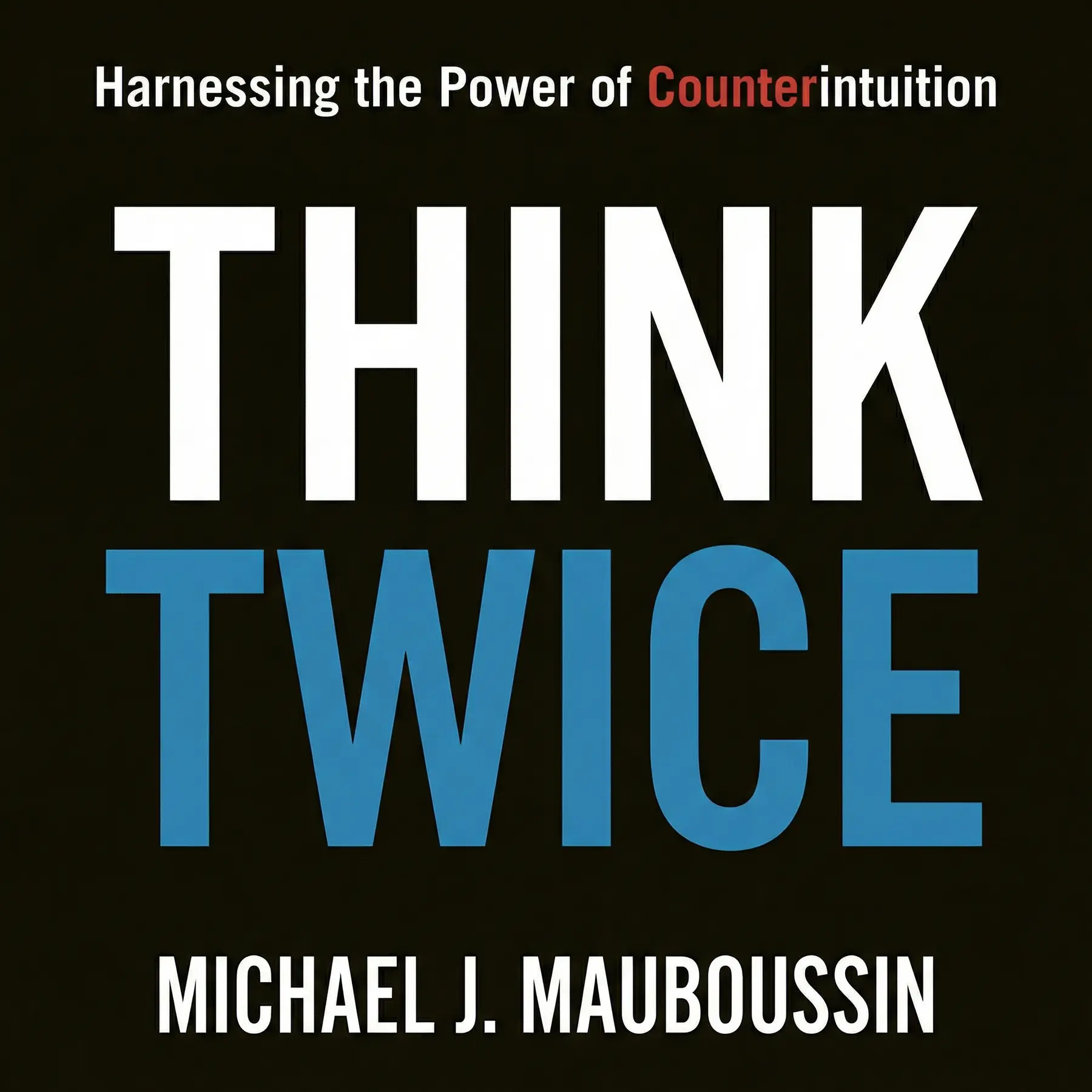
Think Twice: Harnessing the Power of Counterintuition
Think Twice provides a practical framework for identifying the mental shortcuts that lead to poor decisions, offering strategies to improve judgment by embracing counterintuitive thinking and objective data over gut instinct.
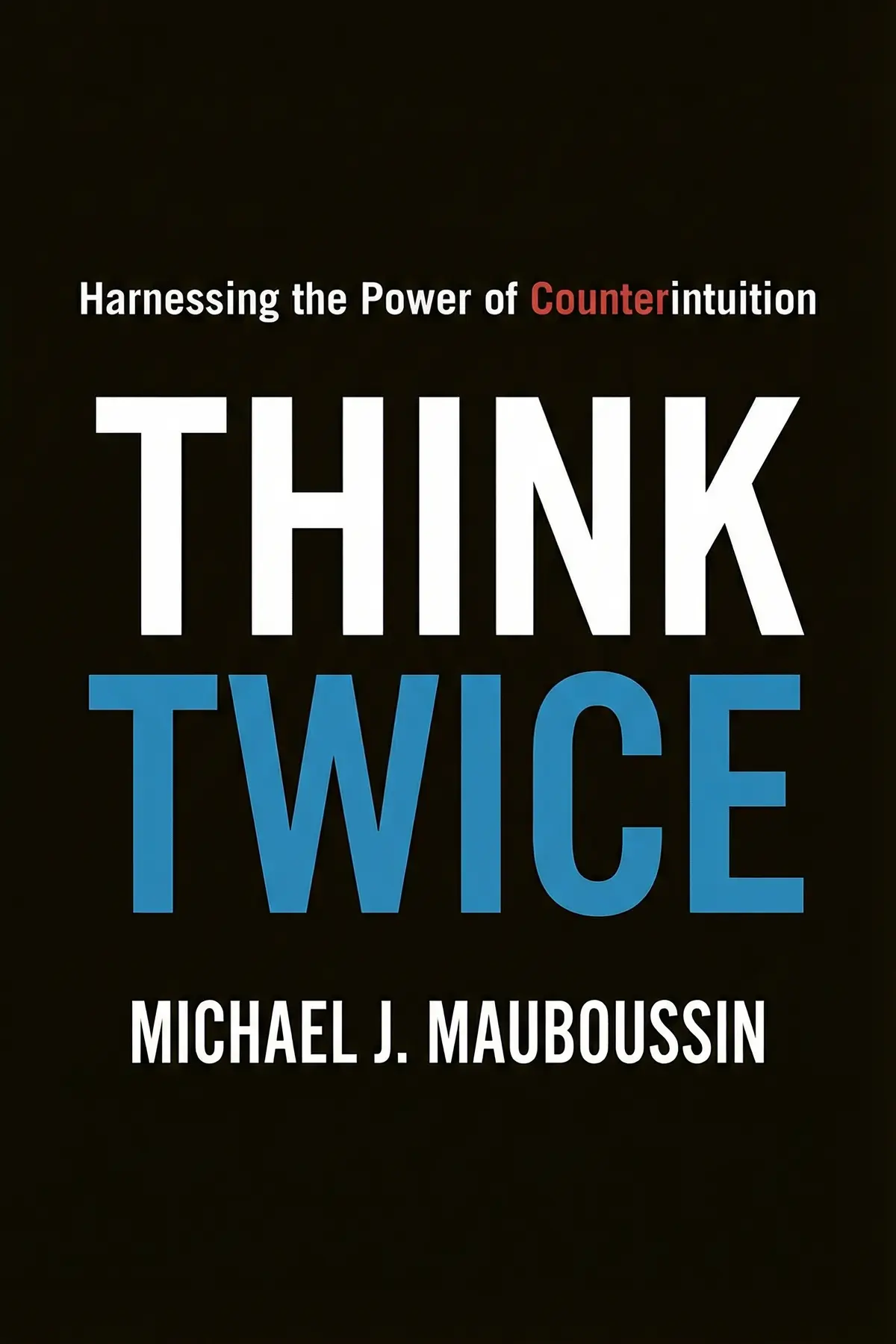
Table of Content
1. Introduction
1 min 15 sec
We often equate intelligence with good judgment, assuming that a high IQ or a list of prestigious accolades serves as a shield against foolishness. However, history is littered with examples of brilliant minds making catastrophic errors. Take, for instance, the downfall of Long Term Capital Management. This was not a group of amateurs; the firm’s leadership included Nobel Prize-winning economists. Yet, their sophisticated models crumbled because they didn’t account for the unpredictable nature of global markets. This reveals a fundamental truth: human brains are not naturally wired for the complexities of the modern world.
Instead, our minds are built for speed and efficiency, relying on mental shortcuts and ingrained assumptions that helped our ancestors survive. In today’s environment, these same shortcuts often lead us astray. To make better choices, we have to perform a deliberate act: we must think twice. This means pausing to question our initial impulses, examining problems from entirely new angles, and being willing to look past our own biases. In this exploration of Michael J. Mauboussin’s work, we will dive into the specific ways our thinking narrows and learn how to broaden our perspective to avoid the traps of the ‘inside view’ and ‘tunnel vision.’
2. The Power of the Outside View
2 min 41 sec
Discover why our natural optimism and focus on specific details often lead to failed predictions, and learn how to use statistical context to make more accurate forecasts.
3. Breaking Free from Tunnel Vision
2 min 57 sec
Uncover the invisible mental anchors and shortcuts that restrict your thinking, and learn practical strategies to widen your perspective and evaluate information objectively.
4. Conclusion
1 min 04 sec
The common thread through all these cognitive traps is that our first instinct is rarely our most accurate one. Our brains prefer the path of least resistance, favoring the easy story over the complex data set. But as we have seen, the cost of following that path can be immense. Whether it’s the overconfidence of the ‘inside view’ or the restrictive grip of ‘tunnel vision,’ our defaults often lead us toward error.
True expertise in decision-making doesn’t come from knowing everything; it comes from knowing how you think. By adopting the ‘outside view’ and consciously broadening your perspective, you can override your biological predispositions. Remember that the goal is not to eliminate your instincts entirely, but to subject them to a second, more rigorous evaluation. When you face your next big decision, don’t just act on your first thought. Pause, look at the data, seek a different opinion, and give yourself the opportunity to think twice.
About this book
What is this book about?
This summary explores why even the most intelligent individuals often fall victim to avoidable errors in judgment. It examines the psychological mechanisms that govern our decision-making processes, highlighting how cognitive biases, social pressures, and environmental factors can distort our perception of reality. By following the insights of Michael J. Mauboussin, listeners will learn to distinguish between the 'inside view,' which relies on personal anecdotes and narrow focus, and the 'outside view,' which utilizes statistical data and historical context. The book promises to equip you with the tools necessary to challenge your initial assumptions, recognize the hidden influence of incentives, and develop a more disciplined, evidence-based approach to making choices in both professional and personal life.
Book Information
About the Author
Michael J. Mauboussin
Michael J. Mauboussin is an author and investment strategist. He’s known for his research on behavioral finance and expert insights into investor psychology.
Ratings & Reviews
Ratings at a glance
What people think
Listeners consider the work exceptionally clear and accessible, with one listener mentioning that it offers a structured approach for sharpening decision-making abilities. Furthermore, they value the stimulating material, with one listener pointing out the effective explanation of typical psychological patterns. The book also earns praise for its engaging storytelling, easy-to-follow style, and overall cost-effectiveness.
Top reviews
Ingrid
Ever wonder why smart people make such consistently terrible choices? Mauboussin tackles this head-on by exploring the "thin ice" we skate on when we rely purely on intuition in complex systems. The example of the Best Buy prediction market was a total eye-opener for me regarding the "wisdom of crowds." The book is exceptionally well-written and serves as a vital bridge between theoretical psychology and real-world application. I’ve read a lot in this space, but the way he synthesizes ideas from Charlie Munger and James Surowiecki feels fresh. It’s the kind of book you’ll want to keep on your desk to reference whenever you’re feeling overly confident in a project timeline.
Show moreCarlos
Finally got around to this after seeing it cited in dozens of finance blogs, and it lives up to the hype for the most part. What I appreciated most was the balance between theory and application. He doesn't just tell you that you're biased; he gives you a roadmap to mitigate those biases using "decision hygiene." The discussion on how Easterners and Westerners perceive causes of behavior was a fascinating detour I didn't expect. This is a must-read if you want to understand the patterns behind why groups often outperform experts. It's dense enough to be meaningful but light enough to read on a flight. Definitely worth the investment.
Show moreAurora
Think Twice serves as a much-needed reality check for the "follow your intuition" narrative that is so prevalent in modern management. Mauboussin explains common mental tendencies—like our obsession with anecdotes over hard statistics—in a way that is both convicting and helpful. The specific focus on how subconscious cues affect our choices, like the scent of cleaner making study participants act tidier, was absolutely fascinating. It’s a very thought-provoking book that justifies its place on any professional's bookshelf. The narrative quality is top-notch, and the value you get from the frameworks provided is well worth the price.
Show moreRohan
Mauboussin has a knack for distilling complex psychological theories into something you can actually use on a Monday morning. The book focuses on why our internal "default settings" fail us when we face modern, high-stakes decisions. I particularly liked the summary checklists at the end of each chapter; they turn abstract concepts into a practical framework. While some of the research on behavioral biases feels a bit like a "greatest hits" album of Daniel Kahneman’s work, the narrative quality remains high. It’s a thought-provoking read that challenges the "go with your gut" advice you see in books like Blink. For the price, it’s excellent value for money for any professional. Just don't expect it to reinvent the wheel if you’ve already spent a lot of time in the behavioral finance world.
Show moreOrathai
Frankly, I found the section on the "outside view" to be the most valuable part of this entire book. Most of us are trapped in our own heads, thinking our specific situation is unique when, in reality, there’s usually a statistical pattern we could follow instead. Mauboussin explains these mental tendencies with a clarity that makes the medicine go down easy. The writing style is punchy and accessible, avoiding the dry, academic tone that usually plagues this genre. I did feel that some of the anecdotes were a bit long-winded, but they generally served to illustrate his points well. It's a solid 4-star read that will definitely make you pause before making your next big move.
Show moreJong
The chapter on the planning fallacy hit way too close to home for my current project management role. Seeing the data on how often we underestimate costs and timelines—and why we do it—was both painful and enlightening. Mauboussin does a great job of explaining how our brains are essentially wired for a world that no longer exists. He uses a mix of anecdotes and research that keeps the pages turning without feeling like a textbook. My only minor gripe is that he occasionally oversimplifies the "man vs. machine" debate in decision making. Still, it’s a very readable guide that provides a much-needed framework for anyone trying to avoid systematic errors in judgement.
Show moreMichael
As someone who works in data analysis, I found the discussion on reverting to the mean particularly compelling. The story about the Israeli flight instructors and why they thought yelling worked was a perfect illustration of how we misinterpret feedback. Mauboussin is excellent at showing how we confuse luck with skill, especially in fields like investing. The book is well-written and provides a strong argument for why we should "think twice" before trusting our gut in complex environments. It offers a lot of food for thought regarding how we structure our organizations and decision processes. It's a great companion piece to any of the more technical books on judgement and decision-making.
Show moreAnthony
To be fair, if you haven't read "More Than You Know" yet, you’ll probably find this significantly more insightful than I did. Having already finished Mauboussin's previous work, I felt like a lot of "Think Twice" was covering the same ground, just with slightly different flavoring. It’s certainly easier to digest than something like "Thinking, Fast and Slow," but it lacks some of that deep, rigorous analysis. The checklists are helpful, but some of the action items felt a little vague or familiar to me. It's not a bad book by any means—the narrative flows well and the examples are interesting—but it might feel repetitive for seasoned fans of behavioral economics.
Show moreBird
Look, this is a solid entry-level text for anyone looking to understand behavioral economics without getting bogged down in academic jargon. It’s essentially "Black Swan-light," taking some of Taleb's and Kahneman's heavier concepts and making them palatable for a general business audience. However, if you’re already familiar with the "usual suspects" like the Milgram experiment or the sunk-cost fallacy, you might find yourself skimming. The book is well-structured, but the conclusions sometimes feel like common sense dressed up in fancy psychological terms. It's a quick, easy read, but it lacks the "wow" factor I was hoping for based on the reviews.
Show morePakpoom
Not what I expected based on the glowing recommendations from my colleagues. I found the content to be largely recycled from other popular psychology books, offering very little that felt truly original or groundbreaking. It feels like the author is just trying to temper the popularity of Malcolm Gladwell by taking the opposite stance, but without providing much depth. The examples are fine, but I’ve seen most of them in dozens of other blog posts and TED talks over the last decade. You are better off just reading "Thinking, Fast and Slow" if you want the real deal. This felt like a surface-level summary of much better books.
Show moreReaders also enjoyed
59 Seconds: Change Your Life in Under a Minute
Richard Wiseman
A Liberated Mind: How to Pivot Toward What Matters
Steven C. Hayes

Acting with Power: Why We Are More Powerful Than We Believe
Deborah Gruenfeld
Age of Propaganda: The Everyday Use and Abuse of Persuasion
Anthony Pratkanis
AUDIO SUMMARY AVAILABLE
Listen to Think Twice in 15 minutes
Get the key ideas from Think Twice by Michael J. Mauboussin, plus 5,000+ more titles in English and Thai.
- 5,000+ titles
- Listen as much as you want
- 7-day free trial
- Cancel anytime







