
27 min 55 sec
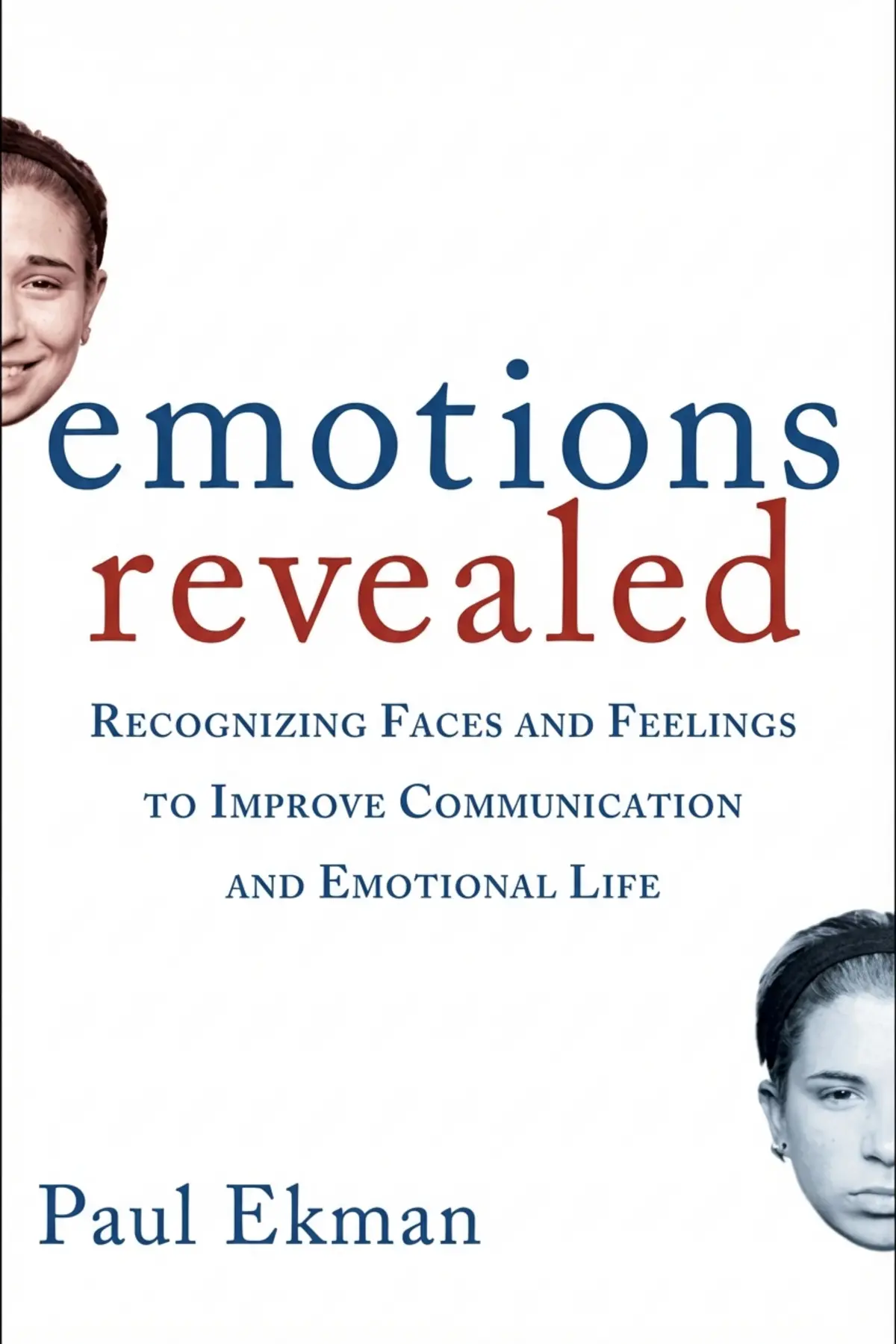
Unmasking the Face: A Guide to Recognizing Emotions From Facial Expressions
Unmasking the Face offers a detailed exploration of human facial expressions, providing readers with a scientific framework to decode hidden emotions and improve their interpersonal communication through the study of microexpressions and muscle movements.

Table of Content
1. Introduction
1 min 44 sec
We often talk about the importance of a ‘poker face’ when the stakes are high. Whether it is a literal card game or a tense boardroom negotiation, the ability to keep our features perfectly still and unreadable is prized as a sign of strength and control. But for most of us, the face is far more than a shield; it is a vibrant, constantly shifting billboard that broadcasts our deepest internal states to the world, often without us ever saying a single word. From the moment we are born, we begin a lifelong process of learning to interpret these silent signals in the people around us. We look to our parents, our peers, and our partners to gauge their reactions and understand the emotional truth beneath their spoken language.
This exploration into the human countenance serves as a bridge between the internal world of feeling and the external world of social interaction. By looking closely at the mechanics of the face, we can begin to uncover what people are truly feeling, even when they might be trying to hide it from us—or even from themselves. This journey will take us across the different regions of the face, from the arch of an eyebrow to the tension in a lip, showing us how to identify the specific markers of various emotions.
We will also discover why some people find it so difficult to read others and why our own faces might sometimes send messages we didn’t intend. We will explore the fleeting nature of surprise, the tensed anticipation of fear, and the complex ways that emotions can blend together to create nuanced expressions. By understanding the science of facial movement, we gain a survival skill that is indispensable in every facet of life, from the courtroom to the classroom. Prepare to see the people in your life in a completely new light as we begin to decode the hidden language written on every human face.
2. The Necessity and Nuance of Facial Reading
2 min 30 sec
Discover why interpreting facial movements is a vital survival skill in both our personal and professional lives, and learn about the specific muscle zones that reveal our truth.
3. The Fleeting Nature of Surprise
2 min 29 sec
Surprise is the shortest of all human emotions, leaving distinct but momentary traces on the face that can easily be confused with other reactions.
4. Distinguishing Fear from Surprise
2 min 21 sec
While fear and surprise share similar facial territory, the specific tension in the brows and mouth reveals the deeper distress of a fearful state.
5. The Low-Face Signals of Disgust and Contempt
2 min 19 sec
Learn to identify the wrinkled nose and raised lip that signal aversion, and discover how contempt differs through its element of perceived superiority.
6. The Threat of Anger
2 min 14 sec
Anger creates a uniquely intense and penetrating gaze, characterized by lowered brows and tight muscle tension across the entire face.
7. The Complexity of the Human Smile
2 min 31 sec
A true smile involves much more than just the mouth; discover how the eyes and the folds of the face reveal genuine happiness versus a social mask.
8. The Quiet Signals of Sadness
2 min 08 sec
Sadness is often muted and subtle on the face, yet the unique movement of the inner eyebrows provides a clear and unmistakable signal of emotional pain.
9. Unmasking Deception and Forced Expressions
2 min 39 sec
Learn to spot the inconsistencies in muscle control and timing that reveal when someone is attempting to hide their true feelings through a false expression.
10. The Eight Distinct Expressor Styles
2 min 54 sec
Understand the eight different ways people habitually show—or hide—their emotions, and how these styles can lead to significant social misunderstandings.
11. Practical Steps for Self-Awareness
2 min 44 sec
Discover how to identify your own expressor style through simple photography and mirror exercises to improve your relationships and social clarity.
12. Conclusion
1 min 22 sec
The human face is a sophisticated instrument of communication, capable of conveying the deepest truths of our emotional lives with incredible speed and detail. Throughout this exploration, we have seen how the specific movements of our eyebrows, eyes, and mouths serve as a universal language that transcends words. We have learned to distinguish the fleeting arch of surprise from the tense, drawn-together brows of fear, and the authentic, eye-crinkling smile of joy from the polite social mask. We have also explored the challenges of deception and the various expressor styles that can lead to miscommunication in our daily lives.
Ultimately, the goal of understanding facial expressions is not just to ‘catch’ people in lies or to become a human lie detector. It is about fostering deeper connections and greater self-awareness. When we know how our own faces are perceived, we can navigate our relationships with more tact and clarity. When we can read the subtle cues of sadness or anger in others, we can respond with more empathy and effectiveness. By paying closer attention to the silent dialogue written on every face we encounter, we open up a new world of understanding, making our personal and professional lives more transparent, honest, and connected. The face is always speaking; the only question is whether we are truly prepared to listen.
About this book
What is this book about?
This guide provides a deep dive into the silent language of the human countenance. It explores how our internal emotional states—ranging from surprise and fear to disgust and joy—are etched onto our features through specific muscle contractions in the brow, eyes, and mouth. By categorizing these movements, the book promises to enhance the reader's emotional intelligence and social intuition. Beyond mere identification, the work addresses the complexities of emotional masking and deception. It introduces the concept of microexpressions—fleeting flickers of truth that appear even when someone is trying to hide their feelings. By the end of this journey, listeners will have a new toolkit for navigating personal and professional relationships with greater clarity and empathy, learning not just to see faces, but to truly read them.
Book Information
About the Author
Paul Ekman
Paul Ekman is a professor emeritus at the University of California, San Francisco. He is a world-renowned pioneer in the study of human emotions and microexpressions. In 2009, Time magazine named him one of the 100 Most Influential People. Wallace V. Friesen is a lecturer at the University of Kentucky. His research focuses on the expression of emotion in old age, and he has coauthored numerous articles exploring the links between emotional expression and longevity.
Ratings & Reviews
Ratings at a glance

What people think
Listeners find the material accessible and educational, noting that the thorough information caters well to those already familiar with the topic. The work offers great perspectives on how emotions are displayed on the face, featuring numerous images of different expressions, and listeners value its practicality in professional environments. They appreciate how the guide assists in interpreting human reactions, with one listener highlighting that it provides useful tools for describing characters. The quality of the writing receives varied reviews, as some listeners consider it well-crafted while others believe it could be improved.
Top reviews
Game
Wow, this book totally changed how I look at people when I'm out in public or in meetings. Ever since I became interested in body language, I've wanted a resource that actually uses scientific data instead of just guessing. This book is the actual blueprint for understanding micro-expressions and the universality of human emotion. Ekman's research is groundbreaking and honestly quite mind-blowing when you see the evidence for universal signals like disgust and surprise. I loved the practical exercises and the way the authors separate the face into different zones to make the learning process easier. It requires some intense focus, but the payoff for your social intelligence is well worth the effort. If you want to know what someone is actually thinking behind their 'polite' mask, you need to read this immediately.
Show moreLily
Essential reading for anyone interested in uncovering the truth in their personal and professional relationships. This is hands down one of the most useful books on my shelf because it provides the literal keys to unlocking human emotion. While some critics might say it's just 'common sense,' the level of precision regarding specific combinations of muscle movements is unmatched. It is a rigorous, scientific look at the face that remains accessible enough for a general audience to understand. I found the chapters explaining why we mask our feelings—the cultural and personal display rules—to be incredibly revealing. It’s not just a book; it’s a toolkit for navigating the complexities of social interaction. This masterpiece of behavioral psychology is something I recommend to everyone who wants to communicate more effectively.
Show moreAva
After seeing Dr. Ekman’s name in so many research papers, I had high expectations for this classic text. I was not disappointed, as the book serves as a comprehensive guide to the nuances of facial anatomy and emotional signaling. The authors do a fantastic job of explaining how micro-expressions occur when a person is either deliberately or unconsciously concealing a feeling. I found the section on 'message control' particularly fascinating because it reframes the idea of lying into something more complex and human. Even though the photos are old, they clearly illustrate the points being made in the text. This book is foundational for a robust understanding of human behavior at a much deeper level than standard pop-psychology. It is a brilliant resource that I find myself returning to again and again for my studies.
Show moreLucas
This book is a fascinating deep dive into the silent language we all speak every single day. Truth is, most of us go through life completely blind to the subtle cues that the people around us are giving off. Ekman and Friesen provide the facial schematics that enable you to read emotions like happiness, fear, and anger with high accuracy. I appreciated the academic rigor and the way they addressed the psychological reasons why people carry out the actions they do. It’s written with a level of detail that satisfies the intellectual mind while remaining practical for everyday use. If you’ve ever wondered why some people are so much better at 'reading the room,' this book contains the answers. It’s an eye-opening experience that makes you realize how much you’ve been missing in your conversations.
Show moreKenji
Finally got around to reading what many consider the 'bible' of facial expressions and micro-expressions. Dr. Ekman breaks down the mechanics of the human face in a way that is incredibly detailed and easy to follow if you are patient. I work in sales, and being able to identify those fleeting reactions has definitely given me an edge in understanding my clients. The book provides a solid framework for recognizing happiness, fear, and anger before a person even realizes they are showing it. To be fair, the writing quality is a bit hit-or-miss; some chapters feel like they belong in a technical manual. Despite the dated aesthetic of the photographic examples, the core information remains top-tier for anyone serious about human behavior. It is a vital skill to have in any high-stakes professional setting today.
Show moreSelin
An excellent, though somewhat clinical, guide to the hidden language of human behavior and emotion. If you can get past the dry, academic tone, there is a massive wealth of knowledge buried inside these pages. Ekman and Friesen provide a very detailed look at how to spot subtle shifts in a face that betray someone's true feelings. I found the section on 'facial deceit' and the four reasons why people control their expressions particularly enlightening for my work. It helps to have a structured, scientific way to look at something as fluid and confusing as human emotion. The only reason I am not giving it five stars is that the layout is a bit dated and the photo quality is poor. Still, the content itself is vital for anyone who works with people and needs to understand what isn't being said out loud.
Show moreSamira
I decided to pick this up for professional development after hearing it inspired the television show 'Lie to Me.' The book is essentially a training manual that teaches you how to decode the human face like it's a second language. Personally, I found the breakdown of the 'Atlas of Facial Expressions' to be the most useful part of the entire volume. It's not just about catching liars; it's about becoming more empathetic by truly seeing the pain or joy others are experiencing. Not gonna lie, some of the technical descriptions of muscle movements can get a bit tedious after a while. However, if you stick with it, you'll start seeing these patterns everywhere in your daily life. It is a fascinating study that remains relevant decades after its original publication date.
Show moreFrida
The ebook version of this text is a total mess that clearly needs a serious redesign for digital formats. I really wanted to enjoy this, especially after seeing Ekman's name everywhere in the field of body language studies. However, reading this on a Kindle was a frustrating experience because you have to constantly flip back and forth between the text and the reference images. The photos themselves look like they were taken with a low-quality camera and haven't been updated since the seventies. It reads more like a dry, clinical research paper than a compelling guide for the general public. While some of the information on facial deceit is admittedly interesting, the delivery is so incredibly sluggish that I struggled to stay engaged. If you absolutely must read it, track down a physical copy so you can actually see the diagrams clearly.
Show moreSook
As a writer looking for tools to describe characters more vividly, this was a helpful but ultimately flawed resource. There are some gems here regarding how emotions actually manifest in specific muscle groups, which is great for descriptive prose. I particularly appreciated the sections on 'display rules' and how different cultures or professions manage their outward expressions. But look, the pacing is all over the place and the tone is frequently repetitive. One moment it is fascinating, and the next, it is repeating the same point about brow movements for the tenth time. It lacks the engaging, narrative flow found in Ekman's other works like 'Telling Lies,' which I found much more digestible. It is a decent reference manual to keep on the shelf, but it is not something I would sit down and read for pleasure again.
Show moreCholada
Don't fall for the hype if you are looking for deep, groundbreaking psychological revelations. It is mostly common sense packaged as elite science, which feels like a bit of a grift to sell expensive consulting services. The text completely ignores the fact that people aren't robots; neurodivergent individuals often express and understand emotions in ways this book doesn't even acknowledge. Honestly, just go people-watching at a busy mall for twenty minutes and you will likely learn more than these pages could ever teach you. The photos are grainy, dated, and frankly quite distracting from the actual message the authors are trying to convey. I was hoping for something transformative, but it felt like a sluggish slog through obvious observations. Save your money and buy a better, more modern textbook on human behavior instead.
Show moreReaders also enjoyed


59 Seconds: Change Your Life in Under a Minute
Richard Wiseman


A Liberated Mind: How to Pivot Toward What Matters
Steven C. Hayes
Acting with Power: Why We Are More Powerful Than We Believe
Deborah Gruenfeld
AUDIO SUMMARY AVAILABLE
Listen to Unmasking the Face in 15 minutes
Get the key ideas from Unmasking the Face by Paul Ekman, plus 5,000+ more titles in English and Thai.
- 5,000+ titles
- Listen as much as you want
- 7-day free trial
- Cancel anytime







