
23 min 39 sec
Until the End of Time: Mind, Matter, and Our Search for Meaning in an Evolving Universe
By Brian Greene
Explore the epic timeline of the universe, from the Big Bang to the final evaporation of matter, while uncovering how human consciousness and culture emerged to create meaning in a temporary cosmos.
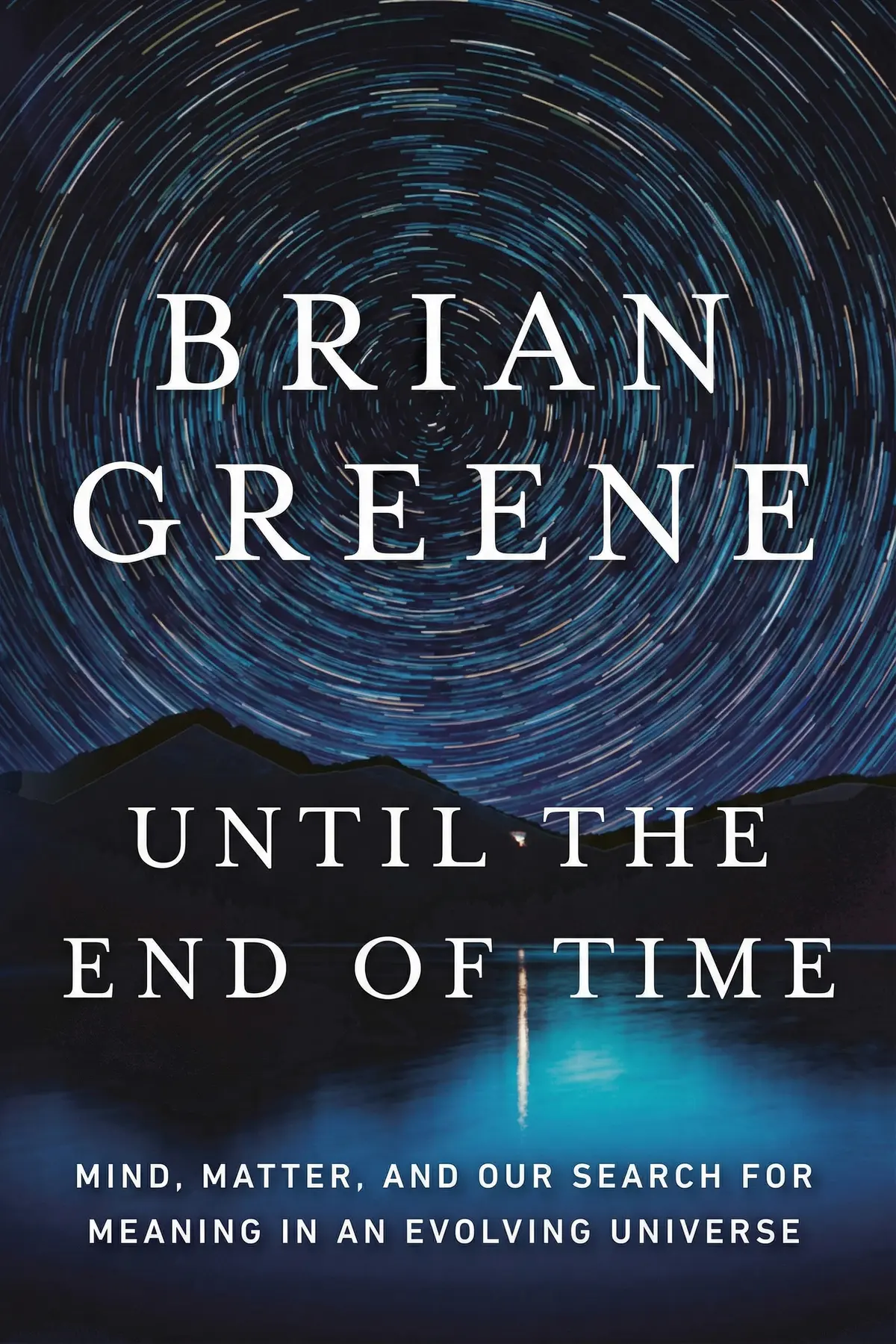
Table of Content
1. Introduction
1 min 40 sec
Have you ever looked up at the night sky and felt a strange mixture of awe and insignificance? It’s a common human experience to wonder how the swirling galaxies and distant stars relate to our everyday lives—to our struggles, our triumphs, and our art. We often view the laws of physics as something cold and separate from the warmth of human culture, yet they are inextricably linked. From the first spark of the Big Bang to the final notes of a grand symphony, everything we see, feel, and create is part of a single, continuous narrative.
In this exploration, we are going to bridge that gap. We’ll see how the same principles that govern a black hole also dictate the limits of human achievement. We will follow a throughline that connects the most ancient particles of the universe to the evolution of the human mind, the development of language, and our persistent search for meaning. This is a story about two competing forces: evolution, which builds complex structures, and entropy, which eventually tears them down.
By the end of this journey, you’ll see the universe not just as a collection of matter, but as a temporary window of opportunity. It’s a window that has allowed for the emergence of consciousness—a way for the universe to finally look back at itself and ask, ‘Why am I here?’ We will dive into the scientific origins of our world, the eventual fate of our planet, and the reason why our search for purpose is so vital, even if the cosmos itself is destined to go dark. Let’s begin our journey at the very start of time, where the seeds of everything we love were first sown in a state of nearly perfect order.
2. The Duality of Creation and Decay
2 min 11 sec
Everything in existence is caught between the drive toward order and the inevitable pull of chaos, a struggle that gives life its profound meaning.
3. The Spark of Gravitational Repulsion
2 min 18 sec
Discover how a peculiar form of gravity didn’t pull things together, but instead acted as the cosmic detonator that launched the expansion of space.
4. The Stellar Origins of Matter
2 min 28 sec
The heavy elements that form our world were forged in the fiery hearts and violent deaths of ancient stars, making us literal children of the cosmos.
5. The Physical Reality of Consciousness
2 min 14 sec
Sentience is often viewed as a spiritual mystery, but it may actually be a complex physical process governed by the same laws as the stars.
6. Language and the Power of Story
2 min 01 sec
Humanity’s rise wasn’t just due to tools, but to our unique ability to share information and create shared realities through storytelling.
7. The Evolutionary Role of Faith
2 min 11 sec
Religious belief may have provided a crucial advantage by fostering group loyalty and helping our ancestors cope with the terror of mortality.
8. Art as an Evolutionary Spark
2 min 08 sec
Artistic expression isn’t just a luxury; it serves as a powerful tool for social bonding and sharpening the human mind’s creative potential.
9. The Fading Light of the Cosmos
2 min 11 sec
The universe has a definitive expiration date, and the very stars that gave us life will eventually leave us in a cold, dark void.
10. The End of Matter and the Potential for Rebirth
2 min 23 sec
In the ultimate future, even black holes will vanish, leaving a void where the laws of physics themselves might undergo a radical transformation.
11. Conclusion
1 min 54 sec
As we reach the end of our journey through time and space, we are left with a powerful realization: our existence is both a mathematical fluke and a profound achievement. We have seen how the universe began in a state of exquisite order and how it is slowly drifting toward an inevitable, silent end. Between these two points, the laws of physics have allowed for the rise of stars, the birth of planets, and the emergence of life.
Most remarkably, those same laws have given rise to the human mind—a structure so complex that it can contemplate the very laws that created it. We have used our consciousness to build languages, to tell stories that shield us from the dark, and to create art that speaks to the deepest parts of our experience. We have developed religions to foster cooperation and to find comfort in the face of our own mortality. All of these cultural pillars are not ‘extra’ to our biology; they are the tools we evolved to make sense of a temporary world.
In the face of an indifferent and eventually dying universe, the ‘meaning’ of life is not something we find out there in the stars. Instead, meaning is something we manufacture. It is a human creation, as real and as vital as the air we breathe. We are the only part of the cosmos that can assign value to things, and that makes our brief time here infinitely precious.
So, as you step back into your daily life, remember the throughline that connects you to the Big Bang. Your thoughts, your creative impulses, and your connections to others are the universe’s most sophisticated way of expressing itself. Our story may be finite, but the search for meaning is a journey that makes every second count. In a universe destined for silence, our voices, our laughter, and our quest for understanding are the most beautiful sounds ever made.
About this book
What is this book about?
Until the End of Time is a grand narrative that bridges the gap between the hard sciences of physics and the deep questions of philosophy. Brian Greene takes readers on a journey through the life of the cosmos, starting with the chaotic energy of the early universe and moving through the formation of stars, planets, and eventually, the complex organic structures we call life. The book doesn't just stop at the physical; it explores how the same laws of thermodynamics that govern black holes also influenced the development of human language, the rise of religious belief, and the creation of timeless art. The promise of this exploration is to provide a sense of place within an incredibly vast and indifferent timeline. By understanding the inevitable rise of entropy—the force of decay that will eventually claim everything we know—we can better appreciate the miraculous, fleeting moment in which we exist. Greene offers a perspective that is both humbling and empowering, suggesting that while the universe may have no inherent purpose, the human ability to create meaning is our species' greatest achievement in the face of eternity.
Book Information
About the Author
Brian Greene
Brian Greene is a world-renowned theoretical physicist and a leading expert in the field of string theory. He is a professor at Columbia University and has gained international acclaim for his ability to translate complex scientific concepts into accessible narratives for the general public. Greene has authored five books on physics, including several bestsellers. Beyond his writing and research, he is the co-founder of the World Science Festival, an initiative he started with his wife to foster a more scientifically informed and engaged society through public events and education.
Ratings & Reviews
Ratings at a glance
What people think
Listeners value the thorough scientific explanations in this work, including one who mentions its coverage of intricate themes ranging from entropy to consciousness. Furthermore, they consider it deeply stimulating, offering perspective and life context through the exploration of topics such as religion and morality. The writing is clear and accessible; one listener remarks that it reads like a college-level textbook, whereas others characterize the work as a mind-expanding journey. Listeners also commend the quality of the narrative, with one emphasizing the blend of scientific facts and illustrative storytelling, making it an excellent choice for those with curious minds.
Top reviews
Jiraporn
Wow. Brian Greene has transitioned from being a mere explainer of string theory to a profound philosopher of the human condition. This book is a masterwork that demands your full attention, moving seamlessly from the molecular mechanics of the Big Bang to the eventual cold silence of the cosmos. If you’re looking for a quick beach read, look elsewhere, because Greene dives deep into the Higgs field and the Schwarzschild Radius with the precision of a textbook. However, he balances the heavy physics with a soul-searching narrative about why we exist at all. The way he describes the 'entropic two-step'—how life creates order while inevitably increasing the universe's total chaos—is nothing short of brilliant. It’s a mind-expanding experience that left me feeling both tiny and incredibly significant. Truth is, I haven't felt this sense of cosmic awe since reading Sagan. A breathtaking achievement.
Show moreSangduan
The chapter on the 'entropic two-step' alone is worth the price of admission. It finally helped me visualize how complex order can emerge from chaos without violating the laws of thermodynamics. Greene writes with a compassion and humility that is rare among physicists of his stature, acknowledging the existential dread that often accompanies these topics. His prose is often as beautiful as a novel, yet it carries the weight of rigorous scientific inquiry. Personally, I found the exploration of how our brains evolved to tell stories to be the most fascinating part of the journey. He manages to bridge the gap between the cold facts of the cosmos and the warmth of human experience. This isn't just a science book; it’s a meditation on what it means to be a conscious observer in a temporary world. Absolutely supernova.
Show moreVera
As someone who usually finds physics intimidating, I was shocked by how accessible this felt. Greene uses personal anecdotes to ground these massive cosmic concepts, making the reader feel like they're having a conversation rather than attending a lecture. The way he connects the laws of physics to the human search for meaning is masterful. Frankly, I didn't expect a book about entropy and the end of time to be so uplifting. He provides a framework for understanding morality and religion within a strictly physicalist worldview, which is a rare feat. The scientific exposition is deep without being alienating, and the narrative flow keeps you moving through some very dense material. It’s a thought-provoking look at the universe that manages to be both scientifically rigorous and deeply poetic. A must-read for anyone curious about the big questions.
Show moreManika
Directly stated, this is the most comprehensive 'big history' book I have ever read. Greene manages to synthesize physics, biology, and philosophy into a single, cohesive story that spans from the Big Bang to the final dark era of the universe. The level of detail is impressive—especially the 74 pages of footnotes—but the main text remains fluid and engaging. I particularly enjoyed the discussion on the Schwarzschild Radius and how gravity and entropy have been in a continuous battle since the beginning of time. It’s a book that invites you to think deeply about your place in the cosmos. While some might find the physicalist approach a bit cold, I found his conclusion about the 'nobility of being' to be incredibly inspiring. We are just collections of particles, but we are particles that can think and love. Truly a masterwork.
Show moreHugo
Ever wonder why we bother creating art or religion in a universe destined for cold, dark heat-death? Greene tackles these heavy existential questions by framing our brief existence as a 'flitting burst of activity' against an eternal backdrop. The book is well-written and easy to understand for the most part, though some of the sections on quantum fluctuations required a second reading. I found his discussion on the 'nobility of being' particularly moving, as it suggests that meaning isn't something we find, but something we manufacture. Gotta say, the scientific narrative is top-notch, providing a cohesive story that links the earliest particles to our modern quest for purpose. My only gripe is that the pacing slows down significantly when he discusses the future of consciousness. Still, it’s a thought-provoking journey for anyone with an inquiring mind.
Show moreRatchada
Picked this up during a particularly gloomy week, and it surprisingly provided a lot of comfort. There’s something strangely liberating about acknowledging our own impermanence alongside the stars. Greene does a fantastic job of making complex topics like the second law of thermodynamics accessible to a general audience. He uses clever analogies—like his story about blowing up an oven as a kid—to ground the more abstract concepts. The narrative quality is high, and he successfully weaves a story that spans trillions of years. Although he admits that free will might be an illusion, he still manages to make the human experience feel special. It reads like a college-level textbook but one taught by the most engaging professor you've ever had. A few sections on the far future felt a bit repetitive, but the overall impact is profound. Definitely worth your time.
Show moreWacharapol
Finally got around to finishing this massive tome, and I feel like my brain has been expanded and flattened simultaneously. Greene’s exploration of the 'entropic two-step' is a highlight, explaining how life can flourish even as the universe runs down. The book covers a dizzying array of topics, from the molecular spark of life to the eventual disintegration of matter itself. Not gonna lie, some of the chapters on the distant future are genuinely haunting and may cause a bit of existential anxiety. However, the author’s tone is so empathetic that you never feel completely lost in the void. He argues that the very fact we can contemplate our own end is what gives us dignity. While the book is deep, the language is clear enough for a layman to follow. It’s a grand journey that reminds us how lucky we are to exist at all.
Show moreIce
It’s a bit of a mixed bag, if I’m being frank. The first few chapters on entropy and the early universe are classic Greene—crisp, informative, and genuinely mind-bending. I loved the scientific exposition regarding how stars are born and how they eventually die. But then, the book undergoes its own form of entropic decay. About halfway through, Greene veers away from physics and into 'softer' territories like linguistics, myth-making, and the evolution of religion. To be fair, his writing remains elegant, but I felt like I was reading a talented amateur rather than an expert in those middle sections. Some parts felt like hand-waving filler designed to stretch a physics essay into a full-length book. I appreciated the personal anecdotes, especially the one about his daughter on the swing, yet I really just wanted more of the hard cosmology that made his earlier books so essential.
Show moreSue
After hearing so much hype, I found the middle section on consciousness and storytelling to be a bit of a disappointment. To be fair, Greene is an incredible writer who knows how to turn a phrase. However, his foray into philosophy felt a bit shallow compared to the deep-dive physics he's known for. I found myself skimming the parts about the evolutionary benefit of the arts just to get back to the talk of black holes and the Higgs field. In my experience, these 'everything' books often lose their way by trying to cover too much ground. He starts with the birth of time and ends with its death, which is a massive scope, and naturally, some parts feel rushed or speculative. It’s a decent read for the science, but the philosophical 'woffle' didn't quite land for me. Three stars for the stellar beginning and ending.
Show moreJonathan
Not what I expected from a world-class physicist. While the science in the beginning is solid, the book eventually devolves into what I can only describe as amateur sociology and linguistics. Greene is a master of string theory, but here he spends far too much time speculating on the origins of religion and the 'meaning' of consciousness without providing much new data. I felt like an eager student waiting for the physics to return, but instead, I got a lot of flowery prose about the human spirit. Look, he's a great writer, but this felt like he was overreaching his expertise. The transition from the Big Bang to discussing 'Finnegans Wake' felt disjointed and somewhat pretentious. It lacked the sharp, focused wonder of 'The Elegant Universe.' For me, the 'soft science' chapters were a slog that didn't offer enough substance to justify the detour.
Show moreReaders also enjoyed
Alien Earths: The New Science of Planet Hunting in the Cosmos
Lisa Kaltenegger

A Life Decoded: My Genome: My Life
J. Craig Venter
A Planet of Viruses
Carl Zimmer
AUDIO SUMMARY AVAILABLE
Listen to Until the End of Time in 15 minutes
Get the key ideas from Until the End of Time by Brian Greene, plus 5,000+ more titles in English and Thai.
- 5,000+ titles
- Listen as much as you want
- 7-day free trial
- Cancel anytime







