
20 min 01 sec
Verbal Judo: The Gentle Art of Persuasion
Discover how to transform conflict into cooperation using the principles of Verbal Judo. This guide provides tactical communication tools to defuse tension and handle high-pressure interactions with professionalism and empathy.
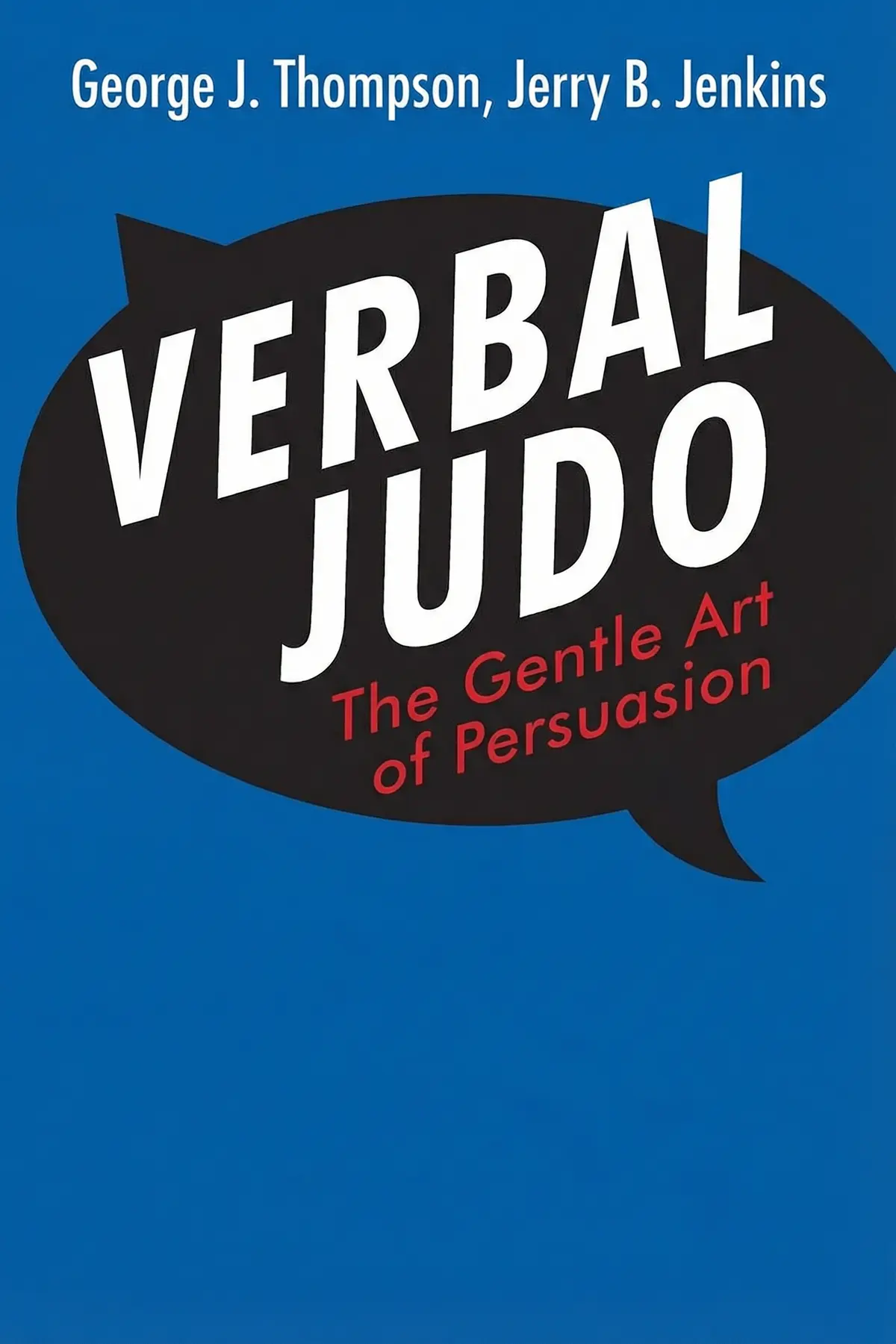
Table of Content
1. Introduction
1 min 41 sec
Communication is often compared to a bridge, but in reality, it frequently feels more like a battlefield. We have all been there: a simple misunderstanding spirals out of control, voices rise, and suddenly, the goal isn’t understanding—it is winning. Whether it is a tense moment with a supervisor, a heated disagreement with a spouse, or a frustrated exchange with a customer service representative, the result is the same: stress, resentment, and a total breakdown of cooperation. But what if there was a way to navigate these verbal minefields with the grace of a martial artist?
This is the core promise of Verbal Judo. It is not about manipulation or winning through sheer force of will. Instead, it is about learning to redirect the negative energy of others to reach a peaceful and productive resolution. By treating communication as a tactical discipline, you can learn to stay centered when others are spinning out of control. This summary will take you through the essential principles of this linguistic art, showing you how to replace defensive reactions with professional responses.
We will explore why direct orders often backfire and how a simple shift in your phrasing can completely change the outcome of an encounter. You will discover the psychological power of empathy—not as a soft emotion, but as a hard-edged tool for de-escalation. We will also dive into practical techniques like paraphrasing and mediation that allow you to take control of a conversation without appearing controlling. By the end of this journey, you will see that communication excellence is not a personality trait you are born with, but a skill you can master through study and practice. Get ready to develop your own black belt in the art of persuasion.
2. The Foundations of Tactical Communication
2 min 13 sec
Communication is far more than just exchanging information; it is a learned discipline that can be studied and refined, much like a martial art, to handle high-stakes human interactions.
3. Replacing Direct Orders with Reason and Respect
2 min 18 sec
Discover why giving blunt commands and acting with condescension are the fastest ways to shut down cooperation, and learn a more effective way to lead others toward compliance.
4. The Strategic Application of Empathy
2 min 11 sec
Empathy is often misunderstood as a soft emotion, but it is actually a powerful cognitive tool that allows you to see through another person’s eyes to find a path to resolution.
5. Harnessing the Power of the Paraphrase
1 min 55 sec
Paraphrasing is the most versatile tool in your verbal arsenal, but using it effectively requires a specific type of neutral interruption to reset the conversation.
6. Mastering Your Inner Enemies and Triggers
2 min 02 sec
To become a professional communicator, you must identify your personal weaknesses and triggers that cause you to react emotionally rather than strategically.
7. The Art of Translation and Tone
1 min 58 sec
Effective communication requires more than just clear thoughts; it requires ‘translating’ those thoughts into the specific language and tone that will resonate with your audience.
8. Using Mediation to Redirect Dangerous Momentum
1 min 49 sec
Learn how mediation can be used to lay out clear choices and consequences, helping people who have lost their perspective to find a rational path forward.
9. Transforming Domestic Conflict into Growth
2 min 03 sec
Domestic disputes are an inevitable part of close relationships, but applying tactical communication can turn these heated moments into opportunities for deeper connection.
10. Conclusion
1 min 51 sec
As we wrap up our exploration of Verbal Judo, it is clear that the ‘gentle art’ of persuasion is a powerful tool for anyone seeking to improve their personal and professional lives. We have seen that effective communication is not about dominating others, but about mastering ourselves. By moving away from direct commands and towards a model of respect and explanation, we invite others to join us in cooperation rather than resistance. We have learned that empathy is a strategic asset that allows us to navigate even the most volatile situations by seeing the world through the eyes of our interlocutors.
We have also covered the practical ‘moves’ of the art: using neutral interruptions to create space, paraphrasing to ensure clarity, and mediating to provide a logical path forward. Most importantly, we have recognized the need to identify our own internal triggers—those ‘inner enemies’ that tempt us to react emotionally rather than professionally. Whether you are dealing with a crisis on the street, a difficult negotiation at work, or a sensitive conversation at home, these principles remain the same.
To put this into action immediately, start by becoming a student of your own speech. The next time you find yourself about to use a label or a dismissive phrase, pause. Instead of falling back on authority, explain the ‘why’ behind your request. When a conversation gets heated, try the ‘Whoa!’ technique and paraphrase the other person’s frustration back to them. You will find that when you change how you speak, you change how people respond to you. Communication is a lifelong study, and with every interaction, you have the opportunity to move closer to that black belt level of mastery. Go forth and use your words as a force for peace, clarity, and connection.
About this book
What is this book about?
Have you ever walked away from a conversation wishing you had handled it differently? Verbal Judo explores the sophisticated art of tactical communication, a method originally developed for law enforcement but applicable to every facet of life. It provides a roadmap for navigating difficult dialogues, from professional disputes to intimate domestic arguments, by teaching you how to stay calm and persuasive under fire. The book promises to turn communication into a strategic skill rather than a reactive impulse. It emphasizes the power of empathy, the necessity of avoiding condescension, and the practical utility of paraphrasing. By learning to identify your own verbal triggers and understanding how to redirect the energy of an adversary, you can gain compliance and build rapport even in the most hostile environments. Ultimately, it offers a way to master the gentle art of persuasion to ensure your message is truly heard.
Book Information
About the Author
George J. Thompson
George J. Thompson was the visionary behind the Verbal Judo method and founded its dedicated institute. His unique background combined a career as an English professor and a master of karate before he transitioned into police work, where he refined his communication strategies. He passed away in 2011. Jerry B. Jenkins is a prolific best-selling author of both fiction and nonfiction, renowned for co-authoring the religious novel series Left Behind.
Ratings & Reviews
Ratings at a glance
What people think
Listeners find this guide provides useful strategies and guidance applicable across multiple professions, especially within law enforcement. The book is lauded for being highly readable; one listener mentions it is mandatory reading for their organization, and they appreciate the straightforward communication advice that helps enhance personal connections. Listeners value the high-caliber information provided, with one pointing out that the compact volume is filled with substance. They are also drawn to the verbal judo methodology, as one review emphasizes how effectively it works for de-escalating tense interactions.
Top reviews
Phimwan
Finally got around to reading this classic on communication. It’s easy to see why it’s required reading for so many organizations. Thompson’s background as both an English professor and a cop gives him an effective edge in explaining how words function in high-pressure situations. He breaks down how to use 'strip phrases' to deflect insults and keep a conversation on track. The book is definitely dated in parts—some anecdotes feel like they’re straight out of a 70s cop show—but the core principles of de-escalation are sound. I’ve already started using the 'let me be sure I heard what you said' technique with my coworkers, and it actually works to lower the temperature of a room. It's a quick read, though a bit repetitive toward the end with the constant acronyms like LEAPS and SAFER. If you deal with difficult people daily, you need this in your toolkit.
Show moreIsaiah
Dr. Thompson has a unique perspective that bridges the gap between academia and the street, and it shines in this text. I picked this up because it’s a staple in law enforcement training, and I was surprised by how applicable it is to general management. The book teaches you how to get people to do what you want without creating an enemy in the process. I loved the breakdown of dealing with 'difficult' people—it’s a helpful framework when you’re in the heat of a moment. Some might find his tone a bit callous, but I think he's just being realistic about human nature. The focus on 'voluntary compliance' is something every leader should study. It’s a quick, high-impact read that I’ll likely revisit. It definitely helped me improve my relationships at work by teaching me to respond rather than react.
Show moreDen
Ever wonder why some people can talk their way out of a confrontation while others escalate it? This book explains the art of 'voluntary compliance' in a way that is easy to understand and immediately applicable. Thompson isn't interested in your feelings; he’s interested in results. He teaches you how to stay calm when someone is screaming in your face, which is a superpower in today's world. I found the 'Ultimate Empathetic Sentence' to be a particularly powerful tool for my marriage, ironically enough. The book is short and dense, which I appreciate. No fluff, just practical strategies. Even though some of the examples are dated, the psychology behind them is timeless. It’s one of those rare books that actually changes how you speak to people the next day. Five stars for the impact it’s had on my temper.
Show moreEmma
As someone who works in the security industry, I found the tactical advice here invaluable for daily interactions. It’s not about being nice; it’s about being professional and keeping yourself safe. The book is packed with content in a small format, focusing on how to maintain emotional distance during a conflict. Thompson’s emphasis on 'looking good and sounding good' is a harsh reality in our field. Sometimes you have to fake empathy to de-escalate a situation before it turns physical. I do agree with other reviewers that the acronyms are a bit much—it starts to feel like alphabet soup after a while. However, the 'Sword of Insertion' technique for interrupting a tirade is a total game-changer. It’s a very readable guide that offers practical 'street smart' material instead of just dry theory. A solid 4 stars for real-world utility.
Show moreTeng
Picked this up on a recommendation from my supervisor, and it’s been surprisingly helpful for my customer service role. I’m not a cop, but I deal with angry people all day, and the 'strip phrases' Thompson suggests really do help de-escalate things. Using a phrase like 'I 'preciate that, but...' allows the other person to vent without you losing control of the situation. I will say, the book is a bit heavy on the acronyms—PAVPO, LEAPS, SAFER—it’s a lot to memorize. The audio book narrator has a crazy, gravelly voice and an accent that makes him sound like he’s right out of a police precinct. While I don't agree with every 'rule' he lays out, the core message of keeping your professional face on is vital. It’s a solid manual for anyone who has to provide service to difficult people.
Show morePing
The chapter on 'strip phrases' alone made this worth the purchase for me. I work in a high-stress environment where insults fly frequently, and learning to 'strip' the power from those words has saved my sanity. Thompson’s writing is definitely an acquired taste—he’s got that old-school, 'jock' energy that can be a bit much. But if you can get past the bravado, there is real gold here. He explains the difference between reacting and responding in a way that finally clicked for me. I do wish the book was better edited; it gets very repetitive and the 'guru' vibe is a little cringey. However, the techniques for paraphrasing to ensure you're actually hearing the other person are brilliant. It's a 4-star book because while the delivery is flawed, the content is life-changing for professionals dealing with the public.
Show moreRome
Look, the writing isn't exactly Pulitzer-winning material, but the core message is solid. George Thompson was a man who clearly knew how to handle himself in a conflict. I’ve read a lot of communication books, and most are too 'soft' for the real world. This one isn't. It's about how to win a verbal fight without actually fighting. I liked the section on the 'Sword of Insertion' and how to interrupt people politely. It’s definitely directed toward police officers, but as a teacher, I found plenty of takeaways for my classroom. My only gripe is that it feels a bit like a sales pitch for his seminars at times. Still, the advice on 'looking good or no good' is a reality check we all need. If you want practical tips that work on the street, this is it.
Show moreWanphen
Is this book useful? Yes, but it's also incredibly frustrating. On one hand, the concept of 'Verbal Judo'—using an opponent's energy against them—is a brilliant metaphor for communication. On the other hand, the writing style is unnecessarily verbose and the structure is a mess. Thompson repeats himself constantly, and the 'gurules' are hard to keep track of. I appreciated the sections on paraphrasing and the fourteen benefits he lists, but did we really need a hundred pages of 'why this matters' before getting to the 'how to do it' part? To be fair, there are some gems hidden in the fluff. The advice to treat everyone with respect but talk to them differently is a perspective shift I needed. It's a 3-star read for me because I had to dig through too much bravado to find the actual skills.
Show moreYuki
Not what I expected based on the title. I was hoping for deep psychological insights, but instead, I got a lot of macho bravado and a guru-like presentation that rubbed me the wrong way. The author describes himself as a jock with a chip on his shoulder, which makes it hard to take his advice on 'gentle' communication seriously. He spends way too much time boasting about his PhD and his street smarts rather than just giving us the tools. While the idea of 'voluntary compliance' is interesting, the methods often feel like you're just pretending to care to get what you want. Personally, I found the stories about people in crisis more disturbing than helpful. The way he categorized people into 'Nice, Difficult, or Wimps' was far too simplistic for the complexities of real human behavior. If you’re looking for genuine connection, read Nonviolent Communication instead.
Show moreWilliam
Truth is, I felt like I was being taught how to manipulate people rather than actually empathize with them. The author admits that whether you're actually interested in the other person is 'irrelevant' as long as they believe you are. That’s a pretty cynical way to view human interaction. Coming from a background in behavioral health, I found his approach to crisis intervention borderline dangerous. The story about the man in the bathtub was horrifying; his lack of genuine compassion for someone in a mental health emergency was hard to read. There are some okay tips on active listening, but they are buried under layers of toxic masculinity and chest-beating stories. Frankly, I think the popularity of 'Verbal Judo' is just because the name sounds cool. If you want real communication skills that build trust, look elsewhere. This felt like a time capsule of bad 90s attitudes.
Show moreFeatured in
Readers also enjoyed
AUDIO SUMMARY AVAILABLE
Listen to Verbal Judo in 15 minutes
Get the key ideas from Verbal Judo by George J. Thompson, plus 5,000+ more titles in English and Thai.
- 5,000+ titles
- Listen as much as you want
- 7-day free trial
- Cancel anytime







