Behave: The Biology of Humans at Our Best and Worst
Robert M. Sapolsky
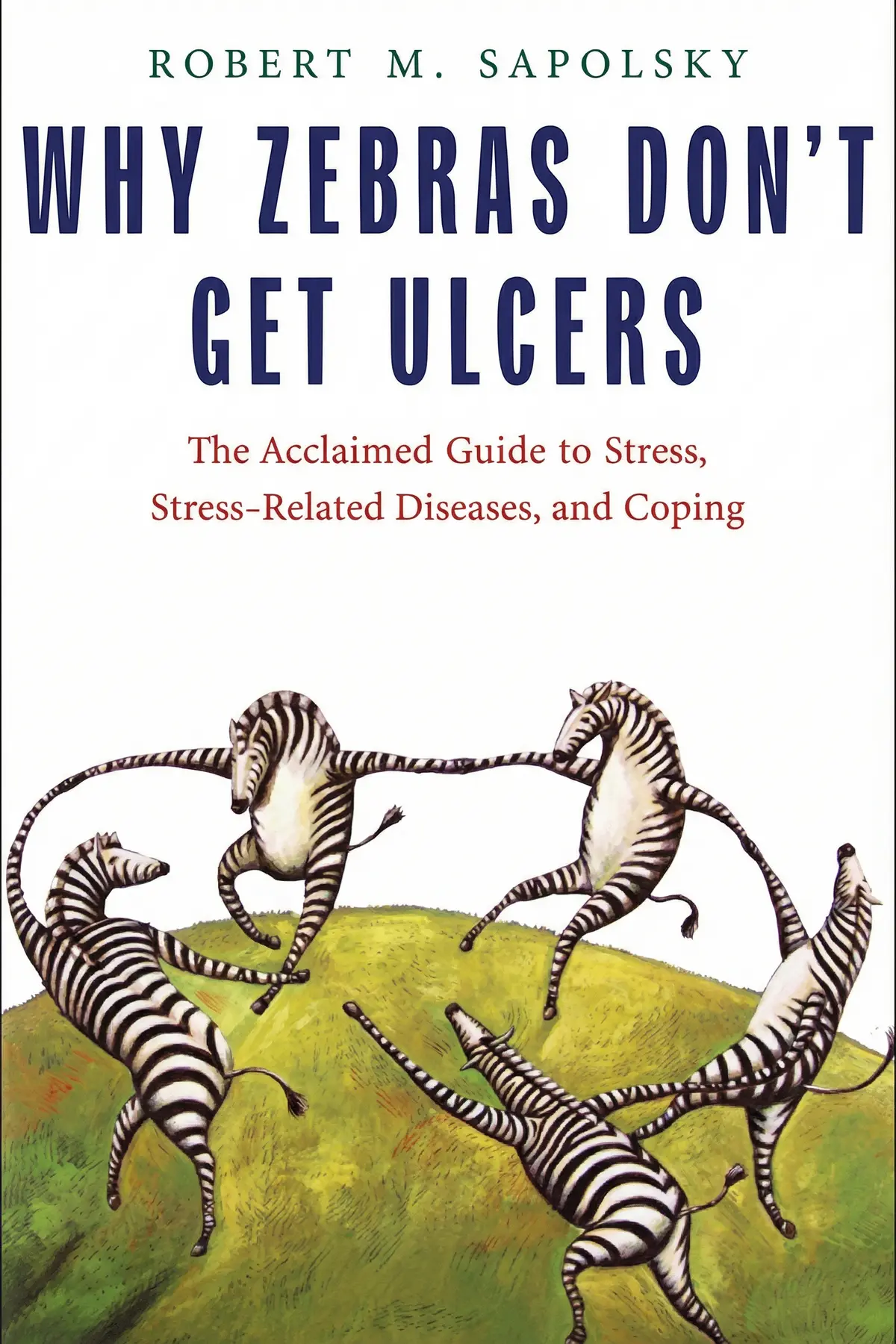
Why Zebras Don't Get Ulcers explores the biological mechanics of stress, explaining how the systems meant to save us from physical danger often become the very things that make us chronically ill.
1 min 23 sec
Picture a zebra on the African savannah. Suddenly, a lion leaps from the tall grass. In that instant, the zebra’s body undergoes a radical transformation. Its heart races, its muscles flood with energy, and every non-essential biological function—like digestion or growth—grinds to a halt. This is an acute physical crisis. If the zebra survives, its body returns to a state of calm within minutes. It doesn’t spend the rest of the afternoon worrying about whether the lion might return tomorrow or if its stripes are fashionable enough for the herd.
Now, consider the modern human. We experience that same physiological surge, but we feel it while stuck in a traffic jam, staring at a mounting stack of bills, or replaying an argument with a coworker. For us, the stress response isn’t just a survival mechanism; it has become a constant background hum. This mismatch between our ancient biological hardware and our modern psychological lives is exactly what we are going to explore today. We’ll look at why our bodies are so good at surviving the short term, yet so poorly equipped to handle the long-term mental pressures of the twenty-first century. By understanding the mechanics of how stress affects our hearts, our brains, and even our social standing, we can begin to see the path toward a more balanced and resilient way of living.
1 min 57 sec
Discover why our survival mechanisms, perfectly tuned for physical emergencies, are actually harming us in a world of deadlines and digital pressures.
2 min 11 sec
Learn how the autonomic nervous system acts as the body’s control center, shifting between action and rest to manage the demands of life.
2 min 04 sec
See how the body makes a ‘biological bargain’ during stress, sacrificing long-term health projects to deal with immediate demands.
2 min 01 sec
Explore the hidden damage that high blood pressure and rapid flow cause to your heart and arteries over years of chronic tension.
2 min 00 sec
Understand how the constant movement of energy in and out of storage during stress can lead to metabolic exhaustion and disease.
2 min 06 sec
Delve into the neurological link between prolonged pressure and the loss of pleasure, illustrating how stress can rewire the brain.
2 min 03 sec
Explore why the body’s ’emergency mode’ is fundamentally at odds with reproductive health and sexual function.
2 min 04 sec
Move beyond the simple idea of balance to discover how the body manages complex, high-stakes adjustments to survive chronic pressure.
2 min 09 sec
Find out why the way we perceive our challenges and the strength of our social circles are our most powerful weapons against stress.
1 min 56 sec
Investigate how our position in society and the level of inequality around us shape our health more than we might realize.
1 min 36 sec
We have traveled a long way from the zebra on the savannah to the complex social structures of the modern world. The central lesson is clear: our stress response is a magnificent tool for surviving a crisis, but a terrible way to live a life. When we allow psychological worries to run our biological engines at full speed, we pay a price in our hearts, our metabolism, and our minds. We trade our long-term health for a short-term sense of emergency that rarely leads to actual survival.
However, the takeaway shouldn’t be one of despair. By understanding these mechanisms, we gain the power to intervene. We can’t always change the stressors in our lives, but we can change how we respond to them. The key is to find your own ‘brake’—whether that’s through physical activity, meaningful social connections, or a shift in how you perceive your challenges. There is no single solution that works for everyone, but there is a universal need to find balance.
As you move forward, try to look for the things you can control and let go of the things you can’t. Seek out community and offer support as much as you receive it. Recognize that your body is a system that requires maintenance, not just fuel for emergencies. By making small, conscious choices to disengage the ‘gas pedal’ and give your ‘brakes’ a chance to work, you can help ensure that you don’t just survive the day, but thrive for years to come. Remember, you might not be a zebra, but you can still learn to live without the ulcers.
Have you ever wondered why animals in the wild don’t seem to suffer from the same stress-related illnesses that plague modern humans? This exploration delves into the biological heart of the human stress response, illustrating the profound difference between a zebra fleeing a predator and a human worrying about a mortgage payment. While the zebra’s stress is intense and brief, the human’s stress is often sustained and purely psychological, leading to devastating long-term consequences for our bodies. Through a detailed look at the autonomic nervous system, cardiovascular health, and even our reproductive systems, the book clarifies exactly how chronic worry disrupts our natural balance. It explains the transition from simple homeostasis to the complex concept of allostasis—where the body makes constant, taxing adjustments to keep up with the demands we place on it. By the end, readers understand not only the damage caused by chronic stress but also the social and psychological factors that can help mitigate its effects, offering a path toward better health through control, social support, and perspective.
Robert Sapolsky is a highly distinguished professor of biology and neurology at Stanford University. A leading figure in stress research, he is widely known for his ability to translate complex scientific concepts into engaging narratives. Sapolsky has contributed regularly to publications like Discover and The Sciences and is a recipient of the prestigious MacArthur Foundation Genius Grant. He is also the author of acclaimed works such as A Primate’s Memoir and The Trouble With Testosterone.
Robert M. Sapolsky
Robert M. Sapolsky
Listeners find this work to be an accessible and amusing read, with one review highlighting how intricate scientific concepts are rendered both relatable and easy to grasp. Additionally, they appreciate the explanations regarding the consequences of long-term stress and the biology underlying stress eating, all delivered with a witty and charming narrative voice. The writing style is transparent and approachable, and listeners value the informative nature of the book, with one listener pointing out its particular relevance for those working in the helping professions. However, the level of detail receives varied reactions, as some praise the elegant descriptions of biophysiological functions while others consider the material too technical.
Sapolsky has this incredible ability to take terrifying physiological concepts and make them genuinely funny. I was fascinated by the deep dive into how our bodies haven't quite caught up to the 21st century's psychological demands. While the first fifteen chapters focus heavily on the 'how' and 'why' of our bodies breaking down under pressure, his dry wit keeps the material from feeling like a funeral dirge. It’s enlightening to understand the actual chemistry behind why we feel like we’re dying when we're just stuck in traffic. To be fair, if you’re looking for a quick '10 steps to zen' guide, this isn't it. This is a rigorous exploration of biology, glucocorticoids, and the metabolic cost of chronic anxiety. It made me realize that my stress isn't just 'in my head'—it's a systemic physical event. I’m walking away with a much deeper respect for my own nervous system and a desire to read more of his work.
Show moreEver wonder why you're reaching for the cookies after a bad day at the office? This book provides the most satisfying explanation of the biology behind stress eating I’ve ever come across. Sapolsky walks the reader through the ancient evolutionary mechanisms that make us crave high-calorie fuel when we’re under 'attack,' even if that attack is just a passive-aggressive email from a boss. The way he compares our modern psychosocial stressors to a zebra running from a lion is both hilarious and deeply illuminating. It’s rare to find a science book that is this entertaining while remaining so academically rigorous. I found the 3rd edition updates to be quite helpful, especially regarding newer research on the brain’s plasticity. It’s a witty, engaging, and ultimately humbling look at what it means to be a primate in the modern world. Every page felt relevant to my daily life.
Show moreWow, the depth here is staggering. I went into this expecting a self-help book and came out with a mini-degree in neurobiology. Sapolsky’s exploration of the 'stress response' is comprehensive, covering how it affects everything from your growth to your reproductive system. What really set this apart for me was the socioeconomic context; he doesn't just look at stress in a vacuum but explores how poverty and inequality create a physiological trap. The writing is incredibly sharp and often self-deprecating, which balances out the more alarming facts about what chronic stress does to our arteries. It’s fascinating to see how our ability to think about the future—a gift of our advanced evolution—is also the very thing that keeps us in a state of constant, low-level panic. This is mandatory reading for anyone who wants to understand the physical reality of their mental state. It’s brilliant, hilarious, and deeply necessary.
Show moreIn my experience, science writing usually leans either too far into dry academic jargon or too far into fluffy pop-psychology. Sapolsky hits the sweet spot perfectly. He explains the implications of chronic stress with a level of clarity that is rare in the field. I loved the chapters on the 'economics of stress' and how our social hierarchies mirror those of other primates. It's a bit of a wake-up call to realize that our bodies are essentially running a marathon every time we worry about a mortgage payment. The book is definitely technical, and there were moments where the sheer amount of hormonal pathways discussed made my head swim, but the author’s voice always pulls you back in. He’s like that one professor everyone loved in college—the one who could make a lecture on insulin feel like a stand-up routine. It's truly accessible and relevant.
Show moreFinally got around to reading this classic, and it absolutely lives up to the hype. The central premise—that we have evolved a stress response for acute physical crises but use it for chronic psychological ones—is explained with such elegance and humor. I was particularly gripped by the discussion on how stress impacts memory and the actual physical survival of neurons. Sapolsky doesn't shy away from the limitations of our current knowledge, which I find refreshing. He admits where the science is still fuzzy. The examples are atavistic and vivid, helping to ground the biophysiological workings in something we can actually visualize. It’s a masterful piece of science communication that bridges the gap between the lab and the living room. Even if the 'solutions' chapter is brief, understanding the mechanism of the problem is the first step toward fixing it. I’ll be thinking about these concepts for a long time.
Show moreAs someone who works in the helping profession, I found this to be an essential, if slightly overwhelming, piece of literature. The book brilliantly deconstructs the biophysiological workings of the human body under duress, specifically focusing on how chronic activation of the stress response leads to long-term damage. Sapolsky’s writing is clear and personable, which helps when you’re wading through complex discussions about neurons and insulin resistance. I particularly appreciated the sections on how socioeconomic status influences health; it adds a necessary political layer to what could have been a purely clinical book. My only gripe is that it can feel a bit repetitive towards the middle, as he hammers home the same point about chronic stress across different organ systems. Still, the insights regarding pain management and addiction were incredibly valuable. It’s a dense read, but one that rewards your patience with a much clearer understanding of the mind-body connection.
Show morePicked this up during a particularly hectic month, which was probably a mistake in retrospect! There is something deeply ironic about reading 400 pages of detailed evidence on how cortisol is slowly destroying your hippocampus while you're already feeling frayed. That said, Sapolsky is a master of 'science-translation.' He moves from the molecular level to the societal level with such ease that you almost forget you’re reading a textbook-adjacent work. I was especially struck by the discussion on how our 'smart' brains allow us to be miserable to each other in ways other animals can't even imagine. It’s a bit technical at times—expect to learn more about the pituitary gland than you ever intended—but it’s never boring. Not gonna lie, I skipped a few of the more data-heavy charts, but the core message stuck. We are essentially making ourselves sick because we can't turn off our brains.
Show moreAfter hearing Sapolsky on a podcast, I knew I had to check out his writing, and 'Why Zebras Don't Get Ulcers' didn't disappoint. It’s a fantastic example of how to make complex scientific ideas accessible without dumbing them down. He addresses everything from the role of stress in clinical depression to the physiological nature of pain. I found the section on anti-depressants particularly eye-opening; it changed how I think about mental health medication entirely. While the book relies on those classic 'ancestors vs. lions' examples, they serve as a great anchor for the more technical parts. Look, it’s not a light read—you have to pay attention—but his personable style makes the 'hard science' go down easy. It’s educational in the best way possible. I’d recommend the third edition specifically, as the newer research on the immune system is really vital to the overall argument.
Show moreThe chapter on cardiovascular health was fascinating, but I have to say, the sheer volume of 'bad news' in this book started to wear me down. It’s a bit of a paradox: reading about how stress causes ulcers, memory loss, and heart disease actually made me feel more stressed out. Sapolsky is a brilliant communicator, no doubt, and his sense of humor is top-notch, but the ratio of 'here is how you are dying' to 'here is what to do about it' is quite lopsided. Truth is, by the time I got to the final chapter on management techniques, I felt too defeated by the science to apply them. It’s very technical, and while he explains things well, it often felt like I was back in a high-stakes biology lecture. If you love data and evolutionary history, you’ll adore this. If you’re looking for actual relief, you might just end up with more questions than answers.
Show moreFrankly, this felt like being beaten to death with a stack of medical journals for twenty-two chapters. I understand that Robert Sapolsky is a legend in the field, and his wit is certainly present, but the structure of this book is maddening for a casual reader. He spends hundreds of pages cataloging every single way that stress can ruin your life—from infertility to diabetes—only to offer a handful of generic 'coping' suggestions at the very end. The 'don't be born poor' and 'have good friends' advice felt almost insulting after such a heavy scientific buildup. It’s clearly well-researched, but the balance is way off. If you’re a biology student, you’ll probably find the technical details about glucocorticoids and neurons fascinating. For me, it was just a long, depressing slog through the various ways my body is failing because I have to pay rent. I wanted a way out, but I mostly just got a diagnosis of the human condition.
Show more
J. Craig Venter
Carl Zimmer
Bill Bryson
Jeff Hawkins

Lisa Kaltenegger
AUDIO SUMMARY AVAILABLE
Get the key ideas from Why Zebras Don’t Get Ulcers by Robert M. Sapolsky, plus 5,000+ more titles in English and Thai.