Behave: The Biology of Humans at Our Best and Worst
Robert M. Sapolsky
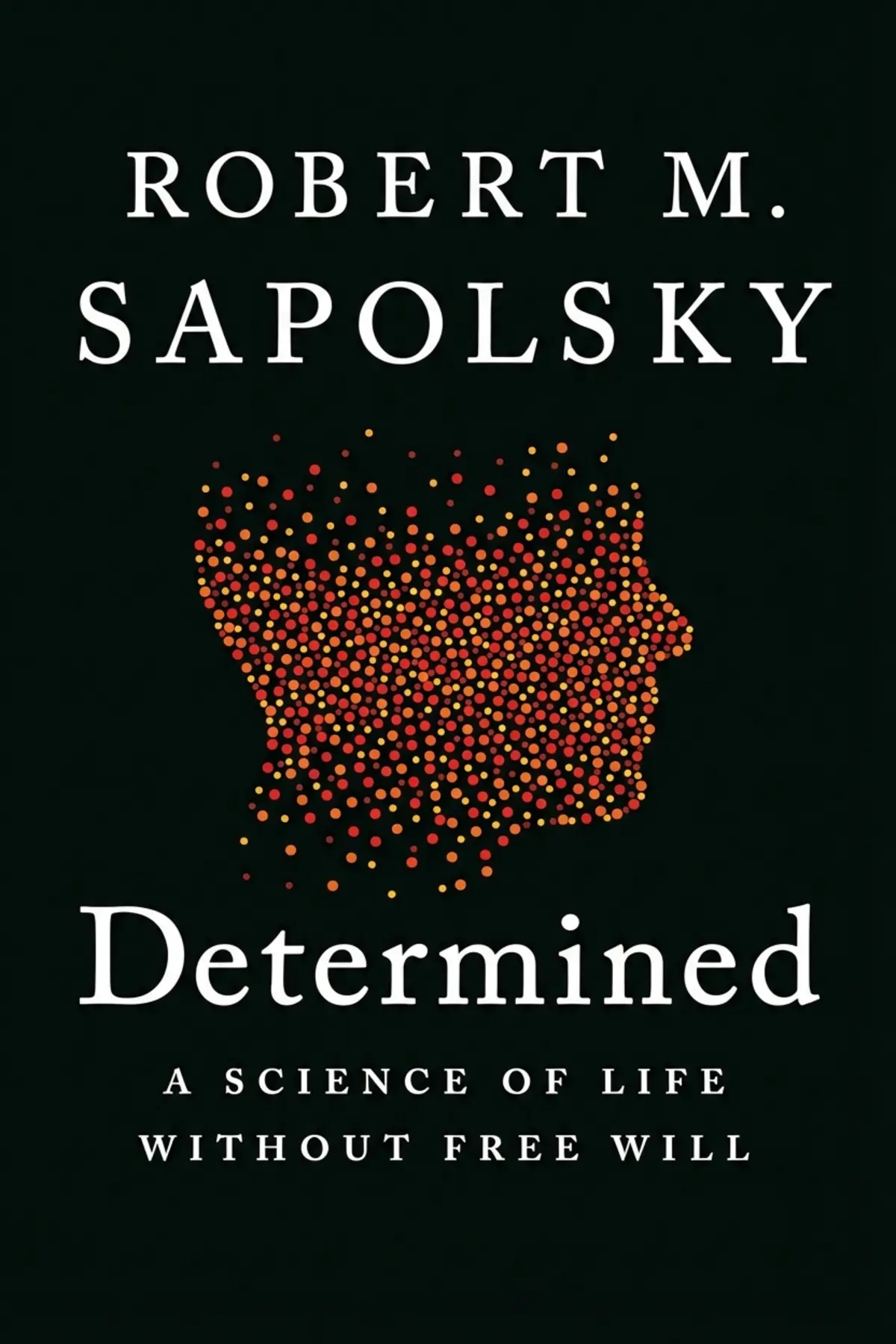
Determined challenges the existence of free will, arguing that our actions are the inevitable result of biological and environmental forces. Robert M. Sapolsky explores how genetics, culture, and neurology shape every human decision.
1 min 51 sec
Imagine for a moment the last major decision you made. Perhaps it was choosing a career path, ending a relationship, or even just deciding what to have for dinner. In that moment of choice, you likely felt a sense of agency—a feeling that ‘you’ were the one in the driver’s seat, weighing options and pulling the levers of your own destiny. But what if that feeling of control was nothing more than a trick of the light? What if the path you took was already paved by forces you didn’t choose and cannot see?
This is the radical and deeply challenging territory explored in Robert M. Sapolsky’s Determined: Life without Free Will. Sapolsky, a leading voice in neurobiology, invites us to look under the hood of human behavior. He suggests that what we call ‘choice’ is actually the final output of a massive, invisible machine built from our genes, our childhood experiences, our cultural heritage, and even the evolutionary history of our species.
In this summary, we are going to walk through a worldview that strips away the ego’s claim to autonomy. We’ll explore why the brain acts before the mind ‘decides,’ how a lifetime of conditioning prepares us for a single second of action, and why accepting a world without free will might actually make us a more just and empathetic society. It’s a journey that asks us to rethink everything from how we punish criminals to how we praise our own successes. By the end, you may find that the ‘self’ you’ve always known is far more connected to the biological machinery of the universe than you ever imagined. Let’s dive into the evidence for why we are, quite literally, determined.
3 min 06 sec
Discover why our actions are like a stack of turtles stretching into infinity, where every biological event is triggered by a preceding one.
2 min 49 sec
Explore the startling scientific evidence that your brain makes decisions before you are even aware of them, leaving you to simply play catch-up.
2 min 58 sec
Understand how your split-second reactions are actually the result of years of environmental sculpting and genetic predispositions.
2 min 54 sec
Imagine a society that replaces punishment with a more humane, biological understanding of behavior, much like we did with epilepsy.
1 min 59 sec
The idea that we are not the authors of our own lives can be frightening. It challenges our pride, our sense of achievement, and our desire for justice. However, as Robert M. Sapolsky has shown us in Determined, the evidence for a purely deterministic world is overwhelming. From the ‘turtles all the way down’ chain of causality to the neurological delay of our conscious intent, the ‘self’ appears less like a commander and more like a passenger.
Yet, this realization doesn’t have to be bleak. In fact, it can be liberating. If you accept that your failures are the result of biological and environmental factors you didn’t control, you can let go of crushing shame. Similarly, if you accept that your successes are a product of your ‘biological luck’—your genes, your supportive upbringing, your healthy brain—you can replace arrogance with a profound sense of gratitude and humility.
More importantly, this perspective provides a blueprint for a more humane future. By moving away from a ‘punishment’ mindset and toward a ‘treatment and prevention’ mindset, we can address the root causes of societal problems rather than just reacting to their symptoms. Just as we stopped burning people for having seizures, we can stop the cycle of retribution and focus on creating environments that bring out the best in the biological machines we call humans.
Ultimately, Sapolsky’s message is one of radical empathy. If we are all just the sum of our parts and our pasts, then the only logical response to the behavior of others is understanding. We may not have the free will to change the past, but by understanding the mechanics of our behavior, we can work together to build a more supportive and compassionate future for everyone. It is a call to look at ourselves and others not with judgment, but with the curious, kind eyes of a scientist who knows just how complex the machinery of life truly is.
Have you ever wondered if you are truly the master of your fate, or if your life is a series of pre-written events? In Determined, neurobiologist Robert M. Sapolsky presents a provocative argument that free will is a persistent illusion. By synthesizing insights from neurobiology, genetics, and sociology, he demonstrates that every action we take—from the trivial to the life-altering—is the byproduct of a chain of causality that stretches back long before we were born. This book promises to reshape your understanding of human behavior by dismantling the concept of individual agency. Sapolsky doesn't just argue that our choices are influenced by our environment; he asserts they are entirely dictated by it. Through this lens, he invites readers to reconsider the foundations of our legal systems, our moral judgments, and how we view success and failure, ultimately proposing a more compassionate, science-based approach to the human experience.
Robert M. Sapolsky is a distinguished professor of biology and neurology at Stanford University. Beyond his academic work in the United States, he serves as a research associate with the Institute of Primate Research at the National Museum of Kenya. Sapolsky is a prolific writer known for making complex biological concepts accessible, with acclaimed titles such as Why Zebras Don’t Get Ulcers and Behave.
Listeners find this book both amusing and thoroughly researched, with one listener highlighting the inclusion of detailed notes on various research papers. Additionally, the content is intellectually stimulating with deep philosophical consequences, and listeners value the author’s humor and writing style. Nevertheless, opinions on the tempo are varied; some consider it absorbing while others call it incoherent. The level of difficulty also draws mixed feedback, as one listener feels it is not overly simplistic whereas another views it as unnecessarily complicated.
Robert Sapolsky has a way of making the most complex neuroscience feel like a conversation over coffee. His humor is sharp, often self-deprecating, and helps bridge the gap when the discussion on neurons and prefrontal cortex function gets heavy. I was particularly impressed by the sheer volume of research cited—the footnotes are almost a book in themselves! While the idea that we have zero free will is terrifying to some, Sapolsky frames it as a call for a more humane society. He argues that if we aren't "responsible" for our failures, we also don't "deserve" our accolades in the way we think. It’s a radical shift in perspective. Even if you don't buy into his hard determinism, the insights into how our environment and biology interact are invaluable. The pacing felt right for such a dense topic, though I had to reread a few sections on quantum mechanics.
Show moreFinally got around to reading this, and it’s easily one of the most challenging books I’ve tackled this year. Sapolsky doesn't just suggest we have less control than we think; he systematically dismantles the very idea of "grit" and "intent." The truth is, I found it incredibly liberating. If we are just the sum of our biology and environment, then we can stop being so judgmental of ourselves and others. The author’s wit keeps the tone from becoming too bleak, which is a feat given he's basically telling us we're biological puppets. I loved the detailed notes and the way he challenges the "free will" advocates in both the scientific and philosophical communities. It's a thick, complicated read that requires your full attention. If you’re looking for a light summary, this isn't it. This is a deep dive into what makes us tick.
Show moreWow. This book completely reframed how I look at my own successes and failures. Sapolsky is brilliant, and his ability to weave together endocrinology, history, and sociology is unmatched. I’ve read a lot of pop science, but this feels more substantial, like a definitive statement on the human condition. Some people find the lack of free will depressing, but I found his argument for empathy much more compelling. We are all just products of a "complex biochemical recipe," as one of his examples suggests. The writing style is engaging and surprisingly funny for such a heavy subject. It’s definitely dense—don't expect to fly through it—but every page feels like it’s building toward a more compassionate world. Truly a masterpiece of scientific writing.
Show moreAfter hearing Sapolsky on a podcast, I knew I had to dive into the full text. It did not disappoint. The way he connects his work with baboons to the modern human experience is fascinating. He shows us that our behavior isn't just "us" making choices in a vacuum—it's layers of hormones, childhood stress, and cultural heritage. The truth is, it’s a lot to process. He doesn’t shy away from the technical details, but his "puckish" tone keeps things moving. I particularly liked the discussion on how our legal system is basically still in the dark ages when it comes to understanding the brain. This is essential reading for anyone interested in why we do what we do. It’s a long book, but it’s packed with insights that will stick with you for years.
Show moreWhat if everything you did today wasn't actually your choice? This book dives deep into that unsettling question with the kind of intellectual rigor only Sapolsky can provide. To be fair, the technical sections on chaos theory and the "neurons that fire on their own" are quite a slog. I found myself skimming a few pages when the physics got too abstract. However, the second half of the book is where it truly shines. His analysis of the criminal justice system is revolutionary. Comparing our current treatment of criminals to the 15th-century treatment of epileptics was a massive eye-opener for me. It makes you realize how much our morality is tied to our ignorance of the brain. It’s a bit incoherent in its structure at times, jumping from baboons to legal theory, but the core message is impossible to ignore.
Show moreThe chapter on chaos theory alone is worth the price of admission, even if the conclusions are hard to swallow. Sapolsky is a master at taking these high-level concepts and making them somewhat digestible for the average reader. Not gonna lie, some of the middle chapters felt like they could have been trimmed by forty pages. He tends to hammer home his points with example after example, which can get a bit mind-numbing if you already understand the gist. But the humor is top-notch. I actually laughed out loud at his descriptions of academic rivalries. My main takeaway was his vision for a "quarantine" model of justice instead of a retributive one. It's a compassionate, albeit radical, way to look at human behavior. It’s a thought-provoking journey, even if you end up disagreeing with his final destination.
Show moreLook, you might not agree with Sapolsky’s central premise that free will is a total myth, but you can’t deny the rigor of his research. He leaves no stone unturned, from the immediate triggers of a neuron firing to the evolutionary pressures from millions of years ago. Personally, I think he ignores some of the nuance in the philosophical debate about "compatibilism," but his scientific data is hard to argue with. The book is unnecessarily complicated in parts, and the pacing drags in the middle when he’s debunking quantum randomness. However, the implications for how we view meritocracy are profound. If you didn't "earn" your high IQ or your discipline, how can you claim you deserve more than anyone else? It’s an uncomfortable read, but that’s exactly why it’s important.
Show moreThis isn't just a book about biology; it's a manifesto for a more compassionate legal system. Sapolsky argues convincingly that we should stop punishing people for things they literally cannot control. I appreciated how he broke down the difference between "intent" and "culpability" using the example of epilepsy. It’s a powerful analogy that makes the science feel relevant to real-world problems. To be fair, the book is quite technical and might be a bit much if you don't have a background in science or psychology. There were moments where the sheer volume of data felt overwhelming. But if you stick with it, the rewards are great. It forces you to question the very foundations of how we judge each other. A deeply researched and ultimately hopeful look at a difficult topic.
Show moreAs someone who loved Behave, I found this follow-up to be a bit of a mixed bag. Frankly, the argument feels like a bit of a straw man. Sapolsky defines free will so narrowly—as something that must happen completely outside of physical laws—that of course he "proves" it doesn't exist. Most people don't think free will is magic; they think it's about having a choice between two outcomes. The writing is still witty and the research is top-tier, but the pacing is all over the place. One minute you’re laughing at a joke about tenure, and the next you’re drowning in a hundred pages of dense biology that feel repetitive. It’s an interesting intellectual exercise, but I’m not sure it successfully bridges the gap between scientific facts and moral philosophy. It's a long walk for a conclusion that feels a bit forced.
Show moreIs it possible for a book to be both brilliant and incredibly frustrating at the same time? Sapolsky is a genius, but this book is a bit of a mess. He spends so much time arguing against a supernatural version of free will that he misses the point of why most people find the concept useful in the first place. The transition from "science" to "morality" felt clunky and lacked a solid philosophical foundation. One moment he's a hard-nosed naturalist, and the next he's making these casual moral proclamations that don't seem to follow his own rules. That said, his writing is always entertaining, and I appreciate his willingness to tackle such a massive topic. It’s just a shame that the central argument feels like it’s built on a bit of an identity crisis. Good for the science, shaky on the logic.
Show more
Lisa Kaltenegger
William B. Irvine
J. Craig Venter
AUDIO SUMMARY AVAILABLE
Get the key ideas from Determined by Robert M. Sapolsky, plus 5,000+ more titles in English and Thai.