

16 min 46 sec
Woke, Inc.: Inside Corporate America's Social Justice Scam
Vivek Ramaswamy exposes how corporations use social justice causes to gain power and silence dissent. This summary reveals the hidden mechanics of woke capitalism and its impact on modern American democracy.
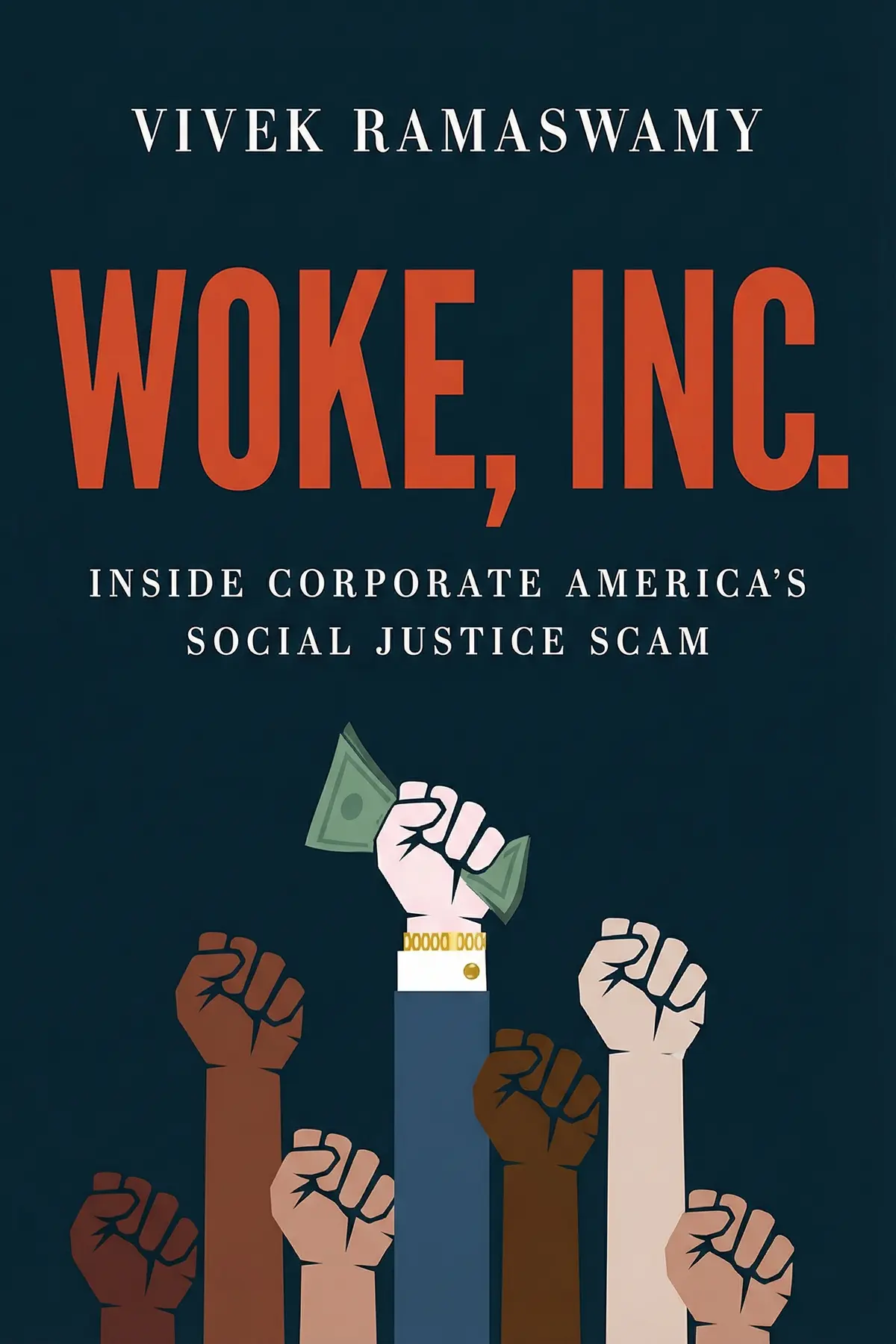
Table of Content
1. Introduction
1 min 32 sec
Consider the world of professional stage magic. A great magician is a master of directing your attention. They use bright lights, swirling smoke, and charismatic assistants to draw your eyes exactly where they want them to go. While you are mesmerized by the flourish of a cape, the real action is happening in the shadows—the secret trapdoor, the hidden card, the subtle mechanical switch. Vivek Ramaswamy suggests that modern corporate America is currently performing the greatest disappearing act in history, and they are using social justice as their primary distraction.
At their most basic level, corporations are designed to hunt for profit and accumulate power. This isn’t necessarily a secret, but in a world that is increasingly skeptical of big business, it is a reality that companies want to soften. To do this, they have adopted a new costume: a set of progressive social values often referred to as wokeness. By loudly championing causes like racial equity, gender diversity, and environmental sustainability, these massive organizations win over the hearts and minds of consumers. But behind this virtuous veneer, a more cynical exchange is taking place. This summary pulls back the curtain on what Ramaswamy calls the woke industrial complex. We will explore how these moral declarations serve as a convenient cover for corporate scandals, how they distort the very foundation of American democracy, and why this merger of corporate and political power is far more dangerous than it looks on the surface. By the end of this journey, you will see how these maneuvers allow businesses to grab power behind the scenes while appearing to be the heroes of the modern age.
2. Wokeness as a Corporate Smokescreen
2 min 16 sec
Discover how major firms use social activism to divert public attention from their own ethical failures and legal scandals.
3. The Dangers of Stakeholder Capitalism
1 min 58 sec
Explore why the shift from serving shareholders to serving stakeholders is a threat to the democratic process and civic debate.
4. Addressing Corporate Conflicts of Interest
1 min 52 sec
Learn how the legal rules protecting executives could be reformed to stop them from using company resources for personal political agendas.
5. The Religious Nature of Modern Wokeness
2 min 02 sec
Examine the parallels between woke ideology and traditional religion, and what this means for employment law and discrimination.
6. Corporate Collusion with Authoritarian Regimes
2 min 00 sec
Uncover the hypocrisy of companies that preach social justice at home while enabling human rights abuses and censorship abroad.
7. Big Tech and the Erosion of Free Speech
1 min 45 sec
Examine how legal loopholes allow social media giants to censor information and influence major political events.
8. Restoring Meaning Through Civic Service
1 min 56 sec
Discover why a lack of real purpose has fueled the rise of identity politics and how national service could rebuild American unity.
9. Conclusion
1 min 25 sec
In this exploration of Woke, Inc., we’ve seen how the intersection of corporate power and social activism is fundamentally reshaping our world. The central lesson is that the rise of stakeholder capitalism has given corporations a dangerous level of influence over our moral and political lives. By wrapping themselves in the language of social justice, these organizations are able to distract us from their own failings, silence their critics, and even collaborate with authoritarian regimes, all while appearing to be on the right side of history. This merger of state-like power and corporate profit motives is a direct threat to the democratic principle that citizens—not CEOs—should determine the values of their society.
However, the path forward is clear. We can demand better by holding companies accountable for their conflicts of interest and by using legal frameworks to protect the rights of workers who don’t want to be forced into a secular religion. Most importantly, we can look for ways to rebuild our own sense of civic identity. When we find meaning in true service and in our shared identity as citizens, we become less susceptible to the empty moralizing of the corporate world. The challenge is to stop letting corporations tell us who we are and start deciding for ourselves what kind of country we want to build. True progress won’t come from a boardroom or a marketing campaign; it comes from the courage to think for ourselves and the commitment to a shared democratic future.
About this book
What is this book about?
Woke, Inc. explores the intersection of corporate power and social activism. Vivek Ramaswamy argues that the rise of stakeholder capitalism has transformed businesses into moral arbiters, often using progressive rhetoric to mask profit-driven motives and scandals. The book examines how this shift undermines democratic processes, allows for political censorship by Big Tech, and facilitates complex relationships with authoritarian regimes like the Chinese Communist Party. Through a mix of legal analysis and personal observation, the author challenges the idea that corporations should lead the way on social justice. He proposes that wokeness has become a secular religion that threatens individual liberties and distracts from a deeper crisis of meaning in American life. The book offers a provocative vision for restoring a sense of shared civic identity and holding corporate leaders accountable for using their positions to influence the political landscape.
Book Information
About the Author
Vivek Ramaswamy
Vivek Ramaswamy is an entrepreneur and political pundit with degrees in molecular biology and law. He is the founder of the biotech company Roivant Sciences and appeared on the cover of Forbes in 2015 for his work on drug development. Ramaswamy serves on the board of directors of the Philanthropy Roundtable and the Foundation for Research on Equal Opportunity. In 2021, he stepped down as Roivant’s CEO in order to focus on political analysis and commentary.
Ratings & Reviews
Ratings at a glance
What people think
Listeners find the writing accessible and articulate, noting that the author provides lucid and compelling explanations from start to finish. The work is filled with engaging case studies and deep reflections, especially regarding the idea of diversity of thought. Listeners also value how the book addresses impacts on social media and the business world, with one listener highlighting how it reveals WOKE culture's infiltration across American society.
Top reviews
Javier
This book provides a masterclass in understanding the modern 'social justice scam' that has effectively hijacked the American boardroom. Vivek Ramaswamy utilizes his background as a former biotech CEO to peel back the curtain on how corporations use virtue signaling to distract from their own bottom-line motives. It’s a cogent and punchy read that challenges the shift from shareholder capitalism to this new, murky stakeholder model. Frankly, his analysis of how companies like Disney and Apple ignore human rights issues abroad while lecturing Americans on social equity is spot-on. He argues that corporations have become the unwanted stewards of our culture, and I couldn't agree more. The writing is incredibly clear and accessible, even when he dives into complex economic theories. It really makes you think about the true cost of corporate 'wokeness' and how it erodes the diversity of thought necessary for a functioning democracy.
Show moreMaya
Wow, talk about a wake-up call for anyone who thinks corporate activism is actually about helping people. Ramaswamy hits the nail on the head regarding the hypocrisy of the managerial class. He explains how elite executives work hand-in-hand with the state to enforce a specific social agenda, often at the expense of the actual shareholders. The book is packed with interesting examples, from the NBA’s relationship with China to the ways diversity metrics are used to silence dissent. Personally, I found his take on the 'secular religion' of wokeness to be one of the most compelling parts of the text. It’s well-written and flows naturally, making it easy to finish in a weekend. This isn’t just a political tirade; it’s a reasoned call for corporations to return to their primary purpose: making products and generating profits without trying to play God with our social values.
Show morePensuda
As someone who has worked in corporate HR for over a decade, I found this book incredibly validating. We have seen a massive shift away from 'E Pluribus Unum' toward a system that demands we categorize everyone by their innate characteristics. Ramaswamy’s focus on 'diversity of thought' is a breath of fresh air. He correctly identifies that when institutions conflate skin color with viewpoint, they are actually engaging in a new form of prejudice. The book is packed with sharp insights and real-world examples of how cancel culture is used to enforce a monolithic cultural force. It’s a brave move for a former CEO to speak out like this, and his insider perspective adds a layer of authenticity that other political commentators lack. This is a crucial read for anyone worried about the future of free discourse in the American workplace. It’s easily one of the most influential books on corporate culture I’ve read in years.
Show moreAubrey
Vivek Ramaswamy hits the nail on the head with this one. He exposes the 'Woke Industrial Complex' for exactly what it is: a way for the elite to maintain their status while pretending to care about the marginalized. The book is clear, concise, and doesn't pull any punches. I loved the way he explained the difference between the 'Old American Dream' and this new, fragmented identity politics. His argument that we should be defined by our ideas and our work, not our skin color, is something that used to be common sense but now feels revolutionary. The chapters on the 'Silicon Leviathan' were particularly eye-opening regarding how our digital lives are being controlled by a few unelected executives. Every business owner and concerned citizen in this country should read this. It’s a 5-star analysis of why our institutions are failing and how we can start to reclaim our national identity.
Show moreGai
After hearing Ramaswamy speak in various interviews, I wanted to see if his written arguments held the same weight. The book is largely an impressive exposé of the 'Woke Industrial Complex.' He defines the marriage between big business and big government as a new kind of cultural authoritarianism that threatens individual liberty. I particularly appreciated the section on 'Silicon Leviathan' and the subversion of Section 230. It’s thought-provoking stuff, though I’ll admit he occasionally overreaches when he compares progressive activism to a literal religion. While the parallels are there, the rhetoric gets a bit thick in the middle chapters. However, his defense of shareholder capitalism—keeping companies in their lane—is a necessary perspective in today’s polarized climate. If you want to understand why every corporation suddenly seems to have a political platform, this is the book you need to pick up.
Show moreDream
The chapter on Silicon Valley and the erosion of free speech is worth the price of admission alone. Vivek offers a very clear and cogent explanation of how tech overlords leverage their power to dictate what is moral and ethical. It’s a terrifying look at how democracy is being subverted from within. I enjoyed his writing style—it’s fast-paced and avoids the typical academic jargon you’d expect from a Yale Law grad. To be fair, he does repeat himself a bit, beating a dead horse regarding the 'religion' metaphor. However, his insights into how 'wokeness' serves as a smoke screen for corporate greed are undeniably accurate. Whether you identify as left or right, his critique of the way companies use social causes to gain leverage over the public is something everyone should consider. It definitely changed the way I look at corporate PR campaigns.
Show moreConnor
Finally got around to reading this exposé, and I was pleasantly surprised by how nuanced it was in certain areas. Ramaswamy isn't just shouting at clouds; he's diagnosing a specific shift in how power operates in America. The book is packs with interesting examples of corporate-state collusion that should worry anyone who cares about a free society. I particularly liked his breakdown of how companies like Google and Apple navigate their relationship with the Chinese government while posturing as social justice warriors at home. The writing is cogent and the arguments are easy to follow, even if you don't have a background in finance. My only real complaint is that it feels slightly dated already, as many corporations have started to pull back from these 'woke' stances due to the very pushback Ramaswamy advocates for. Still, it’s a vital historical document for understanding the cultural shifts of the early 2020s.
Show moreSienna
Ever wonder why every corporate logo turns into a rainbow in June, but stays the same in markets where those rights are suppressed? Ramaswamy does a great job pointing out this blatant hypocrisy in the first half of the book. His critique of stakeholder capitalism is sharp and necessary. However, the second half of the book loses some steam as it drifts into more speculative territory. He tries to legally prove that 'wokeness' is a religion under Title VII, which felt more like Yale Law mental gymnastics than a practical solution. While I agree that cancel culture is a threat to free thought, his dismissal of any and all social responsibility for corporations feels a bit extreme. It’s a thought-provoking read, but I wish he had spent more time on how to actually fix the system rather than just labeling it a 'scam.' Worth a read, but take some of the broader claims with a grain of salt.
Show moreOtt
To be fair, Ramaswamy is an incredibly sharp guy, and his critiques of corporate hypocrisy are often brilliant. There is an interesting thread here about how businesses hide behind progressive language to maximize profits, and I found those sections very convincing. However, the book becomes a bit tedious when he starts using 'woke' as an all-encompassing pejorative for anything he doesn't like. His dismissal of intersectionality as something 'no one understands' felt a bit lazy; it’s actually a fairly simple concept regarding overlapping disadvantages. He also has a tendency to frame every issue as a binary choice between A and B, which ignores a lot of the complexity in modern economics. It’s a worthwhile read to understand the current right-wing perspective on corporate culture, but it definitely feels like he’s catering to a specific base rather than trying to engage with the actual core of the movements he’s criticizing.
Show moreMats
I found the premise intriguing, but the execution feels like a deluded rich man trying to rebrand corruption as a left-wing conspiracy. Ramaswamy spends a lot of time valorizing shareholder capitalism without ever explaining why wealth concentration is actually good for the public. He waves away systemic racism as a 'woke essentialism' myth, which shows a glaring lack of understanding regarding the de jure policies that built this country. While he makes some valid points about corporate hypocrisy and the absurdity of tokenism, his bias is overwhelming. He blames the government for the 2008 financial crisis using debunked talking points about housing policies from the 90s, ignoring the private predatory lending that actually caused the bubble. It’s a well-written book, but it functions more as a manifesto for the billionaire class than a serious sociological critique. It serves mostly to provide confirmation bias for those who already agree with him.
Show moreReaders also enjoyed
A Promised Land
Barack Obama
A River in Darkness: One Man’s Escape from North Korea
Masaji Ishikawa
A Theory of Justice
John Rawls

A Warning
Miles Taylor
Abolish Rent: How Tenants Can End the Housing Crisis
Tracy Rosenthal
AUDIO SUMMARY AVAILABLE
Listen to Woke, Inc. in 15 minutes
Get the key ideas from Woke, Inc. by Vivek Ramaswamy, plus 5,000+ more titles in English and Thai.
- 5,000+ titles
- Listen as much as you want
- 7-day free trial
- Cancel anytime







