
22 min 21 sec
Words on the Move: Why English Won’t – and Can’t – Sit Still (Like, Literally)
John McWhorter explores the dynamic evolution of the English language, demonstrating that constant change in slang, grammar, and punctuation is a sign of vitality rather than a decline in standards.
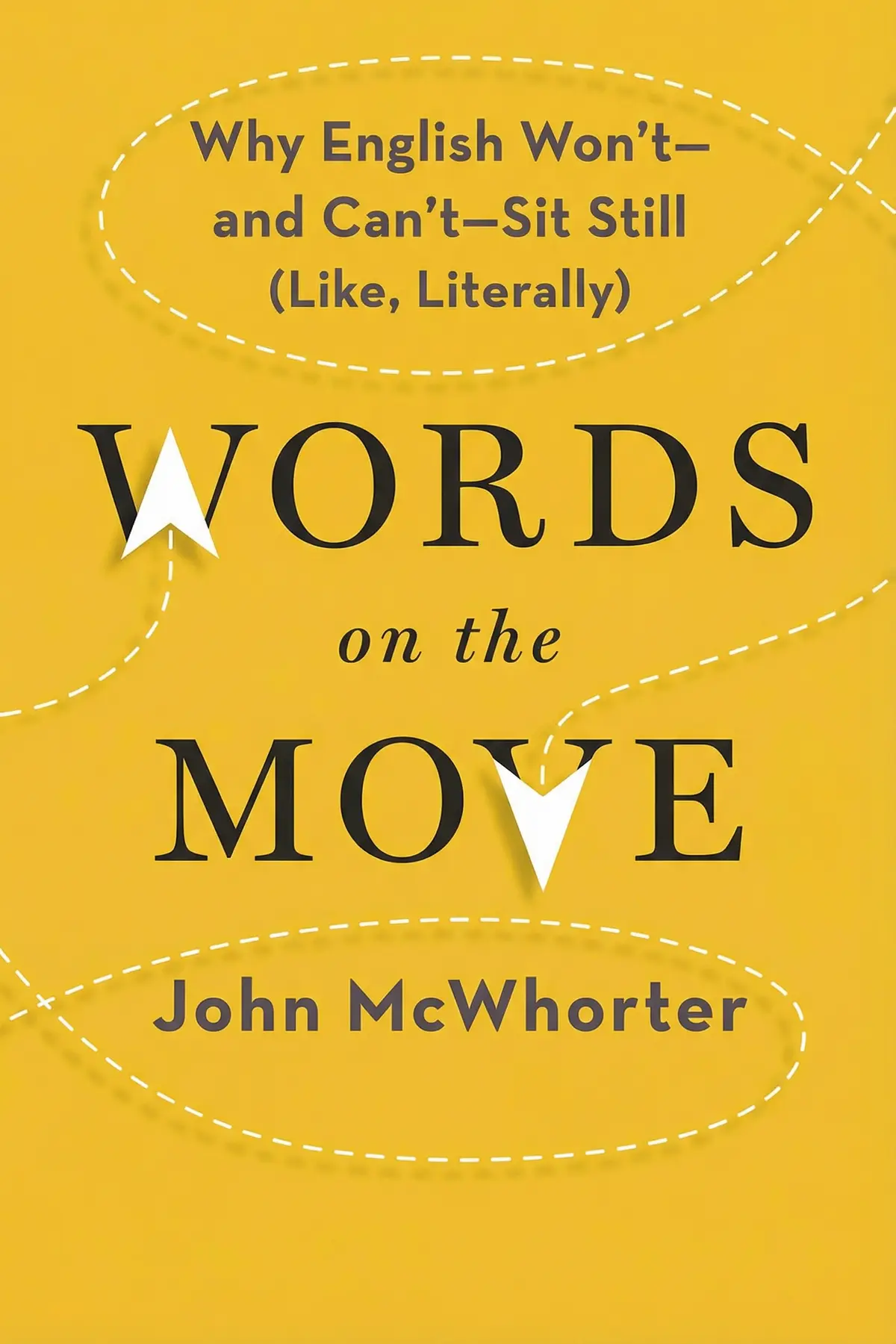
Table of Content
1. Introduction
1 min 44 sec
We often think of language as a solid structure, like a building that was finished centuries ago and just needs occasional dusting. We have dictionaries to tell us what words mean and grammar guides to tell us where the commas go. But if you look closer, English isn’t a building at all. It’s more like a river—constantly flowing, shifting its banks, and picking up new sediment as it moves through the landscape of time.
In the following pages, we are going to explore the fascinating world of linguistic evolution through the lens of John McWhorter’s work. The central throughline here is a simple but profound truth: English is, and has always been, on the move. It cannot sit still because human life cannot sit still. Whether it’s the way we stress certain syllables, the way we blend two concepts into one, or the way we use punctuation to signal our moods, every change is a response to our need to communicate more effectively and more personally.
Many people worry that the way we speak today—with our emojis, our frequent use of the word ‘like,’ and our tendency to turn verbs into nouns—is a sign that the language is falling apart. But McWhorter argues the exact opposite. These aren’t signs of decay; they are signs of life. By understanding the history of English, from the days of the Dark Ages to the era of the smartphone, we can see that today’s ‘innovations’ are actually part of a very old tradition of adaptation. So, let’s get ready to see the English language not as a set of rigid rules, but as a vibrant, living organism that is constantly reinventing itself to suit our needs.
2. Language as an Emotional Tool
2 min 34 sec
Discover how our everyday words do the heavy lifting of expressing feelings and attitudes, a role they’ve played long before art began focusing on the individual.
3. The Evolution of Digital Emotion
2 min 44 sec
Explore why emoticons and modern slang aren’t destroying the language, but are actually filling a vital gap in how we convey tone and personality in writing.
4. The Constant Drift of Meaning
2 min 47 sec
Words are rarely static; most wander far from their original definitions over time, revealing a language that is in a perpetual state of flux.
5. The Flexibility of English Grammar
2 min 36 sec
Learn how English’s unique ability to turn verbs into nouns gives us a practical, punchy way to describe the modern world, unlike more rigid languages like French or Spanish.
6. Punctuation and the Politeness Inflation
2 min 37 sec
The exclamation mark isn’t just for excitement anymore; it has evolved into a necessary tool for digital politeness, reflecting a shift in how we signal engagement.
7. The Power of Word Blending
3 min 05 sec
From ‘staycation’ to ancient ‘nave,’ discover how English constantly creates new meaning by magnetically pulling words together into hybrids.
8. The Unfair Reputation of 'Like'
2 min 46 sec
Reclaim the word ‘like’ as a sophisticated linguistic tool, tracing its journey from a suffix meaning ‘body’ to its modern role as an essential attitude marker.
9. Conclusion
1 min 28 sec
As we have seen throughout this journey, the English language is a masterpiece of constant motion. From the way our words drift in meaning over the centuries to the way we invent new punctuation habits to survive the digital age, English is defined by its restlessness. It is a language that absorbs, adapts, and innovates, always keeping pace with the humans who use it.
John McWhorter’s exploration reminds us that the ‘errors’ of today are often the ‘standard’ of tomorrow. The slang we roll our eyes at, the abbreviations we find confusing, and the grammar shifts we fear—these are the very things that keep the language alive. If English ever stopped changing, it would be because it had stopped being useful.
The next time you hear a new phrase or notice a shift in how people are speaking, instead of reaching for a red pen, try reaching for a sense of wonder. You are witnessing evolution in real-time. You are seeing the same forces at work that transformed the language of Shakespeare into the language we speak today.
The actionable takeaway here is to embrace the flow. Recognize that language is a tool for connection, and as long as we are connecting, the language is doing its job. By letting go of the need for rigid permanence, we can appreciate the incredible, fidgety, and brilliant machine that is the English language—a language that, like us, is always on the move.
About this book
What is this book about?
Words on the Move offers a deep dive into the fluid nature of English, illustrating how the language we speak today is a product of centuries of relentless transformation. Linguist John McWhorter challenges the idea that language should remain static, arguing instead that its 'fidgety' nature is exactly what makes it a powerful tool for human expression. The book promises to change how you hear everyday speech. By tracing the history of words like 'like' and 'well,' and examining the rise of emoticons and new nouns derived from verbs, McWhorter reveals the hidden logic behind linguistic shifts. You will walk away with a newfound appreciation for the way our speech adapts to reflect culture, emotion, and technology, understanding that even the most controversial modern trends have historical precedents.
Book Information
About the Author
John McWhorter
John McWhorter is a linguist who teaches at Columbia University. He’s best-known for his writing on the English language and its history. His previous books include The Language Hoax (2014) and Our Magnificent Bastard Tongue (2008). McWhorter is also a regular contributor to major newspapers including the New York Times and the Los Angeles Times.
Ratings & Reviews
Ratings at a glance
What people think
Listeners find the work entertaining and simple to follow, valuing the thoroughly researched material and the clear explanation of various ideas. They appreciate the perspective on language evolution, with one listener mentioning that it speaks to the audience like a friend. Listeners enjoy the humor and admire the thorough history of English, while also commending the author’s writing style.
Top reviews
Nongnuch
McWhorter writes with the casual confidence of a friend who also happens to be a world-class linguist. The book is an absolute delight, focusing on the idea that language is a parade rather than a stationary statue. I loved the breakdown of how words like 'literally' or 'decimate' shift meanings despite our best efforts to gatekeep them. The truth is that English is a living, breathing thing that adapts to its users in real-time. While some chapters felt a bit more like collected lectures than a tight narrative, his wit kept me engaged throughout. It is a fantastic resource for anyone who feels a bit too precious about grammar and needs to learn to chill. This isn't just a history book; it’s an invitation to see the beauty in how we actually talk today.
Show moreThanit
Ever wonder why 'literally' doesn't mean literally anymore? This book provides the answers in a way that is both entertaining and incredibly easy to digest. McWhorter treats language as a moving target, explaining that drift is inevitable and even healthy for a society. I appreciated the specific examples involving Black English and how certain sounds have shifted over the decades. It’s written with a verve that makes you want to keep turning the pages, even when he dives into the more academic weeds. Some might find the tone a bit too 'loosey-goosey' for a linguistics book, but I think that’s exactly what makes it so readable. It’s rare to find a book that educates you this much while still making you laugh at the absurdity of our own speech. Highly recommended for anyone curious about why we talk the way we do.
Show moreChokdee
John McWhorter has this incredible knack for making complex linguistics feel like a chat over coffee with a very smart friend. This book is a phenomenal exploration of how English is constantly 'on the move' whether we like it or not. I loved learning about how 'all' is shifting into a legitimate grammatical marker in phrases like 'what all do I need.' He handles the debate between prescriptivists and descriptivists with a lot of grace and practical wisdom. It really helped me shed some of that acrid disgust for 'bad grammar' by showing there are no scientific grounds for it. The examples from Beowulf to Moby Dick provide a deep historical context that keeps the argument grounded. If you're interested in language at all, this is a must-read.
Show moreJeeranan
This book is a fantastic antidote to the 'language is dying' crowd that seems to be everywhere these days. McWhorter shows that English has always been a chaotic, beautiful mess, and that’s exactly what makes it so fascinating to study. I loved the deep dives into Shakespeare and the realization that so much of what we read is full of 'false friends.' The writing is witty and full of energy, making even the more technical sections on vowel shifts feel like an adventure. It’s one of those rare books that actually changes the way you listen to the people around you in your daily life. While it occasionally wanders off on a tangent, those digressions are usually packed with enough trivia to keep you entertained. This is 10/10 edutainment that I’ve already started recommending to my fellow bookworms. It really puts the 'move' in Words on the Move!
Show moreAudrey
As a self-diagnosed word nerd, I came in expecting to be offended by his descriptive approach to language. Instead, I left feeling much more empathetic toward how people speak in the real world. McWhorter does a great job of dismantling the 'grammar nazi' mindset by showing that even the words we consider 'correct' today were once considered bastardizations. The chapter on vowel shifts was especially fun, and I actually found myself reading the examples aloud to hear the sounds change. I did feel like some of the humor fell flat on the page, almost like it was meant for a live classroom audience instead of a reader. Still, the insights into how 'all' is becoming a grammatical marker were worth the price of admission alone. It’s a solid, thought-provoking read for any pedant.
Show moreAmara
The chapter on Shakespeare is going to be polarizing for a lot of people, but it’s definitely worth a read. I’ve always been someone who enjoys the 'work' of deciphering older English, yet McWhorter makes a compelling case for why updating the false friends would bring more people to the theater. His writing style is remarkably accessible and engaging for such a technical subject. He manages to explain complex concepts like modal markers and back-shifting without ever sounding condescending. There were a few moments where the social theorizing felt a bit disconnected from the linguistic examples, which disrupted the flow. But overall, it’s a very well-researched book that successfully challenges your internal language paradigm. You’ll definitely come away with a bunch of trivia about the word 'world' and other common phrases.
Show moreWachira
Finally got around to finishing this, and I’m still thinking about that section on 'fishburgers' and the evolution of suffixes. John McWhorter has a way of making you notice things you’ve been saying your entire life without ever actually hearing them. The book explores the vast difference between the 'statue' of print and the 'living person' of speech. I found the discussion on how texting and emojis are actual forms of communication particularly relevant to our current cultural moment. To be honest, some of the chapters felt a little like blog posts that had been stitched together, which made the pacing feel uneven at times. However, the sheer amount of 'aha!' moments makes up for the occasional rambling. It’s an eye-opening journey through the history of English that isn't afraid to get a little bit messy.
Show moreYaowaluk
Picked this up after hearing the author on a podcast, and it didn't disappoint in terms of sheer educational value. The concepts of back-shifting and grammaticalization were explained with such clarity that I felt like a mini-expert by the end. I especially liked the analysis of how the meaning of words can flip entirely over a few centuries, like 'awful' once being a compliment. To be fair, there was one metaphor at the very end that felt a bit icky and unnecessary, which left a strange taste in my mouth. But the rest of the book was a fantastic journey through the 'vaster than it seems' difference between speech and writing. It’s a short, accessible read that will definitely make you think twice before correcting someone’s grammar. It’s definitely more about the 'why' than the 'how' of language change.
Show moreHom
To be fair, I found this to be a bit of a mixed bag in terms of structure. The book itself felt less like a unified argument and more like a collection of hazy meditations on various linguistic themes. At times, the professorial rambling made it a bit of a slog, and I found myself wanting to skip the repetitive humor to get back to the meat of the ideas. His argument for 'translating' Shakespeare into modern English was particularly hard for me to get on board with. However, the 'bones' of the book are undeniably good. When he explains things like the 'grammaticalization of ass' or the evolution of 'fishburger,' his brilliance really shines through. It's educational, but you might find yourself skimming the digressions.
Show moreDarawan
Look, I really wanted to love this, but the structure felt like a collection of disjointed blog posts rather than a cohesive book. While McWhorter is obviously brilliant, his 'professorial rambling' became a distraction for me after the first fifty pages. I found the attempts at corny humor to be mostly misses, and they often led me away from the actual linguistic thread he was trying to build. There were moments of genuine insight, especially regarding vowel shifts, but they were buried under too many hazy meditations. It felt like a slog to get through the repetitive main ideas just to find a few nuggets of gold. If you’re a die-hard fan of his podcast, you’ll probably enjoy the conversational tone more than I did. For me, it just lacked the focus I expect from a nonfiction book.
Show moreReaders also enjoyed

A Life Decoded: My Genome: My Life
J. Craig Venter

A Planet of Viruses
Carl Zimmer
A Short History of Nearly Everything
Bill Bryson
A Thousand Brains: A New Theory of Intelligence
Jeff Hawkins

Alien Earths: The New Science of Planet Hunting in the Cosmos
Lisa Kaltenegger

AUDIO SUMMARY AVAILABLE
Listen to Words on the Move in 15 minutes
Get the key ideas from Words on the Move by John McWhorter, plus 5,000+ more titles in English and Thai.
- 5,000+ titles
- Listen as much as you want
- 7-day free trial
- Cancel anytime







