
16 min 43 sec
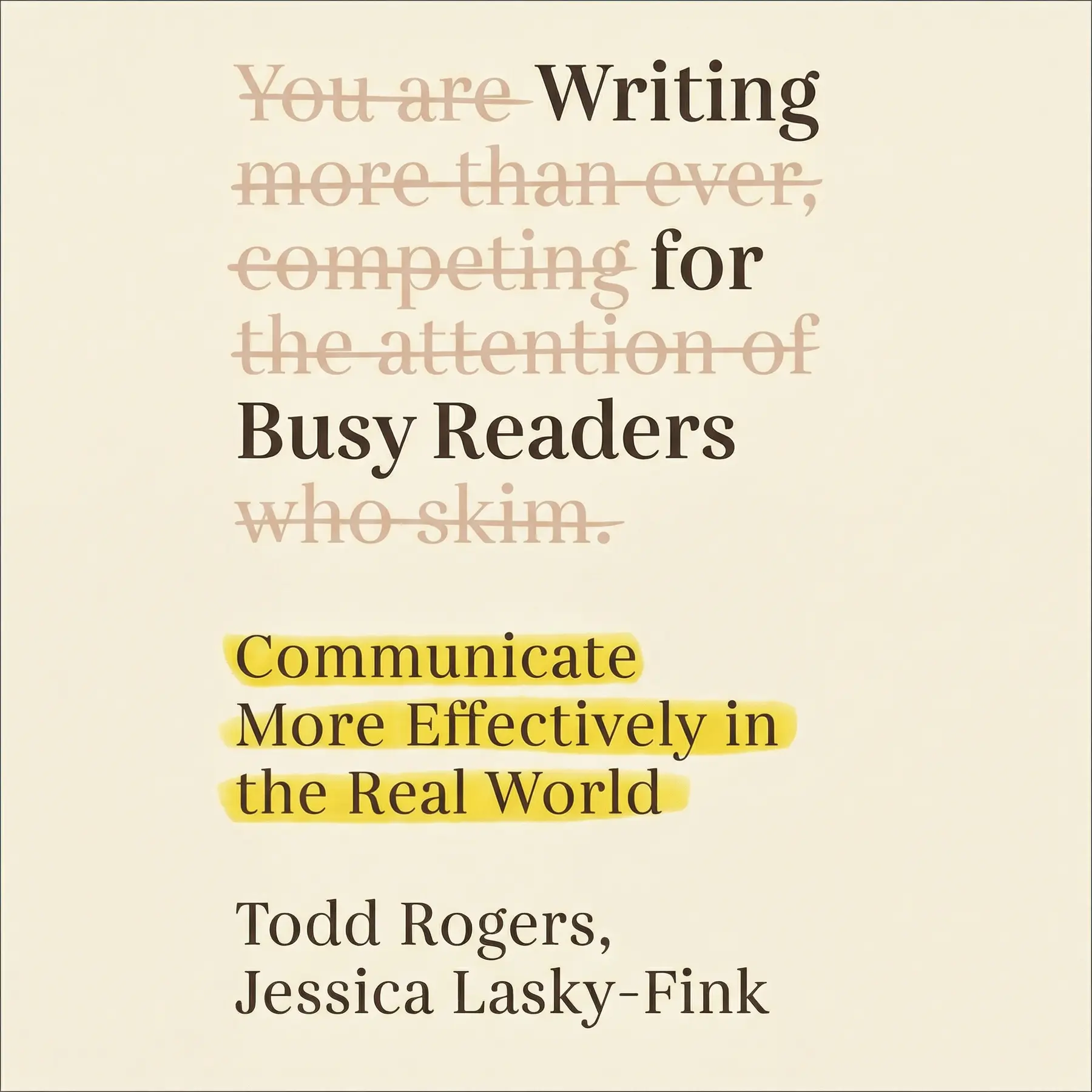
Writing for Busy Readers: Communicate More Effectively in the Real World
Writing for Busy Readers reveals how behavioral science can transform your communication. Learn six core principles to cut through digital noise, capture wandering attention, and ensure your message leads to real action.
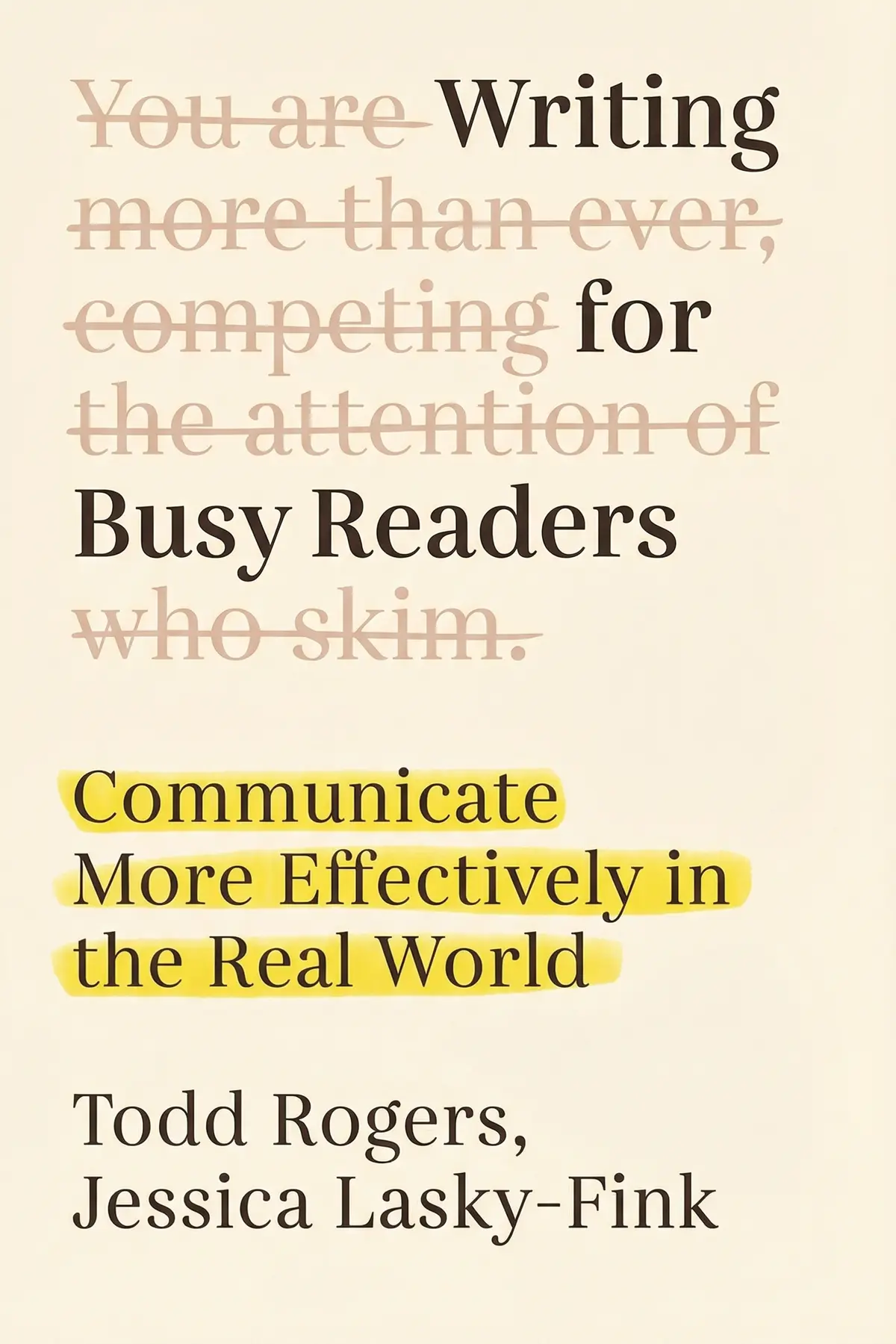
Table of Content
1. Introduction
1 min 38 sec
We have all been there: you open your laptop or check your phone, and you are immediately greeted by a wall of red notification badges. There are emails from colleagues, direct messages from friends, alerts from social media, and newsletters you don’t remember signing up for. In this constant storm of information, your first instinct isn’t to read—it is to survive. You delete, you archive, and you skim at lightning speed. This is the reality of the modern reader. They aren’t looking for a reason to read your message; they are looking for a reason to ignore it.
In Writing for Busy Readers, authors Todd Rogers and Jessica Lasky-Fink provide a lifeline for anyone who needs to communicate in this distracted world. They argue that effective writing in the twenty-first century isn’t about flourish or flowery prose; it is about cognitive ease and behavioral science. If you want people to actually process your words and act on your requests, you have to stop writing for the person you wish they were—someone with endless time and perfect focus—and start writing for the person they actually are: someone who is busy, stressed, and looking for the exit.
This summary will walk you through the psychological filters that stand between your words and your reader’s brain. We will explore why the most well-intentioned messages often fail and how a few structural shifts can dramatically increase your response rates. From the tragedy of the missed Airbnb stock opportunity to the confusion of civic ballots, we will see how the stakes of clear writing are much higher than they appear. By the end of this journey, you will have a toolkit of six core principles that will turn your writing into a precision instrument, ensuring that when you have something to say, the world actually listens.
2. The High Stakes of Clarity
2 min 18 sec
Discover how a single boring subject line cost people thousands of dollars and how confusing language can even threaten the democratic process.
3. Working Within Cognitive Limits
2 min 29 sec
Explore why the human brain is hardwired to ignore most of what it sees and how to navigate the four stages of a reader’s decision-making.
4. The Virtue of Minimalism
1 min 57 sec
Learn why cutting your word count in half can actually double your impact and how to find your ‘North Star’ message.
5. Structuring for the Skimmer
2 min 07 sec
Standard paragraphs are the enemy of the busy reader. Discover how to use simple language and visual design to guide the eye.
6. Empathy and the Path of Least Resistance
2 min 20 sec
Writing is a two-way street. Learn how to frame your message around the reader’s needs and make responding effortless.
7. Adapting to the Real World
2 min 34 sec
Principles are great in theory, but how do they work in practice? Learn how to handle long reports, technical jargon, and diverse audiences.
8. Conclusion
1 min 20 sec
In the end, writing for busy readers is about much more than just being brief. It is about a fundamental shift in perspective. It requires moving from a writer-centric view—where the goal is to dump everything you know onto the page—to a reader-centric view—where the goal is to be as helpful and efficient as possible. By embracing the six principles of brevity, readability, design, formatting, relevance, and friction-reduction, you transform your communication from a burden into a benefit.
Remember that your readers are human. They are tired, they are multitasking, and their attention is a precious commodity. When you respect that attention by being clear and direct, you build trust and professional credibility. You don’t need to be a literary genius to be an effective writer. You just need to be kind to your reader’s brain.
As you move forward, try to look at every email, text, and report as an opportunity to practice these skills. Ask yourself: Can I make this shorter? Can I make the point easier to find? Have I told them why this matters? The more you refine your approach, the more you will stand out in the crowded digital landscape. In a world of noise, clarity is a superpower. Use it to ensure that your ideas don’t just land in an inbox, but actually make an impact on the world.
About this book
What is this book about?
In an era of endless notifications and overflowing inboxes, the greatest challenge for any writer is simply being heard. Writing for Busy Readers explores the psychology behind how people actually consume written content in the digital age. Most readers don’t read; they skim, filter, and prioritize based on immediate perceived value. This summary breaks down how to navigate these cognitive hurdles using six research-backed principles designed to make your writing impossible to ignore. You will discover the specific decision-making process every reader goes through when they see a new message, from the initial choice to engage to the final decision to take action. By understanding the 'why' behind reader behavior, you can move beyond basic grammar and learn to structure emails, reports, and messages that respect the reader's time while achieving your specific goals. The promise is simple: by applying these strategies, you will stop being part of the digital noise and start being the voice that gets results, whether you’re writing a corporate memo or a community call to action.
Book Information
About the Author
Todd Rogers
Todd Rogers is a distinguished behavioral scientist and a professor at the Harvard Kennedy School. Beyond his academic work, he is the cofounder of EveryDay Labs, an organization that applies behavioral science to improve student attendance in primary and secondary schools across the United States. Jessica Lasky-Fink serves as the research director at The People Lab, also based at the Harvard Kennedy School. Her extensive research focuses on optimizing the delivery of the social safety net, using behavioral science to improve how public services reach those who need them most.
Ratings & Reviews
Ratings at a glance
What people think
Listeners value the book’s prose, focusing on its 6 principles of effective communication. Furthermore, the quality of the advice is well-received, as one listener noted it offers practical strategies for immediate application. The research standards are also commended for showcasing the data behind the authors' recommendations. Nevertheless, reactions to the clarity are split; one listener considered it very clear, while another felt the suggestions were difficult to follow.
Top reviews
Chanpen
Finally got around to reading this, and it’s a game-changer for anyone drowning in an overflowing inbox. The behavioral science research backings really elevate the advice from mere opinion to actionable data. I particularly enjoyed the sections on how eye-tracking software shows exactly where readers lose interest in a standard email. It’s one thing to be told to use headings, but quite another to see the visual proof of why they work. While some of the tips—like using short sentences—feel elementary, the way they are packaged into six distinct principles makes them much easier to internalize and apply. Not gonna lie, I started rewriting my memos halfway through the third chapter. It's a quick read, but the impact on your professional communication will be immediate and profound for those willing to change their habits.
Show moreKanokwan
Ever wonder why people just ignore your most important Slack messages or skip over the crucial details in your newsletters? This book explains exactly why that happens and how to fix it using actual data. I loved the practical strategies for immediate implementation, specifically the advice on how to make the most important points stand out visually. It’s easy to dismiss this as 'common sense,' but seeing the behavioral science behind human attention spans makes a huge difference in how you approach the page. Personally, I think every college student should read this before they enter the workforce. The tone is accessible and the layout is helpful, though I agree with others that it could have been tighter in the final chapters. Still, it’s a solid five stars for the sheer utility.
Show moreVera
The six principles outlined by Rogers and Lasky-Fink offer a solid framework that I’ve already started using for my weekly newsletters. What I appreciated most was the emphasis on how to cause readers to actually act, rather than just passively consume information. The behavioral science research is top-notch and provides a level of authority that most writing books lack. It’s incredibly actionable, and I loved the visuals showing how people’s eye movements change based on formatting. While I found some of the advice on technical language a bit vague—it often ended with a 'use your best judgment' response—the overall strategy is sound. This is a fantastic tool for marketers or anyone in a leadership position who needs to communicate complex ideas quickly and clearly. It’s a very practical guide.
Show morePot
The authors clearly know their stuff when it comes to the science of human attention. This isn't just a grammar guide; it’s a deep dive into the psychology of how we process information in a digital age. Frankly, the six principles for effective communication are worth the price of admission alone. I appreciated the specific examples comparing 'before' and 'after' versions of fundraising letters and office updates. However, it’s worth noting that the book itself occasionally ignores its own advice by being a bit repetitive in the middle sections. You could probably skim the case studies once you get the gist of the core concepts. Despite that minor bloat, the practical strategies for immediate implementation make it a worthwhile purchase for anyone in marketing or management who needs their messages to actually land.
Show moreRatree
As a project manager who spends half my life drafting emails, I found these behavioral science insights incredibly useful. The chapter on the six principles provided a structured way to think about messages that I usually just fire off without much thought. I’ve already noticed a higher response rate since I started implementing their tips on visual cues and clear goals. The research quality is evident, and I appreciated how they used actual experiments to prove why certain formatting choices work better than others. It’s not a perfect book—some of the chapters on technical language felt a bit like they were 'hedging' their bets with vague answers—but the core message is vital. It’s a must-read for anyone who wants to stop being ignored in a busy, digital-first workplace.
Show moreRod
Truth is, I expected another generic 'how-to' guide, but the research-backed approach here sets it apart from the crowd. Rogers and Lasky-Fink don't just tell you what to do; they explain the psychological 'why' behind reader behavior. I found the experiments comparing different versions of the same email to be the highlight of the text. It makes the six principles feel less like arbitrary rules and more like a proven system for getting results in a noisy world. My only gripe is that the text clarity can be a bit inconsistent, with some sections feeling a bit more academic than they needed to be for a 'busy' audience. Regardless, if you write for a living—or even if you just send a lot of texts—there is plenty of value here to improve your daily communication.
Show moreYui
Looking at the eye-tracking heatmaps included in the text was a total 'aha' moment for me. It really drives home the point that people don't read every word; they scan for relevance in a sea of text. The authors do a great job of breaking down how to write for this 'skimming' behavior without sacrificing the quality of the message. I particularly liked the section on setting clear goals before you even start typing. This book has definitely changed the way I approach everything from internal memos to quick text messages. Gotta say, even though a few parts felt like they were padding the length, the core principles are so effective that it's hard to complain too much. It’s a very practical guide for the modern, over-stimulated professional who wants to be heard.
Show moreIce
Is it ironic that a book about writing for busy people feels about fifty pages too long? Look, there are some genuinely excellent nuggets of wisdom here, especially regarding visual hierarchy and the behavioral science of reader response. But I found myself wishing the authors had been more ruthless with their own editing. Many of the suggestions, like putting the most important information first and using clear headings, are things we should have learned in middle school. It’s a bit of a mixed bag because the research is high quality, yet the text clarity oscillates between being incredibly punchy and strangely dense. If you can ignore the fluff, you’ll find a solid framework for better emails, though you might find yourself skimming the latter half just to get to the summary points.
Show morePrinya
After hearing the hype on a few podcasts, I picked this up hoping for some advanced editing masterclass. In reality, it felt more like a validation of things I was already doing rather than a source of new learning. Don’t get me wrong, the focus on practical messages like emails and reports is great because those are often overlooked. But if you’re already a relatively concise writer, you might find the 200 pages a bit repetitive. The authors advocate for simplicity, yet the book itself meanders through various case studies that feel like filler. It’s a decent three-star read that would have been a five-star long-form article. Use it as a reference guide for the six principles and skip the parts that feel like they’re just repeating the same point over and over.
Show moreJoy
This book basically tells you that to be concise, you should just... be concise. I was expecting something much more nuanced given the positive buzz in the media. Instead, I got a 200-page expansion of a blog post that could have been summarized in five bullet points. The advice is painfully basic: use short words, use headings, and don't send too many messages. To be fair, the eye-tracking visuals were interesting, but they didn't justify the time investment required to finish the entire volume. It felt like the authors were struggling to meet a page count requirement from their publisher. If you're looking for a deep dive into the 'art of explanation,' you're better off looking elsewhere because this stays strictly on the surface of communication theory.
Show moreReaders also enjoyed
AUDIO SUMMARY AVAILABLE
Listen to Writing for Busy Readers in 15 minutes
Get the key ideas from Writing for Busy Readers by Todd Rogers, plus 5,000+ more titles in English and Thai.
- 5,000+ titles
- Listen as much as you want
- 7-day free trial
- Cancel anytime







