
Buffett: The Making of an American Capitalist
Roger Lowenstein
Explore the dramatic history behind the creation of the Federal Reserve. This summary details the political battles, financial panics, and secret meetings that transformed America from a fractured economy into a global financial powerhouse.
1 min 26 sec
In the modern era, the presence of a central bank is often taken for granted. We view the Federal Reserve as a permanent fixture of the landscape, a regulatory giant that manages interest rates and steps in during the darkest hours of a financial meltdown. However, for a significant portion of American history, such an institution was seen not as a solution, but as a threat to the very core of democratic freedom. The journey toward creating this financial backbone was anything but smooth; it was an epic struggle defined by ideological warfare, secret meetings on remote islands, and the crushing weight of economic panics that threatened to destroy the country’s prosperity.
This story takes us back to a time when the United States was a patchwork of competing interests, where state-level banks printed their own money and the lack of a central coordinator made the economy vulnerable to sudden, violent shocks. It is a tale of how a nation deeply suspicious of centralized authority was forced by necessity to reinvent its relationship with money. By looking at the origins of the Federal Reserve Act of 1913, we can see the throughline of American economic history: a constant, often messy negotiation between the need for stability and the fear of elite control. As we move through this narrative, we will see how the ghosts of the past—the populist anger and the fear of Wall Street—continue to haunt our modern financial debates. Here is the story of how the American banking system was born from fire, compromise, and a desperate search for order in an age of uncertainty.
2 min 07 sec
Early Americans viewed centralized banking as a tool for government overreach, leading to a century of fragmented financial systems and recurring fiscal instability.
2 min 09 sec
A catastrophic market collapse triggered by a failed copper monopoly proved that the American economy could no longer survive without a formal safety net.
1 min 58 sec
As social and political reforms swept the nation, the American public began to accept that government oversight was a necessary component of a stable economy.
2 min 05 sec
In 1910, a secret meeting of powerful bankers and politicians on a remote island laid the groundwork for the modern Federal Reserve system.
2 min 06 sec
The 1911 Aldrich Plan introduced three vital goals: unifying state banks, standardizing currency, and ensuring market liquidity through paper money.
2 min 04 sec
President Wilson’s unique blend of progressive and conservative ideals allowed him to pass the Federal Reserve Act by balancing state oversight with market freedom.
2 min 02 sec
The newly formed Federal Reserve faced its first major test during the Great War, demonstrating its ability to regulate trade and stabilize international economies.
1 min 53 sec
Contemporary anger toward financial institutions mirrors the historical distrust of the Fed, showing that the tension between Wall Street and Main Street is a permanent feature of American life.
1 min 30 sec
The creation of the Federal Reserve stands as one of the most significant achievements in American history, representing a hard-won victory over a century of financial instability and ideological paralysis. From the early days of Andrew Jackson’s populist crusade against centralized power to the desperate hours of the 1907 panic, the road to 1913 was paved with lessons learned through failure. The Federal Reserve Act was not a perfect document, nor did it mark the end of economic hardship, but it provided a framework for a modern, industrial nation to manage its own destiny. It introduced the concepts of an elastic currency and a lender of last resort, tools that remain essential to our survival in an increasingly complex global market.
What this history teaches us is that the tensions we see today—the debates over interest rates, the anger at big banks, and the fear of government overreach—are not new. They are the same questions that have always defined the American experiment. The Federal Reserve is an institution born of compromise, designed to protect the many from the mistakes of the few, even while it remains subject to the scrutiny of a skeptical public. As you move forward, remember that change in the financial world rarely happens overnight. It is the result of long-term shifts in thought and the pressure of real-world crises. By keeping this historical context in mind, we can better understand the headlines of today and approach the challenges of the future with a clearer sense of where we’ve been and how much we’ve already overcome.
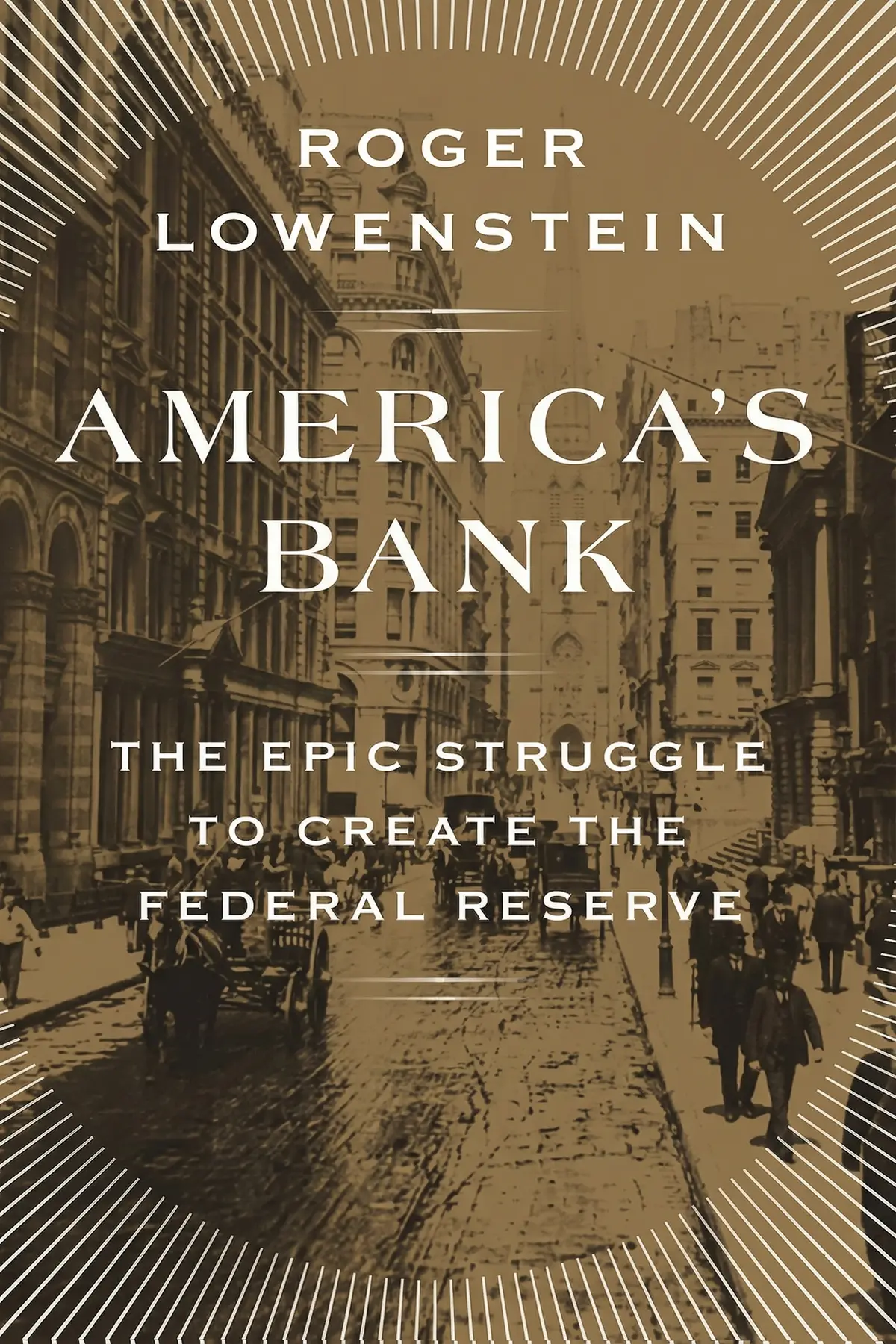
America’s Bank investigates the turbulent journey toward establishing the United States Federal Reserve. For over a century, the young nation operated without a centralized financial authority, a situation that led to recurring market collapses and widespread fiscal chaos. This narrative follows the unlikely alliance of bankers and politicians who eventually overcame deep-seated American suspicions of concentrated power. The book promises a deep dive into the 1907 panic, the clandestine gathering at Jekyll Island, and the legislative maneuvering of the Wilson era. It explains how the need for a unified currency and a lender of last resort finally outweighed the populist fears of financial elitism. Readers will understand how these historical struggles directly inform modern economic debates and the persistent tension between Wall Street and Washington.
Roger Lowenstein is a seasoned journalist who has contributed his expertise to prominent publications such as the Wall Street Journal, the New York Times Magazine, and Fortune. He is the author of several acclaimed books focused on the world of finance, including The End of Wall Street and Origins of the Crash.
Roger Lowenstein
Listeners find the work to be thoroughly researched and packed with excellent information, effectively animating historical events through vivid detail. They characterize it as a compelling and accessible narrative that is straightforward to follow, with one listener pointing out the connections made to the 2008 financial crisis. Listeners appreciate the caliber of the prose, and one listener specifically mentions the author's remarkable level of analysis. There are varying opinions among listeners regarding the book's level of complexity.
After hearing the author discuss this on a podcast, I knew I had to see if the book lived up to the hype, and it absolutely does. Lowenstein paints a vivid picture of the Progressive Era, showing how Woodrow Wilson navigated a minefield of conflicting interests to pass the Federal Reserve Act. The parallels he draws between the financial instabilities of the early 1900s and our modern era are striking and quite sobering. I particularly enjoyed the deep dives into the 1912 election and how it shaped the final structure of the regional banks. This isn't just a book about money; it’s a study of power and the art of the political possible. It made me appreciate the stability we often take for granted today.
Show moreFinally got around to reading this, and I’m kicking myself for waiting so long because it’s easily the best banking history I’ve encountered. Lowenstein has a gift for making complex economic theories accessible without stripping away the nuance that makes them interesting. Seeing the evolution of Paul Warburg from an outsider to a key architect of the system was fascinating. The book captures the tension between the 'End the Fed' mindset of the time and the practical need for a lender of last resort. It’s well-researched, filled with great information, and brings a forgotten era of American politics back into the spotlight. A must-read for anyone who wants to understand the engine under the hood of our economy.
Show moreRoger Lowenstein manages to turn what should be a coma-inducing subject into a genuinely gripping political thriller. I was impressed by how he brings historical figures like Nelson Aldrich and Paul Warburg to life, making their backroom dealings feel immediate and high-stakes. While the prose is fluid and the research is clearly top-tier, the book does occasionally get bogged down in the minutiae of banking structures that might lose a casual reader. Truth is, I never realized how much the Panic of 1907 mirrored the 2008 crisis until reading these chapters. It’s a masterful analysis of how our current financial foundation was built through grit and messy compromise. Even if you aren't a math person, the human drama here is worth the price of admission.
Show moreEver wonder why our money looks the way it does or why the Fed has twelve different branches? This book answers those questions with impressive detail and a narrative style that mostly avoids the 'textbook' trap. Lowenstein’s focus on the human element—the egos, the rivalries, and the secret meetings—makes the legislative process feel like a high-stakes chess match. I did feel that the middle section dragged slightly when discussing specific draft bills that never went anywhere. However, the explanation of the Panic of 1907 was absolutely riveting and set the stage perfectly for why reform was so desperate. It’s a solid 4-star read that fills a massive gap in my understanding of U.S. economic history.
Show moreAs someone who typically finds economics a bit tedious, I was pleasantly surprised by how much I enjoyed this account of the Fed's creation. The author does an incredible job of balancing the technical aspects of banking with the larger-than-life personalities of J.P. Morgan and Carter Glass. Look, the book is definitely 'in the weeds' at times, but that level of detail is necessary to understand why the system is so convoluted. I appreciated the discussion on how the 1913 Act was a series of baby steps rather than a radical overhaul. My only minor gripe is that the ending felt a bit rushed compared to the painstaking detail of the early chapters. Still, it’s a highly readable story that makes sense of a very complex institution.
Show morePicked this up on a whim, and I was immediately struck by the author’s ability to weave together disparate threads of political and financial history. The story of how a group of men met in secret at Jekyll Island sounds like a movie plot, but Lowenstein treats it with the seriousness it deserves. I found the sections on the 1893 panic particularly enlightening, as they provided the necessary context for the public’s deep-seated distrust of banks. Gotta say, the way the author explains the compromise behind the twelve regional banks was a highlight for me. It’s a bit dense in the middle, but the payoff is a much clearer understanding of our current financial landscape. Definitely worth the time.
Show moreThe truth is, banking history doesn't have to be boring, and Roger Lowenstein proves that with this deep dive into the Fed's origins. He successfully bridges the gap between scholarly analysis and popular non-fiction, creating a narrative that feels both authoritative and engaging. I was especially drawn to the descriptions of the 1912 presidential race and how the three-way split between Taft, Roosevelt, and Wilson paved the way for reform. Some might find the focus on 'great men' a bit old-fashioned, but it works here because the personalities involved were truly colossal. While the author’s admiration for the central bank is obvious, he doesn't shy away from the messy political horse-trading that defined its birth. Solid, informative, and very relevant.
Show moreI found this to be a bit of a slog, even though the information presented is undoubtedly important for understanding American history. The author’s clear bias toward the Federal Reserve as a 'worthy necessity' occasionally grates, especially when he glosses over the arguments of those who preferred more decentralized alternatives. To be fair, Lowenstein is a great writer, but he treats the opposition's views as mere populist demagoguery rather than legitimate policy debate. There’s a lot of talk about the secret meeting at Jekyll Island and the 1913 Act, but the narrative lacks the flair needed to keep the pacing brisk. It’s an informative read for students of history, but be prepared for some very dry sections regarding reserve requirements and currency elasticity.
Show moreThis book is clearly a product of immense research, but the sheer volume of names and dates can be overwhelming for the uninitiated. I appreciate the effort to humanize the bankers and politicians involved, yet the narrative often feels like it's pulling in too many directions at once. To be honest, I was expecting more analysis on the long-term effects of the Fed, but the book remains strictly focused on the 1903-1913 window. While it does a great job of debunking some of the wilder conspiracy theories, it replaces them with a version of history that feels a bit too sanitized. It’s a decent resource for a history buff, but it lacks the oomph to make it a page-turner.
Show moreNot what I expected at all, as I was hoping for a more balanced critique of central banking rather than a love letter to Wall Street. The author writes with a clear 'big bank' mindset, often dismissing the concerns of rural farmers and Southern politicians as mere ignorance. While the research is exhaustive, the 'epic struggle' described felt more like a series of dry committee meetings than a compelling historical conflict. Personally, I found the omission of the Second Bank's role in the 1819 panic to be a significant oversight that skewed the historical context. If you want a pro-Fed perspective, this is your book, but anyone looking for a neutral analysis should probably look elsewhere. It was simply too one-sided for my taste.
Show more
William J. Bernstein

Ishmael Beah

Yanis Varoufakis
Ben Macintyre
AUDIO SUMMARY AVAILABLE
Get the key ideas from America’s Bank by Roger Lowenstein, plus 5,000+ more titles in English and Thai.







