

24 min 03 sec
Bargaining for Advantage: Negotiation Strategies for Reasonable People
Discover how to transform negotiation from a high-stress confrontation into a strategic advantage by leveraging your authentic personality, setting high expectations, and understanding the psychological principles of reciprocity and leverage.
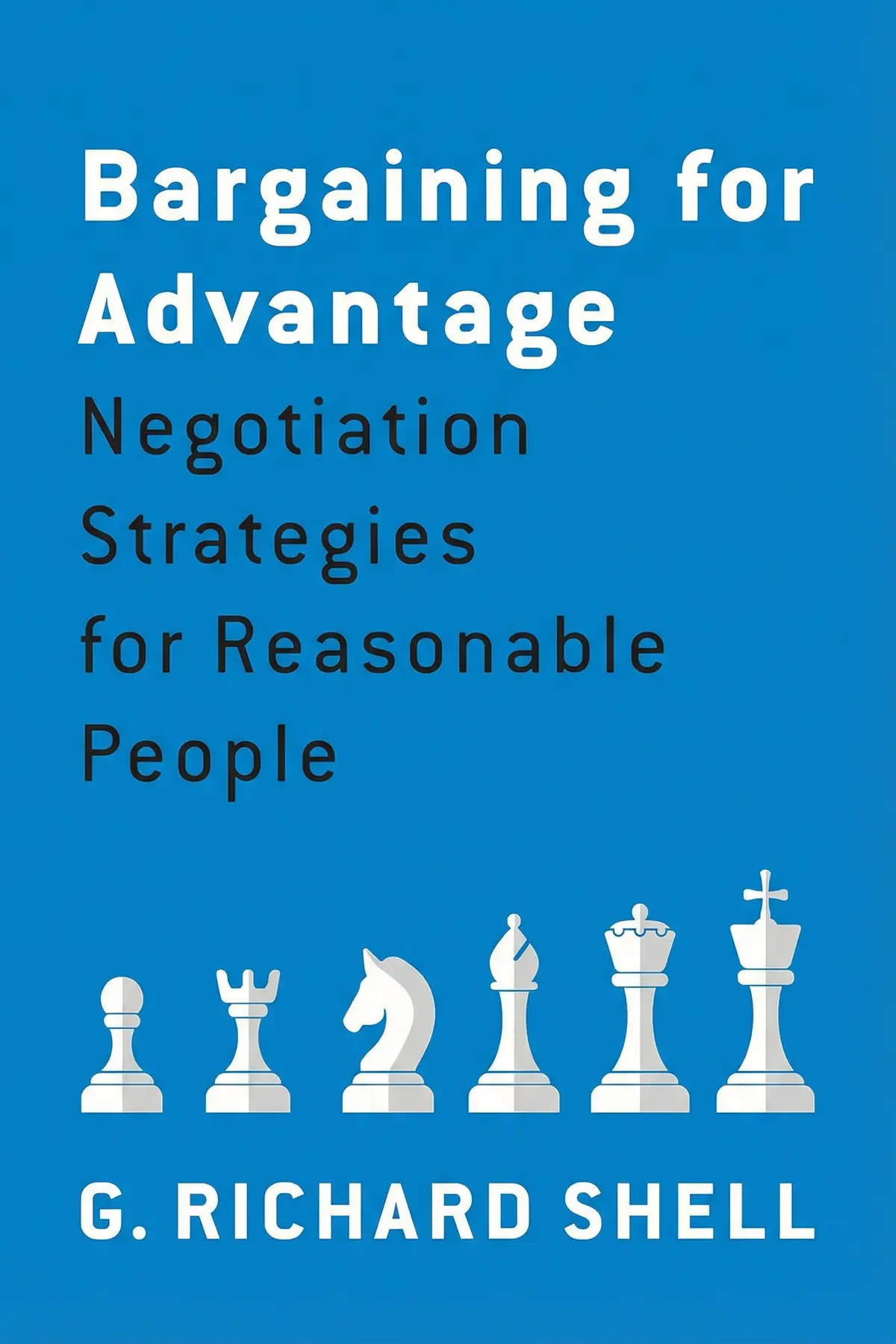
Table of Content
1. Introduction
1 min 59 sec
Negotiation is often portrayed as a high-stakes battle of wits, a cinematic showdown in a glass-walled boardroom where the most aggressive voice wins the day. We imagine a world of hard-nosed executives and shrewd dealers squeezing every last penny out of their opponents. For many of us, this image makes the prospect of bargaining feel deeply uncomfortable. We worry about being taken advantage of, or worse, we worry that we aren’t ‘tough’ enough to get what we deserve. But what if the secret to a great deal isn’t about being someone else? What if the most effective way to negotiate is actually to be more like yourself?
In this exploration of Bargaining for Advantage, we move away from the caricatures of the ‘shark’ and the ‘pushover’ to look at negotiation as a structured, psychological craft. Whether you are discussing a salary increase with your manager, haggling over the price of a vintage item, or establishing a complex multi-million dollar partnership, the underlying dynamics remain remarkably consistent. It is a process that involves understanding human motivation, respecting social standards, and managing the delicate balance of power.
Throughout this journey, we will see that bargaining is not just about the final number on a contract. It is about the preparation that happens before you even sit down. It is about the relationships you build and the reputation you maintain. We will look at the lives of master negotiators—ranging from industrial titans like J.P. Morgan to social visionaries like Mahatma Gandhi—to see how they navigated the perilous terrain of conflict and cooperation.
The core throughline we will follow is that effective bargaining is a skill that can be learned and refined by anyone, regardless of their natural temperament. By the end of this summary, you will understand how to set expectations that carry weight, how to use leverage without burning bridges, and how to handle the inevitable ethical dilemmas that arise when interests collide. Let’s begin by looking at the most fundamental tool you bring to any negotiation: your own personality.
2. Embracing Your Authentic Style
2 min 52 sec
Trying to mimic a ruthless negotiator can backfire if it doesn’t match your true self. Learn why your natural personality is your greatest asset at the table.
3. The Power of High Expectations
2 min 27 sec
Setting a clear, justifiable expectation is far more effective than simply having a vague goal. See how Sony’s founder used this to build a global brand.
4. Using Norms to Build a Case
2 min 19 sec
Discover how using the other person’s own rules can be the most persuasive tactic in your arsenal, from hospital budgets to social justice.
5. The Strength of Fair Reciprocity
2 min 33 sec
Great negotiators know that generosity today can lead to massive returns tomorrow. Learn how a small gesture by J.P. Morgan changed industrial history.
6. Uncovering the Other Side's Motivation
2 min 18 sec
Negotiation isn’t just about what you want; it’s about solving the other person’s problems. See how a clever waste manager won a contract by thinking about sand.
7. The Strategic Use of Leverage
2 min 26 sec
Leverage is the hidden engine of every deal. Learn how one woman saved her company millions by creating her own alternative to a monopoly.
8. Breaking Deadlocks with Small Steps
2 min 15 sec
When negotiations grind to a halt, emotions often take over. Learn the ‘one small step’ technique that ended decades of war in the Middle East.
9. The Three Schools of Bargaining Ethics
2 min 35 sec
Is it okay to lie in a negotiation? Explore the different ethical frameworks that successful bargainers use, from ‘poker players’ to ‘idealists.’
10. Conclusion
2 min 19 sec
As we wrap up our journey through the art of negotiation, it’s clear that ‘bargaining for advantage’ is far more nuanced than simply demanding the best price. We’ve seen that the most effective negotiators are those who refuse to wear a mask. By staying true to your authentic strengths—whether you are a fierce competitor or a thoughtful collaborator—you build the trust and credibility necessary for lasting success.
We’ve explored how the foundation of a great deal is laid long before the first offer is made. It begins with setting justifiable expectations that are backed by thorough research and a deep belief in your own value. It continues by understanding the social norms and internal rules that govern the other side, allowing you to speak their language and appeal to their own standards of fairness. We’ve also learned that the most powerful tool in the room isn’t an aggressive attitude, but leverage—the ability to create alternatives and shift the balance of needs in your favor.
Perhaps most importantly, we’ve seen that negotiation is a deeply human endeavor. It is built on the principle of reciprocity, where fairness begets fairness and generosity can yield dividends for years to come. When things get tough and a stalemate seems inevitable, the ‘one small step’ approach reminds us that even the most ancient conflicts can be resolved through patience and a willingness to make a single, sincere gesture. Finally, by understanding the different schools of ethics, you can navigate the moral complexities of the boardroom with a clear conscience and a sharp eye.
The actionable takeaway for your next negotiation is to consider the power of a gesture. Before the conversation even starts, try using a small ‘prop’ or an opening statement that signals your commitment to the other side’s needs. If you are meeting with a potential partner who loves a certain cause, mention a recent development in that area. If you are negotiating with a company, perhaps bring a small item that subtly references their history or logo. This isn’t about manipulation; it’s about signaling that you have done your homework and that you see them as a person, not just a paycheck. By combining this human touch with the strategic principles of expectations and leverage, you will find that you aren’t just bargaining—you are building a path to mutual advantage.
About this book
What is this book about?
Negotiation is an inescapable part of the human experience, yet many people approach it with dread or a sense of inadequacy. Bargaining for Advantage dismantles the myth that you need to be a ruthless shark to win. Instead, it offers a research-based framework that emphasizes preparation, self-awareness, and the strategic use of social norms. The book promises to turn you into a more effective communicator by teaching you how to identify your unique bargaining style and use it to your advantage. From the power of leverage and the importance of professional ethics to practical techniques for breaking stalemates, this guide provides the tools necessary to navigate complex deals in both business and personal life. You will learn how to set justifiable expectations and build relationships that yield long-term benefits.
Book Information
About the Author
G. Richard Shell
G. Richard Shell is a management professor at the University of Pennsylvania’s Wharton School and creator of its popular Success Course. He lives near Philadelphia.
Ratings & Reviews
Ratings at a glance
What people think
Listeners find the book highly knowledgeable and accessible, featuring real-world scenarios that prove useful in day-to-day life. Additionally, they value how it demystifies the negotiation process for everyone and supports the maintenance of important relationships. The text also provides practical activities for identifying bargaining styles and incorporates excellent storytelling, all while being worth the cost.
Top reviews
Thanit
Ever wonder why some people just seem to 'get' what they want without breaking a sweat? I used to think negotiation was just a high-stakes game for sharks, but Shell argues it’s actually about deep self-awareness. He breaks things down into five distinct personality types—competitive, cooperative, accommodating, compromising, and avoiding—and seeing where I fit on that spectrum changed my entire perspective. There is an old Pashto folk saying about not being so sweet that people eat you, nor so bitter they spit you out; this book perfectly illustrates that balance. By focusing on your expectations and leveraging your specific style, you can find the optimal outcome in almost any situation. It is well-informed and backed by solid psychological research, making it more than just another 'business' book. If you are ready to lean beyond your edge, this is the guide you need.
Show moreBrahim
Finally got around to reading this classic, and I am genuinely surprised by how much it focuses on empathy and listening. Most people assume negotiations center on dividing a fixed pie, but Shell shows you how to make that pie bigger by uncovering common ground. The emphasis on 'collaborative' strategies really resonated with me because it’s about solving problems rather than just crushing the opponent. I especially loved the section on how to handle the 'winner's curse'—that sinking feeling when your first offer is accepted too quickly. It is an easy read with practical examples that I have already started using in my personal life. This is easily one of the best bang-for-your-buck books you will read this year if you want to improve your professional relationships.
Show morePenelope
After hearing about Shell's Situational Matrix in a professional development seminar, I decided to dive into the full source material. I’m glad I did. The book breaks down negotiations for everyone, regardless of whether you are naturally competitive or more of a compromiser. One of the most useful tips was about making the first concession large and then decreasing the size of subsequent ones to signal you are reaching your limit. It’s those kinds of tactical details that make this book so valuable. Plus, it incorporates great stories that keep the momentum going. If you want to preserve critical relationships while still getting what you deserve, this is the gold standard. Worth every penny.
Show moreAndrew
This book basically serves as a roadmap for anyone who feels uncomfortable with the 'game' of bargaining. In my experience, most business books are either too aggressive or too vague, but Shell finds the sweet spot. He explains that your personality isn't a weakness—it's just a style you need to understand. By focusing on preparation and information gathering, you can overcome almost any tactical disadvantage. The exercises to understand your bargaining style were eye-opening and surprisingly accurate. I also appreciated the emphasis on how potential losses loom larger in the human mind than gains. This is a practical, essential read for anyone who wants to navigate life's inevitable trade-offs with more grace and better results.
Show moreNatchaya
As a new small business owner, I found Shell’s approach to be incredibly grounding during high-stakes meetings where I usually feel outmatched. The biggest takeaway for me was the chapter on goal-setting—specifically the idea that writing a goal down makes it 'real' and creates a sense of personal obligation. I also appreciated the concept of 'normative leverage,' which is basically using a person's own standards to frame your proposal. It makes the whole process feel less like a fight and more like a puzzle. My only minor gripe is that some of the references feel a bit dated, including a few mentions of Donald Trump as a master negotiator that haven't aged particularly well. Still, the practical exercises for understanding your bargaining style are worth the price of admission alone.
Show moreChanpen
Look, I have read my fair share of negotiation guides, but this is the first one that actually made me look at my own 'avoiding' tendencies without feeling judged. Shell’s theory is simple: you must prepare, listen, and respond to signals. It’s not about tricks or 'winning' at all costs. I found the discussion on leverage particularly insightful—the idea that leverage is based on the other party’s perception of the situation, not the actual facts. That one shift in mindset has already helped me feel more confident in my freelance contract discussions. The book loses a star because it repeats itself a lot in the middle sections, but the core framework is excellent for anyone who hates conflict.
Show moreWorawit
Not what I expected from a Wharton professor—there is a surprising amount of ethics and heart discussed in these pages. Shell doesn't just teach you how to grab a bigger slice of the pie; he explores the 'why' behind our actions. I loved J.P. Morgan's quote that a man has two reasons for what he does: a good one and the real one. This book helps you find the 'real' one in your counterparts. The section on building trust while still 'cutting the cards' was a great reminder that you can be both kind and cautious. My only complaint is that the 'Situational Matrix' felt a bit forced at times. Overall, it’s a well-informed, easy-to-read guide for the modern professional.
Show moreRungrat
The chapter on the 'consistency trap' was definitely the highlight for me, but the rest of the book felt a bit hit-or-miss. Shell has some great insights into how we allow ourselves to be precommitted to standards that don't serve us. However, I found the constant academic citations to be a bit distracting from the actual advice. Truth is, I preferred the smaller, relatable stories, like how he negotiated with a neighbor girl over cookies and pet-sitting. It showed that we are bargaining every day, not just in boardrooms. It’s a good primer for beginners, but if you’ve already read the 'classic' negotiation books, you might find a lot of this material repetitive. A decent read, just not life-changing.
Show morePor
Had to slog through this for a business comms class and, yup, it is definitely a textbook. Not gonna lie, I am not entirely sure why this needed to be an entire book when the core concepts could have been a long PDF. The author spends way too much time on academic theory and 'Situational Matrix' diagrams that feel like overkill for everyday life. While the stories about Shanghai markets were okay, the pacing is just incredibly slow. To be fair, if you love deep-diving into every tiny psychological nuance of a deal, you might like it. For me, it felt like common sense dressed up in fancy Wharton Professor clothes. It’s dense, it’s dry, and it takes forever to get to the point.
Show moreAdam
To be fair, the research presented here is exceptionally solid, but the writing style is just so academic and dense that it is hard to stay engaged. I picked this up hoping for a quick, punchy guide to salary talks, and instead, I found myself wading through what felt like a 200-page graduate thesis. It feels like common sense padded with unnecessary corporate jargon. Do we really need complex matrices to tell us that some deals matter more than others? Look, while the advice on avoiding emotional involvement is interesting, the delivery makes it a chore to get through. It is probably a great resource for a classroom setting, but for a casual reader, it’s just too dry and repetitive.
Show moreFeatured in
Readers also enjoyed

AUDIO SUMMARY AVAILABLE
Listen to Bargaining for Advantage in 15 minutes
Get the key ideas from Bargaining for Advantage by G. Richard Shell, plus 5,000+ more titles in English and Thai.
- 5,000+ titles
- Listen as much as you want
- 7-day free trial
- Cancel anytime







