
A Life Decoded: My Genome: My Life
J. Craig Venter
Explore the fascinating intersection of molecular biology and daily life. Learn how exercise, sleep, and sensory integration can drastically improve how you think, work, and learn in a modern environment.
1 min 36 sec
Have you ever wondered if you are actually using your brain the way nature intended? Most of us spend our days sitting in cubicles, staring at glowing screens, and trying to force information into our memories through sheer willpower. But if you look at the history of our species, this is a radical departure from the conditions under which our brains actually evolved. We weren’t built for stagnant environments or endless lists of dry facts. We were built to survive on a dangerous savanna, where movement was constant and every sense had to be sharp.
In this exploration of Brain Rules by John Medina, we are going to dive deep into the biological mechanics of how we think, learn, and remember. Medina, a molecular biologist, takes the complex world of neuroscience and translates it into practical, everyday wisdom. The throughline here is simple: when we respect the biological rules of our brains, we perform better. When we ignore them, we struggle.
Throughout this journey, we’ll uncover why physical activity is essentially brain food and how your natural sleep cycle might be the secret weapon you’ve been ignoring. We’ll look at the destructive power of chronic stress and why our education and work systems might be fundamentally misaligned with how we process information. By the end, you’ll have a new framework for understanding your own mind—one that allows you to work with your biology rather than against it. Whether you are a student trying to ace an exam, a professional looking for a competitive edge, or just someone curious about the three-pound organ between your ears, these rules offer a roadmap to a sharper, more effective life.
2 min 23 sec
Discover why our ancestors’ daily 12-mile treks were the ultimate brain-training exercises and how movement still fuels your cognitive engine today.
2 min 13 sec
Sleep isn’t just a period of downtime; it’s a vital cognitive process that can make or break your ability to function during the day.
2 min 08 sec
While brief stress can save your life, long-term pressure acts as a poison that impairs your memory and your ability to solve problems.
2 min 10 sec
Your brain is a filter that ignores almost everything. Learn the secret of the 10-minute rule to ensure your message actually gets through.
2 min 14 sec
No two brains are wired the same way. Explore how your personal experiences physically reshape your neural pathways over time.
2 min 06 sec
Forget rote memorization. Learn why spaced repetition and meaningful association are the only ways to make information stick for the long haul.
1 min 58 sec
Our ancestors lived in a world of sights, sounds, and smells. Discover why using multiple senses at once is the most efficient way to learn.
2 min 14 sec
Vision is the heavyweight champion of our senses. Learn how it can override what we hear, feel, and even taste.
1 min 38 sec
As we wrap up our look at John Medina’s Brain Rules, the overarching theme is clear: our brains are not cold, logical computers, but biological organs shaped by thousands of years of survival. To get the most out of them, we have to respect their origins and their limits. We’ve seen how exercise provides the fuel, how sleep performs the maintenance, and how stress acts as a toxic inhibitor. We’ve explored the way our minds filter the world through attention and vision, and how our unique life experiences physically carve our neural paths.
The real power of these rules lies in their application. Now that you know your brain is a multisensory, image-loving, movement-hungry machine, you can start making small changes that yield big results. Instead of staying up late to cram for a project, you might choose to sleep and let your brain consolidate your thoughts. Instead of a stagnant meeting in a windowless room, you might suggest a walking meeting to get the blood flowing and the ideas sparking.
What this really means is that intelligence isn’t just about what you were born with; it’s about the environment you create for your mind. By aligning your daily habits with these twelve principles, you aren’t just working harder—you’re working smarter. You are giving your brain the conditions it needs to survive and, more importantly, to thrive in a world that is very different from the one it was built for. Take these rules, apply them to your own life, and watch as your mental potential reaches new heights. Your brain has been waiting for you to follow the instructions; now, you finally have the manual.
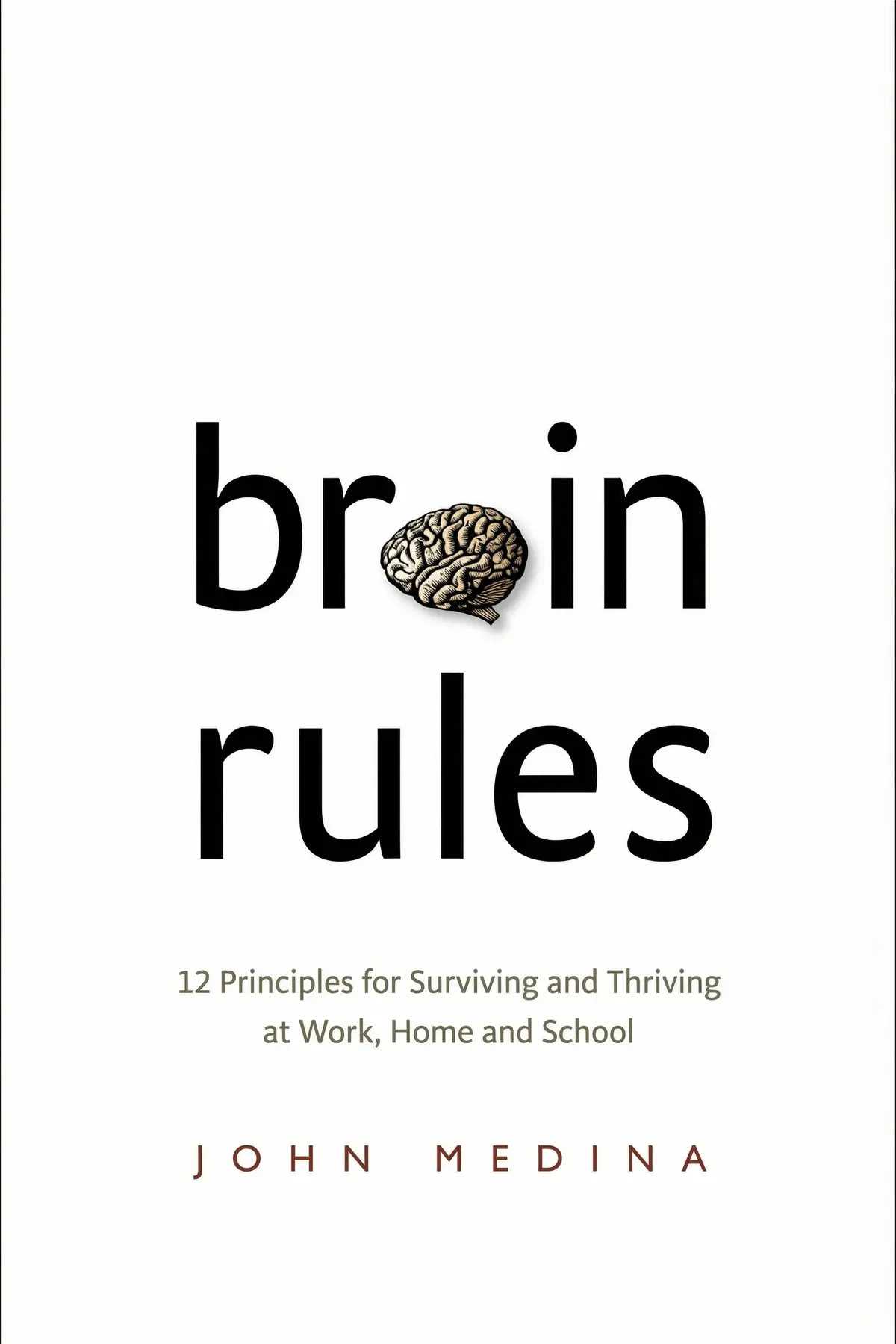
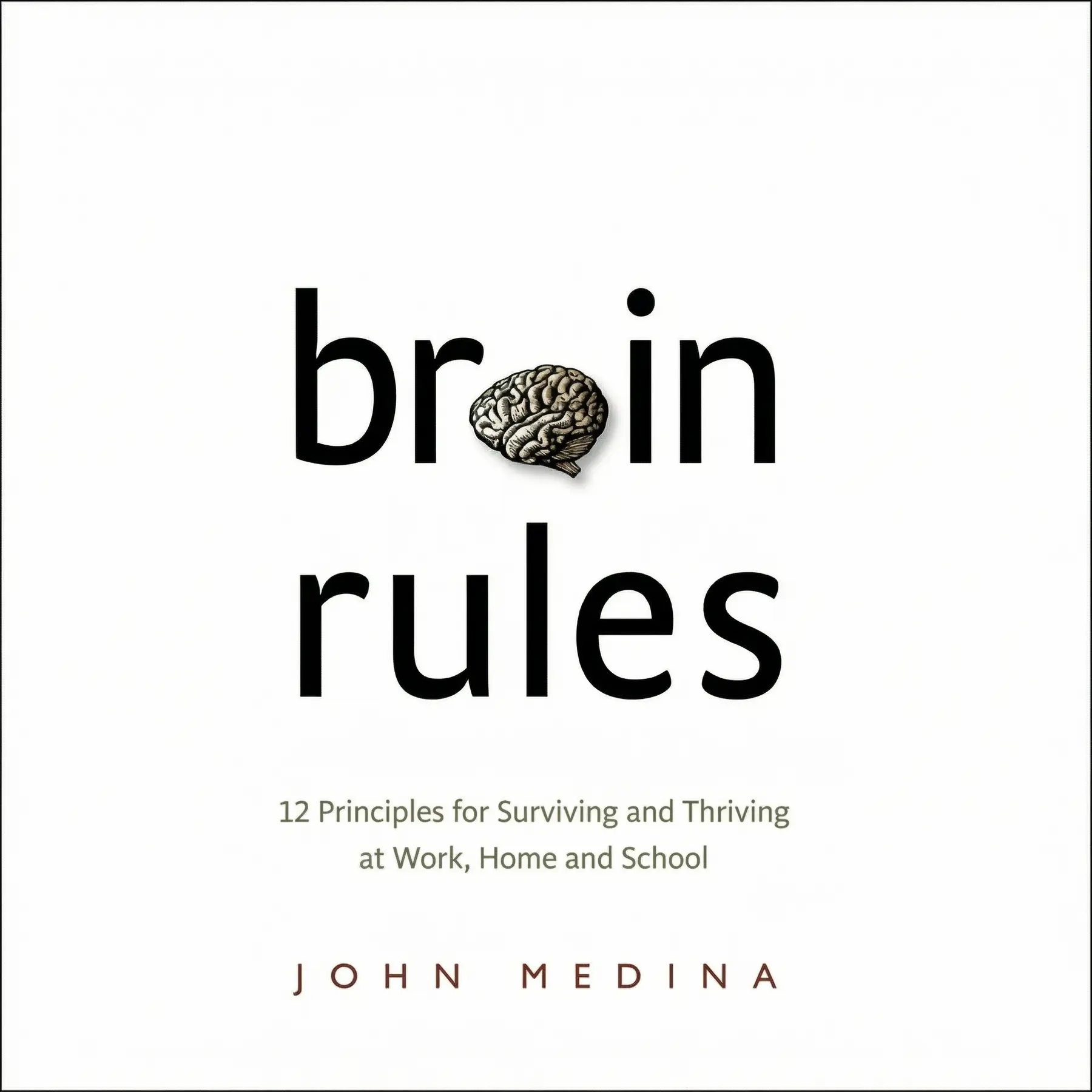
Have you ever felt like your brain wasn't designed for the modern world? In Brain Rules, molecular biologist John Medina bridges the gap between the laboratory and your living room. He presents twelve vital principles that explain how our minds actually function, stripping away myths about multitasking and rote memorization to reveal the biological truth behind human intelligence. The book promises a toolkit for optimizing your mental performance across all areas of life, from the classroom to the boardroom. By understanding the evolutionary pressures that shaped our ancestors, you can unlock better focus, more resilient memory, and a healthier lifestyle. It’s an exploration of why we need movement to think, how stress acts as a cognitive poison, and why our visual sense is the ultimate gatekeeper of information.
John Medina is a distinguished professor and research consultant with a specialized background in molecular biology. He has dedicated his career to understanding the development of the human brain and the genetics behind psychiatric disorders. Medina founded the Brain Center for Applied Learning Research and serves as the director of the Talaris Research Institute.
Listeners find this work captivating and accessible, featuring evidence-based observations grounded in brain science. The delivery is both amusing and succinct, making it essential material for those committed to lifelong learning. They value its utility for both professional and personal life, while one listener highlights how thoroughly it addresses the rules of the brain.
Ever wonder why your brain just shuts off during a long PowerPoint presentation? John Medina explains it through the lens of evolution and biology, making a compelling case for why our modern world is built for a brain we no longer fully understand. I was especially gripped by the 'Vision' rule—the idea that our eyes can actually trick our other senses is just mind-blowing. The story about wine experts being fooled by red dye was a highlight for me. It’s rare to find a science book that is this easy to digest without feeling like it’s being oversimplified for the masses. Every chapter provides practical takeaways for the home and the office. If you want to improve your productivity or just understand your own sleep cycles better, you need to pick this up. It is an engaging, research-driven masterpiece that I'll be recommending to my entire team.
Show moreFinally got around to reading this after seeing it on every 'must-read' list for years, and it lived up to the hype. What makes this stand out is that it doesn't just tell you what to do—it explains the 'why' under the hood. For instance, knowing that dreams are a way for our neural networks to replay learning experiences makes me prioritize my eight hours of sleep much more than a simple health tip would. The book is organized brilliantly, with each rule standing on its own while contributing to a larger picture of human potential. I especially loved the focus on 'Exploration' and the idea that we are natural scientists from birth. It’s an inspiring read that provides a clear roadmap for anyone looking to optimize their cognitive performance at work or home. Absolutely a five-star resource.
Show moreThis book is a game-changer for anyone trying to navigate the modern workplace without burning out their synapses. Medina’s breakdown of how chronic stress affects the brain—leading to a feeling of helplessness and even physical damage—was a wake-up call for me. I’ve started implementing the 'Sensory Integration' rules in my presentations, using more visuals and fewer bullet points, and the engagement from my team has been night and day. The writing is incredibly lucid and entertaining, making it one of the few science books I couldn't put down. I love that he includes a DVD and a website for further exploration, which shows he really practices what he preaches about multiple sensory inputs. This is a must-read for managers, parents, and anyone who wants to understand the engine inside their head.
Show moreAs an educator, I’m constantly looking for ways to make lessons stick, and this book delivered exactly what I needed to rethink my classroom. Medina breaks down complex molecular biology into twelve accessible 'rules' that explain how our brains actually process information. I found the '10-minute rule' particularly transformative, as it forced me to realize why my students were tuning out halfway through a standard lecture. While some of the suggestions for school reform feel a bit 'pie-in-the-sky' for our current system, the underlying science is rock solid. Truth is, the chapter on how exercise boosts brain power changed my own morning routine immediately. I do wish he’d cut back on some of the more flowery descriptions of brain anatomy, which felt like filler. However, for a lifelong learner, this is an essential primer on why we think the way we do.
Show moreWow, John Medina has a real talent for making complex neurobiology feel like a casual conversation over coffee. I picked this up hoping for some productivity tips and walked away with a completely new perspective on how to structure my workday. The section on 'Wiring' and how our experiences physically change our brain structure was particularly eye-opening for me. I also appreciated the gender chapter, which handled the differences between male and female brain processing with a lot of nuance and scientific backing. Some of the analogies for brain parts—like the scorpion with an egg—were a bit weird and didn't really help me visualize the anatomy any better. Still, the practical value here is high, especially regarding the 'Sensory Integration' rule. It’s a very quick read that manages to bridge the gap between the lab and the living room.
Show moreAfter hearing Medina speak at a conference, I knew I had to get my hands on the full text to see the research behind his claims. The book is written with a very light, accessible tone that makes it easy to breeze through in a weekend. I was fascinated by the section on 'Theory of Mind' and how it impacts the way we teach and interact with children. It’s clear that his primary passion is improving our schools, which is a noble goal, though some of his proposed solutions feel a bit impractical for today's budget-strapped districts. In my experience, the most useful part was the discussion on multitasking—or rather, the fact that multitasking is a complete myth. That realization alone has helped me focus on one task at a time, and I’ve seen my efficiency jump. It's a solid, practical guide for anyone interested in the mind.
Show morePicked this up on a whim, and I was pleasantly surprised by how much of it stuck with me. The 'Exercise' rule is the one that really hit home; the idea that our brains were designed to think while moving 12 miles a day on the savannah makes so much sense. Now, I try to take walking meetings whenever possible. The book is a bit repetitive in places, but that’s actually one of the rules (repeat to remember!), so I suppose he’s just being consistent. While some of the education-focused chapters felt a little distant from my daily life, the general principles are universal. It’s a great mix of storytelling and hard science that doesn't require a PhD to understand. I'd recommend it to anyone who enjoys learning about human behavior and wants actionable tips to improve their focus and memory.
Show moreThe information tucked inside these chapters is undeniably fascinating, yet I found the 'cutesy' writing style occasionally grating. Medina is clearly a brilliant lecturer, but his habit of using gimmicky teasers—like the 'Jennifer Aniston neuron'—felt a bit like he was talking down to me. To be fair, the research on how stress impacts learning is incredibly valuable and helps explain why high-pressure environments are so toxic for creativity. I just wish the book stayed on track instead of wandering off into long-winded anecdotes that didn't always feel tightly connected to the core principle. The 12 rules themselves are great, but many are things we’ve heard before, like the importance of sleep and repetition. It’s a decent overview for someone totally new to neuroscience, but more seasoned readers might find it a bit too 'pop-science' for their tastes.
Show moreLook, I enjoyed the core concepts of this book, but the delivery felt like a missed opportunity. The 12 rules are solid, and the research is clearly there, but the author's insistence on being 'entertaining' often got in the way of the actual content. I found myself skipping through the long-winded anecdotes about his personal life or the quirky habits of other researchers just to get to the actual data. To be fair, the 'Long-Term Memory' chapter is excellent and provides a very clear explanation of why 'repeat to remember' is so vital for learning. However, I felt like I could have gotten the same value from a 20-minute summary on the book’s website. It’s not a bad book by any means, but it’s a bit fluffed up with stories that don’t always land. It’s a decent 3-star read for me.
Show moreNot what I expected from a book that promised to help me 'thrive.' While the science is based on reputable research, much of the advice feels like common sense dressed up in academic robes. Do we really need a molecular biologist to tell us that exercise is good for us or that we don't pay attention to boring things? The author spends way too much time describing the physical appearance of other scientists, which I found completely irrelevant to the actual data. Frankly, the book feels more like a manifesto for education reform than a guide for personal growth. The '10-minute chunk' writing style, intended to keep the reader engaged, actually felt fragmented and annoying in a written format. If you’ve read any other modern book on habits or the brain, you’ve likely already heard 90% of what is in here.
Show moreJ. Craig Venter
Carl Zimmer
Bill Bryson
Jeff Hawkins


Lisa Kaltenegger
AUDIO SUMMARY AVAILABLE
Get the key ideas from Brain Rules by John Medina, plus 5,000+ more titles in English and Thai.







