
5 min 47 sec
Conscious Capitalism: Liberating the Heroic Spirit of Business
Conscious Capitalism explores how businesses can move beyond profit to serve a higher purpose. It demonstrates how prioritizing stakeholders—employees, customers, and the environment—leads to sustainable success and a more ethical world.
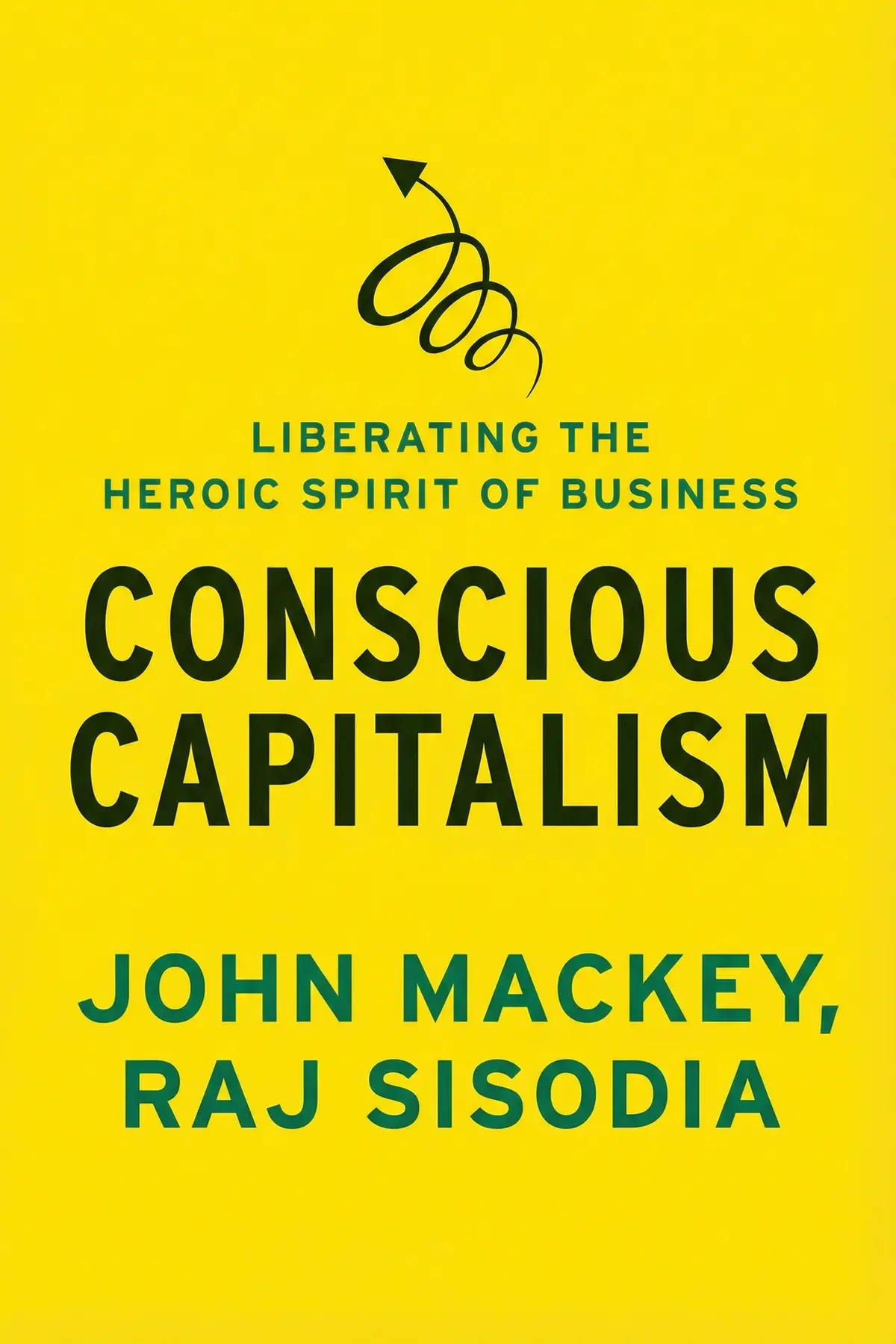
Table of Content
1. Introduction
46 sec
Today’s corporate leaders are facing a massive trust gap. Public confidence in big business has reached historic lows, with many people viewing corporations as entities that prioritize greed over the well-being of the planet. But there is a different way to look at the power of the market. John Mackey and Raj Sisodia argue that business can actually be a heroic force for good. By moving toward a more enlightened path, companies can rediscover their true purpose and create value for everyone involved, not just those at the top. The key is to shift from a focus on short-term numbers to a model of deep, conscious engagement with the world. As we walk through these concepts, we will see that it’s not just about being nice—it’s about a fundamental evolution of the market itself.
2. The Broken Reputation of a Global Engine
1 min 00 sec
Does capitalism deserve its bad reputation? While it has brought unprecedented wealth to the world, trust is at an all-time low. Let’s look at the disconnect between global success and public disdain.
3. Beyond the Bottom Line: The Power of Purpose
54 sec
What happens when a company stops obsessing over the bottom line? By finding a mission that goes beyond money, organizations can transform their entire energy and unlock a new level of excellence.
4. The Stakeholder Symphony
51 sec
Is it possible to make every person involved with a business a winner? Discover how treating suppliers and communities as partners creates a cycle of prosperity that outlasts short-term profits.
5. Redefining Leadership Through Love and Autonomy
50 sec
Why do some of the most successful companies in the world have almost no traditional management? Here is how trading command-and-control for mentorship and trust can turn a workforce into a family.
6. The Real-World Heroic Model
46 sec
Can a business really change the world while being a commercial powerhouse? We look at real-world examples of brands that have turned social and environmental stewardship into a competitive advantage.
7. Conclusion
40 sec
The final takeaway is that the future of business depends on a move toward higher consciousness. When we treat a company as a living entity with a soul rather than a machine for making money, everything changes. It is not enough to just avoid doing harm; the businesses of the future must actively seek to do good for their employees, their customers, and the world at large. It’s about creating a world where profit and purpose go hand in hand, and where every interaction is handled with care and integrity. As you move forward, consider how your own work can align with these principles. By embracing this heroic spirit, we can build a capitalism that truly serves all of humanity.
About this book
What is this book about?
This book challenges the traditional view that business is solely about maximizing shareholder value at any cost. Instead, it proposes a holistic model where companies operate with a higher purpose that benefits everyone they touch. By focusing on the core principles of conscious leadership and a stakeholder-driven culture, the authors argue that business can be a heroic engine for social and environmental good. Through real-world examples, the text explains why the old ways of doing business are failing and how a shift in consciousness can create more resilient, profitable, and meaningful organizations. It promises a roadmap for leaders who want to build trust and inspire their workforce while still achieving financial excellence. Ultimately, it is a vision for a more compassionate and sustainable form of capitalism.
Book Information
About the Author
John Mackey
John Mackey, cofounder and former CEO of Whole Foods Market, grew the natural grocer into a Fortune 500 company with over 460 stores and 87,000 employees while earning many leadership accolades. Raj Sisodia is a business professor and cofounder of Conscious Capitalism Inc. He has coauthored two best-selling books on purpose-driven business and has been recognized as a top thought leader in trustworthy business practices.
Ratings & Reviews
Ratings at a glance
What people think
Listeners consider this work an essential read, particularly for those in business school, and laud its high-quality writing and accessibility. They also value the uplifting themes, noting its emphasis on core principles and a higher purpose, as well as its passionate justification of free market systems. Furthermore, the book is commended for its utility, providing strong real-world examples and excellent worth, with one listener highlighting that it provides proven business models.
Top reviews
Titiluck
Finally got around to finishing this, and I find it to be a refreshing defense of the free market system in an era of corporate greed. Mackey and Sisodia argue that business isn’t just about the bottom line; it’s about a higher purpose that serves everyone from the janitor to the customer. While some might find the spiritual aspects a bit 'woo-woo,' I found the focus on core values incredibly inspirational for any aspiring entrepreneur. The book flows well and offers a blueprint for what a more humane version of capitalism could actually look like in the real world. It's not just theory, as they provide plenty of examples where these models have actually outperformed traditional, cutthroat competitors.
Show moreKiattisak
Wow, what a spirited defense of capitalism that doesn't ignore the ethical responsibilities that come with running a massive corporation. The authors do a fantastic job of distinguishing between 'crony capitalism' and the heroic spirit of true entrepreneurship. I was moved by the idea that a company can prioritize its culture and community impact without sacrificing its profitability or stock price. It’s an essential read for anyone who feels disillusioned with the current state of Wall Street but still believes in the power of commerce. The examples provided, like Southwest Airlines and The Container Store, prove that this isn't just some pipe-dream philosophy.
Show morePrim
Ever wonder if it’s possible to be a successful CEO without losing your soul in the process? Mackey and Sisodia argue that it’s not only possible but actually necessary for the survival of our global economic system. This book is a revolutionary look at how we can brand capitalism as a force for liberation rather than exploitation. I found the sections on 'conscious culture' to be particularly moving, emphasizing trust and transparency over the usual corporate secrecy. It’s an inspirational guide that makes you want to go out and build something that truly matters to the world. A must-read for any leader who wants to leave a lasting, positive legacy.
Show moreSirichai
Truth is, I wasn't sure if a book co-authored by the Whole Foods founder would be anything more than a vanity project, but I was wrong. This is a deeply thoughtful and well-written exploration of how ethics and commerce can coexist in a way that benefits everyone. The readability is fantastic, and the authors do a great job of making the reader feel empowered to make changes in their own professional lives. It provides a much-needed positive spin-off for capitalism, showing that it can have a redemption arc if we choose to lead with empathy. This is easily one of the most important business books I've read in the last decade.
Show moreSomporn
As someone currently grinding through a business degree, this was a necessary break from the dry, profit-obsessed textbooks I'm usually assigned. The writing quality is top-notch, making complex economic theories feel accessible and even exciting to read. I particularly enjoyed the sections on 'conscious leadership,' though I do think Mackey spends a bit too much time talking about his own company, Whole Foods. It can feel like a bit of a promotional piece at times, but the underlying message about stakeholder integration is solid. If you want to believe that business can be a force for good, this is probably the most practical guide you'll find on the shelf.
Show moreWanida
Picked this up on a recommendation and found the emphasis on 'Systems Intelligence' to be one of the more fascinating takeaways. The book argues convincingly that we must balance the needs of all stakeholders—employees, suppliers, and the environment—to achieve long-term success. Frankly, it gets a bit repetitive in the middle sections, especially when they dive deep into shareholder minutiae, but the overall framework is incredibly valuable. I appreciated the practical business models that are laid out, even if the tone occasionally veers into 'preachy' territory. It’s a great value for the money if you can look past the author's clear bias toward his own brand.
Show moreNook
After hearing so much buzz about this title, I was surprised by how much practical advice was actually tucked between the spiritual bits. The authors provide a clear roadmap for how a company can transition from a narrow focus on profits to a broader focus on value creation. While the 'must-do' tone can be a bit patronizing at times, the actual business models they highlight are proven and effective. It’s an excellent read for anyone looking to build a company with a strong internal culture and a positive external impact. Even if you don't agree with every point, the challenge to rethink the purpose of business is well worth your time.
Show moreThawee
The chapter on conscious leadership had some interesting points, but the rest of the book felt incredibly uneven to me. On one hand, you have these beautiful ideals about purpose and meaning, but then you're hit with long strings of flowery adjectives that don't really mean much. I wanted to see more diverse case studies instead of hearing about Whole Foods every ten pages. It’s an 'okay' read if you’re new to the concept of sustainable business, but more experienced finance professionals will probably roll their eyes at the lack of hard data. It functions better as a manifesto for the 'do-gooder' crowd than a serious economic critique.
Show moreOrawan
This book felt like one long, wordy advertisement for Whole Foods disguised as a manifesto on corporate ethics. Mackey seems unable to separate his own ego from the narrative, constantly referencing his grocery store as the pinnacle of human achievement. To be fair, some of the ideas about treating employees better are great on paper, but the execution in the text is full of hokey buzzwords and spiritual prescriptions. I didn't need a lecture on why I should give up caffeine or start meditating in the middle of a business strategy book. It’s a very pretty-looking distraction from the systemic issues of wealth hoarding and crony capitalism that actually plague our society.
Show moreRay
Not what I expected at all; it’s mostly just John Mackey trying to convince us that he’s some kind of enlightened guru. The man was in a cult and it shows in his writing, which is packed with condescending advice about how workers should be grateful for 'trickle-down' crumbs. He labels Walmart and Amazon as 'conscious' businesses, which is honestly laughable if you've ever looked at their actual labor practices. This isn't a book about reforming capitalism; it's a manual for billionaires to feel better about their wealth while masking it with empty employee discounts. I found the whole thing to be a miserable, ego-driven slog that failed to address any real economic problems.
Show moreReaders also enjoyed
A Year with Peter Drucker: 52 Weeks of Coaching for Leadership Effectiveness
Joseph A. Maciariello
Acting with Power: Why We Are More Powerful Than We Believe
Deborah Gruenfeld
All In: How Great Leaders Build Unstoppable Teams
Mike Michalowicz
7 Powers: The Foundations of Business Strategy
Hamilton Helmer
AUDIO SUMMARY AVAILABLE
Listen to Conscious Capitalism in 15 minutes
Get the key ideas from Conscious Capitalism by John Mackey, plus 5,000+ more titles in English and Thai.
- 5,000+ titles
- Listen as much as you want
- 7-day free trial
- Cancel anytime







