
A Promised Land
Barack Obama
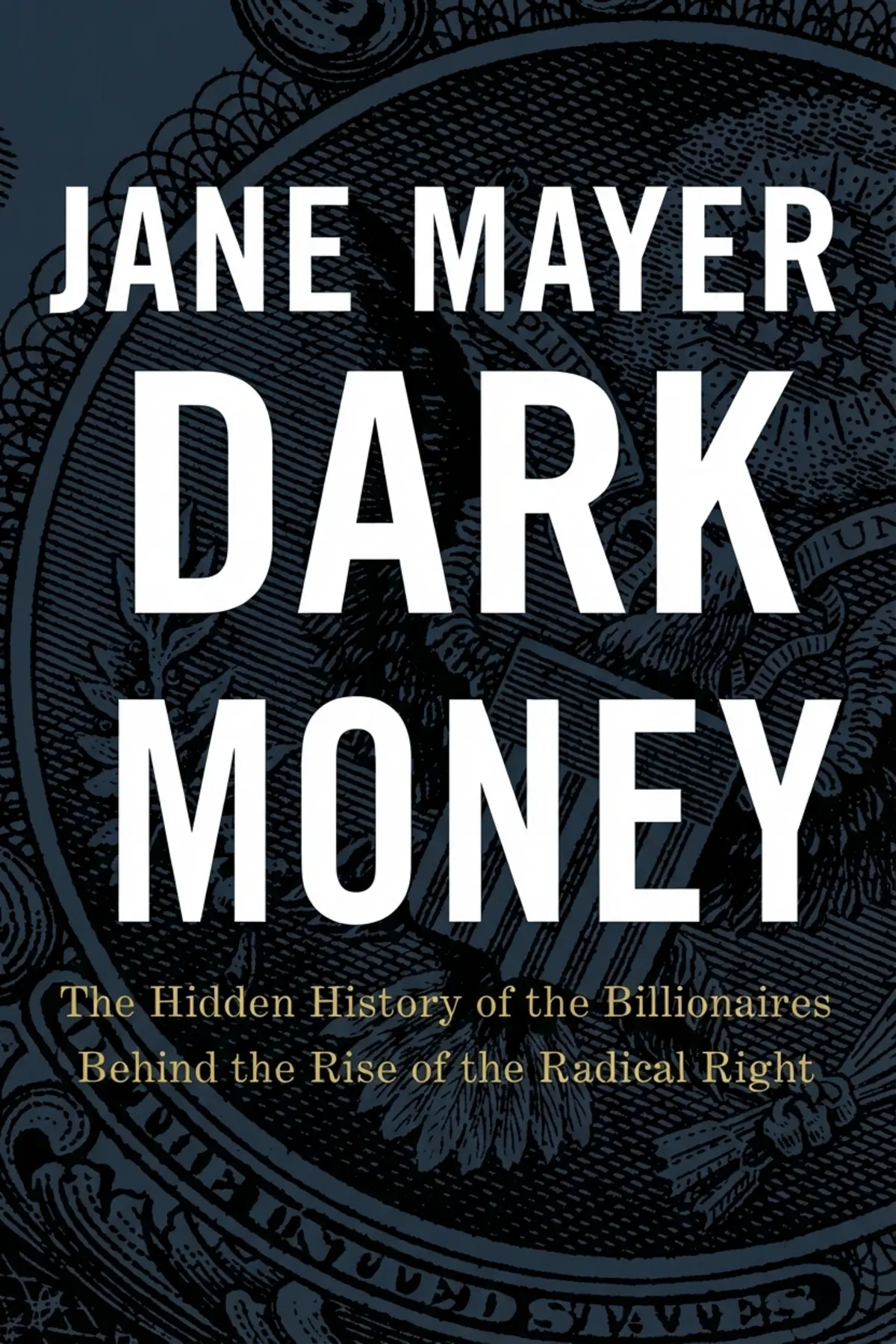
Dark Money investigates how a small group of incredibly wealthy individuals, led by the Koch brothers, have spent decades and billions of dollars to systematically reshape American politics and public opinion.
1 min 52 sec
In the world of political thrillers, there is a famous instruction that serves as a compass for those trying to uncover the truth: follow the money. It sounds simple enough, but in the modern American political landscape, that trail often leads into a labyrinth of shadows, anonymous foundations, and complex corporate structures. This is the world explored in Jane Mayer’s Dark Money. It is a world where the traditional mechanisms of democracy—the votes of citizens and the transparent debates of the public square—are increasingly rivaled by the quiet, concentrated power of immense private wealth.
At the center of this narrative are two brothers, Charles and David Koch, whose names have become synonymous with a specific brand of political influence. But Mayer’s investigation goes much deeper than just two individuals. She uncovers a multi-generational project designed to shift the very foundations of American society. This isn’t just about winning an election here or there; it is about changing what Americans believe is possible and desirable in their government.
As we walk through this summary, we will see how a philosophy of radical libertarianism was nurtured in the mid-twentieth century and then systematically deployed across universities, think tanks, and eventually the halls of Congress. We will explore the ingenious ways that tax laws and nonprofit regulations have been used to shield the identities of donors while maximizing their impact. We will look at how seemingly spontaneous grassroots movements were, in fact, carefully cultivated by sophisticated political machines.
Ultimately, this is a story about power—who has it, how they use it, and what happens to a democratic system when the financial scales become so heavily tilted. By the end of this journey, you’ll have a clearer understanding of the forces that have reshaped the American right and the hidden architecture that supports today’s most heated political battles. Let’s begin by looking at the roots of this influence and the men who built the ‘Kochtopus.’
2 min 31 sec
Discover how a fortune built on oil and controversial international ties laid the groundwork for a massive, multi-decade campaign to influence the American government.
2 min 28 sec
Explore the clever use of nonprofit organizations to funnel billions into politics while maintaining total anonymity and securing significant tax breaks.
1 min 59 sec
See how the Koch network targeted prestigious universities to cultivate a new generation of conservative leaders and legal scholars.
2 min 16 sec
Uncover the role of billionaire-funded think tanks in sowing doubt about climate change and other scientific realities to protect corporate interests.
2 min 17 sec
Learn how the Tea Party movement, often seen as a spontaneous uprising, was actually a carefully manufactured ‘astroturf’ campaign.
1 min 59 sec
Understand how the landmark Citizens United decision fundamentally altered American democracy by giving corporations unprecedented political power.
1 min 58 sec
Discover the REDMAP strategy, a ruthless plan to secure long-term control of the House of Representatives by redrawing the political map.
2 min 09 sec
Examine the chilling possibility that the United States is moving away from democracy and toward a system controlled by a handful of the ultra-wealthy.
1 min 41 sec
Jane Mayer’s Dark Money is a deeply researched and disturbing look at the machinery of modern American politics. It reveals that the polarization and gridlock we see today aren’t just accidents of history or the result of simple ideological differences. Instead, they are the intended outcomes of a deliberate, well-funded, and highly coordinated campaign to reshape the country according to a radical libertarian vision. By following the money, Mayer shows us how a few families have been able to bypass the traditional democratic process and exert a disproportionate influence over our lives, our laws, and our environment.
The throughline of this summary is clear: when money becomes invisible and its influence becomes unlimited, the foundations of democracy begin to crumble. We have seen how the Koch brothers and their allies built a network that spans from the classroom to the courtroom, using anonymity as a shield and philanthropy as a weapon. They have successfully moved ideas from the fringe to the mainstream and structuralized their advantage through clever legal and political maneuvering.
However, the ultimate takeaway of this book is not one of total despair. By bringing these ‘dark’ activities into the light, Mayer provides us with the knowledge necessary to begin a conversation about reform. Understanding the ‘Kochtopus’ is the first step toward dismantling its undue influence. The challenge for the future is to find ways to restore transparency and fairness to our political system, ensuring that the voice of the average citizen is once again as powerful as the wallet of the billionaire. It is a call to action for everyone who believes that the American government should be ‘of the people, by the people, and for the people’—not just for the highest bidders.
Dark Money explores the clandestine financial networks that have come to dominate the American political landscape. Investigative journalist Jane Mayer reveals how a handful of billionaire families, most notably Charles and David Koch, utilized their massive fortunes to fund a sprawling ecosystem of think tanks, academic programs, and political front groups. The book follows the money from its origins in the early twentieth-century oil industry to the highest levels of contemporary government. It promises to pull back the curtain on how 'dark money'—anonymous, tax-free contributions—has been used to bypass traditional democratic processes. By examining the rise of the Tea Party, the impact of the Citizens United Supreme Court decision, and strategic efforts to redraw congressional districts, Mayer demonstrates how these efforts have pushed the country toward a more radical, libertarian-leaning agenda that often favors the interests of the ultra-wealthy over the general public.
Jane Mayer is a highly regarded investigative journalist and a staff writer for the New Yorker. Her work has earned her significant acclaim, including the John Chancellor Award for Excellence in Journalism in 2008. In addition to her reporting on political finance, she is the author of The Dark Side: the Inside Story of How the War on Terror Turned into a War on American Ideals, which examines the tension between national security and democratic principles.
Listeners find this book to be an essential listen that flows like a novel, featuring deep research and superb investigative journalism. They characterize it as a revelatory and captivating expose that is expertly crafted. Reactions to the pacing are varied, with some finding the detail incredibly meticulous while others find it disturbing.
Jane Mayer has delivered a masterclass in investigative journalism with this staggering expose. It is a rare nonfiction book that genuinely reads like a high-stakes political thriller, yet the reality it depicts is far more sobering than fiction. She meticulously traces the flow of 'dark money' from a handful of ultra-wealthy families, specifically the Koch brothers, into the very veins of our democratic system. The level of research is simply astounding. I found myself highlighting passages on almost every page, especially regarding the 'shell games' used to bypass campaign finance laws. While the information is deeply disturbing, the writing is so fluid and engaging that you won't want to put it down. This is an essential read for anyone who wants to understand the invisible forces shaping modern American policy. Truly eye-opening work.
Show morePicked this up on a recommendation and it was far more terrifying than any horror novel I’ve read recently. The way Mayer details the Koch family history—from Fred Koch’s involvement with the John Birch Society to the brothers’ 'Freedom School'—is absolutely fascinating. It’s not just about the money; it’s about a calculated, long-term plan to reshape the American intellect through university funding and judicial influence. The narrative moves at a brisk pace despite the incredible amount of data being presented. You can feel the weight of the research behind every paragraph. It left me feeling both enlightened and incredibly frustrated about the state of our plutocracy. If you care about the future of democracy, you need to read this. It’s an essential, albeit upsetting, piece of reporting.
Show moreWow. I am still processing the sheer scale of the political machine described in these pages. Mayer shows how 'philanthropy' has been weaponized to create a shadow government that answers only to the super-rich. The most eye-opening part for me was learning about the 'Structure of Social Change' blueprint. It isn't just about buying ads; it’s about buying the intellectuals, the think tanks, and the citizens' groups all at once. The writing is sharp and the author does an excellent job of making complex financial structures easy to understand. It’s a disturbing look at how our legal system has been tilted to favor the 1% through decades of quiet investment. This book is a must-read for any citizen who feels like their voice is being drowned out by big money. It’s absolutely brilliant.
Show moreFinally got around to this expose and it’s essentially the secret history of modern American politics. Mayer manages to connect the dots between the early radical right-wing fringes and the current mainstream Republican party. The way she describes the 'Astroturfing' of the Tea Party movement was a real lightbulb moment for me. It’s a fascinating, if depressing, look at how easily democracy can be manipulated when you have an almost infinite supply of capital. The book is excellently written, balancing personal biographies with complex systemic analysis. It reads like a novel because the 'characters' involved are so larger-than-life and their ambitions are so vast. Even if you don't agree with every conclusion Mayer draws, the sheer volume of evidence she presents is hard to ignore. This is a powerful piece of journalism that demands your attention.
Show moreThe chapter on the Koch family history, particularly the influence of their father Fred and his strict upbringing of the boys, is worth the price of admission alone. It provides such a vivid psychological background for their later political obsessions. Mayer doesn't just tell you that money influences politics; she shows you exactly which buttons are being pushed and how the machinery works behind the scenes. The book is disturbing because it makes the case that we are moving toward a neofeudalist society where the public interest is a distant second to the interests of the donor class. The writing is clear, the pacing is generally excellent, and the research is bulletproof. It’s a fascinating, high-stakes story that everyone should know. I cannot recommend this book highly enough for anyone interested in the survival of democracy.
Show moreIn my experience, few books actually live up to the 'must-read' hype, but Dark Money absolutely does. It is a brilliant, meticulously detailed account of how the American political system was essentially privatized. Mayer’s ability to untangle the web of foundations, trusts, and LLCs is nothing short of heroic. She exposes a world where the 'fig leaf of philanthropy' covers up what is essentially a hostile takeover of the government. The book is eye-opening and provides the necessary context for everything from environmental deregulation to the gridlock in Congress. It’s a heavy lift emotionally, as the implications are quite grim, but the knowledge is empowering. This is investigative reporting at its absolute finest. If you want to know who is really pulling the strings, start here. It’s a total game-changer for how you perceive the political landscape.
Show moreEver wonder why the political center in America seems to keep shifting further to the right regardless of what the public actually wants? This book provides the roadmap. Mayer explains how a small group of billionaires have spent decades funding think tanks and 'grassroots' organizations to mainstream radical libertarian ideas. I found the section on the 1980 Libertarian platform particularly enlightening, as it mirrors so much of today’s discourse on abolishing the EPA and dismantling social safety nets. To be fair, the book can feel a bit one-sided at times, and the sheer volume of names and organizations can be overwhelming to keep track of. However, the core message is undeniable. It is a dense, meticulously documented look at how wealth is being converted into raw political power. It definitely changed how I view the news.
Show moreAs someone who follows the news closely, I thought I understood how lobbying worked, but Mayer reveals a whole other level of influence. The book is an excellent deep dive into the 'mercenaries' of the political world—the operators who turn billionaire checks into attack ads and gerrymandered districts. I was particularly struck by the history of the DeVos and Scaife families, which added much-needed context beyond just the Koch brothers. Truth is, it’s a lot to take in, and the tone can be somewhat cynical, but perhaps that’s just a reflection of the subject matter. My only minor gripe is that some chapters feel slightly repetitive as they hammer home the same themes of deregulation and tax evasion. Still, the reporting is top-tier. It provides a vital perspective on why our government functions the way it does.
Show moreFrankly, the most disturbing part of this book isn't just the money; it’s the long game they’ve played with our educational institutions and the judiciary. Mayer’s reporting on how specific law schools and centers were funded to promote a certain ideology is really eye-opening. However, the book is quite long and could have used a tighter edit in the latter half. There are moments where the meticulous detail actually hinders the flow of the argument. You get lost in the sea of 'dark money' conduits and shell companies. It’s definitely a valuable resource and a work of serious investigative reporting, but it requires a lot of patience to finish. I’d recommend it with the caveat that you should be prepared for a very dense read. It’s important, but it’s definitely not light reading for the beach.
Show moreLook, I understand the importance of this subject, but the pacing of this book is incredibly uneven. The amount of detail provided on every single minor donor and obscure foundation is just staggering. It felt like a slog to get through the middle chapters. I appreciate the meticulous investigative reporting, but it often reads more like a legal brief than a narrative for a general audience. The author clearly has a specific perspective, and while she backs it up with documentation, the tone can be quite repetitive. I was hoping for more analysis on how to fix these issues rather than just 400 pages of naming and shaming. It’s informative, yes, but it’s a very dry and exhausting experience. Only for the most dedicated political junkies.
Show moreBarack Obama
Masaji Ishikawa
John Rawls
Miles Taylor
Tracy Rosenthal
Jessica Valenti
AUDIO SUMMARY AVAILABLE
Get the key ideas from Dark Money by Jane Mayer, plus 5,000+ more titles in English and Thai.







