
20 min 48 sec
Drive: The Surprising Truth About What Motivates Us
Drive explores the science of human motivation, revealing why traditional rewards often fail. Daniel Pink explains how autonomy, mastery, and purpose serve as the true engines of high performance and personal satisfaction.
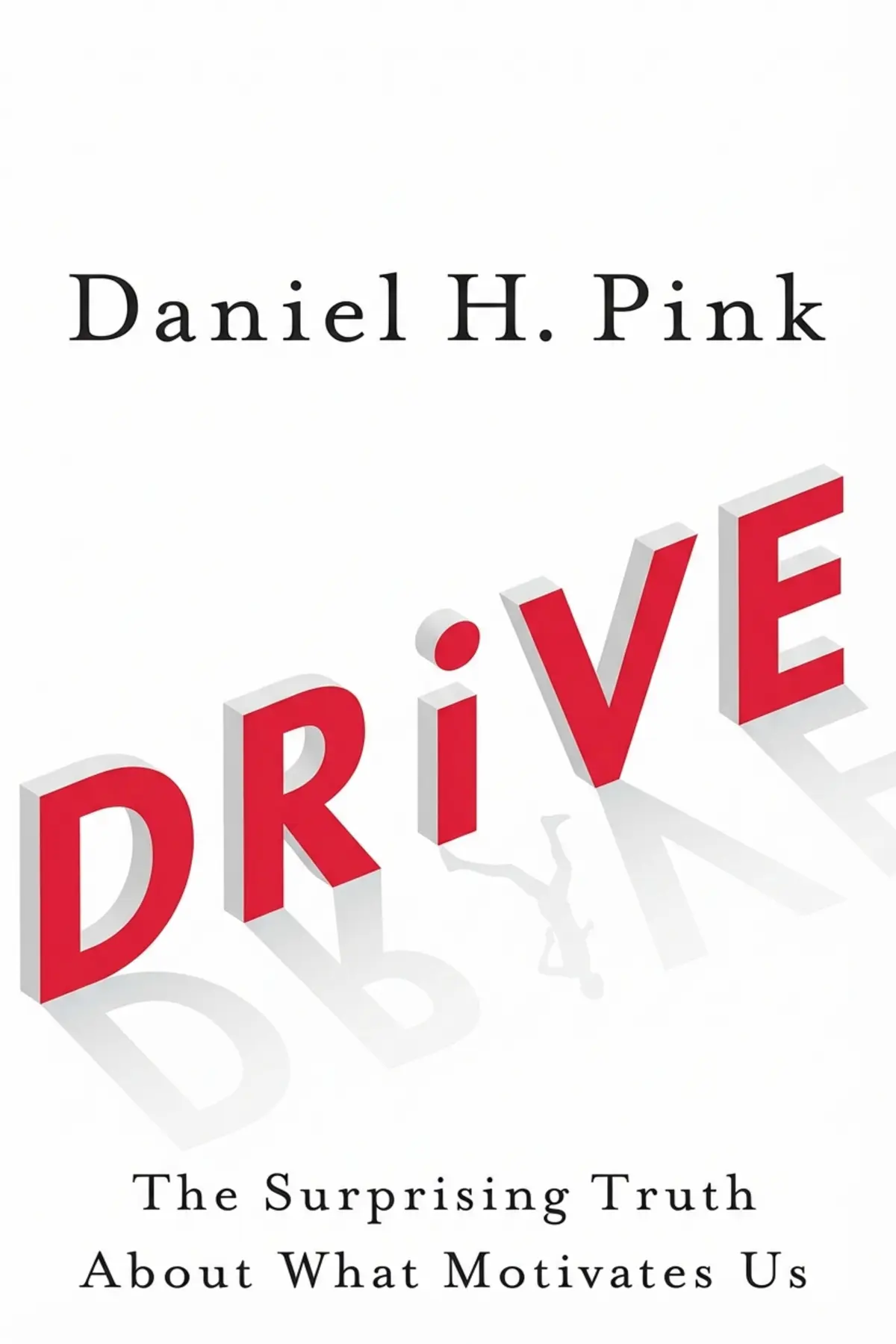
Table of Content
1. Introduction
2 min 26 sec
Think about the last time you were completely lost in a task. Perhaps you were painting, coding, solving a difficult puzzle, or even just gardening. During those hours, you weren’t checking the clock, and you certainly weren’t thinking about a paycheck or a potential bonus. You were doing the activity for the sake of the activity itself. This is what we call intrinsic motivation, and according to Daniel Pink’s Drive, it is the most powerful and yet most misunderstood force in our professional and personal lives.
For a long time, the world of work has been built on a different premise. We’ve been told that humans are essentially simple creatures who respond to external stimuli. We assume that if we want more of a behavior, we should offer a reward—the carrot. If we want less of it, we should threaten a punishment—the stick. This model, which Pink calls Motivation 2.0, worked reasonably well for the routine, repetitive tasks of the Industrial Revolution. If your job is to haul coal or turn a wrench in the same way for eight hours, a financial incentive can indeed make you move a little faster.
But the world has changed. Most of us no longer work on assembly lines. We are knowledge workers, creatives, and problem solvers. Our work requires us to be innovative, empathetic, and cognitively flexible. And here is the shocking truth that science has discovered: for these kinds of tasks, the old carrot-and-stick methods don’t just fail—they often backfire. They can narrow our focus, stifle our creativity, and lead to burnout.
In this summary, we are going to explore why we need an upgrade to Motivation 3.0. We will look at the fascinating experiments that proved humans have a third drive—one that isn’t about biological survival or external rewards, but about the inherent joy of the task itself. We’ll break down the three essential elements of this new operating system: autonomy, mastery, and purpose. By the end of this journey, you’ll understand how to reshape your environment—whether it’s your office, your classroom, or your home—to tap into the deep well of human potential that traditional management has ignored for far too long. It’s time to move past the simple incentives of the past and embrace the surprising truth about what truly motivates us to do our best work.
2. The Evolution of Human Motivation
3 min 08 sec
Discover how our internal operating systems have evolved over millennia, from basic biological survival to the complex intrinsic drives of the modern era.
3. The Hidden Costs of External Incentives
3 min 02 sec
Explore the counterintuitive research showing how ‘if-then’ rewards can actually destroy creativity and hinder long-term performance.
4. Autonomy: The Power of Self-Direction
2 min 40 sec
Learn why giving people control over their time, tasks, and teams leads to higher engagement and more innovative results.
5. Mastery: The Pursuit of Excellence
2 min 41 sec
Uncover the psychological state of ‘flow’ and how a growth mindset can turn work into a lifelong journey of self-improvement.
6. Purpose: The Why Behind the Work
2 min 38 sec
Discover why the search for meaning is becoming a primary driver in the professional world and how it leads to greater well-being.
7. Implementing Motivation 3.0 in Daily Life
2 min 39 sec
Transform your environment by shifting from controlling management to supportive leadership using practical, science-backed strategies.
8. Conclusion
1 min 34 sec
As we look back at the landscape of human motivation, the message is clear: the old ways of doing things are no longer enough. The carrot and the stick might have helped us navigate the survival needs of our ancestors or the industrial demands of the last century, but they are ill-equipped for the creative, complex, and deeply human work of today. Daniel Pink’s Drive challenges us to reconsider everything we thought we knew about what makes us tick. By moving toward Motivation 3.0, we recognize that people aren’t just passive responders to external incentives. We are active, curious, and meaning-seeking beings.
To truly transform your workplace or your personal life, remember the three pillars: Autonomy, Mastery, and Purpose. Seek out ways to give yourself and others more control over the ‘four Ts’—task, time, technique, and team. Foster an environment where people can pursue mastery, getting lost in the ‘flow’ of a challenging but rewarding task. And never forget the importance of purpose. We all want to feel that our time on this planet is being used for something that matters. When we align our work with our values, the results are nothing short of extraordinary.
So, as you step back into your world, ask yourself: Where can I introduce more autonomy today? What skill am I working toward mastering? And most importantly, what is the purpose that drives me? By focusing on these internal fires rather than external rewards, you won’t just perform better—you’ll live better. The science is on our side, and the future belongs to those who are driven from within.
About this book
What is this book about?
For decades, the business world has operated on a simple assumption: if you want people to perform better, you reward them with more money, and if you want them to stop a behavior, you punish them. This is the classic carrot-and-stick approach. However, as Daniel Pink reveals in Drive, this model is increasingly out of sync with the modern world. Drawing on decades of behavioral science, the book argues that for tasks requiring creativity and problem-solving, external incentives can actually hinder performance rather than help it. The book promises a new framework for understanding what truly drives us. It identifies three core pillars: autonomy, which is the desire to direct our own lives; mastery, the urge to get better at something that matters; and purpose, the yearning to do what we do in the service of something larger than ourselves. By moving from an extrinsic model to one based on internal fulfillment, individuals and organizations can unlock higher levels of engagement and innovation. This summary provides the blueprint for that transition, offering a deep dive into the research and practical applications of intrinsic motivation.
Book Information
About the Author
Daniel H. Pink
Daniel Pink studied linguistics and jurisprudence before becoming a prolific author of seven books. His notable works include A Whole New Mind, Drive, To Sell is Human, When, and The Power of Regret, all of which achieved New York Times best-seller status. Beyond his career as a writer, Pink served as the chief speechwriter for US Vice President Al Gore between 1995 and 1997, bringing a high-level perspective on communication and influence to his later psychological and business research.
Ratings & Reviews
Ratings at a glance
What people think
Listeners find the material highly accessible and straightforward, as it simplifies complicated ideas with clarity. They also value the book’s actionable advice, with one listener specifically highlighting its utility as a reference tool. The text offers deep perspectives on what drives human actions and motivation, delivering enthusiastic viewpoints that contest traditional ways of thinking. Furthermore, listeners appreciate its focus on cultivating leadership skills, especially for those in management or organizational roles, as well as its guidance on instructing and coaching students.
Top reviews
Tawee
Have you ever wondered why some projects ignite your soul while others feel like a soul-crushing slog through knee-deep mud? Pink delivers a masterclass on the psychology of what actually gets us out of bed in the morning, focusing on intrinsic drive rather than the outdated carrot-and-stick approach. As a teacher, I found the insights into student motivation particularly eye-opening because it explains why pizza coupons and gold stars usually fail in the long run. We often treat people like horses that need a nudge, but the research here suggests we crave autonomy and a sense of purpose above all else. The writing is snappy and accessible, making complex social science feel like a conversation over coffee with a very smart friend. While some might find the repetition a bit much, I think the core message needs to be hammered home until it sticks. It is a vital read for anyone trying to build a culture of genuine engagement instead of just temporary compliance.
Show moreNew
Wow, the comparison between Wikipedia and Encarta really shifted my perspective on how the world operates now. Pink proves that the old-school management system is basically a legacy operating system that is crashing in the face of modern, creative demands. He calls it Motivation 3.0, and it centers on the idea that humans have a biological urge to learn, create, and better the world. The Swedish blood bank example was another 'aha' moment for me, showing how paying people can actually decrease their willingness to do good. It’s a quick read that packs a punch, focusing on the 'Type I' personality that thrives on internal satisfaction. I’ve started applying these ideas to my own hobbies, focusing on the mastery of the craft rather than the external validation. It’s rare to find a business book that feels this human and optimistic about our innate nature.
Show moreDimitri
After hearing so much about this book in leadership circles, I finally dived in and found it incredibly validating for my own unconventional management style. Pink articulates exactly why the old 'Command and Control' methods are failing in the modern era and offers a compelling alternative based on human dignity. The stories about 3M’s Post-it notes and the success of open-source software like Linux provide concrete evidence that freedom beats force every time. I loved the section on 'Grit' and how the pursuit of mastery requires a certain level of endurance and acceptance of pain. It’s a passionate, insightful look at human behavior that challenged me to rethink how I mentor my own students and staff. The writing is incredibly clear, making it a fast read that stays with you long after you’ve finished the final chapter. This is essential reading for anyone who wants to lead with empathy and intelligence.
Show moreWacharapol
This book is essentially a blueprint for a modern workplace that doesn't suck the life out of its employees. Pink argues that once you pay people enough to take the issue of money off the table, the traditional 'if-then' rewards actually hinder creative output. I found the distinction between routine tasks and non-routine, creative work to be the most practical takeaway for my own management style. Frankly, the inclusion of the 'Cocktail Party Summary' and the chapter recaps at the back are genius moves for busy professionals who need the gist without the fluff. My only gripe is that he occasionally glosses over the reality of mundane jobs where intrinsic joy is harder to manufacture. Still, the transition from Motivation 2.0 to 3.0 feels inevitable and necessary in our current economy. If you want to understand why Wikipedia crushed Encarta despite having no budget, this is your starting point.
Show moreYaowares
Picked this up after a colleague wouldn't stop raving about 'FedEx Days' and I can see why it sparked such a fire in our office. The concept of allowing workers time to work on whatever they want—as long as they deliver something by the next morning—is a game changer. Pink breaks down human motivation into three pillars: autonomy, mastery, and purpose, which sounds simple but is rarely executed well in corporate settings. It's fascinating to see how the 'stick' approach can actually destroy the very creativity we are trying to incentivize. While the book can feel a bit like a padded-out TED talk at times, the case studies are robust enough to keep the pages turning. I’m already thinking about how to implement more '20% time' for my team to explore their own passions. It’s a refreshing perspective that challenges the traditional hierarchy of command and control.
Show moreChaiwat
The chapter on mastery being an 'asymptote'—something you can approach but never fully reach—was the most profound part of the entire experience for me. It reframes the struggle of learning a new skill as a joyous pursuit rather than a frustrating destination you never quite arrive at. Pink’s writing style is punchy and direct, which helps keep the momentum going even when the data gets a little dense. I appreciate how he provides a 'Toolkit' at the end with specific ways to apply these concepts to your life and career. To be honest, I think the book is a bit one-sided, as it ignores the necessity of extrinsic motivators for survival in low-wage sectors. But for the knowledge economy, his arguments for autonomy and purpose are essentially undeniable at this point. It’s a high-energy call to action for anyone who feels stuck in the traditional grind.
Show moreAroon
Truth is, I expected another dry management manual, but what I got was a fascinating dive into the 'why' behind our actions. Pink explains that our current business models are built on assumptions about human nature that were debunked by scientists decades ago. By shifting the focus to 'Type I' behavior, he shows how we can unlock higher levels of performance and satisfaction simultaneously. I particularly liked the discussion on 'if-then' vs. 'now-that' rewards, which clarifies why some bonuses work while others backfire spectacularly. There is a bit of jargon involved—Motivation 2.0, Type X, etc.—but it’s used to clarify the concepts rather than to obscure them. My team is already experimenting with the 'Purpose' element, trying to connect our daily tasks to a larger mission. It’s a helpful resource for anyone who feels that the 'carrot' just isn’t working anymore.
Show morePia
Gotta say, the idea that we are 'born to be players, not pawns' is a powerful mantra that resonated with me throughout the whole book. Pink does an excellent job of distilling complex psychological theories into actionable advice for leaders and parents alike. The emphasis on autonomy—control over our task, time, technique, and team—is a radical departure from the micromanagement culture most of us are used to. While the book does rehash its central thesis quite often, the practical tips on how to foster 'Flow' in the workplace are worth the price of admission alone. I found myself nodding along to the critiques of standardized testing in schools, which perfectly mirrors the flaws in corporate performance reviews. It’s a thought-provoking read that encourages you to stop treating people like units of production. I’ll definitely be keeping this on my shelf as a reference for future projects.
Show moreTern
As someone who spends a lot of time thinking about organizational behavior, I found this to be a solid summary of existing research rather than a groundbreaking discovery. Pink is a fantastic storyteller, and he weaves together the work of scientists like Deci and Ryan into a very digestible narrative for the layperson. However, to be fair, the book is incredibly repetitive and could have easily been a long-form article or a pamphlet. He makes the same point about intrinsic rewards in every chapter, using slightly different anecdotes that all lead to the exact same conclusion. The section on 'Flow' felt a bit thin compared to Csikszentmihalyi’s original work, though it serves as a decent introduction for those who haven’t read it. It’s a good 'starter' book for new managers, but seasoned leaders might find the lack of contradictory evidence a bit frustrating.
Show moreWittaya
Look, this entire book could have been a fifteen-minute podcast episode, and we all would have saved a lot of time. While the core idea that people are motivated by more than just money is obviously true, Pink beats the point into the ground for over 200 pages. He relies heavily on 'consultant-speak' and creates these artificial categories like 'Motivation 3.0' that feel more like marketing than actual science. Furthermore, he conveniently ignores any studies that might suggest extrinsic rewards are actually necessary for many types of labor. It’s a very 'Silicon Valley' view of the world that doesn’t translate well to the average worker who is just trying to pay their rent. If you’ve seen his TED talk, you’ve already received 95% of the value this book has to offer. It’s not that he’s wrong, it’s just that he’s incredibly repetitive and lacks the depth I was hoping for.
Show more
Readers also enjoyed
Acting with Power: Why We Are More Powerful Than We Believe
Deborah Gruenfeld
59 Seconds: Change Your Life in Under a Minute
Richard Wiseman
All In: How Great Leaders Build Unstoppable Teams
Mike Michalowicz
A Liberated Mind: How to Pivot Toward What Matters
Steven C. Hayes
AUDIO SUMMARY AVAILABLE
Listen to Drive in 15 minutes
Get the key ideas from Drive by Daniel H. Pink, plus 5,000+ more titles in English and Thai.
- 5,000+ titles
- Listen as much as you want
- 7-day free trial
- Cancel anytime







