
21 min 23 sec
To Sell Is Human: The Surprising Truth About Moving Others
To Sell Is Human explores how the modern workforce revolves around moving others. Daniel H. Pink reveals why sales skills are now essential for everyone and how to master them with integrity.
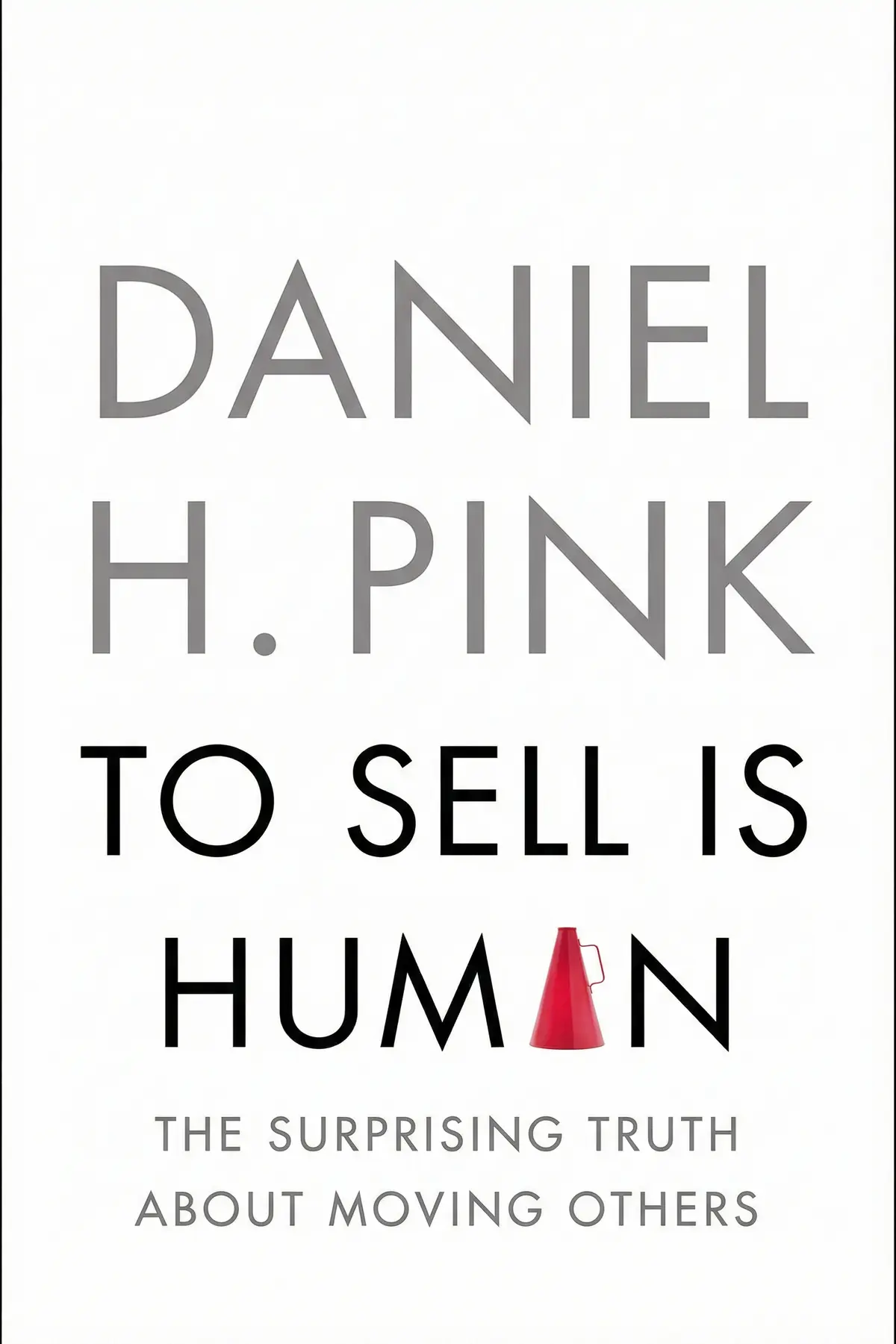
Table of Content
1. Introduction
1 min 55 sec
When we hear the word ‘sales,’ most of us have an immediate, visceral reaction. We think of pushy tactics, insincere smiles, and the feeling of being manipulated into buying something we don’t truly need. For a long time, ‘sales’ was considered a separate, perhaps slightly less-than-reputable department in a company. But as Daniel H. Pink reveals in ‘To Sell Is Human,’ that world is gone. The traditional door-to-door salesman has been replaced by a workforce where nearly everyone—from the software engineer to the nurse—is constantly engaged in the act of moving others.
What this means is that selling, in its broadest sense, has become a core competency for the twenty-first century. We aren’t just selling widgets; we are selling ideas, behaviors, and perspectives. We spend an enormous portion of our professional and personal lives trying to convince someone to part with their time, their attention, or their effort. In this summary, we are going to explore why this shift happened and how the rules of engagement have been rewritten for a world where information is free and transparency is mandatory.
We will look at the new ‘ABC’ of moving people—a framework that replaces the aggressive ‘Always Be Closing’ mantra with three sophisticated psychological tools: Attunement, Buoyancy, and Clarity. We’ll also dive into practical strategies for pitching, improvising, and finding a deeper purpose in our daily interactions. By the time we finish, you’ll see that the ability to move others isn’t just a career skill—it’s a deeply human act of service that, when done right, benefits both the mover and the moved. So, let’s start by looking at how the landscape of work has fundamentally changed and why, like it or not, we’re all in sales now.
2. The Universal Nature of Selling
2 min 19 sec
Discover why the traditional sales role is fading as persuasion becomes a core part of every profession, from engineering to education.
3. The Shift from Buyer Beware to Seller Beware
1 min 59 sec
The internet has leveled the playing field, making transparency and honesty more profitable than deception.
4. Attunement and the Power of Perspective
2 min 18 sec
Learn why the best persuaders aren’t necessarily extroverts and how subtle mimicry can build deep connection.
5. Maintaining Buoyancy in a Sea of Rejection
2 min 18 sec
Master the psychological mindset needed to stay motivated and resilient when faced with constant ‘no’s.’
6. Clarity: From Solving Problems to Finding Them
2 min 18 sec
Discover why the modern value of sales lies in helping others identify the right problems rather than just offering solutions.
7. Mastering the Modern Pitch
2 min 08 sec
Learn how to capture attention in a distracted world using brevity, questions, and the power of rhyme.
8. The Improvisation Mindset in Sales
2 min 07 sec
Replace rigid scripts with the principles of improv theater to stay agile and build collaborative solutions.
9. Serving with Personhood and Purpose
2 min 16 sec
Go beyond the transaction by making your interactions personal and connecting them to a higher purpose.
10. Conclusion
1 min 45 sec
As we’ve explored, the world of sales has undergone a quiet but total revolution. The old boundaries have crumbled, and the old tactics of information hoarding and high-pressure closing are no longer effective—or even possible—in our transparent, hyper-connected world. Whether we are in a traditional sales role or one of the millions of ‘non-sales’ positions, our success depends on our ability to move others. By adopting the new ABCs of Attunement, Buoyancy, and Clarity, we can navigate this new landscape with skill and integrity.
To apply these ideas in your own life, start by shifting your mindset from solving problems to finding them. Look for the underlying needs that people may not even realize they have. Use interrogative self-talk to prepare for challenges, asking yourself ‘Can I do this?’ to activate your problem-solving brain. Practice the ‘Yes, and…’ approach in your next difficult conversation to build a bridge rather than a wall. And finally, always remember the human element. Whether you are pitching a multi-million dollar deal or trying to get your kids to eat their vegetables, your goal should be to leave the other person better off than you found them.
Ultimately, Daniel H. Pink shows us that ‘selling’ isn’t something we do *to* people; it’s something we do *with* them. It’s an act of service, a way of solving problems, and a fundamental part of how we interact as a species. When we lead with honesty, perspective, and a sense of purpose, we don’t just move people—we build lasting connections and create value in a way that is deeply, fundamentally human.
About this book
What is this book about?
Think of the word salesperson. What comes to mind? For many, it's an image of a fast-talking, high-pressure individual in a cheap suit. But according to Daniel H. Pink, that stereotype is not only outdated—it’s entirely wrong. In the modern economy, the traditional wall between sales and every other department has collapsed. Whether you are an engineer pitching a new feature, a teacher trying to engage a classroom, or a parent negotiating with a toddler, you are in the business of moving people. This book promises to reshape your understanding of persuasion. It moves away from the old-school tactics of deception and information hoarding toward a new era defined by honesty, empathy, and service. Pink introduces the new ABCs—Attunement, Buoyancy, and Clarity—and provides a toolkit of modern techniques, from the one-word pitch to the power of improvisational theater. By the end, you’ll see that selling isn't a dirty word; it's a fundamental human skill that allows us to connect, solve problems, and make the world a more functional place.
Book Information
About the Author
Daniel H. Pink
Daniel H. Pink is a renowned American author who has written several influential books on work, management, and behavioral science. His previous bestsellers, including Drive and A Whole New Mind, have transformed how organizations view motivation and creativity. Recognized by the Harvard Business Review as one of the top 50 most influential management gurus globally, Pink's work has reached a massive audience, with his books selling over one million copies in the United States alone.
Drive: The Surprising Truth About What Motivates Us
Daniel H. Pink
When: The Scientific Secrets of Perfect Timing
Daniel H. Pink
Ratings & Reviews
Ratings at a glance
What people think
Listeners view this work as an essential read for salespeople, highlighting the approachable writing and gripping narrative. The book is heavily evidence-based, drawing on educational research and examples that push people to think creatively. Additionally, listeners find the hands-on tips useful for any professional role and value the modern perspective on how selling works today.
Top reviews
Pruet
As a career educator, I never thought a book about sales would apply to my daily life in the classroom. Daniel Pink completely changed my perspective by showing how we are all in the business of 'moving' others, whether we’re pitching a product or a lesson plan. The concept of 'non-sales selling' is a total game-changer for those of us who find traditional marketing methods slimy or aggressive. I particularly loved the section on the Pixar Pitch; it’s a brilliant, structured way to tell a compelling story that sticks. The writing is incredibly conversational and moves at a brisk pace, making it easy to digest between classes. While some might find the research a bit light compared to a textbook, the practical application is where this book shines. It’s a must-read for anyone who needs to persuade, which, as Pink points out, is basically everyone.
Show moreNam
This book completely dismantled my prejudice against the word 'sales' and replaced it with a sense of purpose. Pink argues that in a world of information parity, the old 'buyer beware' mentality is dead, replaced by 'seller beware.' I found the concept of 'servant-selling' to be deeply moving—the idea that moving others is actually about improving their lives. The Pixar Pitch framework alone was worth the price of admission for me. It’s rare to find a business book that is this well-researched yet remains so accessible and fun to read. The examples are vivid, and the 'Sample Case' sections at the end of each chapter offer immediate ways to test the theories. Not gonna lie, I’ve already started using the 'Question Pitch' in my team meetings and the results are noticeable. It’s a compelling look at human behavior that everyone should read.
Show moreBunyarit
Wow. This is the best book on human interaction I’ve picked up in years. Pink manages to take the stigma out of sales and shows that moving people is a fundamental human skill that requires empathy and honesty. I listened to the audio version narrated by the author, and his energy is absolutely infectious; you can tell he really believes in this stuff. The ' Pixar Pitch' and the 'Twitter Pitch' are so relevant for today’s fast-paced digital environment where you only have a few seconds to make an impression. It’s well-researched, backed by informative studies, and filled with case studies that actually make sense. Whether you are a parent, a designer, or a CEO, there is something in here that will make you better at your job. I’ve already bought three extra copies to give to my team.
Show moreAkosua
Ever wonder why some people just seem to ‘get’ others instantly while others struggle to communicate? This book dives deep into the psychology of persuasion, but it does so through engaging storytelling rather than dry data. The ABCs of moving others—Attunement, Buoyancy, and Clarity—provide a solid framework for anyone looking to improve their interpersonal skills. Personally, the chapter on ‘Buoyancy’ and how to handle rejection was the most helpful part for me. It’s not just about being positive; it’s about how you explain failure to yourself. To be fair, if you’ve spent years studying social psychology or read 'Influence' cover-to-cover, some of this might feel like a refresher. However, Pink’s ability to synthesize complex ideas into actionable advice is top-notch. It’s a solid four-star read that I’ll likely revisit when I need a boost before a big presentation.
Show moreMarasri
Finally got around to reading this, and I was pleasantly surprised by how much it challenged my introverted assumptions. The data showing that ambiverts actually outperform extreme extroverts in sales roles was incredibly reassuring for someone like me. Pink has a knack for taking familiar concepts and giving them a fresh, modern spin that feels relevant to the 21st-century workforce. I specifically appreciated the 'Clarity' section, which emphasizes that finding the right problem to solve is often more important than the solution itself. My only gripe is that it occasionally feels a bit repetitive, hammering home the 'we are all salespeople' point a few times too many. Still, the practical tips on improvising and the six types of elevator pitches are tools I’ll keep in my back pocket. It’s an insightful, quick read that helps you think outside the box regarding your own career.
Show moreAiden
Picked this up on a recommendation from a colleague, and I’ve been using the techniques in my freelance consulting ever since. The shift from 'selling' as a dirty word to 'selling' as a human necessity is handled with a lot of grace and wit. I loved the breakdown of different pitch styles, especially the Rhyming Pitch—it sounds cheesy, but the research behind it is actually quite fascinating. Look, the book isn't going to turn you into a master negotiator overnight, but it provides a very helpful mental map for navigating professional interactions. The writing is snappy and the tone is encouraging without being overly 'rah-rah' like a lot of old-school sales books. It’s a modern guide for a world where we’re all trying to get our ideas heard. I’d recommend it to anyone who feels like their great ideas are getting lost in the noise.
Show moreOscar
After hearing so much buzz about the 'surprising truth' of moving others, I found this to be a solid, if not revolutionary, read. The most valuable takeaway for me was the idea of 'problem finding' vs 'problem solving.' In my line of work, we often jump straight to solutions without really understanding the client's underlying pain points. Pink’s anecdotes, like the one about the Fuller Brush man, are entertaining and help illustrate his points, even if they feel a bit nostalgic. The book is very much in the vein of Gladwell or the Heath brothers—easy to read, full of 'aha' moments, and very shareable. It’s not a technical manual, but it is a great psychological primer. If you're looking for a way to sharpen your persuasion skills without feeling like a manipulator, this is the right place to start.
Show moreSamroeng
While I appreciate Pink's attempt to modernize the image of the salesperson, this felt a bit like a collection of blog posts stitched together. The structure is very neat—three sections, three chapters each—but sometimes the content feels stretched to fit that symmetry. I found the anecdotes about the last Fuller Brush salesman entertaining, yet they didn't always bridge the gap to my actual work in software development. Truth is, the book leans heavily on 'pop psychology' tropes that have been covered extensively elsewhere. The section on ambiverts was a highlight, though I had already seen most of that data on his website. It’s a pleasant, quick read with some good gems on writing concise emails and subject lines, but don't expect a deep academic dive. If you want something light and encouraging, pick it up, but if you want heavy research, look elsewhere.
Show moreJin
To be fair, the writing style is incredibly engaging and snappy, but I frequently found myself wanting more 'how-to' and less 'why.' The first half of the book spent a long time convincing me that I'm a salesperson, which I already knew because I bought the book! Once we got into the ABCs, things picked up, but even then, the advice felt a bit surface-level at times. I enjoyed the story about the used car lot and how the internet changed that industry, but did it help me close a deal? Not really. The section on 'Attunement' was probably the strongest, specifically the tips on subtle mimicry and perspective-taking. It’s a decent book to keep on the nightstand for a few nights of light reading, but it lacks the 'meat' of some of Pink's other works like 'Drive'.
Show moreHang
Frankly, if you've read Cialdini's 'Influence' or any standard organizational behavior textbook, you can probably skip this one. My first clue that the book wasn't for me was the slim physical size combined with the surprisingly large font and generous margins. It felt like the content was being stretched to justify a hardcover release. Between the constant anecdotes and the lack of truly rigorous data, I felt my time wasn't being respected as a reader who enjoys deep dives. Pink is a talented writer, no doubt, but this felt like it was written for the lowest common denominator of business consumer. The 'surprising truths' aren't particularly surprising if you pay attention to modern workplace trends or have a basic grasp of social psychology. I finished it, but I didn't walk away with anything I hadn't already heard in a dozen TED talks.
Show moreFeatured in

Readers also enjoyed

AUDIO SUMMARY AVAILABLE
Listen to To Sell Is Human in 15 minutes
Get the key ideas from To Sell Is Human by Daniel H. Pink, plus 5,000+ more titles in English and Thai.
- 5,000+ titles
- Listen as much as you want
- 7-day free trial
- Cancel anytime







