


24 min 14 sec
Empire of Cotton: A Global History
By Sven Beckert
Empire of Cotton explores the global history of the cotton industry, revealing how this single commodity drove the rise of capitalism, shaped international relations, and fueled the Industrial Revolution through both innovation and exploitation.
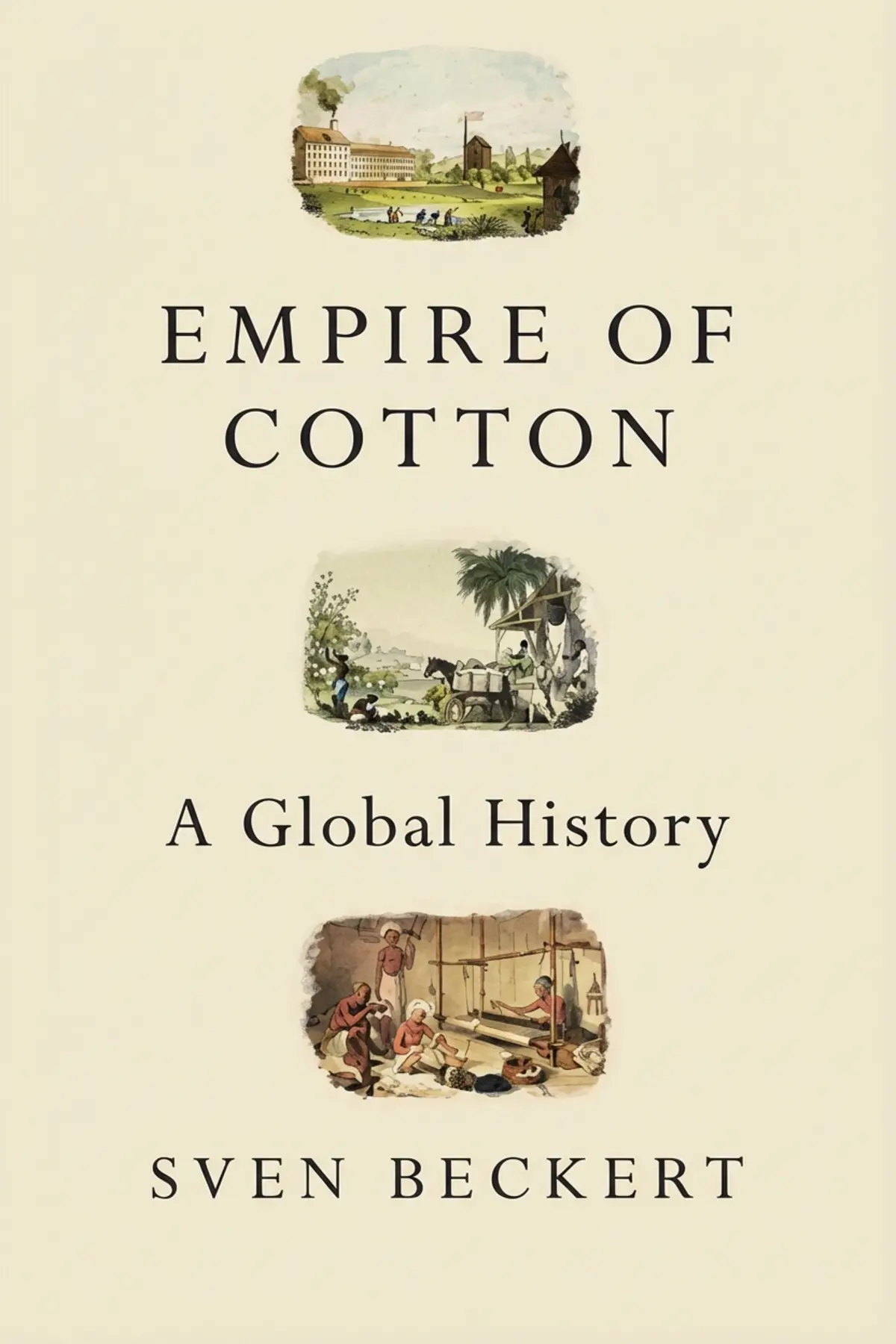
Table of Content
1. Introduction
1 min 53 sec
When you look at the clothes you are wearing right now, there is a very high probability that you are in direct contact with the legacy of a global empire. Whether it is a soft cotton t-shirt, a pair of sturdy denim jeans, or the sheets on your bed, cotton is so ubiquitous today that we often view it as a humble, everyday material. We tend to think of it as far less glamorous than silk or satin, yet this single plant has arguably done more to shape the modern world than any other substance in human history.
To understand the story of cotton is to understand the story of modern capitalism itself. It is a tale that spans centuries and continents, linking the ancient traditions of indigenous peoples to the high-stakes world of global finance. In this summary, we are going to trace the journey of this white, fluffy fiber from its early origins in places like Africa, Asia, and the Americas, through the violent era of colonial expansion, and into the heart of the Industrial Revolution.
We will see how cotton was the catalyst for massive shifts in human society. It moved people across oceans, sparked bloody conflicts like the American Civil War, and created the very concept of the global supply chain. We will explore how the thirst for cotton profit gave rise to ‘war capitalism’—a system built on the twin pillars of stolen land and forced labor—and how that eventually evolved into the factory systems that defined the 19th and 20th centuries.
Through this lens, we can see the origins of the economic divide that still characterizes our world today, separating the industrialized West from the developing global South. By the end of this journey, you will see that cotton is not just a fabric; it is the thread that holds the history of our global economy together. Let’s begin by looking at how this plant was a global phenomenon long before Europeans even knew it existed.
2. The Independent Origins of Cotton Culture
2 min 01 sec
Before it was a global commodity, cotton was a localized miracle discovered independently across three different continents by ancient civilizations who mastered its versatile potential.
3. The Birth of War Capitalism
1 min 42 sec
Europe’s entry into the cotton trade wasn’t just a business move; it was the start of a violent era of global expansion that linked three continents through blood and profit.
4. Mechanization and the Great Productivity Leap
2 min 01 sec
The invention of the mechanized cotton mill shifted the center of global power, allowing European manufacturers to outperform traditional weavers by an staggering margin.
5. The Crucial Role of the Strong State
1 min 52 sec
Industrial success was not just about machines; it required the support of powerful governments capable of enforcing laws and protecting domestic markets from foreign competition.
6. The Rise of the American South as a Cotton Powerhouse
1 min 50 sec
By combining a favorable climate with the brutal efficiency of slave labor, the Southern United States became the primary supplier for the world’s booming textile industry.
7. The Human Reality of the Industrial Machine
1 min 56 sec
Behind the economic statistics of the Industrial Revolution lie the lived experiences of millions of workers who were forced into a relentless new rhythm of labor.
8. The Middlemen and the Architecture of Trust
1 min 39 sec
As cotton production became a global enterprise, a new class of merchants and brokers emerged to manage the complex risks of international trade through family and religious networks.
9. The Global Shock of the American Civil War
1 min 39 sec
The outbreak of war in the United States caused a ‘cotton famine’ that forced European powers to reinvent their supply chains and find new sources of raw fiber.
10. New Systems of Control After Emancipation
1 min 49 sec
When slavery ended, it was replaced by new economic structures like sharecropping and debt-peonage that kept workers tethered to the cotton fields through financial obligation.
11. Colonial Expansion and the Deindustrialization of the Global South
1 min 55 sec
In the early 20th century, emerging world powers like Japan and Russia used colonial expansion to secure their own cotton supplies, often at the expense of local industries.
12. The Great Migration of Industry to Asia
2 min 04 sec
The 20th century saw the decline of European textile dominance as production shifted to China and India, where lower wages and state support created a new center of gravity.
13. Conclusion
1 min 53 sec
The story of cotton is far more than a chronicle of a textile; it is the blueprint of our modern global economy. Over the course of centuries, we have seen how this simple plant was used to forge an empire that linked the entire world in a web of trade, innovation, and often, extreme suffering. From the independent weavers of the ancient world to the ‘war capitalism’ of the colonial era, cotton has been the primary driver of global integration.
We have explored how the Industrial Revolution was not just a story of clever machines, but a story of the state’s power to protect markets and the exploitation of the most vulnerable members of society—from the enslaved people in the American South to the child laborers in the mills of Manchester. We have seen how the American Civil War acted as a global pivot, forcing empires to reinvent their supply chains and deepen their control over colonial territories in India and Egypt.
In the modern era, the shift of the industry back to Asia reminds us that the quest for lower costs and higher productivity is a never-ending cycle. Today’s global landscape, with its clear divide between the wealthy, consuming nations of the West and the producing nations of the East and South, is a direct result of the structures built during the reign of the cotton empire.
The actionable takeaway from this history is a call for greater awareness. When we look at the ‘Made in’ label on our clothing, we are looking at the latest chapter in a long and complex history. Understanding this past allows us to see the hidden costs of our global economy and challenges us to think about how we can build a future where international trade is defined not just by efficiency and profit, but by equity and human dignity. Cotton built the modern world; now, it is up to us to decide what kind of world we want to weave next.
About this book
What is this book about?
This narrative dives deep into the intricate history of cotton, tracing its path from ancient independent civilizations to its role as the backbone of the modern global economy. It examines how European powers transformed a decentralized craft into a massive, violent, and highly profitable global empire. The book explains the shift from 'war capitalism'—characterized by land theft and slavery—to the industrial capitalism of mechanized mills. Listeners will learn how the American South became a dominant force, how the British Industrial Revolution relied on the labor of the vulnerable, and how the global landscape shifted again after the American Civil War. The story concludes by looking at the 20th-century resurgence of cotton production in Asia, illustrating how the legacy of this industry continues to define the divide between the world's developed and developing nations today.
Book Information
About the Author
Sven Beckert
Sven Beckert is a distinguished historian who earned his PhD from Columbia University. He currently serves as the Laird Bell Professor of American History at Harvard University. His acclaimed work, Empire of Cotton: A Global History, was a finalist for the 2015 Pulitzer Prize for History and received the prestigious Bancroft Prize that same year.
Ratings & Reviews
Ratings at a glance
What people think
Listeners find this work to be an authoritative research piece that solidifies historical facts and presents a compelling story regarding cotton’s significance during the Industrial Revolution. Additionally, the book provides a wealth of detail, with one listener praising its all-encompassing global perspective on the textile, and listeners appreciate how it reshapes their grasp of modern capitalism. The prose style draws varied responses; some consider it well-crafted while others describe it as ploddingly written. Listeners also value the text's accessibility and consider it a good investment.
Top reviews
Bun
Sven Beckert has managed to turn a commodity as mundane as cotton into a sweeping epic about the birth of the modern global economy. This isn't just a history of a plant; it's a deep dive into what the author calls 'war capitalism,' showing how state violence and slavery weren't just side effects but essential ingredients of industrial progress. Frankly, the breadth of the research is staggering, with nearly a third of the book dedicated to footnotes and sources. While the prose can occasionally lean toward the academic, the narrative force behind his arguments about globalization kept me hooked until the very last page. It completely reframed how I view the shirts on my back and the systems that put them there. This is a masterful study that reinforces historical reality in a way few other books manage.
Show morePlernpiriya
Wow, I never realized how much of our modern world was built on a foundation of coerced labor and global trade networks centered around a single plant. This book is a powerful indictment of the colonial systems that fueled the Industrial Revolution at the cost of millions of lives. Beckert weaves a complex story that spans continents, showing how the wealth of Europe was inextricably linked to the misery of weavers in India and slaves in Mississippi. Truth is, it’s a heavy read that demands your full attention, but the payoff is a much deeper understanding of the staggering social inequality that persists today. I appreciated how he didn't shy away from the brutal reality of how 'war capitalism' functioned. This is essential reading for anyone trying to make sense of current global wealth gaps and the origins of industrial development.
Show moreYaowares
Ever wonder why the world looks the way it does today? Sven Beckert answers that by following the threads of cotton across history, revealing a story of power, blood, and immense wealth. This book totally altered my understanding of modern capitalism and its roots in state-sponsored violence. The research is masterful, pulling from archives all over the globe to show how interconnected our ancestors really were. Not gonna lie, some of the descriptions of child labor and slavery are hard to stomach, but they are necessary to understand the full picture. It’s one of those rare books that makes you rethink everything you thought you knew about the Industrial Revolution. If you care about history or economics, this is a must-read that justifies every bit of its length. Truly an amazing narrative about cotton's role in global history.
Show moreSamuel
Picked this up thinking it would be a dry economic text, but I was pleasantly surprised by how much it felt like a grand narrative. Beckert traces cotton's journey from small-scale domestic plots in Asia to the massive, soul-crushing plantations of the American South. The information is top-tier, yet the writing style is a bit of a mixed bag for me. To be fair, he repeats certain phrases like 'white gold' and 'war capitalism' so often that it starts to grate after the fifth chapter. I also found the middle section on the British textile industry to be a bit plodding compared to the more dynamic opening. Still, the way he connects the dots between forced labor and modern prosperity is eye-opening. It offers extensive information and provides a fascinating narrative that altered my understanding of modern capitalism.
Show moreHannah
The subject matter is undeniably important, though the execution can be a bit heavy for the average reader. Beckert’s research is clearly exhaustive—there are over a hundred pages of footnotes to prove it—yet the text itself occasionally feels like it needed a sharper editor. Look, I don't mind a dense tome, but the prose is frequently academic with sentences that stretch on for quite a while. Still, he makes brilliant points about the state's role in securing markets through coercion. It is a vital resource for students of history, even if the casual reader might find the pace a bit plodding at times. It’s an informative book that provides a masterful study of historical reality, remaining relevant throughout its entire length. I appreciate how it highlights the comprehensive world-wide view of the textile industry.
Show morePalm
As someone who enjoys macro-history, this was a fascinating look at how a specific commodity can reshape entire civilizations. The central thesis—that the state played a vital role in fostering industrial capitalism through coercion—is backed by an incredible amount of data. I particularly enjoyed the chapters on how the American Civil War forced the global empire of cotton to pivot to new territories like Egypt and Brazil. However, I have to agree with other reviewers that the book is a bit of a marathon. The writing is generally clear, but some sections are so packed with statistics that they become difficult to digest in one sitting. Personally, I think it's a masterful study that deserves its accolades, even if it requires some patience to get through the denser passages. It certainly delivers good value for money.
Show moreWanida
Finally got around to finishing this massive tome, and I'm glad I did, despite the occasional slog through the middle chapters. It provides an incredible amount of information that you just don't get in standard history textbooks. The way Beckert connects the dots between the cotton gin, the expansion of slavery, and British factory profits is simply brilliant. In my experience, books this comprehensive can sometimes lose their way, but the thematic focus on the 'empire' remains strong throughout. I did find the author's habit of repeating key arguments a bit annoying, yet the sheer volume of new insights made it worth the effort. It is definitely good value for money if you want a definitive history of how the textile trade shaped our modern world. It offers extensive information and a comprehensive world-wide view.
Show moreSurasit
Not what I expected, as it focuses far more on the brutal mechanics of capitalism than the actual agriculture of cotton. The author provides a comprehensive world-wide view of the textile industry, which is impressive, but his bias against market structures is woven into almost every paragraph. In my experience, the constant repetition of certain terms like 'white gold' became a major distraction from the actual historical facts being presented. It feels less like a balanced history and more like a long political argument disguised as a commodity study. While the information regarding the shift from household production to factory labor is solid, the tone is often quite dry and academic. It's worth a skim for the data on the Industrial Revolution, but the writing style is unfortunately ploddingly written and difficult to enjoy for long stretches.
Show moreSupranee
The chapter on the reorganization of global labor after the U.S. Civil War was easily the highlight of this otherwise dense work. Beckert is clearly a brilliant historian, but he isn't always the most engaging writer for a lay audience. Frankly, the book feels more like it was written for a graduate seminar than for a general reader looking for a narrative history. There are moments of brilliance where the human cost of the 'empire' shines through, but they are often buried under mountains of economic data and repetitive phrasing. I appreciate the massive scope and the commitment to showing a truly global perspective on the Industrial Revolution. However, I found myself checking how many pages were left more often than I’d like to admit. It’s a solid effort that provides great information if you can stomach the dry delivery.
Show moreAndrew
After hearing so much praise for this book, I found myself incredibly disappointed by the actual reading experience. The text is bloated and suffers from a severe lack of economy in its language, leading to a very repetitive narrative. Got to say, I actually felt like I was reading a translation at times because the sentence structures were so unnecessarily convoluted. It shouldn't take five pages to explain a concept that could be summarized in two sentences. While the 140 pages of footnotes are impressive, they don't make up for a main text that feels like it needed more rigorous editing. It’s a shame because the history of how cotton drove the global economy is genuinely interesting, but the author's writing style turned a fascinating subject into a tedious chore. I struggled to finish it.
Show moreFeatured in
Readers also enjoyed
23 Things They Don’t Tell You About Capitalism
Ha-Joon Chang
A Little History of Economics
Niall Kishtainy
A History of Iran: Empire of the Mind
Michael Axworthy
A History of the World in 6 Glasses
Tom Standage
A Splendid Exchange: How Trade Shaped the World
William J. Bernstein

A Long Way Gone: Memoirs of a Boy Soldier
Ishmael Beah
AUDIO SUMMARY AVAILABLE
Listen to Empire of Cotton in 15 minutes
Get the key ideas from Empire of Cotton by Sven Beckert, plus 5,000+ more titles in English and Thai.
- 5,000+ titles
- Listen as much as you want
- 7-day free trial
- Cancel anytime







