

A Little History of Economics
Niall Kishtainy
An insightful analysis of the deep systemic rifts that triggered the 2008 financial crisis, exploring how political choices, income inequality, and global trade imbalances created a perfect economic storm.
2 min 30 sec
Decades after the global financial crisis of 2008 first shook the world, many of its scars remain visible. We see them in the slow recovery of certain industries, the lingering caution of investors, and a persistent sense of unease about the stability of our financial systems. Yet, for all the headlines and government reports that have been published since the crash, a fundamental question remains: how exactly did we reach that breaking point? It is often tempting to look for a single villain in this story—a greedy banker, a negligent regulator, or an unscrupulous mortgage lender. But as we will explore today, the truth is far more complex and far more systemic.
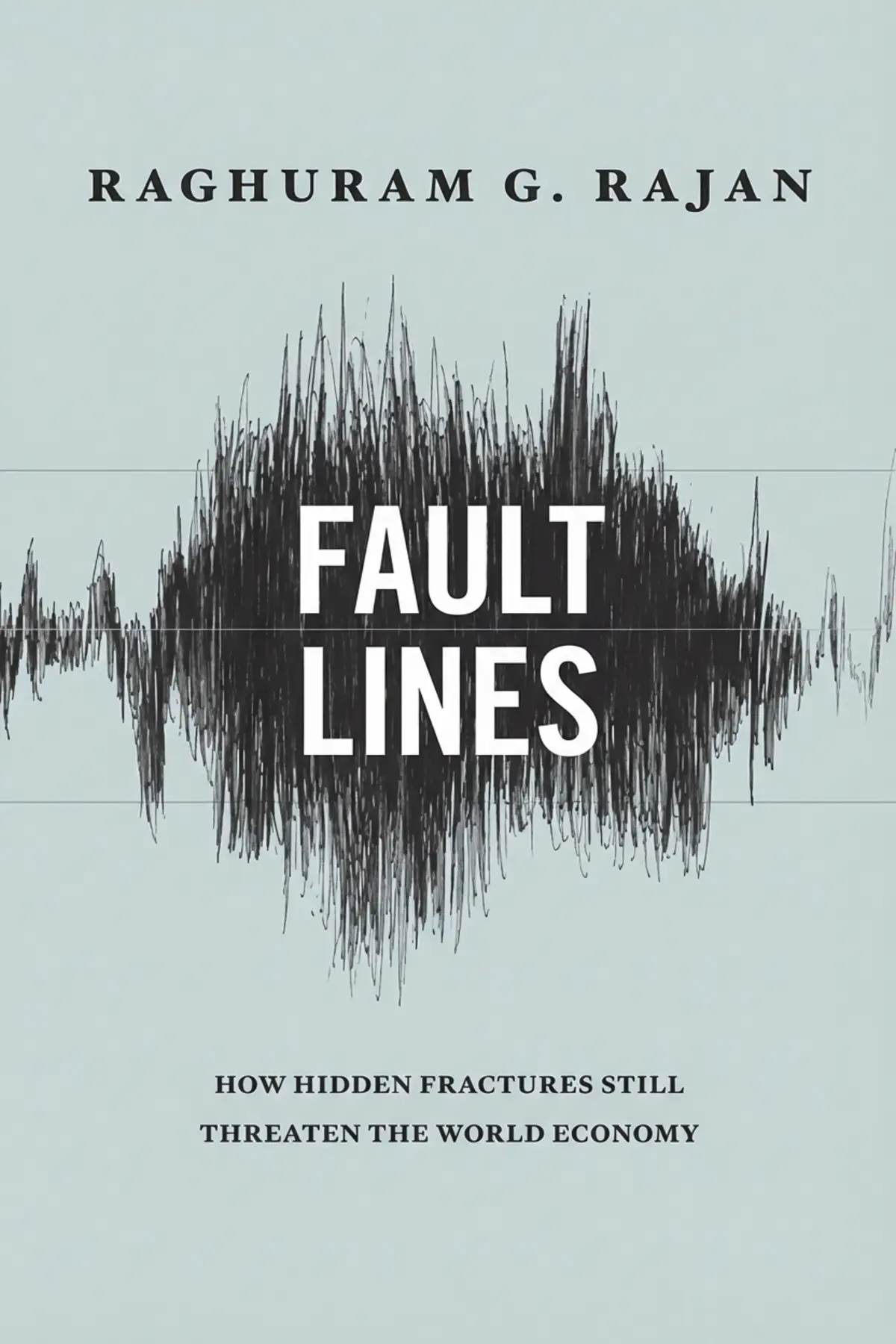
Raghuram G. Rajan invites us to view the financial crisis through the lens of geology. Imagine a massive earthquake. When the ground begins to shake and buildings begin to crumble, the primary cause isn’t the movement of any one person on the surface. Instead, the catastrophe is the result of massive tectonic plates deep underground, slowly grinding against each other until a fault line finally gives way. In the economic world, these fault lines are deep-seated structural flaws that had been building pressure for years before the 2008 collapse. These fissures weren’t just limited to the United States; they ran through the very heart of the global economy, connecting the spending habits of American suburbs to the factories of Japan and the political halls of Washington.
In this summary, we’ll move past the surface-level finger-pointing to understand the underlying tensions that made the crisis inevitable. We will look at how the widening gap in education and income in America forced politicians to lean on cheap credit as a temporary fix for deep economic pain. We will examine how the global trade landscape became dangerously lopsided, with some nations producing far more than they could consume, while the U.S. took on the burden of absorbing the world’s excess goods and capital. By the time we finish, you’ll see how these disparate forces—from car manufacturing in Germany to the dual mandate of the Federal Reserve—aligned to create the most significant financial event of the modern era. More importantly, we’ll discuss why simply returning to ‘business as usual’ isn’t enough to prevent history from repeating itself.
2 min 12 sec
Discover how a mismatch between modern labor demands and educational attainment created a stagnant middle class, setting the stage for political intervention through the expansion of easy credit.
1 min 56 sec
Explore how the government used the housing market to mask stagnant wages, turning easy loans into a temporary tool for social stability that eventually backfired.
2 min 15 sec
Learn how the export-heavy strategies of nations like Germany and Japan forced the United States to become the world’s primary consumer and borrower, unbalancing the global economy.
2 min 13 sec
Examine the shift in how the American economy bounces back from recessions and how the Federal Reserve’s response inadvertently contributed to the housing bubble.
2 min 07 sec
See how financial engineering and the myth of diversification allowed high-risk subprime mortgages to be disguised as rock-solid investments for global buyers.
1 min 51 sec
Uncover why the usual warning signs of economic trouble were silenced by an influx of foreign capital and a blind reliance on incomplete data.
1 min 55 sec
Understand how the structure of executive bonuses encouraged short-term gambles at the expense of long-term stability, making a crash nearly inevitable.
1 min 39 sec
Explore why the 2008 crash was a shared responsibility, involving not just bankers but also politicians, central banks, and the public.
2 min 06 sec
Learn why sustainable economic health requires moving beyond quick fixes to address education, social safety nets, and financial transparency.
1 min 38 sec
The 2008 financial crisis was not a freak accident or the result of a few ‘bad apples.’ As we have seen through the work of Raghuram G. Rajan, it was the inevitable result of deep structural rifts that had been ignored for too long. These fault lines—the education-driven income gap, the political reliance on easy credit, the global trade imbalances, and the flawed incentives in our financial institutions—converged to create a disaster that was felt in every corner of the globe.
What this really means for us today is that our economic health depends on more than just the stock market’s daily performance. It depends on how well we educate our citizens, how honestly we address wealth disparity, and how we manage the flow of goods and capital across borders. The 2008 crash was a warning. It showed us that a system built on debt and short-term thinking is a house of cards waiting for a breeze.
The path forward requires a shift in perspective. We must move away from the ‘quick fix’ mentality that defines so much of our political and financial life. Instead, we must focus on the long-term foundations of prosperity. This means investing in human capital, creating transparent financial systems, and ensuring that our social safety nets are strong enough to protect people during the natural fluctuations of the market. Only by repairing these deep-seated fault lines can we hope to build a global economy that is truly stable and inclusive for the future.
Fault Lines examines the complex web of factors that led to the devastating global economic collapse of 2008. While many analysts focus narrowly on the actions of individual bankers or specific lending practices, Raghuram G. Rajan takes a broader view. He identifies deep structural flaws—the 'fault lines' of the title—that run through the American and global economies. The book promises to move the conversation beyond simple blame, illustrating how well-intentioned political moves, shifts in the global labor market, and massive imbalances in international trade converged to create an unstable financial environment. Rajan provides a sobering look at how the world’s reliance on the American consumer and a lack of social safety nets encouraged risky behavior. Ultimately, it offers a vision for how these fissures can be repaired through long-term educational reform, more transparent financial incentives, and a rebalancing of global consumption to ensure a more stable economic future.
Raghuram G. Rajan is a distinguished economist who gained significant recognition for being among the small group of experts who accurately predicted the 2008 financial crisis. He has held prestigious positions including serving as the chief economist for the International Monetary Fund (IMF) and the governor of the Reserve Bank of India. Additionally, Rajan is a professor of finance at the Graduate School of Business at the University of Chicago, though he was noted as being on leave as of 2013 to fulfill his responsibilities in public service and international finance.
Listeners find this economics book to be insightful and well-composed, characterizing it as an essential read that offers a superb perspective. They appreciate the stimulating material and its persuasive demand for significant reforms, with one listener noting it serves as a fantastic introduction to macroeconomics. The book receives split reviews regarding its political science analysis; some praise its lucid viewpoints while others find fault with its flawed grasp of the field.
Wow. This isn't just another dry economics text about the 2008 crash; it’s a brilliant autopsy of the structural cracks in our global system. Rajan gained massive credibility for his 2005 Jackson Hole speech, and he proves here that he wasn't just lucky with his timing. He explores how the U.S. used easy credit as a palliative for stagnant middle-class wages and a crumbling education system. The writing is surprisingly clear for someone with such an elite CV, making complex themes like 'too systemic to fail' accessible to the average reader. While some of the policy prescriptions at the end feel a bit optimistic, the core analysis of how our domestic political stresses exported instability to the rest of the world is absolutely chilling. It is a tectonic read that remains relevant a decade later.
Show moreFinally got around to reading this, and the 'too systemic to fail' concept really changed how I view the 2008 financial sector meltdown. Rajan argues that it isn't just about the size of the banks, but how interconnected they are, which makes government bailouts almost inevitable unless we change the underlying incentives. He proposes some common-sense solutions like bonus escrow accounts and 'living wills' for financial institutions that are actually practical. I loved the global perspective he brings from his time as the Chief Economist of the IMF; it’s refreshing to see someone look past the U.S. border. The book is non-ideological and hits hard on both sides of the aisle. It’s a dense read, but the clarity of his prose makes the heavy lifting worth it for any serious student of finance.
Show moreThis book hits with a tectonic impact, proving that the 2008 crisis wasn't just a fluke of bad luck or simple greed. Rajan shows how deep structural issues—like the decline in quality of American schooling—forced the government to use credit as a substitute for real wage growth. It is a brilliant, multi-layered look at how we got here. His writing is sharp, and his arguments are backed by the kind of international experience few other authors possess. I particularly enjoyed the sections on how the IMF needs to move away from 'one size fits all' policies. It’s rare to find an economics book that is this readable while remaining so intellectually rigorous. If you want to understand the real causes of global instability, start here.
Show moreAs someone who works in finance, I found Rajan’s breakdown of the 'Greenspan put' and the undervaluing of tail risk to be absolutely brilliant. He explains how the financial sector stopped allocating capital efficiently because the government was implicitly subsidizing risk-taking. Unlike other authors who just want to bash Wall Street, Rajan looks at the political realities that created the mess in the first place. He’s right that we need to find ways to eliminate the temptation for CEOs to take on massive risks for short-term bonuses. The chapter on the future of India and its role as a socioeconomic superpower was a fascinating bonus. This is a masterful piece of work that should be required reading for every policy maker in Washington and beyond.
Show moreAfter hearing Rajan speak on a podcast, I decided to dive into his 'Fault Lines' theory, and it provided an excellent perspective on macroeconomics. He argues convincingly that the housing bubble wasn't just about greed, but was actually a response to income inequality and the lack of a proper social safety net. When people can’t rely on health insurance or unemployment benefits, politicians push for subsidized home ownership to create a sense of security. I found the chapter on the export-led growth models of Japan and China particularly insightful for understanding today’s trade imbalances. My only gripe is that he occasionally oversimplifies the role of Fannie Mae and Freddie Mac while ignoring the private sector's role in the subprime frenzy. Still, it is a thought-provoking work that demands a serious conversation about reform.
Show morePicked this up as an introduction to macroeconomics and found it incredibly well-written and compelling throughout. Rajan avoids the typical partisan blame-game, instead looking at how the goals of capitalism and democratic politics have become dangerously misaligned. He explains how low interest rates served as a 'quick fix' for politicians who didn't want to address the long-term reality of a workforce that is being left behind by technology. The way he links U.S. consumption to the high savings rates in China and the 'jobless recoveries' of the 2000s is eye-opening. Personally, I think he places a bit too much faith in the IMF’s ability to coordinate a global response, but his critique of the 'Greenspan put' is spot on. Definitely a must-read for anyone trying to understand why our economy still feels so fragile.
Show moreEver wonder why we keep repeating the same boom-and-bust cycles? Rajan provides a compelling call for major reforms by identifying the 'fault lines' that most politicians choose to ignore. He does an exceptional job of distilling the factors leading to the subprime crisis, especially the role of the Community Reinvestment Act and the political push for an 'ownership society.' His perspective as a former central banker adds an layer of gravitas that you don't get from journalists or pundits. I especially appreciated his discussion on 'cognitive capture'—the idea that regulators start thinking exactly like the bankers they are supposed to oversee. While some sections on Indian monetary policy felt a bit disconnected from the U.S. focus, the overall message is a powerful warning that we are still sitting on a ticking time bomb.
Show moreGotta say, this is one of the more dispassionate and balanced accounts of the global financial crisis I have come across recently. Rajan isn't interested in vilifying individual bankers; he wants to fix the systemic incentives that make risky behavior rational for them. His analysis of how the 'Washington Consensus' failed developing nations helps explain the current rise of nationalism we see today. The book moves quickly through complex topics like credit default swaps and export-led growth without getting bogged down in too much jargon. I found his suggestions for 'cycle-proof regulations' to be quite prophetic given how little has actually changed in the years since Dodd-Frank. It’s a solid four-star read that offers more substance than your typical airport business book.
Show moreThe truth is, Rajan is a brilliant economist, but his foray into social policy feels a bit half-baked compared to his financial analysis. He identifies the systemic issues perfectly—specifically the 90/10 wage gap and the education premium—but his solutions for preschool and healthcare reform lack the rigor of his work on the IMF. It felt like he was checking boxes for the liberal establishment to be taken more seriously in Washington circles. To be fair, his explanation of how the Federal Reserve’s monetary policy is exported globally is masterclass material. I just wish he had stuck to his expertise instead of offering vague, wide-sweeping suggestions for state-level programs he doesn't seem to fully grasp. It’s worth reading for the financial history, but take the policy rants with a grain of salt.
Show moreLook, while the author's pedigree at the IMF and the Reserve Bank of India is undeniable, I found his political analysis deeply flawed and frustratingly inconsistent. Rajan blames the Fed for blowing up the housing bubble but then suggests they should have a 'triple mandate' that includes monitoring asset prices—a task even he admits is nearly impossible to do in real-time. He completely ignores the massive risk of unfunded pension liabilities and long-term debt while calling for expensive new government spending programs in education and health. It’s a strange mix of astute financial observation and naive political wish-listing. If you want a book that actually understands the history of American housing policy, read Niall Ferguson instead. This one feels like an economist trying to run for office with a platform of vague, contradictory promises.
Show moreNiall Kishtainy
William J. Bernstein

Yanis Varoufakis

Andrew Ross Sorkin
AUDIO SUMMARY AVAILABLE
Get the key ideas from Fault Lines by Raghuram G. Rajan, plus 5,000+ more titles in English and Thai.







