
30 min 51 sec
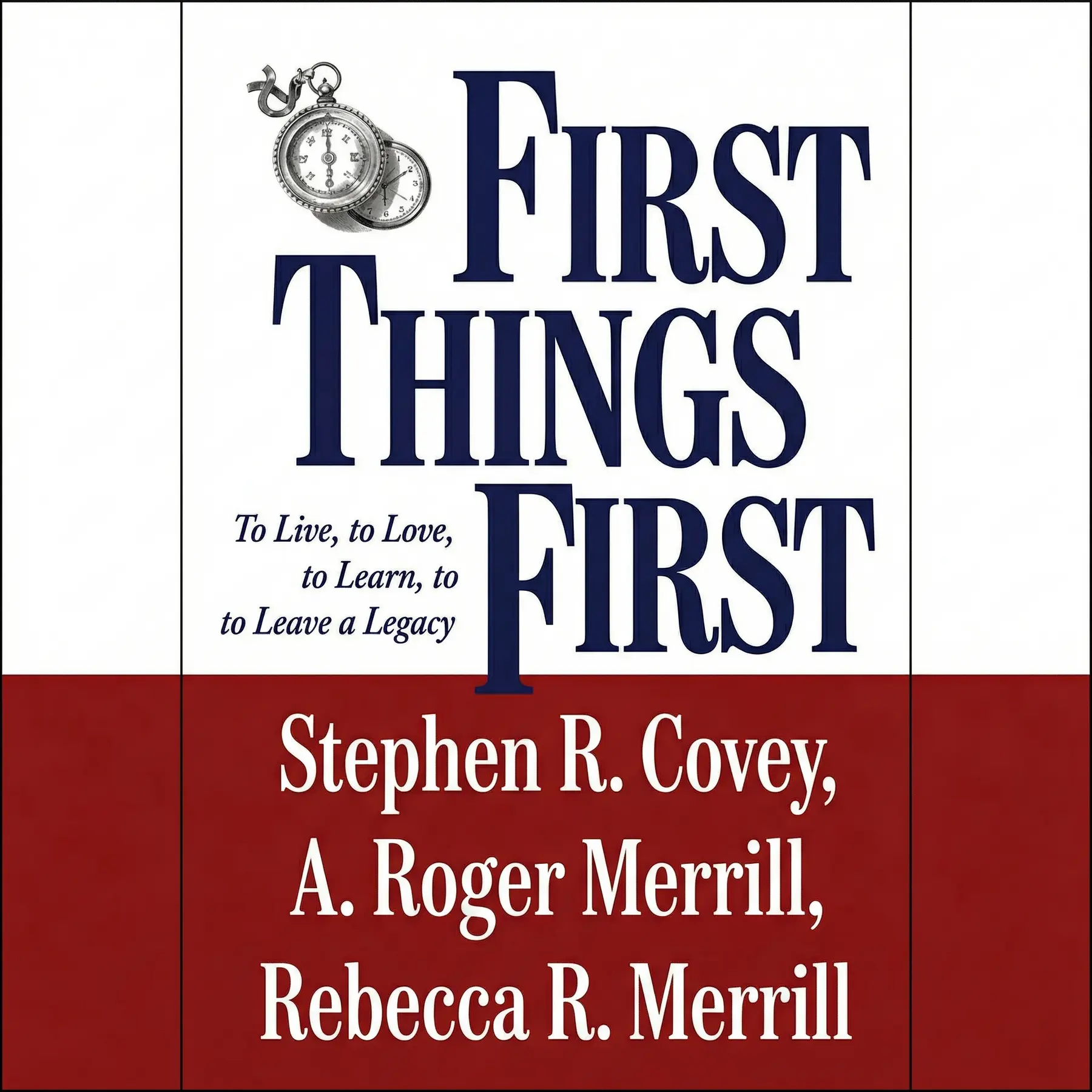
First Things First: To Live, to Love, to Learn, to Leave a Legacy
A deep dive into prioritizing what truly matters over the merely urgent. Learn to align your daily actions with your core values to achieve a more balanced and meaningful life.
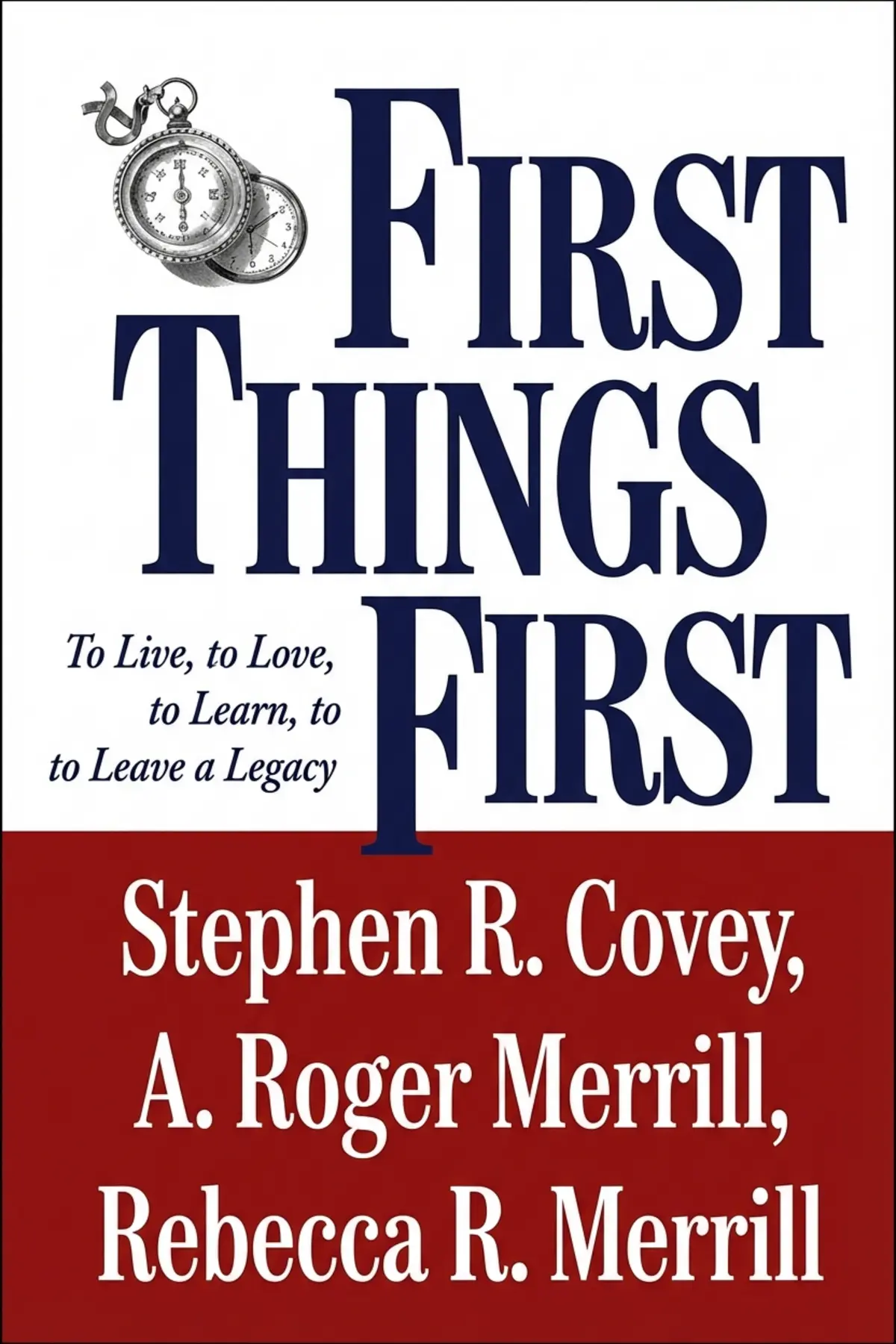
Table of Content
1. Introduction
2 min 04 sec
We live in an era where ‘busy’ is often worn as a badge of honor. We look at our overflowing calendars and endless to-do lists, and we feel a sense of accomplishment when we manage to cross off a dozen minor tasks. But at the end of the day, as we lay our heads on the pillow, a nagging question often remains: Did any of it actually matter? Was I just moving fast, or was I moving in the right direction? This is the fundamental tension that Stephen R. Covey and his co-authors address in their transformative guide, which challenges the very foundations of how we manage our minutes and hours.
Traditional time management is usually about the clock. It’s about efficiency, speed, and cramming more into the day. It’s like a race where the only goal is to run faster. But what if you’re running in the wrong direction? The central throughline of this summary is the shift from the clock to the compass. While the clock represents our appointments and schedules, the compass represents our vision, values, and principles. If we don’t have our compass set correctly, no amount of speed on the clock will lead us to a life of fulfillment.
Over the course of this exploration, we’re going to look at why we are so addicted to urgency and how that addiction keeps us from the things that are truly important. We’ll look at the four fundamental needs that every human being shares and how a lack of balance among them leads to stress and unhappiness. We’ll also discover a new way of planning that isn’t focused on the next hour, but on the next week, allowing us to see our lives as a whole rather than a series of disconnected fragments. By the end, the goal is to help you put your ‘first things’ first, ensuring that when you look back on your life, you see a legacy of meaning rather than a blur of motion.
2. The Conflict Between the Clock and the Compass
2 min 42 sec
Discover why the modern obsession with efficiency might be leading you away from your true purpose and how to reorient your focus toward your values.
3. Breaking the Addiction to Urgency
2 min 55 sec
Uncover the psychological reasons why we prioritize immediate tasks over important ones and learn to escape the cycle of constant crisis management.
4. Satisfying the Four Fundamental Human Needs
2 min 51 sec
Learn how balancing your physical, mental, social, and spiritual needs is the key to escaping chronic stress and finding lasting satisfaction.
5. Living by Universal Principles
2 min 33 sec
Understand why your internal compass must be aligned with objective principles to ensure long-term success and genuine happiness.
6. The Power of a Future-Oriented Vision
2 min 22 sec
See how a clear mission statement and a long-term perspective can give you the courage to overcome fear and stay focused during difficult times.
7. Setting Goals with Meaning and Integrity
2 min 58 sec
Move beyond standard goal-setting to a principled approach that ensures you actually reach your targets for the right reasons.
8. The Shift to Weekly Planning
2 min 41 sec
Discover why the traditional daily to-do list is flawed and how a weekly perspective can help you balance your various life roles more effectively.
9. Choosing Cooperation Over Competition
2 min 36 sec
Learn how shifting from an independent mindset to an interdependent one can unlock new levels of productivity and personal happiness.
10. Empowering Others Through Personal Leadership
2 min 08 sec
Master the art of being a leader in every area of your life by fostering trust and encouraging others to take initiative.
11. Achieving Inner Peace by Putting First Things First
2 min 44 sec
Discover the ‘Big Rocks’ philosophy and how it provides the ultimate blueprint for a balanced, joyful, and stress-free existence.
12. Conclusion
2 min 17 sec
As we wrap up our journey through the principles of prioritization, it’s worth reflecting on the core shift we’ve explored. We’ve seen that the greatest enemy of the ‘best’ is often the ‘good’—or more accurately, the ‘urgent.’ We spend so much of our lives reacting to the loud, pressing demands of the day that we lose sight of the quiet, vital things that define our character and our happiness. The shift from the clock to the compass is not just a time management strategy; it is a life strategy. It’s an invitation to stop measuring your worth by the length of your to-do list and start measuring it by the depth of your integrity.
Putting first things first requires courage. It requires the courage to say ‘no’ to social expectations, the courage to be ‘unproductive’ in the eyes of the world so you can be effective in the things that matter, and the courage to look at your life through the lens of a long-term legacy. But the rewards for this courage are immense. By focusing on your principles, nurturing your four basic needs, and planning your life in weekly chunks, you replace the frantic energy of urgency with the steady power of purpose.
Remember the metaphor of the jar. Your time is limited, but your capacity for meaning is not. If you want a life of balance and inner peace, you have to be the one to decide what the ‘big rocks’ are. Don’t wait for a crisis to remind you what’s important. Start today by looking at your compass. What is one ‘first thing’ you’ve been neglecting? What is one relationship that needs more than just the leftovers of your time? By making the conscious choice to put those things at the center of your schedule, you aren’t just managing your time; you are creating your life. The clock will always keep ticking, but with your compass in hand, you can ensure that every tick takes you closer to the person you truly want to be.
About this book
What is this book about?
This summary explores the transformative philosophy of prioritizing quality of life over mere efficiency. It moves beyond traditional time management techniques, which often focus on doing things faster, and instead emphasizes the importance of doing the right things at the right time. By distinguishing between the 'clock' of daily schedules and the 'compass' of inner values, the book provides a framework for lasting fulfillment. Readers will discover the famous Time Management Matrix, which helps identify and minimize activities that drain energy without adding value. The guide also covers the four fundamental human needs and how to achieve a state of 'inner peace' through principled living. Ultimately, the promise is a shift from a life of constant fire-fighting to one of intentional, legacy-driven contribution.
Book Information
About the Author
Stephen R. Covey
Stephen R. Covey was a distinguished American professor and author whose work significantly impacted the fields of self-help and leadership. He is most famous for his monumental work, The Seven Habits of Highly Effective People, which has reached a global audience of over 25 million readers. Recognized for his influence, Time magazine named him one of the Top 25 Most Influential Americans in 1996. He co-authored this work with A. Roger Merrill and Rebecca R. Merrill, specialists in leadership and time management.
Primary Greatness: The 12 Levers of Success
Stephen R. Covey
The 7 Habits of Highly Effective Families
Stephen R. Covey
The 8th Habit: From Effectiveness to Greatness
Stephen R. Covey
The Speed of Trust: The One Thing That Changes Everything
Stephen R. Covey
Ratings & Reviews
Ratings at a glance
What people think
Listeners find this book to be a superb resource that offers valuable advice for managing time and setting priorities. They value the robust framework for life organization and its transformative effects, while one listener highlights its specific utility for individuals with Attention Deficit Disorder. However, the book's length draws mixed feedback, as some find it too long. Additionally, several listeners mention missing sections, specifically Appendix A, which diminishes the overall experience.
Top reviews
Win
This book completely shifted my perspective on what it means to be 'busy' versus being 'effective.' Rather than just teaching you how to run faster on the treadmill of life, Covey asks you why you’re on the treadmill in the first place. The 'compass over clock' metaphor is powerful because it emphasizes direction over speed. I’ve stopped obsessing over my to-do list and started looking at my life through the lens of my primary roles. It’s not just about getting things done; it’s about doing the right things for the right reasons. To be fair, it is a dense read that requires focus, but the payoff for your mental health and productivity is immense. If you feel like you're drowning in urgency, this is the life raft you need.
Show moreSomchai
As someone who has struggled with Attention Deficit Disorder my entire life, finding a system that prioritizes principles over rigid schedules was a godsend. Traditional time management always felt like a cage to me, focusing on every minute and hour. Covey’s 'Fourth Generation' approach is much more fluid and forgiving for the neurodivergent brain. It teaches you to listen to your conscience and focus on your relationships rather than just checking off boxes. The concept of 'urgency addiction' was a total epiphany for me; I realized I was living for the adrenaline of deadlines. I'm finally learning how to put first things first without the constant anxiety of a ticking clock. It’s truly transformative.
Show moreOm
Wow. I didn't think a book about time management could make me cry, but the focus on family mission statements really hit home. It made me realize I was giving my 'best self' to my coworkers and my 'leftover self' to my wife and kids. This isn't just a book about being more productive at the office; it’s a manual for living a life you won't regret. The authors challenge the Western obsession with speed and remind us that some things, like building trust and raising children, cannot be 'efficient.' You have to put people ahead of schedules. It took me a while to finish because I kept stopping to reflect on my own values. This is essential reading for anyone feeling burnt out by the rat race.
Show moreGun
Finally got around to reading this after years of loving '7 Habits,' and it feels like the deep-dive expansion I always wanted. While the original book introduced the concept of putting first things first, this one provides the practical tools to actually do it. The focus on 'living, loving, learning, and leaving a legacy' provides a beautiful framework for a balanced life. I especially appreciated the advice on saying 'no' to the good so you can say 'yes' to the best. It’s a life-changing impact if you’re willing to put in the work to redefine your priorities. Yes, it’s verbose, but the wisdom is worth the extra pages. This is a classic for a reason and highly recommended for young adults starting their careers.
Show moreTom
After hearing so much about the 'Big Rocks' analogy, I finally dove into the source material. It’s a solid method for organizing your life that moves beyond the typical daily checklist. The focus on Quadrant II activities—those things that are important but not urgent—has helped me carve out time for long-term planning and relationship building. My main gripe is that it feels significantly longer than necessary. Truth is, the authors repeat themselves quite a bit to drive home points that were clear by the second chapter. I also noticed that my copy was missing sections in the back, specifically Appendix A, which was frustrating. Still, the core philosophy is life-changing if you can slog through the fluff.
Show moreKwan
The core message here—prioritizing Quadrant II—is absolutely brilliant, even if the delivery is a bit dry at times. Most of us spend our lives reacting to the 'urgent' (Quadrant III) and wondering why we feel unfulfilled at the end of the week. This book provides a roadmap for breaking that cycle. I particularly liked the section on 'synergy of interdependence' and how our roles should complement rather than compete with one another. It’s an analytical look at life management that treats the reader like an adult. Just be prepared for a slow read. The authors use a lot of lengthy examples that can feel a bit dated or overly sentimental. Regardless, the logic is sound and the framework is one of the best I've encountered.
Show moreArthit
Personally, I found the distinction between the 'urgent' and the 'important' to be the most valuable takeaway from Covey’s framework. We live in a world that demands instant responses, and this book is a great reminder to step back and look at the bigger picture. The weekly planning process is much more realistic than daily scheduling. It allows for the 'interruptions' of real life—like a child needing attention or a sudden work crisis—without ruining your entire sense of accomplishment. I do think the book is a bit repetitive, and some of the terminology like 'True North' feels a bit cheesy. But if you actually apply the 'Big Rocks' method, you will see immediate improvements in your stress levels.
Show moreSureerat
Look, this isn't your typical productivity guide filled with hacks to squeeze more out of your day. It’s more of a philosophical shift. Instead of focusing on the clock—doing things fast—it focuses on the compass—doing the right things. I’ve started using the quadrant system to evaluate my weekly tasks, and it’s been eye-opening to see how much time I was wasting on Quadrant III 'emergencies' that didn't actually matter. My only complaint is the length. The book could have been 150 pages and lost none of its impact. Still, the message of quality over quantity is something I think everyone needs to hear right now. It provides a solid method for reclaiming your schedule from the noise of the world.
Show morePraepimon
Ever wonder why self-help books have to be four hundred pages when they could be eighty? First Things First has some incredible nuggets of wisdom buried under mountains of unnecessary text. The 'Big Rocks' story is a classic for a reason, and the shift from efficiency to effectiveness is a vital lesson for any professional. However, I found myself skimming large sections just to get to the actual 'how-to' parts. To make matters worse, my Amazon copy was missing Appendix A, which several other reviewers mentioned as well. It’s a decent book for those who like deep philosophical dives, but if you want quick productivity hacks, you’ll likely find this frustrating. It’s a bit too 'high-level' for its own good.
Show moreHarper
Not what I expected from such a highly-rated bestseller. While I appreciate the sentiment of living a principle-centered life, the writing style is painfully verbose and repetitive. It feels like a diet book that spends three hundred pages telling you to 'eat less' while using fancy terminology like 'nutritional legacy.' Frankly, the advice seems geared toward corporate executives who have the luxury of delegating their chores. If you're a middle-class worker struggling to pay bills, telling your boss 'no' because of your personal mission statement might just get you fired. I found the 'quadrant' stuff useful, but you can get that from a ten-minute YouTube summary. It’s just too much fluff for a very simple message.
Show moreReaders also enjoyed
59 Seconds: Change Your Life in Under a Minute
Richard Wiseman
A Guide to the Good Life: The Ancient Art of Stoic Joy
William B. Irvine
AUDIO SUMMARY AVAILABLE
Listen to First Things First in 15 minutes
Get the key ideas from First Things First by Stephen R. Covey, plus 5,000+ more titles in English and Thai.
- 5,000+ titles
- Listen as much as you want
- 7-day free trial
- Cancel anytime







