Big Data: A Revolution That Will Transform How We Live, Work and
Viktor Mayer-Schönberger
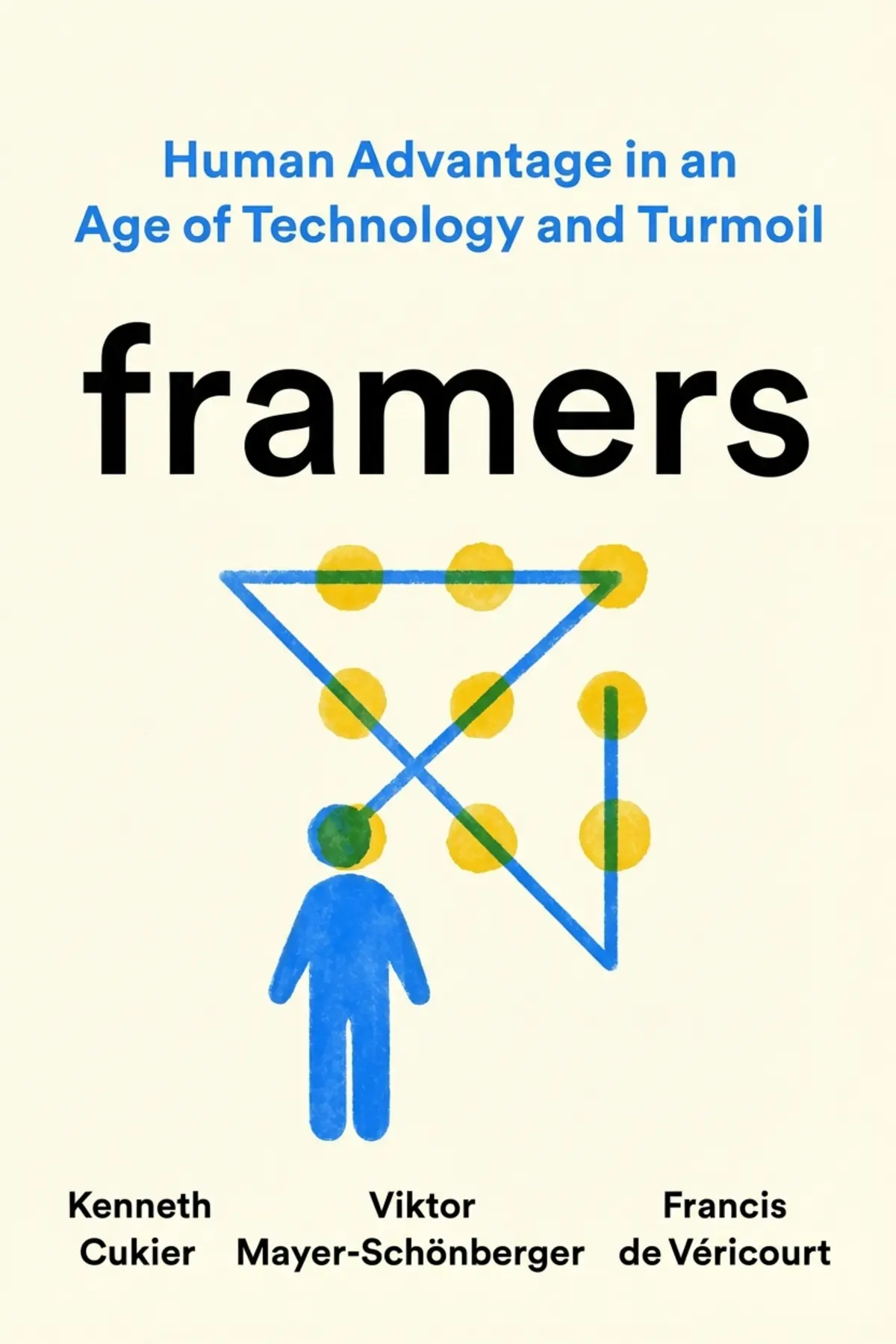
Framers explores the unique human ability to build mental models that shape our reality. It provides a toolkit for making better decisions by understanding how we perceive and redefine the world around us.
1 min 59 sec
In the modern age, we are often told that data is king. We are led to believe that if we just gather enough information and feed it into a powerful enough computer, the right answers will magically emerge. But there is a missing link in that logic—a link that defines our humanity and determines our future. That link is the concept of the ‘frame.’
Think about how you interpret the world around you. When you see a news story or a social conflict, you aren’t just seeing raw facts. You are seeing those facts through a specific lens. Consider the 2016 protest by NFL quarterback Colin Kaepernick. When he took a knee during the national anthem, the public was instantly divided. One group of people saw a frame of ‘patriotism and respect for the flag.’ To them, his actions were a slight against the nation. Another group saw a frame of ‘racial justice and civil rights.’ To them, it was a courageous stand against systemic inequality. The facts were the same—a man kneeling on a field—but the frames were worlds apart.
A frame is essentially a mental model that helps us decide what to focus on and what to ignore. It allows us to simplify a chaotic world so we can act. Most of the time, we don’t even realize we are using them. We simply think we are seeing the world as it ‘is.’ However, as the authors of this book explain, our ability to consciously recognize, build, and switch these frames is what sets us apart from both animals and algorithms.
In this summary, we are going to explore why this human superpower is more important now than ever before. We’ll look at how the right frame can discover life-saving medicines and how the wrong frame can lead to national disasters. We will dive into the three building blocks of a frame—causality, counterfactuals, and constraints—and learn how to use them to navigate the complex challenges of the twenty-first century. By the end, you’ll see that the most important tool you have isn’t your smartphone or a database; it’s your mind’s ability to frame the future.
2 min 29 sec
Discover why artificial intelligence, despite its massive computing power, still falls short of the human ability to redefine the questions we ask.
2 min 42 sec
Explore how frames operate beneath our consciousness to shape everything from national policies to scientific breakthroughs.
2 min 27 sec
Understand why the ability to see ‘why’ something happens is the first pillar of any effective mental frame.
2 min 34 sec
Learn how the second pillar of framing—imagining what ‘could have been’—is essential for making wise choices today.
2 min 36 sec
Discover why the third pillar of framing—setting limits—actually empowers us to find more innovative solutions.
2 min 42 sec
Learn the three specific methods—repertoire, repurposing, and reinvention—to shift your perspective when you hit a wall.
2 min 39 sec
Understand why diversity of thought is not just a moral value, but a strategic requirement for societal and organizational success.
1 min 44 sec
As we wrap up our journey through the world of framing, it is worth remembering the core message: your brain is not a computer, and that is its greatest strength. While machines excel at processing facts, only humans have the ability to decide which facts matter and what they mean. We do this through framing—by understanding the ‘why’ of causality, the ‘what if’ of counterfactuals, and the ‘how’ of constraints.
We have seen how these frames can be the difference between a global catastrophe and a peaceful resolution, between a stagnant business and a revolutionary industry. We have learned that we aren’t stuck with the frames we were born with or the ones we’ve always used. We have the power to reframe our reality by sifting through our mental repertoire, repurposing ideas from elsewhere, or even reinventing our entire worldview.
To leave you with a final piece of actionable advice: remember that timing is everything. Even the most brilliant new frame can fail if the world isn’t ready for it. Consider the electric car. In the year 1900, about a third of all cars on the road were electric. But the frame of the time favored the power and range of gasoline. It wasn’t until decades later, when battery technology improved and the public frame shifted toward environmentalism, that Tesla was able to make the electric car a success.
So, as you go out and begin to consciously build your own frames, don’t just ask if your frame is ‘right.’ Ask if it is ‘right for now.’ Look at the world around you, assess the constraints, and use your imagination to find the paths that others are missing. The challenges of the future—from climate change to the rise of AI—are daunting, but they are not unsolvable. We just need to find the right frame to see the solution that is already waiting for us.
At its heart, this book is about the mental structures we use to make sense of our surroundings and solve complex problems. These structures, known as frames, are more than just perspectives; they are the invisible maps that dictate our choices, our successes, and our failures. The authors argue that while artificial intelligence can process data at incredible speeds, it lacks the human capacity to 'frame' a problem—to step back and ask if we are even asking the right questions. The promise of the book is that by mastering the art of framing, we can unlock a uniquely human superpower. This involves understanding three core components: causality, counterfactuals, and constraints. By learning to manipulate these elements, we can move beyond gut instinct and rigid thinking. Whether it is responding to a global pandemic, managing a financial crisis, or fostering innovation in a business, the ability to consciously choose and change our frames is what allows for true progress. This is a guide to thinking better by understanding how we think.
Kenneth Cukier is a seasoned journalist and a senior editor at the Economist. He is recognized for coauthoring the New York Times bestseller Big Data and hosts the science and technology podcast Babbage. Viktor Mayer-Schönberger is a professor at the University of Oxford’s Oxford Internet Institute. He has served as an advisor to Angela Merkel on Germany’s Digital Council and coauthored Big Data alongside Cukier. Francis de Véricourt is a professor of management science and serves as the director of the Center for Decisions, Models, and Data at the European School of Management and Technology in Berlin.
Viktor Mayer-Schönberger
Listeners find the book well-crafted and highly engaging, as one review notes it includes interesting scientific experiments. They value its motivational quality, while one listener mentions it's particularly suitable for new college students.
This book provides a vital toolkit for anyone navigating a career transition or struggling to revitalize a stale business plan. The authors explain that to be a true strategist, one must be a "framer" who can reimagine the very rules of the game rather than just following them. I loved the distinction between a tactical mindset and a strategic one, especially the point that humans can break rules while machines only optimize within them. The advice on using constraints to fuel creativity was a personal highlight for me. Frankly, in a world obsessed with data, it’s refreshing to see a defense of the "human element" and our capacity for imaginative leaps. If you want to understand how visionaries like Sam Walton actually think, this is the book to grab. It’s motivational, intellectually stimulating, and practically useful for anyone in a leadership role.
Show moreRarely do you find a text that balances AI theory with actionable business strategy so well. Kenneth Cukier and his co-authors have crafted a brilliant defense of the human mind in the age of algorithms. The core idea—that we can choose the frame through which we view reality—is both simple and profound. I was particularly impressed by the scientific experiments cited throughout the book, which lend credibility to their arguments about human ingenuity. It’s a very well-written and polished piece of work that avoids the dry, academic jargon that usually plagues this genre. For any leader feeling stuck, the sections on "reframing wisely" offer a clear path forward through the mess of modern data. A truly optimistic and essential read.
Show moreAfter hearing so much buzz about how AI is going to replace our jobs, reading "Framers" felt like a much-needed breath of fresh air. The authors argue that our ability to build mental models—what they call "frames"—is a uniquely human superpower that machines simply cannot replicate yet. I found the sections on counterfactual thinking particularly fascinating, as they show how we imagine alternate realities to solve current problems. While some of the business examples felt a bit recycled from other popular strategy books, the overall message is empowering and well-supported. It’s written in a clear, journalistic style that makes complex cognitive science feel accessible to anyone. Truth is, we often overlook how much our perspective shapes our success, and this book serves as a great reminder to check our lenses. It’s a solid read for anyone feeling anxious about the digital future.
Show moreAs someone who just entered the workforce, I found this to be an incredibly engaging guide on how to process information effectively. The concept of "making sense" of the world through different frames is something I wish was taught more explicitly in school. The authors use current world news and scientific experiments to illustrate how shifting your perspective can lead to radically different outcomes. It’s written with a lot of energy, making it a very light and fast-paced read compared to some of the denser academic texts on cognitive bias. I did feel that some of the "reframing" advice was a bit simplistic toward the end, but the core chapters are packed with value. It’s definitely a great gift for new graduates who are trying to find their footing in a complex, fast-changing environment.
Show moreFinally got around to reading this, and I was pleasantly surprised by how relevant it feels to the current political climate. The authors make a compelling plea for "cognitive pluralism," arguing that we need to see through multiple lenses to solve the massive, interconnected problems we face today. It's not just about being "smart"; it's about being willing to unlearn old patterns and entertain counterfactuals that feel uncomfortable. The discussion on how constraints actually help us "dream" better was a standout moment for me. While the book could have used a bit more rigor in its psychological explanations, the writing is so crisp and the examples so timely that it’s hard not to stay engaged. It’s a call to action for everyone to stop being so rigid in their thinking.
Show moreThe authors do a fantastic job of weaving scientific experiments into a narrative about human ingenuity. I picked this up because I wanted to understand how to better compete with automated systems, and the book delivered a solid argument for why "framing" is our last line of defense. It’s not just about having the most information; it’s about how you organize that information to find new opportunities. While I agree with other reviewers that the ending felt a little rushed and perhaps a bit too "motivational speaker" for my taste, the bulk of the book is high-quality analysis. The examples of Sam Walton and Howard Schultz illustrate the points perfectly, showing that strategy is often just a matter of looking at a store or a cup of coffee differently. Definitely worth a spot on your shelf.
Show moreIs it a science book or a business manual? "Framers" tries to be both but ends up sitting somewhat awkwardly in the middle. The authors propose that framing is a "cognitive muscle" we can flex, yet the tone remains more journalistic than scientific, which might frustrate those looking for hard psychological data. I appreciated the emphasis on cognitive pluralism and the idea that diversity of thought is essential for progress in our polarized world. However, the reliance on human exceptionalism feels a bit shaky in an era where generative AI is evolving so rapidly. Some of the case studies involving Starbucks and Walmart are interesting, but they’ve been told a thousand times before in business school. It’s a decent introductory text for a college student, but seasoned readers of the genre might find it a bit repetitive and superficial.
Show moreEver wonder why some people thrive during exam season while others crumble? It usually comes down to how they frame the challenge, a concept "Framers" explores with plenty of modern-day anecdotes. This book reminded me of Adam Grant’s "Think Again" because it stresses the importance of staying flexible and being willing to change your mind. I enjoyed the bits about how our frames evolve through education and exposure to diversity, though I wish it went deeper into the "Information Behavior" aspect. Look, the book is short and the chapters are easy to digest, which is perfect for a busy professional. However, for someone who has studied these theories in a university setting, it might feel a bit like a surface-level summary rather than a deep investigation. It’s good, just not groundbreaking.
Show moreNot what I expected at all given the high-profile authors and the promising subtitle about human agency. To be fair, the writing is polished and easy to follow, but it mostly feels like "packaged common sense" served on a silver platter. I was looking for deep, provocative insights that would challenge my worldview, but instead, I got a series of anecdotes about Martin Luther King and Howard Schultz. The "3Cs" framework of causality, counterfactuals, and constraints is a neat way to organize thoughts in hindsight, but it doesn't actually help you improve your decision-making in real-time. By the time I reached the final chapter's advice—which basically boils down to "think beyond yourself"—I felt completely underwhelmed. It’s a light, breezy read, but it lacks the intellectual meat found in works like Shane Parrish’s series on mental models.
Show moreI’ve been a fan of the Knowledge Project for years, so I came into this with high expectations for a deep dive into mental models. Unfortunately, "Framers" is a major disappointment that covers zero new ground for anyone who has read even a single book on behavioral economics. It’s essentially a collection of "greatest hits" stories—like the founding of Starbucks—that have been analyzed to death elsewhere. The authors try to frame "framing" as some revolutionary new concept, but it's just a rebranding of basic critical thinking and empathy. There isn’t a single statement in the book that is actually controversial or surprising, which makes for a very dull reading experience. If you want real depth on mental models, stick to Shane Parrish or even Daniel Kahneman. This is just fluff for the airport bookstore crowd.
Show more
Richard Wiseman
Steven C. Hayes
Deborah Gruenfeld
Anthony Pratkanis
AUDIO SUMMARY AVAILABLE
Get the key ideas from Framers by Kenneth Cukier, plus 5,000+ more titles in English and Thai.