
32 min 33 sec
Free Prize Inside: How to Make a Purple Cow
By Seth Godin
Discover how to transform ordinary products into remarkable sensations using soft innovation. Seth Godin reveals why small, clever additions outshine expensive ad campaigns and how pushing boundaries creates irresistible consumer appeal.
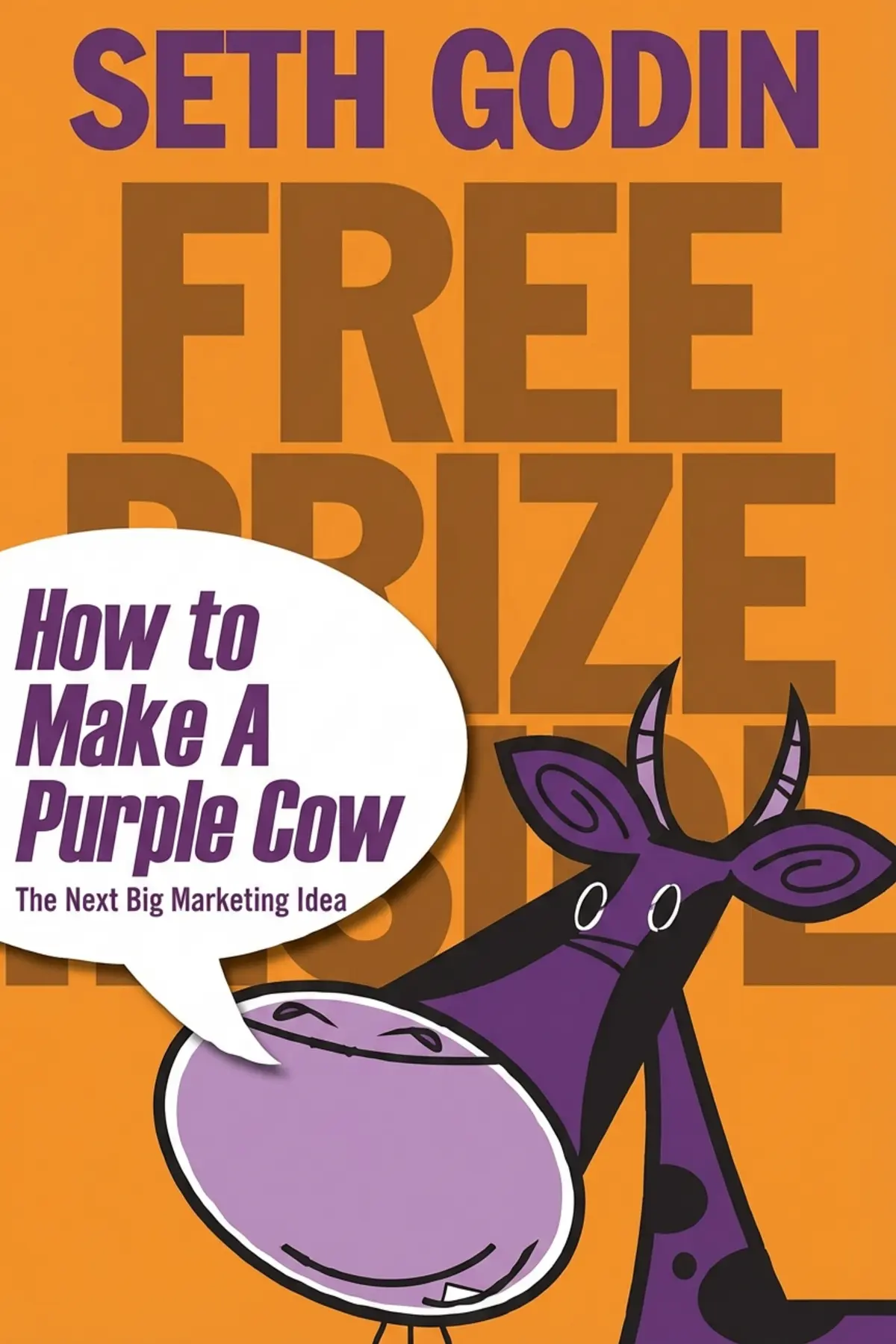
Table of Content
1. Introduction
2 min 06 sec
In the golden age of consumerism, there was a simple magic found in the aisles of every grocery store. Children would pull at their parents’ sleeves, not because of the nutritional value of a specific breakfast cereal, but because of a tiny, plastic trinket buried beneath the flakes. To an adult, that toy was insignificant. To the cereal company, it cost a fraction of a cent to produce. But to the customer, it was a treasure—a ‘free prize’ that transformed a mundane commodity into a must-have experience. This concept is the heartbeat of modern marketing, yet many businesses have forgotten how to use it.
Today, we find ourselves in a landscape where traditional tools are losing their edge. The loud, expensive television commercials that once guaranteed sales now fade into the background as digital noise. The massive, high-risk technological gambles that companies take often end in bankruptcy rather than breakthroughs. So, how do you capture the attention of a distracted world without risking everything? The answer lies in revisiting the philosophy of that cereal box. It’s about finding small, clever, and inexpensive ways to make your product remarkable.
In the following discussion, we are going to explore a new way of thinking about innovation. We’ll move away from the idea that progress requires billions of dollars and years of research. Instead, we’ll look at ‘soft innovations’—the kind of creative shifts that any person in any organization can champion. We will break down the mechanics of ‘edgecraft,’ a process for identifying the unique boundaries of your business and pushing past them to create something people can’t help but talk about. Along the way, we’ll address the very real human obstacles—the fear and skepticism within your own office—that often stand in the way of great ideas. By the end, you’ll see that the path to growth isn’t about yelling louder; it’s about making sure there’s a prize inside that makes the world take notice.
2. The Decline of Traditional Interruption Marketing
2 min 52 sec
Old-school advertising and massive R&D projects are becoming increasingly ineffective and dangerous. Learn why the 20th-century playbook for business growth is now a recipe for failure.
3. Embracing the Power of Soft Innovation
2 min 35 sec
You don’t need a laboratory to innovate. Discover how ‘soft innovations’—clever, small-scale changes—can disrupt industries without requiring a massive budget or years of research.
4. The Requirement of Remarkability
2 min 37 sec
In a world dominated by word-of-mouth, being ‘good’ is no longer enough. Explore why your product must be ‘remarkable’—literally worth a remark—to gain traction.
5. Mastering the Art of Edgecraft
2 min 28 sec
Don’t just be better; be different. Learn the technique of ‘edgecraft’—pushing specific product attributes to their absolute limits to escape the ‘boring’ middle ground.
6. Finding Inspiration Beyond Your Industry
2 min 26 sec
Innovation doesn’t happen in a vacuum. Discover a four-step process for borrowing successful ideas from unrelated fields and adapting them to your own business.
7. The Diversity of Possible Edges
2 min 54 sec
From visibility to intentional scarcity, the ‘edges’ you can explore are endless. Learn how to identify unconventional paths that make your brand stand out.
8. Navigating the Internal Obstacles to Innovation
2 min 33 sec
The hardest part of innovation isn’t the idea; it’s the people. Understand why organizations naturally resist change and how to prepare for the inevitable pushback.
9. Building a Fulcrum: Proving Your Idea's Feasibility
2 min 39 sec
To move a heavy organization, you need leverage. Learn how to build a ‘fulcrum’ by emotionally and logically convincing your team that your idea is practical.
10. The Art of Internal Jujitsu: Proving Worthiness
2 min 29 sec
Is it worth it? Discover how to tailor your pitch to different stakeholders and how to use the dangers of the status quo as a catalyst for change.
11. The Champion’s Journey: Building Leadership and Reputation
2 min 48 sec
An idea is only as good as its leader. Learn why your personal track record and confidence are the final keys to turning a soft innovation into a reality.
12. Living the 'Free Prize' Philosophy
2 min 25 sec
Success in the modern economy requires a permanent shift in mindset. Learn how to make remarkability and edgecraft a central part of your daily professional life.
13. Conclusion
1 min 41 sec
As we wrap up our journey through the world of ‘Free Prize Inside,’ the central theme is clear: the era of mass-market mediocrity is over. We have moved into a time where the only way to thrive is to be truly, undeniably remarkable. We’ve seen that the traditional paths to growth—drowning the public in advertisements or betting the farm on high-risk technology—are no longer viable for most. Instead, the future belongs to those who can master the art of soft innovation.
By embracing ‘edgecraft,’ you now have a framework to look at your business with fresh eyes. You can identify the attributes that define your brand and push them to their limits, creating a ‘free prize’ that captures the imagination of your customers and turns them into your most vocal advocates. You understand that the biggest challenges you face aren’t technical, but human, and you have the tools to build the leverage and reputation needed to navigate those internal hurdles.
The final takeaway is that marketing is no longer a department; it is the soul of the product itself. To succeed, you must bake remarkability into everything you do. Don’t wait for permission to be creative. Don’t settle for the ‘safe’ middle ground where you are just like everyone else. Look for the underlying principles of success in other industries, adapt them to your own, and become the champion your ideas deserve. If you can consistently provide that little something extra—that unexpected treasure that makes a customer smile—you won’t just survive in the modern economy; you will lead it. Go out there, find your edge, and make sure there’s a prize inside.
About this book
What is this book about?
The traditional playbook for business growth is broken. For decades, companies relied on massive advertising budgets or risky, billion-dollar technological breakthroughs to capture the public's imagination. In this summary, you will learn why those old-school methods are failing in an age of media saturation and how the real secret to success lies in the small details—the 'free prizes' that make a product worth talking about. Godin introduces the concept of 'soft innovation,' a low-risk, high-reward approach to creativity. By using a technique called 'edgecraft,' you can identify specific traits of your service and push them to their logical extremes, ensuring your brand stands out in a crowded market. The promise here is simple: you don't need a PhD or a massive R&D budget to innovate. You just need the courage to be remarkable and the leadership skills to navigate the internal politics of your organization.
Book Information
About the Author
Seth Godin
Seth Godin is a best-selling author, public speaker, and entrepreneur who has written 19 influential books. His works include the New York Times bestseller Tribes and the Wall Street Journal bestseller Purple Cow. Godin founded Squidoo, Yoyodyne, and the altMBA leadership program. In 2018, he was honored with induction into the Marketing Hall of Fame.
Linchpin: Are You Indispensable?
Seth Godin
The Practice: Shipping Creative Work
Seth Godin
This Is Strategy: Make Better Plans
Seth Godin
Tribes: We Need You to Lead Us
Seth Godin
Ratings & Reviews
Ratings at a glance
What people think
Listeners find the book to be a pleasant read and value the way it stimulates new thinking. The prose style is also well-regarded, with one listener specifically mentioning the practical application of purple cow principles. Beyond that, listeners find great worth in the book's creative methods and novel suggestions.
Top reviews
Orathai
Seth Godin remains a master of the short, punchy marketing manifesto, and this follow-up to Purple Cow is arguably the more useful of the two. While the original book focuses on being remarkable, this one actually gives you the blueprint for finding those small, 'soft' innovations that transform a boring product into something people actually want to talk about. The truth is, most of us aren't going to reinvent the wheel, but we can definitely add a metaphorical prize to the box. I found the conversational tone incredibly easy to digest over a single weekend. Some might call these tactics 'gimmicks,' but in a world saturated with noise, these little edges are what save a business from the race to the bottom. It’s a thought-provoking read that encourages you to stop waiting for permission and start championing your own projects.
Show moreMarasri
The core concept here—that the 'extra' thing is often more important than the product itself—really changed how I look at my own service offerings. Seth Godin argues that in a crowded marketplace, being 'good' is no longer enough; you need that 'Free Prize' to tip the scales in your favor. This book serves as a fantastic companion to Purple Cow because it moves from the 'what' to the 'how.' I especially enjoyed the sections on soft innovation and how to pitch these ideas internally. My only gripe is that some of the examples feel a bit too 'big' for a solo freelancer to easily replicate. Still, the innovative mindset it fosters is worth the price of admission alone. If you want a book that sparks fresh ideas and makes you rethink your value proposition, this is it.
Show moreSamira
Wow, what a refreshing perspective on how to innovate from the inside out! Godin has this incredible ability to make you see things that were hiding in plain sight the whole time. The way he frames soft innovation as a low-risk, high-reward strategy is absolutely brilliant for anyone working within a tight budget. I loved the conversational and informative tone; it felt like I was sitting down for a coffee with a mentor rather than reading a dry business manual. It’s a very thought-provoking piece that challenges you to find the 'extra' in your everyday tasks. Even if you aren't in a formal marketing role, the lessons on differentiation are universal. This book is a must-read for anyone who wants to bring more creativity to their professional life. Truly one of Godin’s most practical and inspiring works.
Show moreDarius
Finally got around to reading this one after hearing so much about Godin’s earlier work, and I have to say, it holds up surprisingly well for a book written in 2004. Sure, you’ll have to ignore the dated references to CD-ROMs and some of the older tech giants, but the underlying psychology is timeless. The idea that 'little changes' are what actually move the needle is a fantastic reminder for anyone stuck in the corporate grind. It’s definitely a quick read, almost feeling like a series of blog posts stitched together, which might frustrate readers looking for a deep academic dive like Kotler. Personally, I appreciated the brevity and the focus on practical, low-cost ways to stand out. It’s less about big-budget advertising and more about the clever, subtle details that delight a customer.
Show morePui
Ever wonder why certain brands just seem to have a 'vibe' that others lack? This book explains that it's usually a result of intentional, small-scale innovations rather than massive, expensive overhauls. Godin uses the classic cereal box prize as a metaphor for the little delights we should be building into everything we create. Frankly, the writing style is so energetic and punchy that it’s hard not to feel inspired to go out and change something immediately. It’s a very tactical book, focusing on the stuff you can actually control without a million-dollar marketing budget. While it’s certainly not a textbook on marketing theory, it offers something much more valuable: a new way to see opportunities for differentiation. A great read for anyone who feels like their current projects have gone a bit stale.
Show moreOrawan
As a small business owner, I found the advice on 'championing your project one person at a time' to be incredibly empowering. This isn't about the old-school, zero-sum game of traditional advertising; it’s about creating something that's worth remarking on. Godin’s approach to innovation is refreshingly accessible, suggesting that we don't need to change everything to make a big impact. I've read a few of his other titles, and this one feels much more grounded in reality than the more abstract ones. Some of the case studies are definitely aging, but the core lesson about 'the prize' is still 100% applicable to modern digital products. It’s an enjoyable read that keeps you engaged from start to finish. I’d recommend it to anyone who needs a kick in the pants to start being more creative with their work.
Show morePornthip
Not what I expected, but in a good way! I thought this was going to be a technical manual on product design, but it’s actually more about the mindset of 'delighting' the customer. The 'free prize' isn't necessarily a physical object; it’s the feeling or the extra value that makes someone choose you over a competitor. In my experience, most business books are about 200 pages too long, but this one is lean and to the point. I really appreciated how Godin acknowledges that advertising is becoming less effective and that we need new ways to get noticed. While the 2004 publication date means some tech examples are funny to look back on, the core message hasn't aged a day. It’s a short, sweet, and highly effective guide to modern marketing that anyone can pick up and use.
Show moreGin
To be fair, this felt a bit more like a long-form essay than a comprehensive book on marketing strategy. While I appreciate Seth Godin’s enthusiasm and his ability to distill complex ideas into catchy slogans, I found the structure a little scattered at times. There are a lot of random concepts thrown at you in quick succession, and some of them definitely needed more room to breathe. The examples are a bit hit-or-miss, with some feeling very relevant and others feeling like filler from a bygone era of marketing. That being said, there are still some valuable nuggets of wisdom hidden in here if you’re willing to look for them. It’s a decent enough read for a flight or a lazy afternoon, but don’t expect a deep, life-altering methodology. It's more of a spark for creative thinking than a step-by-step guide.
Show moreNing
Picked this up because I was looking for some fresh ideas for my side hustle, and it definitely delivered on that front. The writing is incredibly fast-paced—maybe a little too fast at times—but it keeps you turning the pages. I found myself highlighting a lot of quotes, even if I didn't agree with every single point he made. Not gonna lie, some of the edge cases he uses as examples are a bit weird and don't feel like they apply to 'normal' businesses. However, the overarching theme that little changes lead to big benefits is something I’ve started applying already. It’s not a deep read, but it’s a great one for stimulating the brain when you’re feeling stuck. Godin knows how to write a book that is both fun to read and genuinely useful for entrepreneurs.
Show moreWararat
Look, I wanted to like this because I enjoyed Purple Cow, but this felt like a rushed attempt to capitalize on a previous success. The author basically tells you to 'think up a gimmick' to sell more stuff, which feels a bit hollow in today’s marketing landscape. I found the packaging of the original edition—a fake cereal box—to be more interesting than the actual content inside. It’s very light on data and heavy on anecdotes that don't always translate to different industries. Compared to the heavyweights like Solomon or Chernev, this just doesn't offer the competence you need to be a serious marketer. It’s all style over substance, and the 'free prize' concept feels more like a trick than a genuine value add. If you’re looking for intellectual depth, you’re going to be disappointed by this one.
Show moreReaders also enjoyed
AUDIO SUMMARY AVAILABLE
Listen to Free Prize Inside in 15 minutes
Get the key ideas from Free Prize Inside by Seth Godin, plus 5,000+ more titles in English and Thai.
- 5,000+ titles
- Listen as much as you want
- 7-day free trial
- Cancel anytime







