
18 min 30 sec
The Icarus Deception: How High Will You Fly?
By Seth Godin
Seth Godin challenges the myth of safety, urging us to embrace our inner artist and take creative risks to thrive in a world where old-fashioned conformity is no longer rewarded.
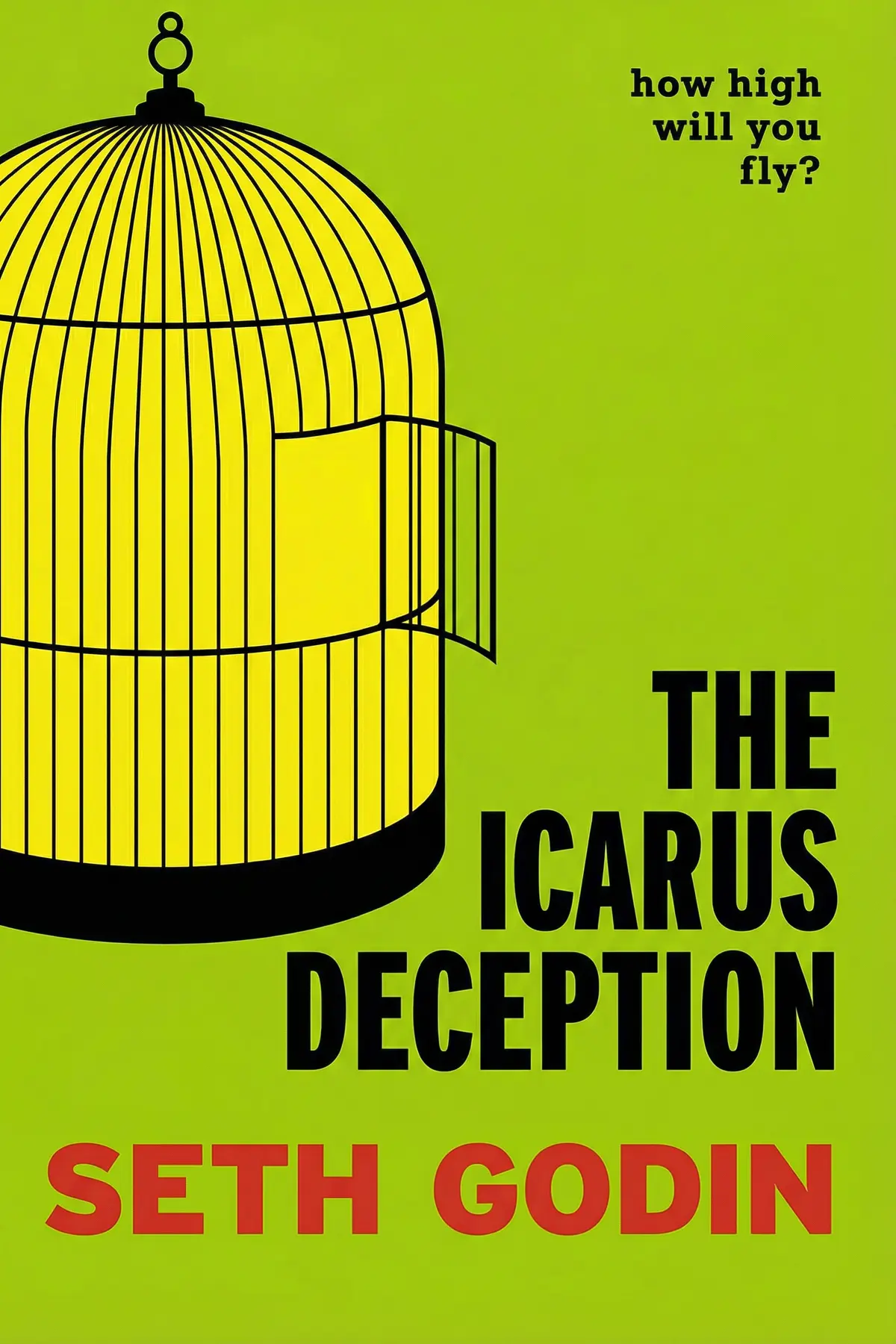
Table of Content
1. Introduction
1 min 37 sec
For generations, we have been operating under a set of rules that were designed for a world that no longer exists. We were told that if we stayed in line, followed the manual, and didn’t make too much noise, we would be rewarded with security. This was the bargain of the industrial age. But today, that bargain has been broken. The digital revolution hasn’t just changed our gadgets; it has fundamentally altered the way value is created and shared. As repetitive tasks are increasingly handed off to intelligent machines, the safe, predictable roles of the past are evaporating.
So, where does that leave us? To thrive in this new landscape, we have to rethink our entire approach to work and life. We have to move toward what Seth Godin calls ‘art.’ Now, when you hear the word art, you might think of galleries, oil paints, or orchestras. But Godin defines it much more broadly. Art is any creative endeavor that requires passion, connection, and the willingness to risk failure. It is the human element that a computer cannot replicate. It is the act of doing something that might not work, for the sake of making a difference.
In the pages ahead, we are going to explore why we are so hesitant to embrace this creative calling. We’ll look at the ancient myth that has been used to keep us small and how the modern economy has actually removed the gatekeepers that used to stand in our way. We will dive into the psychology of creativity, from the destructive power of shame to the transformative power of grit and observation. This isn’t just a guide to being more creative; it’s a manifesto for a new way of being in the world—one where you stop waiting for permission and start flying high enough to see the horizon.
2. The Dual Warning of the Icarus Myth
2 min 20 sec
We have been taught half a story about the dangers of ambition, leading us to play it safe when safety is actually our greatest threat.
3. The Shift from Kittens to Monkeys
2 min 04 sec
In a world without gatekeepers, success no longer comes to those who wait to be rescued, but to those who take initiative.
4. Redefining Humility as Excellence
2 min 18 sec
True humility isn’t about playing small; it’s about the deep commitment to your work that allows you to lose yourself in the process.
5. The Substitution of Talent for Grit
2 min 14 sec
Success in the creative world is rarely about innate ability; it is about the obsessive dedication to small details over a long period.
6. Neutralizing the Weapon of Shame
2 min 03 sec
To be an artist, you must learn to recognize and ignore the societal pressure to conform that manifests as shame.
7. The Power of Extreme Observation
2 min 08 sec
Success is found in the ability to see the world as it really is, rather than through the lens of our own preconceptions.
8. Developing the Habit of Output
2 min 13 sec
Creativity is a muscle that must be exercised daily, and the best way to beat ‘blocks’ is to make production a non-negotiable routine.
9. Conclusion
1 min 33 sec
As we look at the changing landscape of the modern world, it becomes clear that the old maps are no longer reliable. The industrial age, with its focus on conformity and safety, is fading into the background. In its place, a new era has emerged—one that values connection, creativity, and the courage to act without a manual. This is the world of the artist.
Throughout this exploration, we’ve seen that the biggest obstacle to our success isn’t a lack of talent or a lack of opportunity. Instead, it is the ‘Icarus Deception’—the deeply ingrained belief that we must fly low to stay safe. We’ve learned that the gatekeepers have been removed, leaving us with the freedom and the responsibility to choose our own path. We’ve seen that grit and obsession are the true engines of achievement, and that shame is the only real enemy we need to defeat.
Becoming an artist isn’t a destination; it’s a practice. It’s a commitment to seeing the world clearly, showing up every day, and doing the work that might not work. It is a promise to yourself that you will no longer settle for the safety of the waves. The world doesn’t need more compliant workers who follow instructions; it needs more people who are willing to lead, to connect, and to care. It needs people who are brave enough to fly high.
So, as you step back into your daily life, ask yourself: Where am I flying too low? Where am I waiting for permission that I no longer need? The tools are in your hands, the gates are open, and the sun is waiting. It’s time to stop being a kitten and start being an artist. It’s time to take your flight.
About this book
What is this book about?
The world has moved past the industrial age where following instructions and playing it safe led to a guaranteed middle-class life. In this new era, automation and global connectivity have changed the rules of success. This book explores the shift from a 'compliance' economy to a 'connection' economy, where the only way to thrive is to produce 'art'—work that is personal, creative, and inherently risky. Godin promises that by overcoming the psychological barriers of shame and the cultural indoctrination of the 'Icarus Deception,' you can find your unique voice. He provides a blueprint for becoming an artist, which he defines not as someone who paints or sculpts, but as anyone who acts with ingenuity and passion. By developing grit and learning to see the world clearly, you can move beyond the comfort zone and create work that truly matters to others and yourself.
Book Information
About the Author
Seth Godin
Seth Godin is the bestselling author of several books, including Purple Cow, Tribes and Poke the Box. A popular business and self-help blogger, he also founded Squidoo, a blogging platform that brings people together who wish to write about and share their passions.
Linchpin: Are You Indispensable?
Seth Godin
The Practice: Shipping Creative Work
Seth Godin
This Is Strategy: Make Better Plans
Seth Godin
Tribes: We Need You to Lead Us
Seth Godin
Ratings & Reviews
Ratings at a glance
What people think
Listeners find this work both uplifting and intellectually stimulating, with one listener characterizing it as a "magical mystery tour of motivation." They also value how accessible the writing is, as one listener mentions its particular importance for those on a job hunt. The content is filled with excellent guidance and deep insights; notably, one listener points out how it helps individuals take charge of their creativity. Furthermore, listeners commend the prose, as one listener observes that it is specifically tailored for the business world.
Top reviews
Ellie
Seth Godin has this uncanny ability to make you feel like you're standing on the edge of a cliff, ready to fly. This isn’t just a business manual; it’s a manifesto for reclaiming your creative agency in a world that demands compliance. He brilliantly deconstructs the Icarus myth, arguing that we have been brainwashed to fly too low—staying safe and small—rather than too high. To be fair, his definition of 'art' is incredibly broad, encompassing everything from a well-run meeting to a bold marketing campaign. It’s a call to arms for anyone tired of the industrial-age mindset. If you are looking to do work that actually matters, this is your roadmap. It’s punchy, provocative, and absolutely essential for the connection economy.
Show moreDen
This felt like a whirlwind journey through psychological barriers designed specifically for those of us trapped in the grind. Godin’s work reminds me a lot of Steven Pressfield’s 'The War of Art,' but with a more distinct focus on the commercial world. He makes a compelling case that 'safe' is the new 'risky.' In my experience, most people stay in soul-crushing jobs because they fear the sun, but Godin proves that the water—settling for mediocrity—is what will actually drown you. The writing is incredibly accessible and tailored for a fast-paced business environment. It’s more of a spiritual guide for professionals than a technical manual. I walked away feeling like I finally had permission to fail, which is a rare and beautiful gift from an author.
Show moreRapee
After hearing about the connection economy for years, finally reading this book made the concept click into place. It’s an insightful look at why our traditional education system fails us by training us to be obedient cogs. Godin’s writing style is punchy and direct, which I find refreshing compared to the dense, academic prose of most business books. He challenges you to stop waiting for a map and to start drawing your own. The idea that your work is a 'gift' to your audience changed how I approach my daily tasks. It’s not just about getting paid; it’s about making a difference and having a point of view. This is the kind of book you’ll want to highlight and revisit whenever you feel your courage flagging.
Show moreRoo
Finally got around to this classic, and I’m genuinely surprised by how relevant it remains a decade later. The world has only become more connected, making Godin’s arguments about the 'connection economy' even more prescient. He writes in a way that is specifically tailored for the modern, distracted professional—short, high-impact sections that stay with you. I love the idea that every successful breakthrough comes from someone willing to break the rules that came before them. It’s a magical mystery tour of motivation that actually provides a framework for understanding the shift in our global economy. Whether you’re a freelancer or a CEO, there is something in here that will challenge your status quo. It’s a powerful reminder to pick yourself.
Show moreSaengdao
Picked this up during a career pivot, and the timing couldn't have been better for my mental state. Navigating the modern job market feels like a losing game if you follow the old rules of resumes and fitting in. Godin argues that the only way to survive is to be 'indispensable' by creating work that is unique and vulnerable. I appreciated the emphasis on the 'lizard brain' and how fear keeps us from shipping our best work. Some of the assertions felt a bit unsupported, particularly regarding how easily one can just 'start' creating, but the emotional resonance is undeniable. It’s a very readable, high-energy boost for anyone who feels stuck in a cubicle. I’d recommend it to anyone needing a nudge to take that first scary step.
Show moreSomporn
Look, Godin isn't for everyone, but he hits the nail on the head regarding the 'safety' trap. We spend our lives avoiding the sun, terrified of being too bold or too loud, while we completely ignore the danger of flying too low. This book is packed with great advice for anyone who wants to transition from being a 'cog' to being a 'linchpin.' I did find the demonization of 'industrialists' a bit heavy-handed at times; it’s not all black and white. However, the central thesis—that we are now in an economy that prizes human connection over efficient widget-making—is spot on. It’s a quick read that packs a significant punch. Definitely a must-read for creatives trying to find their footing in a corporate landscape.
Show moreJavier
The chapter on vulnerability alone justifies the price of admission for any aspiring creator or entrepreneur. Godin successfully argues that the 'Icarus Deception' isn't just a myth, but a systemic tool used to keep people compliant. To be fair, the book can feel a bit repetitive, as he hammers home the same few points across several hundred pages. But perhaps that’s what we need—constant repetition to unlearn decades of industrial conditioning. It’s a very motivating read that encourages you to step outside your comfort zone and embrace the friction of creation. I found it particularly valuable for framing my career as a series of experiments rather than a ladder to be climbed. It’s empowering, even if it is a bit idealistic at times.
Show moreOat
As someone who has always played it safe, the central thesis here was both terrifying and incredibly liberating. Godin argues that our comfort zones have actually become the most dangerous places to reside. The book is essentially a long-form pep talk, but it’s one that is grounded in a deep understanding of how markets are changing. I gotta say, some of the sections felt a bit like filler, and I wish there were more concrete examples of 'artists' who aren't just in the creative fields. Still, the emotional impact is heavy. It’s an excellent resource for job seekers who want to stand out in a sea of standardized candidates. You’ll walk away wanting to create something—anything—just to prove you can. It’s worth the read for the shift in perspective alone.
Show morePensri
Is this a book or a collection of blog posts bound together by a clever title? I struggle with the structure here because the chapters feel more like a series of disjointed insights rather than a cohesive argument. The truth is, Godin’s writing style is very 'love it or hate it' with its short paragraphs and lack of deep data. While I found the core message about the 'connection economy' versus the 'industrial age' fascinating, the execution felt repetitive. He uses the word 'art' so frequently that it starts to lose its meaning after the first hundred pages. It’s certainly a thought-provoking read for a weekend, but don’t expect a step-by-step guide. It provides plenty of heat but very little light on the actual mechanics of success.
Show moreMaksim
Not what I expected given the high praise from my manager, who seems to worship at the altar of Seth Godin. Frankly, my BS detector was buzzing from the first chapter. Godin makes these sweeping, poetic statements about 'art' without ever acknowledging the financial realities of most workers. It's easy to tell people to quit their jobs and 'make art' when you already have a massive platform and a safety net. The book is structured like a series of inspirational posters, which makes it hard to follow any logical progression. While there are a few nuggets of common sense, they are buried under layers of 'rah-rah' fluff that feels geared toward HR managers rather than actual workers. I found it quite frustrating and ultimately hollow.
Show moreReaders also enjoyed
AUDIO SUMMARY AVAILABLE
Listen to The Icarus Deception in 15 minutes
Get the key ideas from The Icarus Deception by Seth Godin, plus 5,000+ more titles in English and Thai.
- 5,000+ titles
- Listen as much as you want
- 7-day free trial
- Cancel anytime







