
16 min 58 sec
Games People Play: The Psychology of Human Relationships
By Eric Berne
Explore the hidden social scripts that dictate our daily interactions. This breakdown reveals how unconscious psychological maneuvers, or games, shape our relationships, communication styles, and emotional well-being according to Transactional Analysis.
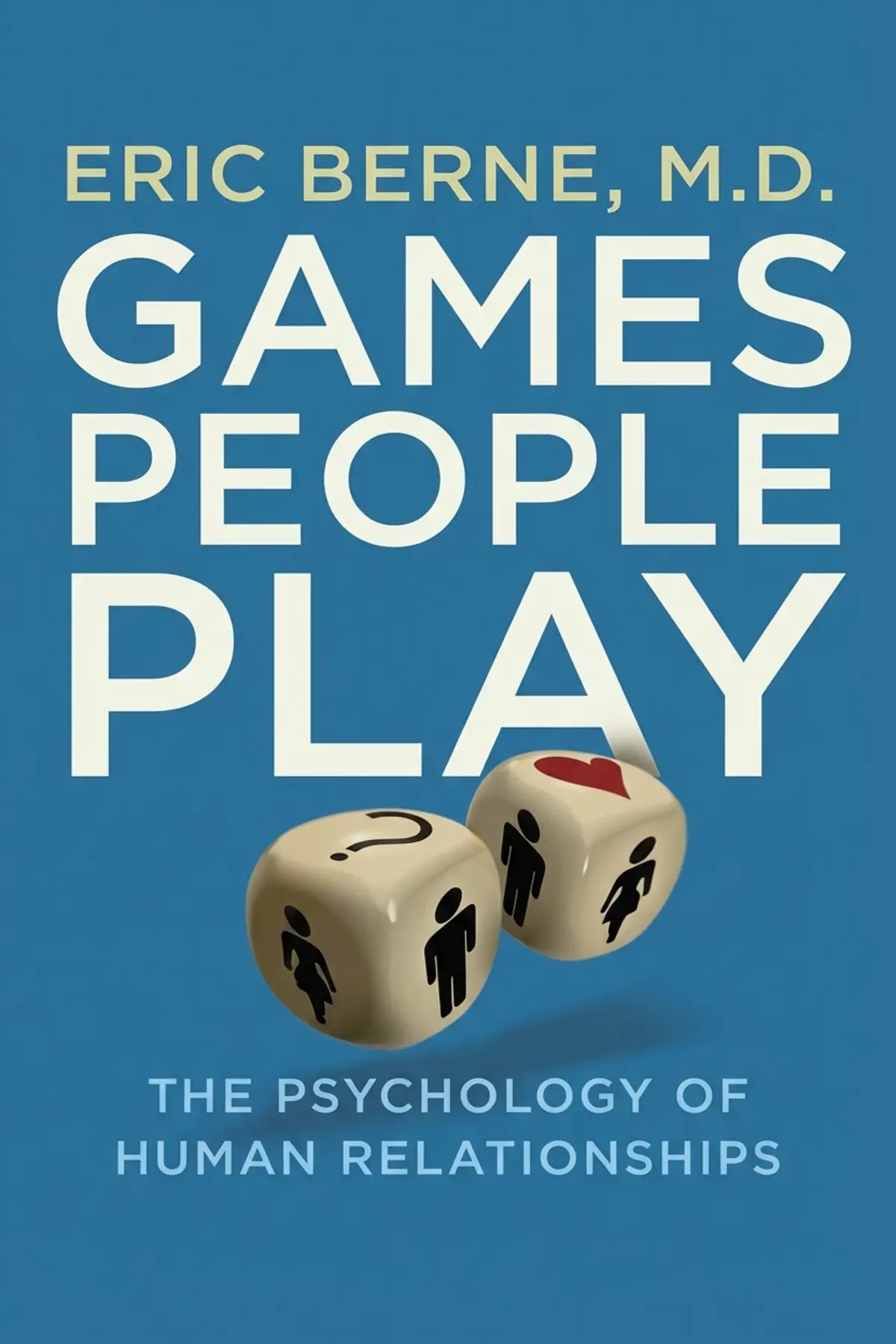
Table of Content
1. Introduction
1 min 24 sec
Have you ever found yourself in an argument that felt strangely familiar, as if you were following a script you didn’t remember writing? Or perhaps you’ve noticed that certain people in your life seem to evoke the same predictable reactions from you every single time you speak. These recurring patterns aren’t just coincidences; they are the maneuvers of what psychiatrist Eric Berne famously called ‘games.’
At its heart, the way we relate to one another is rarely as simple as two people exchanging information. Most of our social lives are governed by complex, often unconscious interactions that serve hidden psychological needs. While we think we are acting as rational individuals, we are often slipping into roles—sometimes acting like a demanding authority figure, other times like a vulnerable youth, and only occasionally as a balanced, objective adult.
In this exploration of human relationships, we are going to peel back the layers of social politeness to reveal the transactional mechanics beneath. We’ll look at the specific psychological states that drive our behavior and the rituals we use to avoid the thing we often fear most: true, unmasked intimacy. By the end of this journey, you’ll have a new lens through which to view every conversation, every conflict, and every connection in your life. You’ll begin to see the games for what they are, which is the first essential step toward living a life that is authentically your own.
2. The Trinity of the Self
2 min 10 sec
Discover the three distinct ego states—Parent, Adult, and Child—that compete for control within us, dictating how we react to the world and everyone in it.
3. The Anatomy of a Social Transaction
2 min 09 sec
Learn how communication is actually a series of psychological transactions, and why things go wrong when our hidden motives clash with our outward words.
4. The Drama of Destructive Habits
2 min 12 sec
Explore why some individuals repeat painful cycles, such as addiction or chronic anger, as a way to fulfill a deep-seated psychological script.
5. Domestic Rituals and Marital Maneuvers
1 min 48 sec
Look behind the closed doors of long-term relationships to see how couples use subtle games to maintain distance and shift blame.
6. The Hidden Scripts of Social Gatherings
1 min 53 sec
See how common party behaviors, from being the ‘clumsy guest’ to the ‘help-rejecter,’ are actually clever ways of manipulating social dynamics.
7. Aggression and the Search for Justification
1 min 46 sec
Examine the darker side of human interactions, where games are used to avoid guilt or to confirm a negative self-image through conflict.
8. The Paradox of the Helping Professional
1 min 39 sec
Uncover the subtle games played in therapy and social work, where the desire to help can sometimes mask a need for superiority.
9. Conclusion
1 min 57 sec
The world of Eric Berne’s ‘games’ can feel a bit cynical at first glance. It suggests that much of what we consider to be our social life is actually a series of dishonest maneuvers designed to keep us at arm’s length from one another. But there is a profound hope buried within this realization. By identifying these games, we gain the power to stop playing them.
We play games because they are safe. They provide a predictable script and protect us from the unpredictability of true connection. However, that safety comes at a high price: a life of repetition, shallow relationships, and suppressed emotions. The alternative Berne proposes is ‘autonomy,’ which consists of three things: awareness, spontaneity, and intimacy.
Awareness means seeing the world as it is, rather than through the filters of our Parent or Child ego states. Spontaneity is the ability to choose how we respond to a situation, rather than falling into a pre-written script. And intimacy is the most rewarding—and most difficult—achievement. It is the ability to show your true, unmasked self to another person without any hidden agendas or psychological payoffs.
As you move forward from this summary, start by being a quiet observer of your own transactions. Notice when you feel that familiar ‘tug’ to be angry, to apologize for a mistake you didn’t really care about, or to offer advice to someone who never takes it. In those moments, pause and ask yourself: ‘What is the payoff here? Am I acting as an Adult, or is an old script taking over?’ Breaking a game often requires nothing more than a refusal to play your part. It might feel uncomfortable, and it might confuse those around you, but it is the only way to clear the path for a relationship that is based on truth rather than a game. When the games end, real life begins.
About this book
What is this book about?
Have you ever walked away from a conversation feeling like something entirely different was happening beneath the surface? Games People Play is the foundational text of Transactional Analysis, a psychological framework that explains why we often fall into repetitive, self-defeating patterns of behavior. It suggests that most of our social interactions are not the straightforward exchanges they appear to be, but rather structured 'games' with hidden motives and predictable payoffs. The book promises to pull back the curtain on these social rituals, categorizing them into marital, sexual, and professional scenarios. By identifying the 'ego states' we inhabit—the Parent, the Adult, and the Child—it provides a map for navigating the complexities of human connection. The goal isn't just to win these games, but to learn how to stop playing them altogether. By achieving social awareness and emotional honesty, individuals can move past superficial scripts and toward genuine, vulnerable intimacy. This summary offers a guide to recognizing these maneuvers in yourself and others, providing the tools necessary to foster more authentic relationships.
Book Information
About the Author
Eric Berne
Dr. Eric Berne (1910–1970) was a distinguished Canadian psychiatrist and the architect of Transactional Analysis. His work revolutionized social psychology in the mid-twentieth century by making complex human interactions understandable through everyday language. Over the course of his career, Berne authored several influential books, including notable titles such as What Do You Say After You Say Hello? and Transactional Analysis in Psychotherapy. His theories continue to be a cornerstone for therapists and individuals seeking to understand the mechanics of human communication and the psychological scripts that drive our lives.
Ratings & Reviews
Ratings at a glance
What people think
Listeners find the book an enjoyable and eye-opening read that offers a firm theoretical base and an effective exploration of transactional analysis. They also value its observations on social dynamics, with one listener mentioning that it helps in building healthy relationships. Nevertheless, there are varied opinions on its accessibility—whereas some find it straightforward for general audiences, others struggle to grasp the text. Additionally, the vocabulary is a point of concern, as one listener notes that terms aren't well-explained, and the era-specific nature of the material triggers mixed responses.
Top reviews
Fort
Ever wonder why your conversations feel like they’re following a script you didn't write? Berne breaks down human interaction into 'games' with predictable payoffs, and it’s frankly eye-opening. The Parent-Adult-Child model gives you a solid conceptual foundation for understanding why people, including yourself, act so irrationally sometimes. While some of the 1960s social commentary is painful to read now, the core insights into Transactional Analysis remain incredibly sharp and applicable. It’s like getting a secret decoder ring for your social life. You start seeing these patterns everywhere—at work, in your marriage, even at the grocery store. It’s not always a comfortable read, especially when you realize which games you’ve been playing for years, but it’s indispensable for anyone seeking more honest communication. Just be prepared to wade through some dense academic language to get to the good stuff. It really changed my perspective on the BS we all put up with.
Show moreVipawan
Berne has a way of stripping away the BS of social life that is both terrifying and refreshing. Once you learn to recognize these games, you’ll start seeing them everywhere—it’s like the Matrix has been revealed. I found it especially useful for identifying my own patterns in relationships and understanding why I revisit certain conflicts. Why do I keep having the same argument? Usually, it's because I'm seeking a specific emotional payoff without even realizing it. This book is indispensable if you want to move toward honest communication rather than just playing a role. Yes, the language is a bit dated and some of the examples are rooted in 1960s stereotypes, but the psychological core is solid gold. It’s one of those rare books that actually changes how you view every single conversation you have. A must-read for anyone on a serious quest for self-awareness and better social interactions.
Show moreAlice
Finally got around to reading this classic and it’s a bit of a mixed bag, though mostly positive. The way Berne categorizes social interactions into degrees—from harmless flirting to life-shattering 'third-degree' games—is brilliant and quite witty in a dry sort of way. I loved the labels he gave them; names like 'RAPO' make the concepts stick in your head much better than standard clinical terms. However, I’ve got to say the terminology can be frustratingly vague at times. He throws around words like 'stroke' and 'script' without always grounding them for a lay reader. You might find yourself flipping back several chapters just to figure out what a specific 'payoff' actually entails. Despite the dated 1960s vibe and some questionable takes on gender roles, there are enough 'aha!' moments here to make it worth the struggle. It’s a foundational text that still feels relevant to building healthier relationships today.
Show moreNitaya
As someone who deals with complex team dynamics every day, I found the descriptions of workplace 'games' to be eerily accurate. Berne’s analysis of how we shift between different ego states explains so much about why professional meetings can suddenly turn into temper tantrums or condescending lectures. It’s a fascinating psychological journey that makes you realize how much of our daily interaction is just a series of maneuvers for emotional payoffs. I particularly appreciated the section on dealing with difficult personalities, like the 'Alcoholic' or the person who always plays 'Why Don't You—Yes But.' To be fair, the writing style is quite jarring and definitely lacks the polish of modern psychology books that rely on hard data. It feels more like a collection of brilliant observations than a scientific study, but the insights are too good to ignore. It helped me recognize my own 'nervous in the service' tendencies.
Show moreSatit
Picked this up after a friend recommended it for understanding office politics, and it really delivered on that front. The classification of games into first, second, and third degrees—ending in either a laugh, a hospital visit, or the morgue—is a stark way to look at human interaction. It makes you realize that what we call 'personality clashes' are often just highly structured games where everyone knows their part. I found the section on 'Nervous in the Service' particularly relatable to my own career struggles. The book isn't always easy to follow, and Berne’s tone can be a bit condescending, but the conceptual foundation is there. It’s a smart look at the secret reasons behind our behavior. Even if you don't buy into Transactional Analysis completely, it’s hard to ignore the 'aha!' moments that pop up every few pages. Definitely helps build healthier relationships if you use it right.
Show moreDen
It’s a fun, slightly weird journey through human behavior that definitely shows its age. After hearing about 'Transactional Analysis' for years, I finally decided to see what the fuss was about. The book provides a solid study of how we interact, though some of Berne's conclusions feel like a reach. I loved the chapter on dealing with alcoholics; it offered a perspective on enabling that felt very modern despite being written in 1964. On the other hand, the terminology is a nightmare to navigate if you aren't already familiar with the field. It’s a bit like learning a new language just to read a relatively short book. Still, it’s enlightening to see how these 'games' provide a shiny pop veneer to our messy social realities. It’s a recommended read, but keep a dictionary—and perhaps a grain of salt for the outdated bits—nearby. The insights on social power are worth the effort.
Show moreConnor
This book is definitely a product of its time, and you have to take the good with the very bad. Look, Berne’s views on women and homosexuals are disgusting and can be very hard to stomach for a modern reader. It’s scary to think this was once standard psychological text used in universities. However, if you can filter out the 1960s sexism, there are genuine nuggets of wisdom buried in here. The concept that we play games to satisfy a deep, albeit unhealthy, need is a powerful one. I found the interaction diagrams helpful, even if the prose was a bit dense. It’s a three-star read for me because while the 'Transactional Analysis' model is a bit outdated, it still provides a unique lens to view social friction. Recommended with a massive asterisk regarding its social politics. You really have to skim through the uglier parts to find the value.
Show moreOak
The core concept of Transactional Analysis is fascinating, but the execution left me feeling a bit cold. I wanted a guide to analyzing my social life, but I spent half the time trying to decipher what Berne actually meant by his strange terminology. The writing is often unconvincing and feels like pseudoscientific psychobabble at points, lacking the rigor I expected from such a famous title. I kept waiting for a clear definition of terms that never quite arrived, making the reading experience more difficult than it needed to be. That being said, the 'games' themselves—like 'See What You Made Me Do'—are instantly recognizable in real life. It’s a weirdly structured book that oscillates between brilliant insight and confusing jargon. I don't buy his analysis completely. It’s not the most reliable guide, but it certainly makes you think twice about your next argument with a spouse or coworker.
Show moreKan
Truth is, I found the 'Parent-Adult-Child' framework a bit oversimplified for the complexities of modern life. While it’s a fun and enlightening read on the surface, the deeper you go, the more it feels like a parlor trick rather than a clinical tool. Berne presents these 'ideas' as if they are universal truths, but there’s a distinct lack of actual research to back them up. Some of the mumbo-jumbo regarding how we fill our 'needs' felt like utter nonsense to me. Still, I can't deny that I recognized a few people I know in the descriptions of the 'Schlemiel' or 'Kick Me' games. It’s a short book, but the jarring style makes it feel much longer than it is. It's a bit of a historical curiosity—useful for understanding where certain pop-psychology trends started, but I wouldn't use it as a primary text for personal growth or serious study.
Show moreThitiwan
Not what I expected from a psychology classic, and not in a good way. I found the writing style incredibly hard to follow and the main subject matter seems mostly outdated. For a book about communication, it’s ironically difficult to understand. Berne uses these witty labels for games that are amusing for five minutes, but the underlying theory feels like it’s built on sand. I was hoping for a reliable guide to human behavior, but instead, I got a collection of anecdotes and sexist observations from sixty years ago. To be fair, the classification of game 'degrees' was interesting in how it categorized social escalation, but that wasn't enough to save the experience. If you’re looking for modern psychology based on research rather than just 'ideas,' you should probably skip this one. It’s a slog that doesn't deliver on its promises. I found myself constantly looking back to see if I missed something.
Show moreReaders also enjoyed
59 Seconds: Change Your Life in Under a Minute
Richard Wiseman
A Liberated Mind: How to Pivot Toward What Matters
Steven C. Hayes
AUDIO SUMMARY AVAILABLE
Listen to Games People Play in 15 minutes
Get the key ideas from Games People Play by Eric Berne, plus 5,000+ more titles in English and Thai.
- 5,000+ titles
- Listen as much as you want
- 7-day free trial
- Cancel anytime







