

A History of Iran: Empire of the Mind
Michael Axworthy
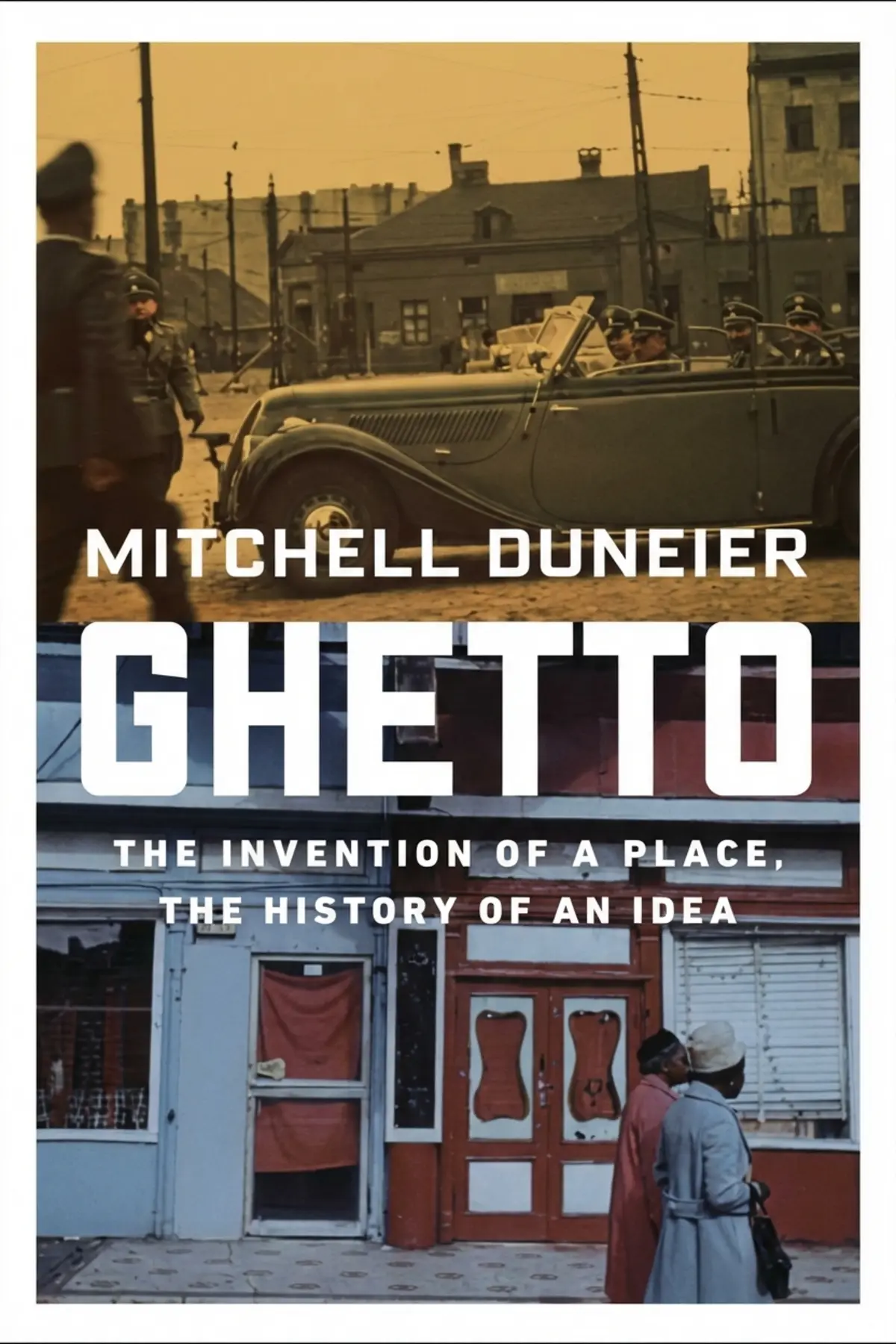
Ghetto explores the five-hundred-year history of urban segregation, tracing how the concept evolved from a 16th-century Venetian enclave to the systemic racial isolation seen in modern American inner cities.
1 min 20 sec
When the word ‘ghetto’ is spoken today, it often brings to mind a specific image: an impoverished, inner-city neighborhood in America, typically populated by black residents struggling against the odds. It is a word heavy with weight and stigma. Yet, this modern American context accounts for less than a tenth of the term’s long and complex five-hundred-year history. To truly understand what a ghetto is—and more importantly, why it exists—we have to look past the contemporary surface and examine the invention of the place and the history of the idea.
In this exploration of Mitchell Duneier’s work, we are going to trace the lineage of the ghetto from its inception in the sixteenth century to its manifestation in modern-day Chicago and beyond. We will see how the ghetto was never a random accident of poverty, but rather a deliberate creation maintained by specific policies and a persistent, circular logic. As we walk through this history, we’ll see the throughline of ‘powerlessness’—how isolation is used to control a population, and how the resulting conditions are then used to justify that very isolation. This isn’t just a story about geography; it’s a story about how society views race, poverty, and the responsibility we have toward one another. Let’s begin by looking back at the original ghetto, where a simple foundry gave its name to a system of segregation that would change the world.
2 min 07 sec
Discover how the first ghetto was established in Venice as a high-walled district for Jewish residents, setting a historical precedent for systemic isolation based on religious and social perceived threats.
2 min 08 sec
Trace the evolution of the term from voluntary ethnic neighborhoods to the horrific forced enclosures of the Nazi era, and finally to the post-war American inner city.
2 min 06 sec
Examine the specific legal and social mechanisms, such as restrictive covenants and institutional bias, that deliberately trapped black residents in overcrowded urban pockets.
2 min 04 sec
Explore why Gunnar Myrdal’s ‘An American Dilemma’ became the definitive text on US race relations despite overlooking the systemic nature of Northern segregation.
2 min 06 sec
Learn how psychologist Kenneth Clark identified the psychological impact of segregation and how government policies like redlining further isolated the urban poor.
1 min 56 sec
Analyze the shift in political focus during the 1960s, where emphasis moved away from structural racism and toward the perceived ‘breakdown’ of the black family.
2 min 19 sec
See how the ideas of sociologist William Julius Wilson were co-opted by politicians to justify punitive welfare reforms and ignore the enduring reality of structural racism.
1 min 44 sec
The history of the ghetto, as Mitchell Duneier reveals, is a five-hundred-year record of intentional isolation followed by a persistent refusal to acknowledge why that isolation exists. From the copper foundries of Venice to the high-rise projects of modern Chicago, the ‘ghetto’ has always been more than just a cluster of buildings; it has been a tool of social and racial management. What we see through this journey is a recurring pattern of ‘circular logic’—a society forces a group into squalor and then points to that squalor as proof of the group’s inherent inferiority.
As we’ve seen, the voices that have most accurately described this reality, from Cayton and Drake to Kenneth Clark, have often been sidelined in favor of narratives that blame the victims. Whether it was Myrdal’s focus on psychology, Moynihan’s focus on the family, or the modern focus on ‘personal responsibility,’ the goal has often been to avoid the uncomfortable truth of systemic racism and structural exclusion. The ghetto remains a central part of the American landscape because it is maintained by policies that are still in effect, and by a political will that often prefers to talk about ‘culture’ rather than ‘power.’
The actionable takeaway from this history is a call for a shift in perspective. To address the problems of the ghetto, we must stop looking for flaws in the people who live there and start looking at the flaws in the structures that surround them. True change requires moving beyond ‘race-neutral’ rhetoric that ignores history and instead confronting the specific, localized mechanisms of exclusion—in housing, in banking, and in urban planning—that continue to define urban life. Only by dismantling the logic that built the walls can we hope to finally see the people living behind them for who they truly are, rather than who the walls have forced them to be.
This summary dives into the complex sociological and political history of the ghetto, a term that has defined urban life for centuries. It moves beyond the common modern association with American poverty to reveal the word’s origins in Renaissance Italy and its devastating journey through the twentieth century. You will learn about the thinkers and researchers who tried to make sense of racial isolation, from the pioneering work of black sociologists in Chicago to the influential yet flawed studies of Swedish economists. The book promises to uncover the structural mechanisms—like restrictive covenants and redlining—that created and maintained these neighborhoods, while exploring how political narratives have often shifted the blame from systemic failure to individual behavior. Ultimately, it offers a deep look at the logic of exclusion that continues to shape our cities.
Mitchell Duneier is the Maurice P. During Professor of Sociology at Princeton University. A respected voice in urban ethnography, he is also the author of the award-winning books Sidewalk and Slim’s Table.
Listeners commend the exceptional blend of sociological expertise and deep intellectual history found here, with one listener drawing attention to its nuanced details of the concept's emergence. Additionally, the prose is skillfully written, as one listener observes the author's great precision. Listeners also find the material compelling and significant; one listener explains that it relates the history and transformation of GHETTO, while another values the layered narrative structure.
Picked this up thinking it would be a straightforward history, but it’s actually a deep dive into how an idea evolves over centuries. Duneier is incredibly precise with his language, showing exactly how the term 'ghetto' was transformed from a site of Jewish containment into a tool for racial segregation in America. The stories about the Chicago School of sociology were a highlight for me; I never knew how much internal politics influenced these theories. It’s fascinating to see how well-meaning liberals often ended up reinforcing the very structures they tried to study. My only gripe is that it skips over about 300 years of history rather quickly to get to the U.S. context, but the American sections are so strong I didn't mind much. It's an important book that makes you rethink the geography of our cities.
Show moreThis book is a powerhouse of sociological insight. Look, many people complain that it focuses too much on the American experience, but that's clearly where the 'idea' of the ghetto took its most complex and enduring form. Duneier’s precision is what sets this apart from other history books. He doesn't just give you dates; he gives you the evolution of thought. The way he connects 16th-century Venice to the Warsaw Ghetto and then to the South Side of Chicago is brilliant, showing a continuity of exclusion that is often overlooked. It's a dense tome, but every page feels necessary to understand the structural forces at play. Personally, I think the deep dive into the lives of Clark and Wilson was the best part. It’s a fascinating, nuanced look at a word we use every day without thinking. Definitely an important read.
Show moreFinally got around to reading this and I’m honestly blown away by the depth of the intellectual history here. Duneier takes a word we all think we know and peels back layers of history I never even considered. The connection between the forced isolation of Jews in the Middle Ages and the systemic segregation of African Americans is handled with such care and precision. It’s a fascinating, layered narrative that doesn't shy away from the darker parts of academic history, especially regarding how black researchers were often sidelined by their white counterparts. The book is well-crafted and feels very relevant to today’s conversations about urban planning and racial justice. Some parts are a bit slow, but the overall impact is powerful. It’s easily one of the most important sociology books I’ve read in years.
Show moreDuneier provides a masterclass in intellectual history by tracing the 'ghetto' from its Venetian roots to the modern American metropolis. The way he weaves together the lives of seminal scholars like Kenneth Clark and Horace Cayton adds a human dimension to what could have been a dry sociological text. While the transition from 16th-century Italy to 20th-century Chicago feels a bit abrupt at times, the precision of his prose keeps the reader engaged. I found the sections on the Warsaw Ghetto particularly haunting, as they serve as a chilling bridge between old-world exclusion and new-world segregation. It is a dense read, certainly, but the layered narrative structure rewards those who stick with it. Some might find the focus too narrow, yet the depth of research here is undeniable. This is an essential resource for anyone looking to understand the mechanics of urban isolation.
Show moreAs someone who appreciates urban sociology, I found this to be a compelling look at the intersection of race, space, and policy. Duneier’s exploration of the intellectual giants like Gunnar Myrdal and William Julius Wilson is top-tier and provides a necessary look at how social science is crafted. Truth is, the book does suffer from a slight identity crisis, as the early chapters on Venice and the Nazi era feel like a prologue that never quite connects to the massive sections on Chicago. To be fair, the research is impeccable, and the writing is clear throughout. However, the lack of attention to the West Coast or the South makes it feel more like a regional study than a definitive global history. Still, the precision of the argument makes it a very valuable read for anyone in the field.
Show moreEver wonder how the places we live in define the people we become? Duneier tackles this head-on with a layered narrative that is both heartbreaking and intellectually stimulating. He doesn't just look at the walls and the buildings; he looks at the scholars who tried to make sense of the chaos. The dynamic between Myrdal and Cayton was particularly revealing, exposing the hidden biases even within 'progressive' academic circles. It's a well-crafted piece of work that centers the Black experience in a way that feels both urgent and historically grounded. I do wish there was more about the current colloquial use of 'ghetto' as a slang term, as that feels like a missed opportunity in the 'history of an idea.' Still, the level of detail regarding the 1940s and 50s is incredible. It makes the invisible walls of our current cities feel much more visible.
Show moreAfter hearing so much about Duneier's work, I finally dove into this 'History of an Idea.' The truth is, it’s an incredibly well-researched study of how white society has historically managed 'undesirable' populations through spatial restriction. The author’s strength lies in his ability to weave together intellectual history with physical reality. His analysis of the Chicago School and the subsequent shifts in sociological thought is where the book truly shines. It’s not just about the places; it’s about the theories that allowed those places to exist and persist. While I agree with other reviewers that the European history is a bit thin, the American section is so detailed it almost makes up for it. The writing is precise, if a bit dry. It’s a solid read for anyone interested in the intersection of race and space.
Show moreThe chapter on the Venetian origins of the ghetto started the book on such a high note, but it never quite recaptured that magic for me. It’s a decent enough book that raises some vital points about segregation, yet it feels overly focused on a handful of individuals. Duneier leans heavily on the work of others, which sometimes makes the book feel like a very long, very expensive book report. I appreciated the nuance he brought to the discussion of the 'Negro Problem,' but the lack of geographic diversity—nothing on the West Coast or the South—is a glaring omission. It’s a good overview for beginners, but seasoned urban scholars might find it lacking in fresh perspectives. A bit too much rehashing of Clark and Wilson for my taste.
Show moreNot what I expected at all, and frankly, quite disappointing in its scope. The title promises a 'history of an idea,' yet it spends almost no time on the five centuries of European history that shaped the word before it ever reached American shores. Instead of a comprehensive global history, we get what feels like a recycled syllabus for an African-American studies course. Don't get me wrong, that history is vital, but the book ignores Asian enclaves, Latino neighborhoods, and even the indigenous reservations which fit the 'ghetto' criteria perfectly. It feels like Duneier had a very specific thesis about white-on-black racism and ignored any evidence that didn't fit that narrow frame. The writing is academic and dry, often reading more like a series of book reports than an original narrative. If you want a full history of the ghetto, this isn't it.
Show moreWow, talk about a letdown. I was looking for a comprehensive history of the ghetto as a global concept, but this felt like it was written in a vacuum. The author spends hundreds of pages on a few specific sociologists in Chicago while almost entirely ignoring the Jewish history he teased in the first chapter. To call this a 'history' is a stretch when it ignores 90% of the timeline. It’s more like a critique of 20th-century American social science. Also, the tone is so academic that it becomes a chore to get through. Not gonna lie, I almost put it down halfway through because the narrative just stalls in these endless descriptions of old research papers. If you’re a sociology student, you might like it. If you’re a general history buff looking for a broad perspective, look elsewhere.
Show moreMichael Axworthy
Johny Pitts
Tom Standage

Ishmael Beah
bell hooks
William J. Bernstein
AUDIO SUMMARY AVAILABLE
Get the key ideas from Ghetto by Mitchell Duneier, plus 5,000+ more titles in English and Thai.







