

22 min 38 sec
Good Reasons for Bad Feelings: Insights from the Frontier of Evolutionary Psychiatry
Randolph M. Nesse explores why evolution left us prone to mental distress. Discover how anxiety, depression, and other painful emotions are actually survival mechanisms that are often misaligned with our modern lives.
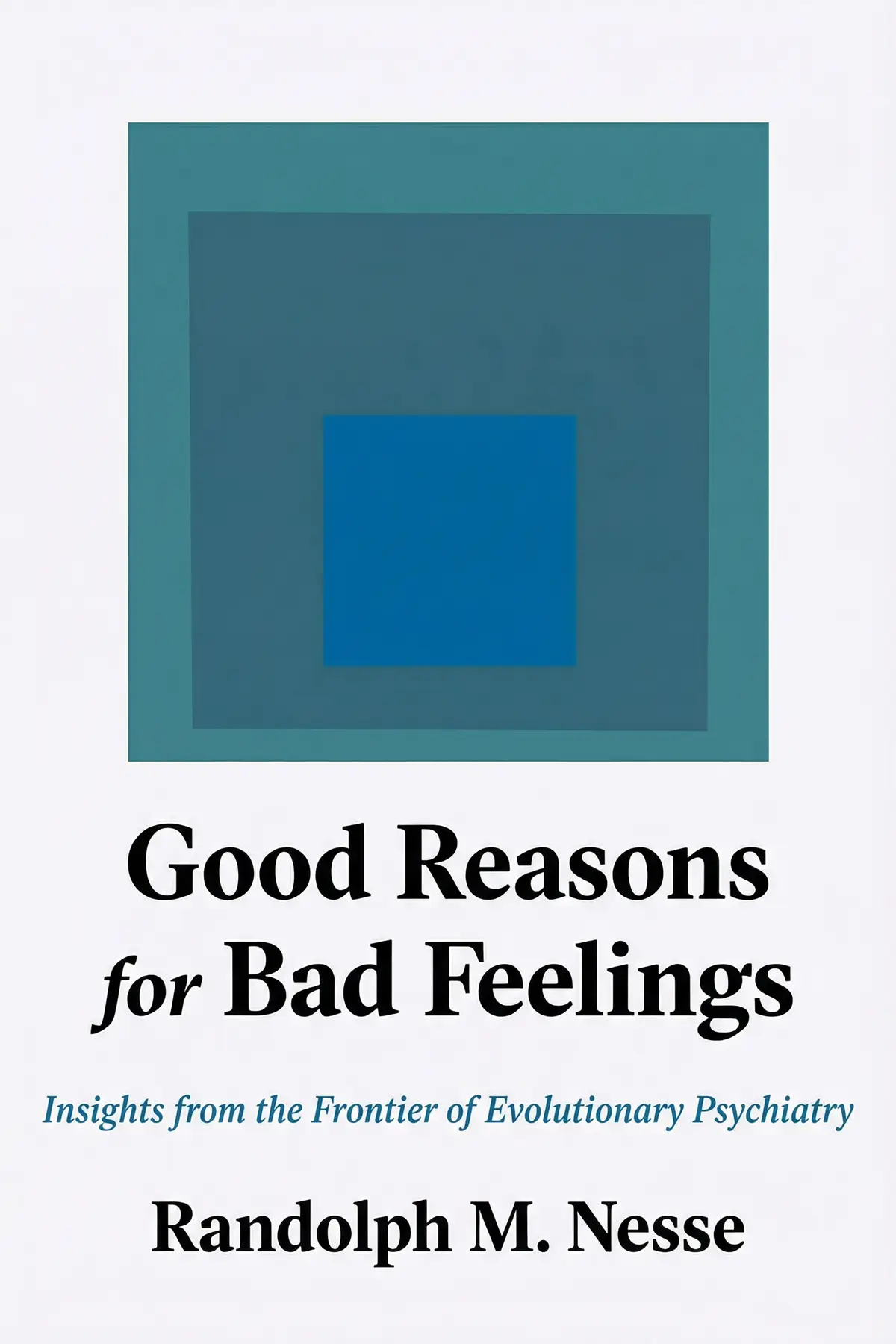
Table of Content
1. Introduction
1 min 41 sec
We often think of our minds as highly advanced biological computers, the product of millions of years of rigorous natural selection. And yet, if our brains are so sophisticated, why do they seem to malfunction so frequently? Why are we prone to panic attacks when there is no physical threat, or why do we sink into a lethargic depression when we should be productive? It feels like a design flaw. But what if these weren’t flaws at all? What if there were actually deeply logical, evolutionary reasons for our most uncomfortable emotions?
In Good Reasons for Bad Feelings, Dr. Randolph M. Nesse introduces us to the frontier of evolutionary psychiatry. This field doesn’t just ask what is happening in the brain during a mental health crisis; it asks why the brain is capable of such states in the first place. Throughout this exploration, we’ll move away from the idea that a ‘bad’ feeling is a sign of a ‘broken’ person. Instead, we’ll see that our emotions are sophisticated tools shaped by evolution to help our ancestors survive and reproduce in a world that was much more dangerous and precarious than the one we inhabit today.
As we journey through these insights, we’ll look at why anxiety acts like a fire alarm, why mood is a regulator of our personal energy, and why our modern world creates a unique friction with our ancient instincts. By the end, you’ll have a new framework for understanding the human condition—one that views our struggles not just as pathologies, but as the echoes of our long struggle to survive. Let’s dive into the evolutionary logic of the human mind and discover why there are, indeed, very good reasons for our bad feelings.
2. The Mismatch Between Evolution and Modernity
3 min 11 sec
Discover why our biological traits prioritize survival over our happiness, and how the sudden shift in our modern environment creates a dangerous friction with our ancient instincts.
3. The Smoke Detector Principle of Anxiety
3 min 25 sec
Explore the counterintuitive logic behind why our brains are hardwired to trigger false alarms, and why a certain amount of ‘excessive’ anxiety is actually an evolutionary success.
4. Mood as a Strategic Resource Regulator
3 min 15 sec
Understand the evolutionary purpose of our shifting moods and how depression might be a malfunction of a system designed to keep us from wasting effort on hopeless goals.
5. The Social Map and the Pain of Connection
3 min 06 sec
Examine the SOCIAL acronym to understand how our relationships and status impact our mental health, and why evolution made us care so deeply about others’ opinions.
6. Reproductive Priority Over Personal Satisfaction
3 min 02 sec
Learn why our sexual lives are often fraught with dissatisfaction and how natural selection prioritizes the efficiency of making life over the pleasure of the experience.
7. The Trap of Artificial Abundance
3 min 06 sec
Examine why our brains have no ‘off’ switch for modern drugs and high-calorie foods, and how our ancestors’ survival traits have become our modern addictions.
8. Conclusion
1 min 52 sec
As we wrap up our look at Good Reasons for Bad Feelings, the primary takeaway is a transformative shift in how we perceive the human mind. We have seen that the anxiety that keeps us awake, the low mood that makes us want to withdraw, and even the pangs of jealousy and grief are not necessarily evidence of a broken brain. Instead, they are often the legacy of a survival strategy that worked for our ancestors over millions of years.
We’ve learned about the ‘Smoke Detector Principle,’ which explains why our brains prefer the annoyance of a false alarm to the catastrophe of a missed threat. We’ve explored how our moods act as strategic regulators of our energy, telling us when to push forward and when to give up on unreachable goals. We’ve also seen how the ‘SOCIAL’ factors of our lives—our status, our families, and our work—are the triggers for these ancient biological responses. And finally, we’ve looked at the ‘mismatch’ between our Stone Age biology and our modern world of abundance and artificial stimuli.
So, what do we do with this knowledge? The most immediate action is to change the internal dialogue we have with ourselves. The next time you feel a wave of anxiety or a dip in your mood, try to look at it through this evolutionary lens. Ask yourself: What is this feeling trying to tell me? Is this a ‘smoke detector’ false alarm? Am I chasing a goal that my biology thinks is unreachable? Am I responding to a social threat that isn’t as life-threatening as my brain thinks it is?
By understanding the evolutionary origins of our distress, we can treat ourselves and others with more empathy. We can move away from the stigma of ‘disorder’ and toward a more nuanced understanding of the human condition. While our feelings may be ‘bad,’ they are often there for very ‘good’ reasons. Recognizing those reasons doesn’t just help us understand our past—it gives us the tools to navigate our future with more wisdom and resilience.
About this book
What is this book about?
Have you ever wondered why, despite thousands of years of human progress, we are still plagued by overwhelming anxiety, crushing depression, and persistent insecurity? Good Reasons for Bad Feelings tackles this paradox by applying the principles of evolutionary biology to the field of psychiatry. Instead of viewing mental suffering simply as a broken biological circuit, the book proposes that many of our most painful emotions actually served a vital purpose in our ancestors' survival. The promise of this work is a radical shift in perspective. By understanding the 'why' behind our bad feelings—using concepts like the smoke detector principle and the mismatch between our ancient brains and modern environments—we can begin to treat mental health with more compassion and effectiveness. It bridges the gap between biological medicine and the deeply personal experience of being human, offering a roadmap for why our minds struggle and how we can better navigate those struggles.
Book Information
About the Author
Randolph M. Nesse
Randolph M. Nesse, MD, is a pioneer in the field of evolutionary medicine. He gained international recognition as the co-author of the seminal book Why We Get Sick in 1994. Currently, he serves as the founding director of the Center for Evolution and Medicine at Arizona State University. A respected voice in the scientific community, Nesse is a member of the American Association for the Advancement of Science and holds the presidency of the International Society for Evolution, Medicine and Public Health.
Ratings & Reviews
Ratings at a glance
What people think
Listeners find the work very accessible, with one describing it as an easy-to-read encyclopedia. Furthermore, they value its insights, as one listener notes how it offers a fresh outlook on psychiatry using evolutionary theory. They also appreciate its relevance to mental health, with one mentioning how it helps in understanding the roots of mental illness. However, listeners have mixed reactions regarding the quality of the narrative.
Top reviews
Suthida
Finally, a book that makes sense of my internal chaos without making me feel like a broken machine! Nesse's perspective is remarkably humane, suggesting that our “bad” feelings are actually functional defenses that were helpful to our ancestors. I loved the section explaining how depression can be a signal to stop pursuing unreachable goals; it made me look at my own periods of burnout through a completely different lens. The writing is clear and engaging, making complex biological concepts feel as easy to navigate as a well-organized encyclopedia. While I wish there had been more focus on female-specific issues like PMS, the broad overview provided here is still incredibly valuable. It’s rare to find a science book that is this comforting and intellectually stimulating at the same time. This is a must-read for anyone looking to bridge the gap between biology and emotion.
Show moreLek
Wow. This is probably the most important book on mental health I’ve read in the last decade. Nesse takes the “chemical imbalance” theory to task and replaces it with a much more logical, evolutionary perspective. He explains how anxiety kept our ancestors alive by making them hyper-aware of rustling bushes, even if most of the time it was just the wind. This “better safe than sorry” logic explains so much about modern phobias and agoraphobia. I loved the humane tone of the writing; it feels like a warm conversation with a very wise doctor. The book is structured like an encyclopedia of human misery, but in a way that feels empowering rather than bleak. It gives you the tools to understand why your brain is doing what it’s doing. I’ve already recommended it to several friends who struggle with chronic stress. It truly provides a new perspective that is long overdue.
Show moreOksana
Not what I expected, but in a good way. I thought this would be a dense, academic textbook, but Nesse actually makes the material very accessible for the general reader. The core idea—that our genes don't care about our happiness—is such a powerful way to frame mental health struggles. I especially liked the chapter on how low mood can be an adaptive response to help us conserve energy when we’re stuck. Some parts of the book, like the history of psychiatric diagnosis, were a bit of a slog to get through. However, the insights into why we are so prone to “false alarms” in our emotions were worth the effort. It’s a thoughtful and careful exploration that avoids the “just-so” story trap better than most evolutionary psychology books. This book definitely changed how I think about my own moods. It’s a solid read for anyone curious about the human condition.
Show morePan
As someone who has always felt let down by the standard “chemical imbalance” model, this book provided a breath of fresh air. Nesse doesn't just dismiss modern psychiatry; instead, he asks the fundamental “why” questions that the DSM often ignores. The way he frames anxiety as a smoke detector—where false alarms are annoying but necessary for survival—totally changed how I view my own panic attacks. Frankly, the middle section on mating and male jealousy felt a bit like a detour, and I found some of the theories on agoraphobia to be a stretch. However, the core message that our genes care about reproduction more than our personal happiness is a bitter but necessary pill to swallow. It’s an accessible read for a general audience, yet it maintains enough scientific rigor to feel authoritative. This is essential reading for anyone trying to understand the biological roots of their own mental struggles.
Show moreChatri
Look, Nesse clearly knows his stuff, but the structure of this book didn’t quite work for me as a casual reader. The initial chapters are brilliant, laying out how natural selection prioritizes the survival of our genes over our individual well-being and happiness. It’s a fascinating, albeit slightly depressing, realization that our brains aren't “designed” for peace. However, the later chapters on specific disorders like bipolar and autism felt a bit rushed compared to the deep dives into anxiety. Some of the evolutionary explanations, like the comparison between “Mellow Guy” and “Jealous Guy” regarding male infidelity, felt a bit too speculative for my taste. To be fair, he admits that we are still in the early stages of this research, which I appreciate. It’s a solid introduction to the field, but it lacks the definitive answers I was hoping for. I’d say it’s worth a read if you have a high tolerance for academic-leaning prose.
Show moreAndrei
Ever wonder why evolution would leave us so prone to misery? This book answers that question by showing how our ancient survival mechanisms are often a poor match for the modern world we live in today. I found the chapter on eating disorders particularly insightful, especially the idea that gorging was once a survival trait. It’s a bit repetitive in places, particularly when Nesse goes over the history of psychiatric diagnosis, which can feel like a slog if you’ve read any other psych books. Despite that, the “smoke detector principle” is a brilliant way to explain why our bodies overreact to stress. The author strikes a good balance between being a scientist and a compassionate clinician. I walked away with a lot more empathy for myself and the “bad” feelings I experience. It's not a self-help book, but the perspective shift is certainly therapeutic in its own way.
Show moreThongchai
Nesse offers a refreshing lens through which we can view the entire spectrum of mental illness. Instead of seeing depression or anxiety as mere malfunctions, he invites us to consider them as signals that we are in a dangerous or unproductive situation. Personally, I found the discussion on unreachable goals being a trigger for low mood to be the most profound part of the book. It shifts the focus from fixing a “broken” brain to looking at the stressors in an individual's life. The prose is surprisingly easy to digest for such a heavy subject matter, and I zipped through the chapters on social anxiety. There were moments where the evolutionary “stories” felt a bit thin on evidence, but the author is always careful to frame them as hypotheses. This book feels like a major step forward for the field of psychiatry. Everyone interested in the future of mental health treatment needs to pick this up.
Show morePenelope
After hearing so much buzz about evolutionary psychiatry, I decided to give Nesse’s book a try and I’m glad I did. It provides a much-needed framework for why our emotions feel so out of whack in the 21st century. The truth is, our brains are still wired for a world of predators and scarce resources, not for a world of social media and constant notifications. I appreciated the nuance he brought to the table, specifically regarding how genes benefit the species at the expense of the individual. Some sections, especially the ones on mating and sexual jealousy, felt a bit like old news if you've read any Dawkins. Still, the clinical examples Nesse shares from his own practice help ground the theory in reality. It’s a positive, well-written book that doesn't claim to have all the answers but asks the right questions. I'd recommend it to anyone who likes science with a bit of heart.
Show moreAna
Gotta say, I have mixed feelings about this one despite the interesting premise. On one hand, the evolutionary explanations for things like the “failure to diet” in a world of abundance were eye-opening. On the other hand, the book feels quite repetitive, especially when Nesse keeps circling back to the limitations of the DSM. I found the section on male jealousy to be a bit one-sided, as he didn't really delve into female jealousy or more diverse social structures. The writing style is a bit dry, which made it a slowish read for me personally. To be fair, the book is very well-researched and avoids the trap of being too “pop-science” or overly simplistic. It just didn't quite grab me the way I hoped it would given the subject matter. If you’re looking for a quick read, this probably isn’t it. It’s more of a deep dive for those who really want to study the intersection of biology and psychology.
Show moreGift
The truth is, I struggled to finish this one because the pacing was just so incredibly slow. While I appreciate Nesse’s credentials as a psychiatrist, the writing often feels like it was intended for his professional colleagues rather than a curious layperson. I was expecting a vibrant exploration of evolutionary psychology, but instead, I got a dry history of the DSM and several repetitive chapters on sex and eating disorders. Many of these ideas felt like “just-so” stories—clever theories that are unfortunately impossible to prove with actual data. For instance, explaining eating disorders simply as an ancient drive to gorge when food is available feels a bit reductive given the complexity of modern culture. If you are already well-versed in psychology, most of this will feel like a review of things you’ve already heard elsewhere. I'd recommend skipping this and looking for something with a bit more narrative punch.
Show moreReaders also enjoyed

59 Seconds: Change Your Life in Under a Minute
Richard Wiseman

ADHD an A-Z: Figuring It Out Step by Step
Leanne Maskell
AUDIO SUMMARY AVAILABLE
Listen to Good Reasons for Bad Feelings in 15 minutes
Get the key ideas from Good Reasons for Bad Feelings by Randolph M. Nesse, plus 5,000+ more titles in English and Thai.
- 5,000+ titles
- Listen as much as you want
- 7-day free trial
- Cancel anytime







