
20 min 08 sec
Great by Choice: Uncertainty, Chaos, and Luck – Why Some Thrive Despite Them All
Discover why some companies thrive in chaos while others fail. This summary explores the discipline, empirical creativity, and productive paranoia required to achieve long-term success in uncertain environments.
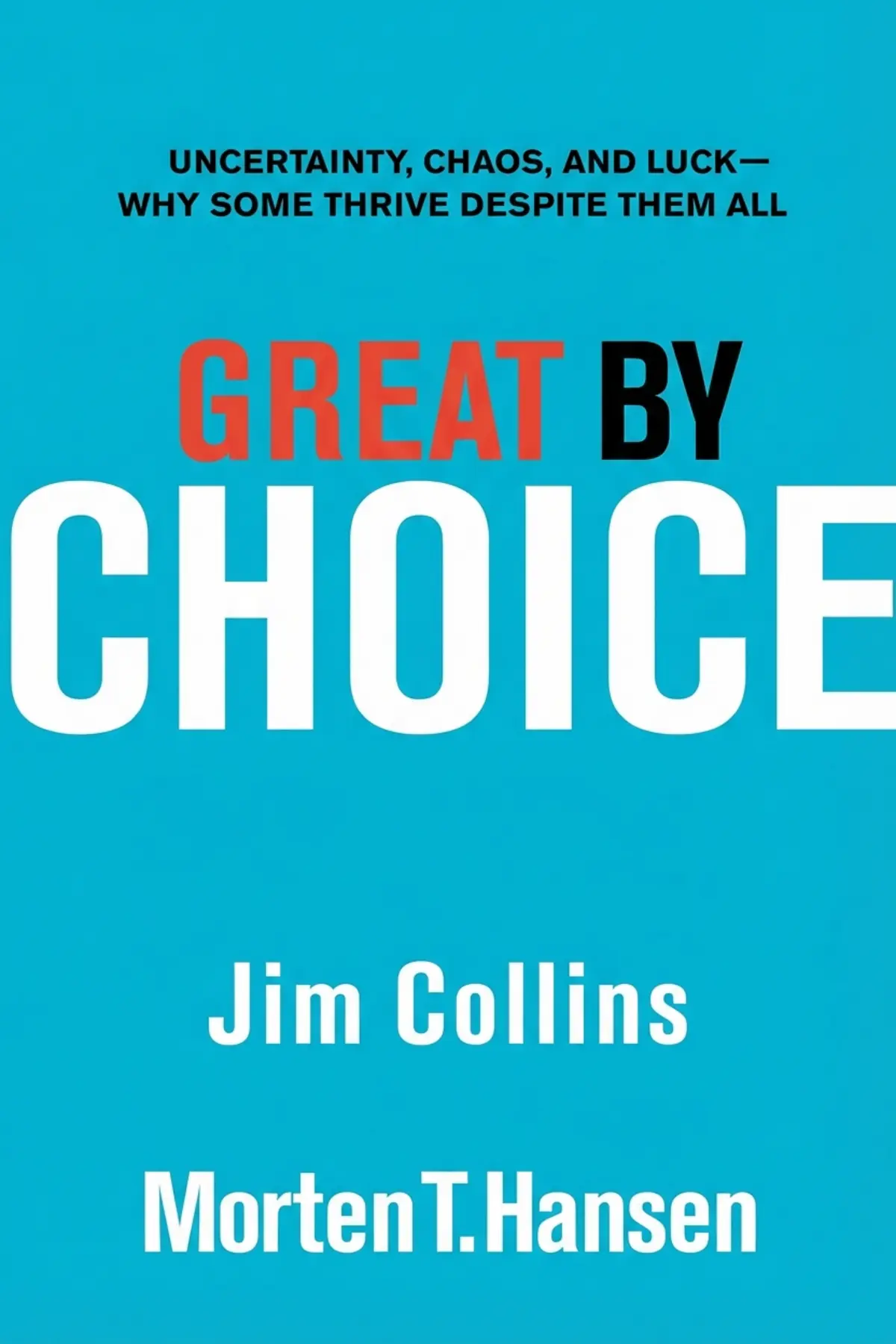
Table of Content
1. Introduction
1 min 52 sec
Imagine the year 1911, in the harshest, most unforgiving environment on Earth: the Antarctic. Two teams were locked in a desperate race to become the first human beings to reach the South Pole. On one side, you had Roald Amundsen, and on the other, Robert Falcon Scott. Their goals were identical, and their starting conditions were similarly brutal. Yet, their outcomes could not have been more different. Amundsen’s team reached the pole first, planted their flag, and returned home safely. Scott’s team arrived more than a month late, found the Norwegian flag already flying, and tragically, every single member of the team perished on the return journey.
What caused such a stark difference in their fates? It wasn’t a matter of one leader being braver or more ambitious than the other. The difference lay in their choices. Amundsen was obsessively prepared. He had spent years learning from Eskimos about polar survival, testing different foods like dolphin meat, and ensuring his team carried redundant supplies. He marked his depots with black flags to ensure they were visible against the white snow. Scott, by contrast, relied on unproven technologies and carried far fewer provisions. When the environment turned against them, Amundsen was ready, and Scott was not.
This story serves as the perfect lens through which to view the world of business. In a modern economy characterized by chaos, uncertainty, and rapid change, why do some companies thrive while others fail? Just like the explorers in the Antarctic, the leaders of the most successful companies—those the authors call 10Xers—do not leave their success to chance. They recognize that while they cannot control the weather or the market, they can control their preparation and their response. This summary explores the specific behaviors and strategies that allow these 10X companies to outperform their competition by at least a factor of ten, proving that greatness is not a function of circumstance, but a matter of choice.
2. The Foundation of 10X Success
2 min 40 sec
Ever wonder why some leaders navigate chaos with ease while others are swept away? Explore the three core behaviors that separate exceptional companies from the rest of the pack.
3. The Power of the Twenty-Mile March
2 min 19 sec
Consistency is often more difficult than intensity. Learn why setting strict upper and lower bounds for your progress can be the difference between survival and sudden collapse.
4. Firing Bullets Before Cannonballs
2 min 19 sec
Great leaps forward are rarely the result of a single giant gamble. See how testing small ideas with minimal risk allows companies to calibrate their biggest moves.
5. The Innovation Threshold
2 min 09 sec
Being the most innovative company in the room isn’t always a winning strategy. Discover why execution and operational discipline are often more important than constant invention.
6. Practicing Productive Paranoia
2 min 12 sec
What if the worst-case scenario happens tomorrow? Explore how successful leaders turn their fears into a strategic advantage by preparing for disasters long before they strike.
7. Building a SMaC Recipe
2 min 34 sec
In a shifting world, a rigid set of operating procedures might seem counterintuitive. However, having a specific, methodical, and consistent playbook is the ultimate tool for enduring success.
8. Maximizing the Return on Luck
2 min 17 sec
Success isn’t about being luckier than the competition; it’s about what you do when luck strikes. Understand how the world’s greatest leaders capitalize on every fortunate break.
9. Conclusion
1 min 46 sec
As we look back at the strategies of the 10X companies, a clear throughline emerges. Greatness is not something that happens to a company because of a favorable environment or a stroke of brilliance. Greatness is a conscious choice. It is the result of a leader and an organization deciding to be more disciplined, more empirical, and more prepared than anyone else. Whether it is the steady pace of the Twenty-Mile March, the careful calibration of bullets and cannonballs, or the protective shield of productive paranoia, these strategies all serve a single purpose: to give the company control over its own destiny in an uncontrollable world.
The comparison between Roald Amundsen and Robert Falcon Scott remains the ultimate metaphor for this journey. Both men faced the same freezing temperatures and the same treacherous terrain. The environment didn’t choose who would live and who would die; their preparation did. In your own professional life, the lesson is clear. You cannot wait for the world to become stable or predictable before you take action. You must build your own stability. You must create your own SMaC recipe and have the discipline to follow it, even when the wind is blowing against you.
Ultimately, the most successful leaders reject the idea that they are victims of circumstance. They take full responsibility for their results, whether they are good or bad. They recognize that everyone gets a certain amount of luck, but only those who have done the hard work of preparation will be able to capitalize on it. By adopting the mindset of a 10Xer—staying disciplined, relying on evidence, and remaining productively paranoid—you can build an organization that doesn’t just survive the chaos, but thrives because of it. The future is uncertain, but your success doesn’t have to be. It is, quite literally, your choice.
About this book
What is this book about?
This summary delves into the research of Jim Collins and Morten T. Hansen to answer a fundamental question: Why do some organizations thrive in uncertainty while others fail? The authors identify a unique group of companies, termed 10Xers, that outperformed their industries by at least tenfold during turbulent periods. By studying the contrast between winners and losers, the book reveals that success is not a matter of luck or a better environment, but a matter of conscious choice and rigorous discipline. The promise of this work is a blueprint for leadership in an unpredictable world. It introduces concepts like the Twenty-Mile March, firing bullets before cannonballs, and productive paranoia to show how consistency and evidence-based decision-making provide stability. Whether you are navigating a volatile market or leading a team through transition, these insights offer a roadmap for building an enterprise that is built to last and designed to excel regardless of external chaos. You will learn how to balance innovation with execution and how to prepare for the unexpected so that your organization is ready for anything.
Book Information
About the Author
Jim Collins
Jim Collins is a renowned business consultant and author of bestsellers like Good to Great and Built to Last, with over ten million books sold. He runs a management laboratory for research and teaching. Morten T. Hansen is a management professor at the University of California and author of Collaboration. He is a global consultant and speaker for major corporations.
Ratings & Reviews
Ratings at a glance
What people think
Listeners describe this work as exceptionally engaging and well-crafted, noting the extensive research and persuasive case studies included. It offers actionable guidance for managing a flourishing enterprise, with one listener highlighting how the lessons apply to both professional environments and individual development. Listeners value the perspective on leadership, especially the concepts surrounding fanatical discipline, and find the included narratives to be captivating.
Top reviews
Nongnuch
The comparison between Roald Amundsen and Robert Falcon Scott's journey to the South Pole is worth the price of the book alone. Collins and Hansen use this historical narrative to brilliantly illustrate the '20 Mile March' concept, showing how consistency beats bursts of energy every single time. As a manager, I found the emphasis on fanatical discipline both convicting and incredibly practical for our current quarterly planning. The book doesn't just offer vague advice; it provides a rigorous framework backed by years of data-driven research. While some might find the detailed methodology sections in the back a bit dry, they add a layer of authenticity that many business books lack. If you are operating in an industry defined by rapid change and total uncertainty, these principles are basically a survival guide for your organization's long-term health.
Show moreSomsak
After hearing so much about the '20 Mile March' in my management circles, I finally decided to see what the hype was about. I was pleasantly surprised to find that the book is far more than just a collection of business slogans; it’s a deeply researched study on human behavior under stress. The concept of 'Productive Paranoia' resonated with me deeply, especially the idea of building huge cash reserves before you actually need them. It’s a sobering reminder that the 'Death Line' is always closer than we think, and only those who prepare for the worst will actually survive to see the best times. The writing style is punchy and accessible, making it a quick read despite the dense subject matter. I've already started applying the 'bullets then cannonballs' approach to my own small business ventures with great results.
Show moreAim
Picked this up because I wanted to understand how companies like Southwest and Intel maintained such a massive lead over their competitors for decades. Jim Collins has a unique gift for turning complex data into compelling stories that stick with you long after you close the cover. The analysis of why innovation alone isn't enough to guarantee success was particularly eye-opening for me as a creative professional. You need that discipline to back it up, or you’re just spinning your wheels. The book is well-written, highly readable, and filled with case studies that feel both authentic and meticulously vetted. It’s refreshing to read a business book that doesn’t just chase the latest fad but looks at long-term, sustainable excellence. Highly recommended for anyone in a leadership role.
Show morePriya
Wow, the idea of 'Return on Luck' completely flipped my perspective on success and failure in the corporate world. We often attribute greatness to a lucky break, but Collins proves that the real differentiator is how a company prepares for and responds to that luck. The case studies on Amgen and Progressive Insurance were fascinating examples of '10X' performance that I hadn't seen covered in this much depth before. I especially appreciated the 'Leading above the Death Line' section, which emphasizes the need for redundant systems and high cash ratios. In an era where everyone is told to be disruptive and aggressive, this book makes a compelling case for being disciplined and productively paranoid. It’s an empowering read that puts the power of choice back into the hands of the leader.
Show moreRosa
Is it possible to actually quantify why some companies survive chaos while others collapse under the weight of their own ambition? This book argues that greatness isn't a result of luck, but of specific, methodical choices made during times of extreme pressure. I particularly enjoyed the section on the SMaC recipe—Specific, Methodical, and Consistent—and how it provides a constitution for a company’s operations. It’s a fascinating look at how 10Xers maintain their independence of mind when everyone else is following the latest trend. My only minor complaint is that the comparison companies often felt like 'straw men' designed to make the winners look even better by contrast. Regardless, the emphasis on empirical creativity is a much-needed counterpoint to the 'move fast and break things' mentality that dominates the tech world today.
Show morePui
Looking at the modern business landscape, the concept of 'Productive Paranoia' feels more relevant today than when the book was first published. The authors do a fantastic job of explaining why some leaders thrive in chaos by being hyper-vigilant and extremely disciplined. I found the 'Return on Luck' chapter to be the most innovative part of the entire book, as it moves the conversation away from whether luck exists to how we actually manage it. 10Xers don’t necessarily get more good luck; they just execute better when it arrives. Look, the book can be a bit formulaic at times, but the clarity of the framework makes it very easy to share with a leadership team. It provides a common language for discussing risk and innovation that is truly valuable in high-stakes environments.
Show moreSupranee
Truth is, I wasn't expecting a business book to change how I view my personal habits, yet the focus on fanatical discipline hit home. This isn't just about corporate strategy; it’s about the psychology of people who refuse to let external circumstances dictate their outcomes. I loved the distinction between 'bullets'—the low-risk tests—and 'cannonballs'—the big commitments. It’s a perfect metaphor for how to innovate without betting the entire farm on an unproven idea. My main gripe is that the tone can get a bit 'self-congratulatory' regarding the research process, which slowed down the pace in the middle chapters. However, the actionable insights on maintaining a 'SMaC' recipe for success are worth the minor annoyance. It’s a very solid four-star read for anyone interested in leadership.
Show moreDylan
To be fair, the research backing this book is undeniably dense and impressive, but the actual prose feels stretched thin at times. Collins spent years analyzing these companies, yet the book is only about 180 pages long before you hit the massive appendix of research notes. I liked the historical anecdotes, especially the IMAX Everest trip, but the corporate examples felt a bit dated since companies like Microsoft and Apple have changed so much since the data was collected. It’s a decent read if you want to understand the Collins philosophy, but it doesn't quite reach the heights of 'Good to Great.' The core behaviors are solid, but you’ll find yourself skimming through the repetitions of the same three or four main points. It’s good, just not groundbreaking.
Show moreGor
Not what I expected after the ground-breaking insights found in 'Good to Great,' though it still offers some value for those new to Collins. In my experience, the concepts here felt a little less 'sticky' than his previous work, perhaps because the 'uncertainty' angle feels a bit forced at times. While I appreciate the thorough research, the constant reminders of how hard they worked on the data can get a bit tiresome. The South Pole comparison is brilliant, but after that, the book loses a bit of its momentum and starts to repeat itself. It’s a helpful reminder of the importance of discipline, but you could probably get the gist of it by reading a summary or just the final chapter. Still, it’s a well-constructed argument for being conservative in an unpredictable world.
Show moreYui
While Jim Collins is a household name in business literature, I found this particular installment to be a bit of a letdown compared to his earlier work. Frankly, it feels like the authors are trying too hard to fit complex corporate histories into neat, catchy metaphors like 'bullets and cannonballs.' The reliance on survivorship bias is glaring throughout the case studies, and I’m not entirely convinced that these traits are truly predictive of future success. Much of the text feels like repetitive padding around a few central ideas that could have been summarized in a lengthy blog post. To be fair, the writing is polished and the stories are engaging, but the 'actionable advice' often boils down to common-sense observations dressed up in new buzzwords. If you’ve read his previous books, you’ve already seen the best he has to offer.
Show moreReaders also enjoyed

A Bigger Prize: How We Can Do Better Than the Competition
Margaret Heffernan

A Year with Peter Drucker: 52 Weeks of Coaching for Leadership Effectiveness
Joseph A. Maciariello


Acting with Power: Why We Are More Powerful Than We Believe
Deborah Gruenfeld
All In: How Great Leaders Build Unstoppable Teams
Mike Michalowicz
AUDIO SUMMARY AVAILABLE
Listen to Great by Choice in 15 minutes
Get the key ideas from Great by Choice by Jim Collins, plus 5,000+ more titles in English and Thai.
- 5,000+ titles
- Listen as much as you want
- 7-day free trial
- Cancel anytime







