
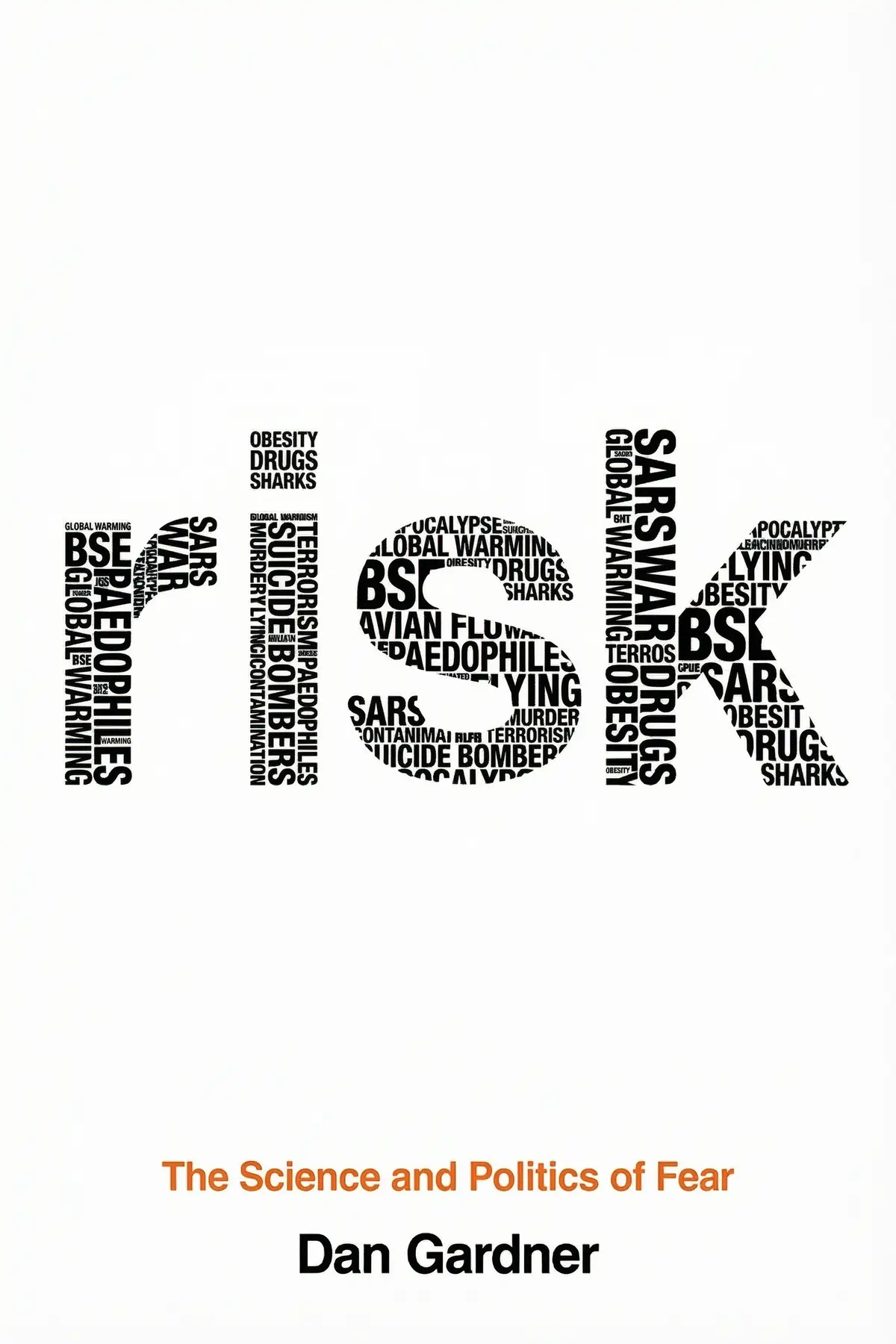
Risk: The Science and Politics of Fear
Dan Gardner
Explore the science behind successful projects. This summary reveals why most megaprojects fail and how modularity, reverse engineering, and psychological awareness can ensure your next big endeavor finishes on time and under budget.
1 min 38 sec
Every year, across the globe, thousands of people set out to build something significant. These projects range from the gargantuan, like a new international airport or a transcontinental railway, to the deeply personal, like a dream home renovation or starting a new business venture. We begin these journeys with a sense of optimism and a clear vision of the finish line. Yet, more often than not, the reality that unfolds is a grueling marathon of delays, escalating costs, and compromised quality. The excitement of the start is replaced by the crushing weight of a project that seems to have a life of its own—one that devours time and money with insatiable hunger.
Why does this happen so consistently? Is it simply bad luck, or is there a deeper pattern at work? In the following segments, we are going to explore the research and insights found in How Big Things Get Done. We will look at the underlying reasons why the vast majority of large-scale projects fail to meet their original goals and, more importantly, we will uncover the strategies that the successful few use to defy the odds.
We will start by examining the ‘iron law’ that governs big projects and why complexity is such a dangerous foe. We’ll delve into the psychological traps that lead even the smartest leaders astray and learn how to shift our perspective by working backward from our ultimate goals. Finally, we will discover the secret of ‘Lego-style’ modularity—a method of building that allows even the most massive undertakings to be completed with speed and precision. This journey isn’t just for engineers or politicians; it’s for anyone who wants to ensure that when they set out to do something big, they actually get it done.
2 min 54 sec
Most ambitious projects are destined to fail before they even start. Discover the statistics behind the ‘iron law’ and why complex systems lead to unpredictable disasters.
2 min 49 sec
Why do we keep pouring resources into projects that are clearly failing? Explore the psychological mechanisms that turn a bad start into a total catastrophe.
2 min 51 sec
Starting at the beginning is a common mistake. Learn why the world’s most successful leaders start at the end and work their way back.
3 min 05 sec
Small is beautiful—and scalable. Discover how breaking big projects into tiny, repeatable units is the secret to building the impossible.
1 min 36 sec
As we wrap up our look at How Big Things Get Done, it is clear that the path to success isn’t paved with more money or more enthusiasm, but with better thinking. We’ve seen that the ‘iron law’ of projects is a formidable opponent, driven by the inherent risks of complex systems and the psychological traps of commitment. We’ve learned that most people fail because they rush into action without a truly rigorous plan, falling victim to the ‘fat tail’ of disaster.
But we’ve also uncovered the tools to fight back. By adopting a ‘think slow, act fast’ mentality, we can give ourselves the time needed to identify risks before they become catastrophes. By thinking from ‘right to left,’ we ensure that our daily efforts are always in service of our ultimate ‘why.’ And by embracing modularity—finding our ‘Lego’—we can harness the power of repetition and the learning curve to build even the most ambitious projects with speed and reliability.
The next time you find yourself at the beginning of a big endeavor, remember these lessons. Don’t be seduced by the urge to just ‘get started.’ Instead, take the time to build a solid foundation. Be honest about the costs, be clear about your destination, and break your vision down into its smallest, most repeatable parts. Big things don’t get done through magic or sheer luck; they get done through the disciplined application of these principles. Whether you are changing a city or just changing your kitchen, you now have the blueprint to see it through to the end.
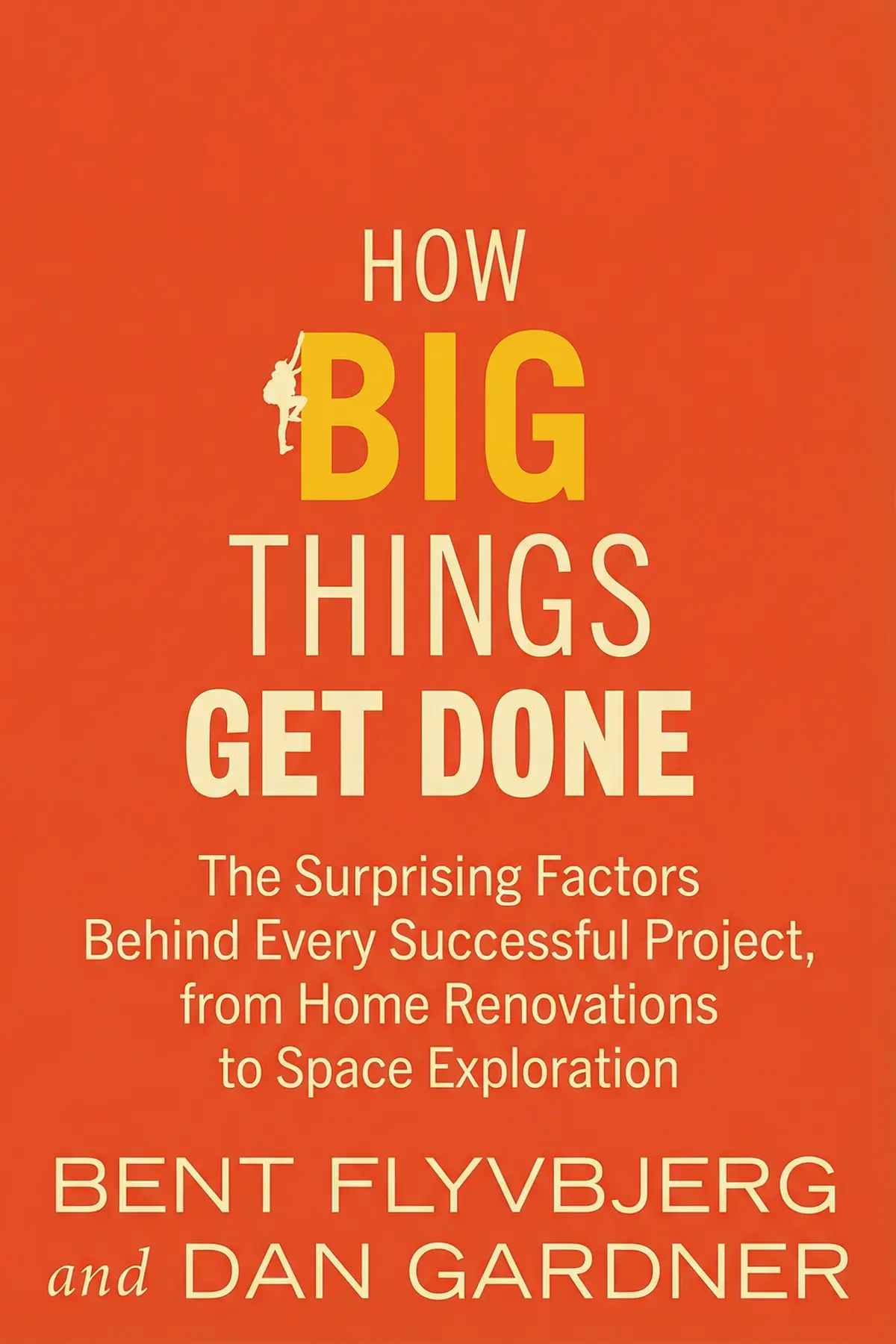
How Big Things Get Done investigates the paradox of large-scale projects: why the most ambitious plans often lead to the most spectacular failures. From massive infrastructure like high-speed rails to personal goals like home renovations, the majority of projects suffer from budget overruns and schedule delays. Authors Bent Flyvbjerg and Dan Gardner provide a roadmap for avoiding these common traps. By analyzing a massive database of global projects, they identify the 'iron law' of failure and offer practical strategies to counteract it. The book promises to change how you approach planning by introducing concepts like thinking from right to left, avoiding the commitment fallacy, and utilizing the power of modularity. Whether you are a project manager or a homeowner, these insights aim to turn the odds of success in your favor.
Bent Flyvbjerg is a leading expert on the politics and management of megaprojects and a professor of planning at Oxford University's Saïd Business School. His extensive research has deeply influenced the fields of planning and project management. Dan Gardner is a bestselling Canadian journalist and author who focuses on psychology and social trends. He is the author of The Science of Fear and Superforecasting, and his writing has been featured in the New York Times and the Wall Street Journal.
Dan Gardner
Philip E. Tetlock

Listeners consider this an outstanding guide packed with useful perspectives and deep case studies, labeling it essential for those in project delivery. The work is also notably straightforward to follow and understand, with one listener describing how it transforms intricate theories into easy-to-grasp segments. Furthermore, they appreciate the strategies for handling massive initiatives, as one review mentions its success in splitting huge projects into smaller, workable parts. The book earns praise for its narrative style of storytelling, with one listener pointing out the engaging stories of past major works and another commending the depth of the research.
Few business books manage to combine rigorous data with such an approachable narrative style. Flyvbjerg and Gardner dismantle the myth that 'starting fast' leads to finishing early. By looking at the database of 16,000 projects, the authors illustrate why a staggering 99.5% of large-scale ventures fail to meet their original goals. The story of the Sydney Opera House served as a haunting warning about what happens when you ignore the planning phase. It was a disaster that almost ended a brilliant career because of a rush to break ground. I found the 'Think Slow, Act Fast' mantra incredibly practical for my own work in software implementation. It is a rare treat to find a book that is both statistically sound and genuinely entertaining. This is essential reading for anyone tired of the 'move fast and break things' culture that rarely delivers on its promises.
Show moreWow, I didn't expect a book about infrastructure and mega-projects to be such a total page-turner. The authors use a 'Lego' analogy for modularity that makes complex engineering concepts feel intuitive for a layperson. Why do some things get done while others languish in budget hell? The secret lies in the 'outside view'—admitting your project isn't a unique snowflake and looking at the base rates of similar past projects. The contrast between the Empire State Building’s speed and the modern delays we see today was particularly eye-opening. Not gonna lie, I’ve already started applying the 'think from left to right' strategy to my quarterly planning. It’s a dense book in terms of information but it reads as fast as a thriller. If you want to understand why your local transit project is five years late, read this immediately.
Show moreFinally got around to reading this after seeing Flyvbjerg’s data cited everywhere, and it truly lives up to the hype. The chapter on hiring a 'masterbuilder' resonated with me deeply because we so often prioritize cost over proven expertise. We think we're saving money by going with the low bidder, but we end up paying tenfold in delays. Look at the Heathrow Terminal 5 example—it shows what happens when you actually invest in the team and the process. The book is remarkably easy to digest despite being backed by heavy research. It turns 'common sense' on its head by showing that our intuition about big projects is almost always wrong. I especially loved the focus on 'why' before 'how.' If you don't know your ultimate purpose, you're just building toward a disaster. Every politician and CEO needs a copy of this on their nightstand.
Show moreThe truth is, most of us treat planning as an annoyance to be cleared rather than the foundation of success. Flyvbjerg shows that 'rushed planning' is actually just a way to ensure a slow, painful execution phase. I was blown away by the statistic that only 0.5% of projects nail cost, time, and benefits. It makes you realize that failure is the default state for big things. The Amazon 'working backward' approach mentioned in the book is something I’ve started implementing in my own small business. Even if you aren't building a skyscraper, the lessons on reference class forecasting and downside risk are invaluable. The book is incredibly well-organized and builds lesson upon lesson in a way that feels natural. It’s one of those rare business books that actually changes how you look at the world.
Show moreIn my experience, the 'outside view' is the hardest thing to convince a board of directors to adopt. Everyone wants to believe their project is the exception to the rule, but this book proves otherwise. The advice to 'make friends and keep them friendly' as a form of risk management is a brilliant take on stakeholder relations. I loved the deep dive into Frank Gehry’s success with the Guggenheim—it wasn’t just about the art, it was about the rigorous technical planning behind it. The writing style is engaging, and the chapters are short enough to stay interesting. It really breaks down why 'big' is best built from 'small' units. This is a masterclass in project leadership. I’ve already bought three more copies to give to my clients who are currently in the middle of their own 'windows of doom.'
Show moreAs a project manager who has seen my fair share of 'black swan' events derail timelines, this felt like a cold splash of water. The book argues that the greatest risk isn't the unknown, but the time we allow for things to go wrong. Frankly, the concept of the 'window of doom'—the period between starting and finishing where disasters strike—is a game-changer for risk assessment. I appreciated the case studies on Pixar and Frank Gehry, showing how iteration in the planning stage saves millions later. However, I did feel the section on nuclear power was a bit one-sided compared to the solar and wind examples. Still, the advice is scalable whether you are building a skyscraper or a kitchen remodel. The writing is punchy, clear, and devoid of the usual management jargon that plagues this genre. I'll be keeping those eleven heuristics on my desk for a long time.
Show moreThe chapter on 'modular' building—or building with Lego, as the authors put it—is worth the price of admission alone. It explains why solar farms and wind turbines are consistently more successful than bespoke, one-off projects like large dams or nuclear plants. My only real gripe is that the book occasionally feels a bit too optimistic about how easy it is to 'say no and walk away.' In the real world, political pressure often makes that impossible. To be fair, Flyvbjerg acknowledges this, but the solutions offered for political bias felt a bit thin. Regardless, the storytelling is top-notch. The way they describe Pixar's iterative storyboarding process made me realize how much we skip over the 'testing' phase in design. It’s a brilliant framework for anyone involved in delivery. I'm recommending this to my entire engineering department.
Show moreAfter hearing about the database of 16,000 projects, I knew I had to see the methodology for myself. The authors do a fantastic job of translating academic research into actionable advice for professionals. Personally, I found the section on 'anchors' and how we get stuck on bad estimates to be the most relevant part. We often let our initial, poorly researched numbers dictate the entire lifecycle of a project. The book teaches you how to step back and take the 'outside view' by looking at what similar projects actually cost. It’s a bit data-heavy, but that’s exactly what I was looking for. Some might find the prose a little dry, but the quality of the insights more than makes up for it. It provides a much-needed reality check for anyone prone to over-optimism.
Show moreTo be fair, the central thesis about 'thinking slow and acting fast' is repeated so often it starts to feel redundant by the middle of the book. The data is impressive, and the database the authors built is clearly a monumental achievement in social science. I enjoyed the anecdotes about the Guggenheim Bilbao and the specific ways Gehry used digital tools to master construction. Yet, I found myself wanting more diverse examples outside of construction and film. It felt like the same five or six success stories were being polished and presented from different angles. While the advice on modularity is solid, it isn't always applicable to every industry. It’s a good book with a vital message, but it could have been fifty pages shorter without losing much impact. It’s definitely worth a skim for the project stories alone, though.
Show moreEver wonder why every government project seems to double in cost before the first shovel even hits the ground? This book gives you the answer, and it usually boils down to 'strategic misrepresentation' or pure delusions of grandeur. While the content is undeniably important, the tone felt a bit repetitive at times. I found myself nodding along for the first few chapters, but by the end, I was ready for some new ideas. The Sydney Opera House case study is fascinating, yet it's a story most people in the industry already know well. In my experience, the hardest part of project management isn't the planning—it's managing the egos involved. The book touches on this, but I wanted more on the psychology of team dynamics. It’s a solid 3-star read that provides a great framework but drags in the final third.
Show more
Joseph A. Maciariello
Deborah Gruenfeld
Mike Michalowicz
Hamilton Helmer

Margaret Heffernan
AUDIO SUMMARY AVAILABLE
Get the key ideas from How Big Things Get Done by Bent Flyvbjerg, plus 5,000+ more titles in English and Thai.







