
16 min 49 sec
Available in:English
How You Say It: Why We Judge Others by the Way They Talk―and the Costs of This Hidden Bias – A Social Psychology Study of Speech Prejudice, Identity, and Social Justice
Explore the profound impact of language and accents on social identity. Katherine D. Kinzler reveals how the way we speak influences bias, shapes our communities, and dictates our success in a diverse world.
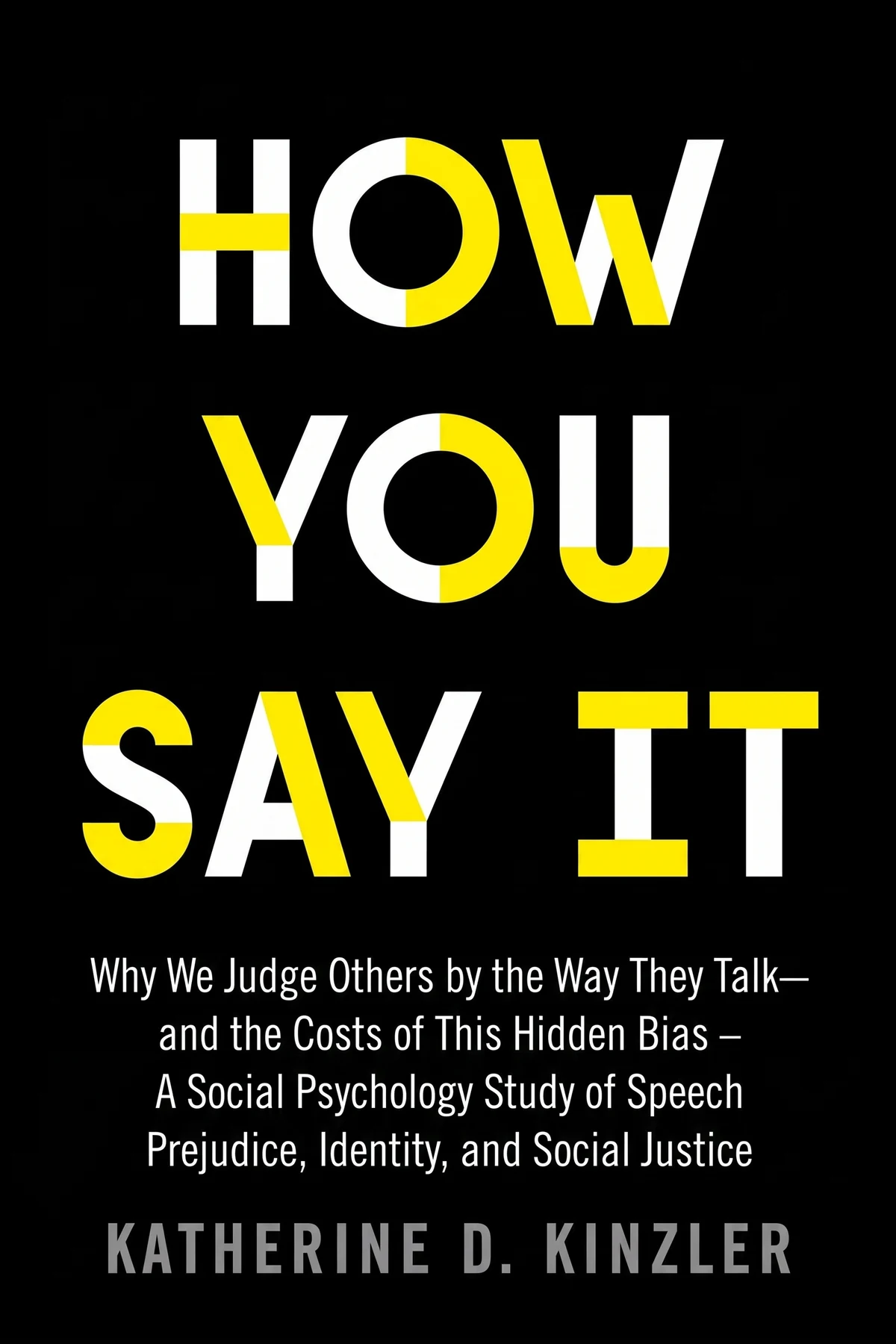
Table of Content
1. Introduction
1 min 45 sec
Think about the last time you answered the phone and spoke to a stranger. Within just a few seconds—perhaps before they even finished their first sentence—your brain had already started building a profile of them. You probably made an unconscious guess about where they grew up, their level of education, and maybe even their personality. This isn’t a coincidence or a psychic intuition; it is the result of a deeply ingrained psychological process that uses speech as a primary social filter.
In our modern world, we spend a lot of time talking about how we look, focusing on physical traits and visible markers of identity. But according to Katherine D. Kinzler, the author of How You Say It, we might be overlooking the most powerful social signal of all: our voices. The way we talk—our accents, our inflections, and even the tiny pauses in our sentences—reveals a hidden map of our social history and our current affiliations.
This summary will take you on a journey through the science of sociolinguistics. We’ll explore why babies are born with a preference for their mother’s tongue and why adults find it so difficult to shed an accent even after living in a new place for decades. We will also dive into the darker side of this phenomenon: the invisible biases that lead to discrimination in the workplace, the courtroom, and the classroom.
But it’s not all about the barriers language can create. We will also look at the incredible flexibility of the human brain, seeing how growing up with multiple languages can actually make us sharper, more empathetic, and more resilient. By the end of this exploration, you’ll see that speech is not just a way to convey information; it is the very fabric of our social reality. Let’s begin by looking at how the social world around us literally changes the way we sound.
2. Speech as a Dynamic Social Identity
2 min 37 sec
Discover how our voices act as a social resume, shifting and adapting to signal our belonging to specific groups and identities.
3. The Evolutionary Priority of the Voice
2 min 19 sec
Language might be a more significant factor in human bias than race, rooted in our deep ancestral need to identify allies.
4. The Critical Window of Language Acquisition
2 min 08 sec
Why is it so much harder to learn a new language as an adult? Explore the biology of the ‘critical period’ for speech.
5. The Pervasiveness of Accent Discrimination
2 min 16 sec
Accent-based prejudice is one of the few socially ‘acceptable’ biases left, with real-world consequences in jobs and law.
6. Language as a Tool for Political Control
2 min 10 sec
Governments have long understood that to control a people, you must first control their tongue. Learn how speech is weaponized.
7. The Bilingual Advantage and the Path Forward
2 min 13 sec
Debunking the ‘monolingual myth’ and revealing the hidden cognitive perks of being raised with multiple languages.
8. Conclusion
1 min 21 sec
We’ve covered a lot of ground, from the ancient forests of our ancestors to the modern courtrooms where linguistic bias still holds sway. The central theme of Katherine D. Kinzler’s research is clear: the way we speak is a profound part of our humanity, a social resume that we carry with us everywhere we go. It’s an identifier that is more ancient than race and more emotionally resonant than almost any other trait we possess.
But realizing this is only the first step. The true challenge is to take this knowledge and use it to change how we interact with the world. We must start by listening to our own ‘ears.’ When you find yourself making a snap judgment about someone’s intelligence or character based on their accent, stop and ask yourself where that bias is coming from. Is it a real communication issue, or is it just your brain falling back on an old, evolutionary shortcut?
By embracing linguistic diversity and supporting bilingual education, we can start to build a more inclusive world. We can choose to see accents not as barriers, but as the rich, musical evidence of a person’s unique history. In the end, how we say things matters just as much as what we say, because it reveals the connections we share and the respect we owe one another. So, the next time you hear an unfamiliar voice, don’t just listen for the words—listen for the person behind them. It’s in those sounds that our shared future is written.
About this book
What is this book about?
How You Say It examines the hidden psychology behind human speech, arguing that our accents and dialects are more than just communication tools—they are powerful markers of social identity that trigger deep-seated biases. The book explores why we form instant judgments based on how someone sounds, often prioritizing linguistic similarity over other traits like race or physical appearance. Through a blend of social science and linguistics, the narrative traces how speech patterns develop from infancy, why children are naturally drawn to familiar accents, and how these early preferences evolve into systemic discrimination in adulthood. The text also highlights the cognitive benefits of bilingualism and offers a vision for a more inclusive society that celebrates linguistic diversity rather than penalizing it.
Book Information
About the Author
Katherine D. Kinzler
Katherine D. Kinzler is a professor of psychology at the University of Chicago. Her research focuses on the intersection of language and socialization, exploring how speech shapes human interaction. Her work has been featured in major publications such as the New York Times and Quartz, as well as numerous academic journals.
Ratings & Reviews
Ratings at a glance
What people think
Listeners find the book immensely accessible and engaging, offering profound perspectives that cover a broad spectrum of topics. Furthermore, the prose is exceptionally well-crafted, and they value the material on language development, with one listener noting how language and accent serve as powerful markers of the social world. However, the content elicits some divided feedback, as one listener found the ten-page afterword wildly off-topic.
Top reviews
Rung
Wow, I had no idea my own unconscious prejudices were so deeply tied to the way people speak rather than just what they are saying. This book provides a fascinating examination of linguistic bias and the social assumptions we make the second someone opens their mouth. Kinzler’s research is eye-opening, especially regarding how we treat non-native speakers or those with regional dialects. It made me realize how I’ve benefited from certain linguistic privileges while unknowingly judging others for theirs. The writing style is incredibly well-written and engaging, making complex sociological concepts feel personal and urgent. It’s a powerful look at language as a marker of identity that has genuinely changed my world view. I cannot recommend this enough if you're interested in human psychology.
Show moreJom
This book should be required reading in our current social climate where we are finally starting to talk seriously about bias. We often focus on visual cues, but Kinzler proves that "how you say it" is just as significant in shaping our social world. The research on how linguistic markers influence everything from employment to basic human empathy is both shocking and necessary to understand. I found myself reflecting on my own experiences with regional accents and how they’ve shaped my career. Truth is, we all have these biases, and this book gives us the tools to start recognizing and dismantling them. It’s an excellent, insightful read that manages to be both scientifically grounded and deeply human. I'll be thinking about these studies for a long time.
Show moreMaja
Finally got around to reading this and the timing couldn't be more perfect given how much we are discussing systemic prejudice right now. This book is so insightful because it highlights a form of discrimination that is often socially acceptable or even encouraged. I’ve realized I’m guilty of linguistic prejudice in subtle ways, especially when listening to non-native English speakers, and this book helped me understand why that happens. The research is presented brilliantly, covering a wide array of topics from childhood development to legal implications. It’s an uncomfortable truth to face, but I’m grateful for the awareness this book provided. If you want to be a better communicator and a more empathetic human being, you need to read this. It’s absolutely fascinating.
Show moreRin
As someone who has always been fascinated by how we communicate, this was a real eye-opener regarding our hidden linguistic biases. Kinzler dives deep into how we use speech to categorize others, often without even realizing we are doing it. I found the sections on how children develop these social assumptions particularly brilliant and well-researched. To be fair, the book does lean heavily on an American perspective, but the core lessons about how accents serve as powerful social markers are universal. It’s written in a very accessible way that doesn’t require a PhD in linguistics to follow along. While some of the points felt a bit drawn out and repetitive, the overall insight into our "native" prejudices is invaluable for anyone trying to be a better listener.
Show morePop
Ever wonder why you automatically trust some voices more than others or why certain accents make people sound "smarter" in your head? Kinzler tackles these uncomfortable questions head-on, exploring the connection between language, culture, and our innate desire to form "in-groups." The chapter on how infants prioritize native speakers was particularly fascinating and helped explain why these biases are so hard to shake as adults. Personally, I found the insights into language development to be the strongest part of the book. While the middle sections dragged slightly and could have been tightened up, the overall message about the power of speech is incredibly relevant. It’s a readable, thoughtful exploration of a social marker we often ignore in favor of race or gender.
Show moreEye
Kinzler presents a compelling case for why we need to stop judging people by how they sound. This book is a highly readable exploration of how language functions as a primary social glue, often trumping other physical markers in how we categorize "us" versus "them." I loved the data-driven approach, even if some of the psychology felt a bit simplified for a general audience. To be honest, I never realized how much linguistic prejudice I carried until I read the sections on foreign accents and non-standard dialects. The book is well-written and manages to be educational without feeling like a textbook, though the afterword did feel a bit disconnected from the rest of the work. Overall, it’s an insightful read that provides plenty of food for thought.
Show moreNikolai
After hearing a podcast interview with the author, I was eager to dive into the full text and it did not disappoint. The book offers a brilliant look at how language and accents serve as powerful markers of our social identities and the world around us. Kinzler’s tone is analytical yet accessible, making the scientific studies feel relevant to everyday life and interactions. I particularly enjoyed the discussion on bilingualism and the social advantages of being exposed to multiple ways of speaking from a young age. My only real criticism is that the focus stays very narrow at times, and I would have loved to see more global examples. Regardless, it’s a fascinating look at a topic that deserves way more attention in public discourse.
Show moreLayla
The central premise here is definitely intriguing, but the execution felt a bit uneven for my taste. I appreciated the deep dive into how accents influence our perceptions of others, yet I felt like I had encountered much of this content in similar psychology books before. It’s a solid 3-star read that offers a decent look at linguistic discrimination without necessarily breaking new ground for seasoned readers of the genre. One minor gripe: the book is very American-centric, which makes some of the specific dialect examples feel less relatable if you aren't from the States. Still, the author’s tone is friendly and the research is presented in a way that is easy to digest. It's fine for a casual read, but don't expect a revolutionary academic breakthrough.
Show moreKenji
Not what I expected at all when I picked this up based on the interesting cover and premise. While the initial chapters on how we perceive different accents were somewhat engaging, the narrative quickly devolved into what felt like a dry, repetitive expository essay. Frankly, the author spends a lot of time rehashing the same few points about social categorization through speech without adding much new depth as the book progresses. It felt like pop psychology at its most surface level, occasionally misconstruing complex studies to fit a very specific narrative about communication. I struggled to stay focused, and by the time I reached the afterword—which felt completely off-topic—I was just ready to be done. It’s a pass for me.
Show moreKasemsan
I really tried to get into this one, but it felt incredibly repetitive after the first few chapters and ultimately missed the mark. The author takes a few interesting studies on language development and stretches them out into a full-length book that could have been a long-form article. Look, the core idea is important, but the writing style felt more like an over-explained essay than a cohesive narrative. I also found some of the conclusions to be a bit of a stretch, as if the data was being forced to support a specific pop-psychology agenda. To make matters worse, the ending of the book wanders off into topics that felt totally unrelated to the primary thesis of linguistic bias. It was quite boring and honestly a chore to finish.
Show moreReaders also enjoyed

A Biography of Loneliness: The History of an Emotion
Fay Bound Alberti

59 Seconds: Change Your Life in Under a Minute
Richard Wiseman

A Force for Good: The Dalai Lama's Vision for Our World
Daniel Goleman


A Room of One’s Own
Virginia Woolf
AUDIO SUMMARY AVAILABLE
Listen to How You Say It in 15 minutes
Get the key ideas from How You Say It by Katherine D. Kinzler, plus 5,000+ more titles in English and Thai.
- 5,000+ titles
- Listen as much as you want
- 7-day free trial
- Cancel anytime







