
A Life Decoded: My Genome: My Life
J. Craig Venter
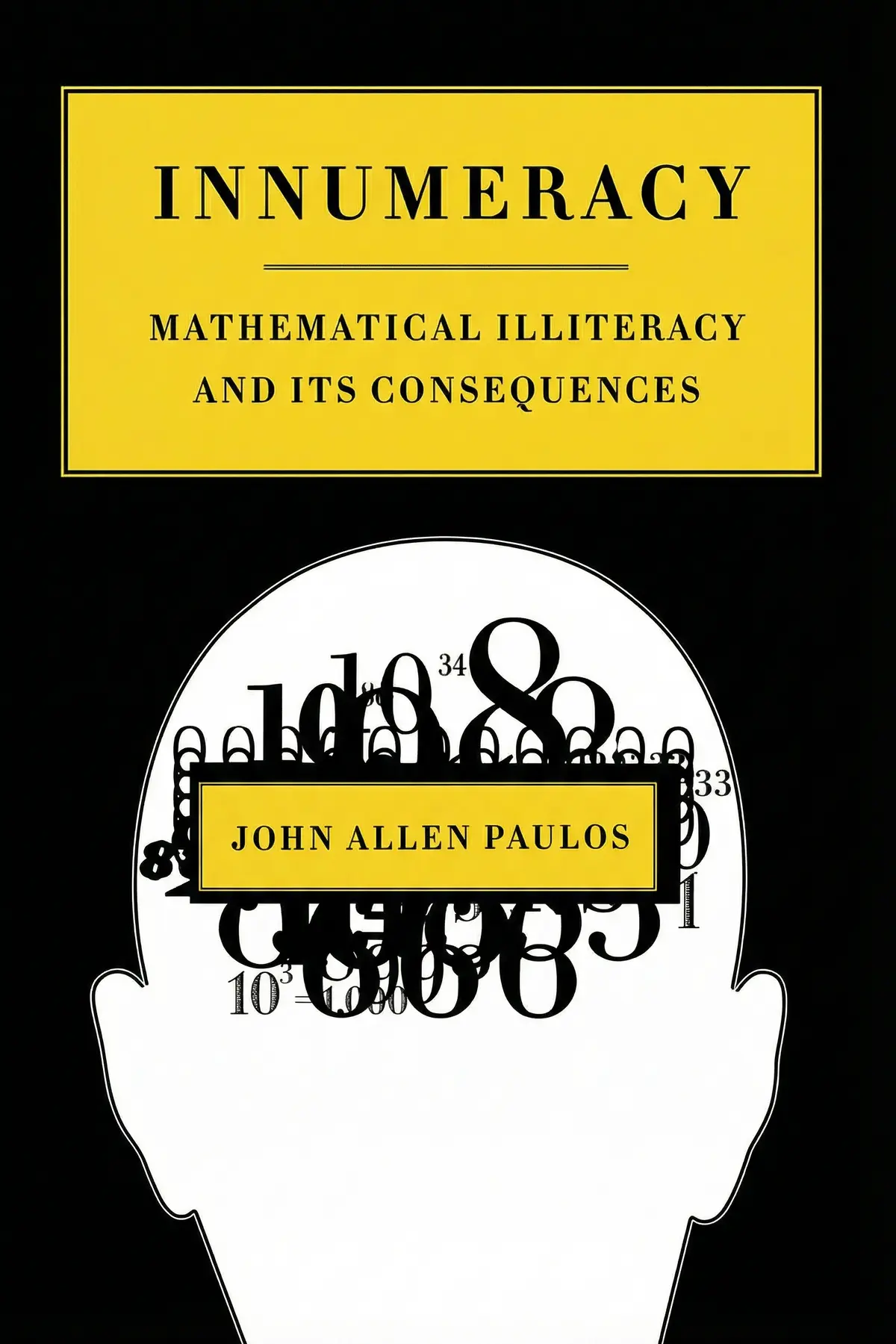
Innumeracy explores the widespread inability to understand basic mathematical concepts and explains how this deficit leads to poor decision-making, susceptibility to pseudoscience, and a distorted view of reality in everyday life.
1 min 41 sec
Imagine standing at a social gathering. If someone mentions they haven’t read a book in years, there’s often a slight sense of awkwardness or even judgment. But if that same person laughs and says they can’t balance a checkbook or that they’ve always been terrible at math, the room usually nods in sympathetic agreement. In our modern culture, it is almost a badge of honor to admit to being a non-math person. This widespread comfort with ignoring the world of numbers is what we call innumeracy.
Just as illiteracy limits a person’s ability to participate in a text-driven society, innumeracy limits our ability to function in a world governed by data, probability, and logic. We are constantly bombarded with statistics about health, the economy, and crime, yet many of us lack the basic tools to interpret what those numbers actually mean. This isn’t just an academic problem; it’s a practical one that affects our personal safety, our finances, and our political leanings.
In the following discussion, we are going to explore why we are so afraid of numbers and how that fear distorts our reality. We’ll look at why we tend to find patterns where none exist, why we fall for pseudoscientific claims, and how the education system might be failing to show us the true beauty and utility of mathematics. By the time we’re done, you’ll see that becoming numerate isn’t about memorizing complex formulas—it’s about developing a sense of scale and a sharper intuition for the way the world truly works. Let’s dive into the mechanics of why we misunderstand the world of numbers and how we can start to see it more clearly.
2 min 10 sec
Discover why it is socially acceptable to be bad at math and how this lack of numerical intuition leads us to fear the wrong things.
2 min 17 sec
Learn how simple choices can lead to massive numbers that defy our intuition and reveal the hidden complexity of daily life.
2 min 20 sec
Explore why ‘miraculous’ events are actually statistically expected and why you shouldn’t be surprised by common occurrences.
2 min 16 sec
See how scammers and pseudoscientists use a thin veneer of math to trick the public and why astrology fails the gravity test.
2 min 10 sec
Uncover why our school systems often produce math-phobic adults and how changing the way we teach can bridge the gap.
2 min 14 sec
Apply mathematical logic to your daily choices, from understanding store discounts to navigating complex social trade-offs.
1 min 40 sec
As we wrap up our journey through the world of numbers, the central message is clear: math is far more than a school subject we can afford to forget. It is a fundamental lens through which we view and interact with reality. Innumeracy is a form of blindness that leaves us vulnerable to manipulation, irrational fears, and poor decision-making. By embracing a few basic principles—like the reality of coincidences, the explosive nature of combinations, and the logic of risk—we can transform the way we live.
We’ve seen how mathematical illiteracy allows pseudoscience to flourish and how it distorts our understanding of everything from retail sales to social justice. We’ve also seen that the roots of this problem often lie in how we were taught, leading to a lifelong anxiety that doesn’t have to be permanent. You don’t need to become a calculus expert to be numerate. You simply need to cultivate a sense of scale and a willingness to look past the anecdotal stories that often lead us astray.
The next time you hear a ‘miraculous’ story or see a confusing statistic, don’t shrug it off as something you’re not equipped to understand. Take a moment to think about the probability, the scale, and the logic. Look for the trade-offs and the compounding effects. By doing so, you move from being a passive observer of the world to an active, informed participant. Mathematics is the language of logic, and when you speak it, the world becomes a much clearer, safer, and more fascinating place to navigate. It’s time to lose the fear of numbers and start seeing the world for what it truly is.
Have you ever felt a sense of pride when admitting you aren't a numbers person? Innumeracy argues that this common social shrug is actually a sign of a significant cognitive gap that affects everything from how we perceive risk to how we spend our money. The book examines the phenomenon of mathematical illiteracy, showing how a lack of comfort with probability and scale makes us vulnerable to scams and irrational fears. Through engaging examples—from the true probability of rare animal attacks to the deceptive math behind store discounts—this summary promises to replace numerical anxiety with a clearer lens for viewing the world. You will learn to recognize the mathematical principles that govern coincidences, understand why astrology is a logical impossibility, and discover how to avoid the psychological traps that keep us from thinking clearly. By the end, the goal is to shift math from a cold, abstract school subject into a vital tool for navigating modern existence.
John Allen Paulos is a Professor of Mathematics at Temple University in Philadelphia. A prolific writer known for making complex topics accessible, he has authored several books including A Mathematician Reads the Newspaper. His work has appeared in major outlets such as The New York Times and ABCNEWS.com.
Listeners describe this book as educational and stimulating, with one listener highlighting how it clarifies concepts that trick our instincts using numerous practical examples of applied mathematics. Furthermore, the prose is clear and engaging, making the material accessible for those without a technical background. Listeners also feel it is essential reading for students and value its focus on the significance of numerical literacy. Nevertheless, views on the entertainment factor vary, as some find it captivating whereas others consider it dull.
The safety index mentioned toward the end of the book should be mandatory teaching in every public school curriculum. By using a logarithmic scale to compare the risks of activities like driving versus smoking or getting hit by lightning, Paulos provides a clear framework for understanding probability in our daily lives. This isn't just a book about math; it is a vital tool for navigating a world filled with sensationalized news. I found the writing to be accessible and the examples, like the volume of human blood if poured into Central Park, were both vivid and memorable. While some might find his tone a bit sharp, the truth is that our society is drowning in innumeracy. We need this kind of cold, rational wake-up call to avoid being duped by bad statistics. It's an essential read for anyone who wants to think more clearly.
Show moreWow, this book does a fantastic job of illustrating how our intuition often fails us when dealing with probability. The 'birthday paradox' example is a classic for a reason, and Paulos explains it with such clarity that even a total novice can understand the mechanics. He takes topics that usually fool our brains and breaks them down into simple, logical steps. I particularly enjoyed the bashing of pseudoscience and phrenology; it’s hilarious to think that corporations used to hire people based on the bumps on their heads. This book is a must-read for anyone who wants to avoid being a 'winner' or 'loser' by pure chance. It’s short, punchy, and packed with insights that remain true decades after it was first published. I highly recommend it for anyone looking to sharpen their critical thinking skills.
Show moreAfter hearing about this book for years, I am glad I finally dove in to see his take on our collective inability to handle numbers. The truth is, we live in a world governed by statistics, and being 'innumerate' is just as dangerous as being illiterate. Paulos writes with a passion that is infectious, even when he’s being a bit of a grouch about how lazy students are these days. His idea for a safety scale for risks is pure genius and something I wish the government would actually implement. Some might find the math heavy in parts, but he gives you permission to skip the bits that overwhelm you. It is a very accessible entry point into mathematical thinking. I finished it in two sittings and immediately started recommending it to my friends. It is definitely not a somniferum!
Show morePicking this up was the best decision I've made for my 'mental library' this year. It is a breezy, fun, and deeply informative exploration of why we all need to know at least a little math to survive in a high-tech society. I loved the quirky calculations, like figuring out how fast hair grows in miles per hour—it’s that kind of playful thinking that makes the subject come alive. Paulos is a great writer who manages to make cold numbers feel warm and full of life. He highlights the need for serious reforms in how we teach kids, moving away from boring formulas and toward real fluency. If you've ever felt intimidated by statistics or confused by the news, this book is for you. It’s an empowering read that gives you the tools to judge reality for yourself.
Show moreEver wonder why you keep hearing about 'miraculous' coincidences on the news? Paulos does a masterful job of debunking the idea that these events are mystical or evidence of ESP. He explains that in a country as large as the United States, even a one-in-a-million event is bound to happen to someone every few days. I loved the section on how we perceive patterns where none exist. The writing is punchy and moves fast, making complex ideas like Bayes' Theorem feel relatively simple. My only real gripe is that the book shows its age; some of the cultural references and examples are definitely stuck in the late 1980s. Still, the core lessons about how we are easily manipulated by percentages remain incredibly relevant today. It’s a solid, informative piece of work that will make you a more skeptical consumer of media.
Show moreAs someone who has always struggled with 'math anxiety,' I found the author’s perspective on estimation to be genuinely grounding. Paulos suggests that we should all build a 'mental library' of various powers of ten, which has helped me visualize the difference between a million and a billion in a way I never could before. No more feeling overwhelmed by the massive figures cited in the morning paper! He makes a persuasive case for why math literacy is a civic duty in a high-tech society. While he can be a bit dismissive of educators, his suggestions for shifting math education away from rote memorization and toward 'playful exploration' are spot on. The prose is fluid and full of humor, though his jokes are admittedly a bit nerdy. It’s not a perfect book, but it’s an eye-opening one for the mathematically timid.
Show moreFinally got around to this classic, and it is fascinating to see how it basically paved the way for the modern pop-science genre. The author’s discussion on 'regression to the mean' was particularly insightful for me. He explains how we often misattribute the effects of punishment and reward simply because we don't understand that performance naturally fluctuates back toward an average level. It is a brilliant observation that explains so much about human behavior and management. The book is easy to follow, well-written, and provides plenty of real-world examples that apply to everything from gambling to healthcare. I do wish he had spent more time on the 'consequences' mentioned in the subtitle, as the book leans more toward the math itself than the societal impact. Nevertheless, it is a thought-provoking read that will definitely change the way you look at the world.
Show moreTo be fair, the information within these pages is quite thought-provoking, even if the delivery feels like a disorganized talent show. It is essentially a precursor to the style of Malcolm Gladwell, filled with 'did you know' moments and counter-intuitive facts that challenge our basic instincts. However, it lacks the social relevancy and narrative focus that makes modern pop-math books so engaging. Paulos spends a lot of time on probability and coincidences—like why having the same birthday as a stranger isn't actually rare—but he fails to weave these into a larger argument. The first two chapters are way too long and could have been condensed into a simple introduction. It’s an okay read if you want some fun dinner party facts, but don't expect a structured roadmap for systemic educational reform. It’s a bit too breezy for the weight of its subject matter.
Show morePaulos describes himself as a former math prodigy, but his arrogance makes him a terrible ambassador for the subject. Throughout the text, he treats the 'innumerate' public with a level of smug superiority that is frankly exhausting to read. He even admits that he was attracted to mathematics because it allowed him to feel superior to others, and that attitude bleeds into every chapter. To be fair, some of the statistical scenarios are interesting, but the author's constant need to flaunt his intellectual dominance over the 'hoi polloi' ruined the experience for me. The organization is also quite messy, jumping from random facts to personal anecdotes without a clear, cohesive thesis. There are much kinder and more effective books out there for those who want to improve their numerical literacy without being insulted on every other page.
Show moreLook, I am a huge proponent of logic, but the author’s own logical inconsistencies are hard to ignore. On page 94, he correctly warns readers not to attribute combination to causation, yet by page 108, he fumbles his own argument while discussing the link between poor education and innumeracy. He compares people with a 'bad' education to those with 'no' education to make a point that doesn't actually follow the rules he established just a few pages prior. It is deeply frustrating to read a book about the poor state of logic in America that contains such sloppy reasoning. Beyond the logic issues, the book feels very dated and often reads like a collection of trivia rather than a serious investigation. I stopped halfway through and have no desire to finish. It’s more of a talent show than a teaching tool.
Show moreJ. Craig Venter
Carl Zimmer
Bill Bryson
Jeff Hawkins

Lisa Kaltenegger

AUDIO SUMMARY AVAILABLE
Get the key ideas from Innumeracy by John Allen Paulos, plus 5,000+ more titles in English and Thai.







