
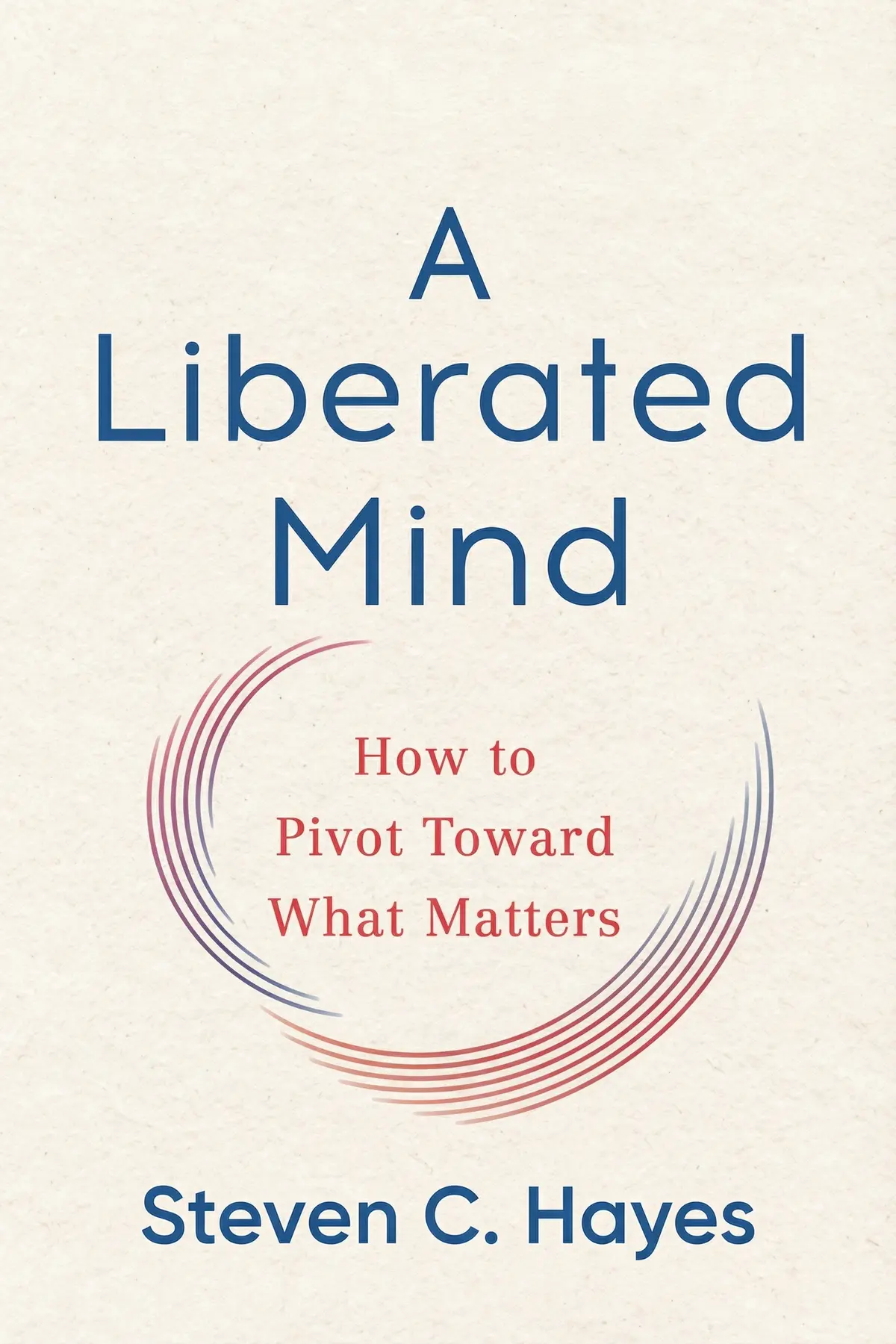
A Liberated Mind: How to Pivot Toward What Matters
Steven C. Hayes
Discover how the anxieties and behaviors you struggle with today might actually be inherited from your ancestors, and learn the practical tools needed to break these generational cycles forever.
1 min 29 sec
Imagine for a moment that you are carrying a heavy backpack. Inside are weights you didn’t choose and stones you didn’t pick up. You’ve been walking with this weight for so long that you’ve forgotten it’s even there, yet your shoulders ache and your pace is slowed. This is the central metaphor for inherited family trauma. Many of us struggle with emotional challenges—anxiety, depression, or irrational fears—that feel deeply personal. We look into our own childhoods or our recent mistakes to find the cause, but often, the source remains a mystery.
What if the reason you feel stuck isn’t actually about you? What if the blueprint for your suffering was drawn decades before you were even born? In this exploration of legacy and healing, we dive into the idea that traumatic experiences don’t always end with the person who first endured them. Instead, they can travel through time, moving from one generation to the next like a quiet, invisible inheritance.
This isn’t just a philosophical idea; it is a call to become an emotional detective. By looking at the throughline of your family’s history, you can begin to see patterns that were previously hidden. We will look at how the silences of your ancestors speak through your own symptoms and how the language you use every day holds the keys to your liberation. The goal here is simple but profound: to understand the past so clearly that you can finally set down that heavy backpack and walk into your own life, unburdened and free.
1 min 53 sec
Your most persistent emotional struggles might not be your own, but rather the echoes of an ancestor’s unresolved pain reaching across the generations.
2 min 18 sec
Science reveals that the effects of fear and stress can actually alter our genetic expression, passing emotional vulnerabilities down through our DNA.
1 min 55 sec
The connection between a parent and child is the primary channel through which family patterns are either healed or repeated.
1 min 51 sec
By paying close attention to the specific, often dramatic words we use to describe our fears, we can uncover the secret narrative of our family’s past.
2 min 01 sec
Creating a visual map of your family’s traumatic history allows you to see the patterns of the past and identify the ‘Bridging Questions’ that lead to clarity.
1 min 55 sec
True resolution comes from active engagement through healing sentences and symbolic actions that honor the past while releasing its grip.
1 min 24 sec
As we conclude this journey into the depths of family history, the most important takeaway is that you are not a finished product of your genes or your past. While it is true that we inherit the echoes of our ancestors’ struggles, we also inherit their resilience. The very fact that you are here, seeking understanding and healing, is proof of that strength.
By engaging with the Core Language Approach, you have learned to listen to your symptoms not as enemies, but as messengers. You now have the tools to decode the secret language of your family’s pain and to map the events that shaped your emotional landscape. Remember that healing is not an overnight event; it is a gradual process of reclaiming your own life. Every time you use a healing sentence, every time you choose to respond with awareness instead of old patterns, and every time you honor an ancestor while setting down their burden, you are breaking the cycle.
The throughline of this book is one of hope and empowerment. It suggests that by looking backward with compassion and clarity, we gain the freedom to move forward with purpose. You have the power to ensure that the traumatic patterns of the past stop with you. By doing the work to heal yourself, you are not only changing your own future but also offering a profound gift to your children and their children. You are choosing to start a new legacy—one built on awareness, reconciliation, and the freedom to be exactly who you are.
Have you ever felt haunted by a persistent sense of dread, a specific phobia, or a self-sabotaging behavior that doesn't seem to have a clear cause in your own life? It Didn't Start With You offers a revolutionary perspective on emotional health, suggesting that the source of our deepest struggles often lies in the unresolved traumas of our parents, grandparents, and even earlier generations. Through a combination of neurobiology and psychological inquiry, this book promises to guide you through the process of unearthing your family’s hidden history. By using the specialized Core Language Approach, you will learn to identify the linguistic clues that point toward ancestral wounds. This journey isn't just about understanding the past; it’s about active healing. You will find actionable strategies to reconcile with your lineage, release burdens that aren't yours to carry, and ensure that the cycle of trauma ends with you.
Mark Wolynn is the founder of the Family Constellation Institute. He is a leading expert in the field of inherited family trauma and specializes in the Core Language Approach, a method he developed to help individuals address and resolve deep-seated psychological patterns rooted in their family history.
Listeners describe the book as deeply insightful, with one individual highlighting how it simplifies complex psychological research, while many share that it helped improve their self-understanding. Furthermore, the content provides actionable advice for overcoming ancestral trauma using targeted exercises, and listeners value the organized framework and straightforward questions. The ideas are also frequently called mind-blowing and fascinating to ponder. Nevertheless, the scientific evidence behind the claims earns a mixed reception, as several listeners remain skeptical of its validity.
This book completely reframed how I view my own recurring anxiety and the unexplained fears I've carried since I was a teenager. The connection between my current struggles and the trauma my grandparents faced during the war was a total revelation for my mental health. I’ve spent years in traditional therapy, but the "Core Language" approach helped me identify specific phrases that actually belonged to my ancestors. Truth is, the exercises are easy to follow and provide a very clear roadmap for anyone looking to dig into their family history. Some people might find the science a bit dense at the start, but it lays a necessary foundation for the healing work that follows. It feels like I finally have the vocabulary to describe feelings that previously felt completely intangible and overwhelming. This is a must-read for anyone interested in deep self-discovery.
Show moreEver wonder why you have specific fears or habits that don't seem to belong to your own life experiences? This book offers a mind-blowing look at how the things our parents and grandparents went through can leave a physical mark on us. The process of creating a family tree focused on trauma rather than just names and dates was incredibly eye-opening for me. Personally, I found the "Core Sentence" exercise to be the most effective tool I've ever used in my personal growth journey. It breaks down complex psychological concepts into a well-laid out process that anyone can follow regardless of their background. Even if you are skeptical about the science of epigenetics, the psychological insights into family loyalty are worth the price of admission. It helped me realize that my internal struggle didn't actually start with me, which was a huge relief.
Show moreWow, I never realized how much of my grandmother's grief I was still carrying around until I sat down with these exercises. The way Mark Wolynn breaks down the "Core Language" of our fears is nothing short of brilliant and life-changing. I found myself crying through several chapters because the descriptions of intergenerational patterns felt so specific to my own family's history. To be fair, you have to be ready to do some very heavy emotional lifting to get the most out of this book. The positive spin it puts on past trauma—reframing it as a source of inner strength—really helped me move past a lot of lingering resentment. It’s a fascinating, mind-blowing journey that offers practical guidance for anyone ready to break the cycle of suffering. I've already recommended this to several friends who feel stuck in their own healing processes.
Show morePicked this up during a really dark period and found the exercises to be surprisingly grounded despite the unconventional theories. The book is very well-laid out and the easy-to-follow questions make the daunting task of exploring family trauma feel manageable. I particularly liked the section on the Yehuda studies, which helped me understand the biological basis for the feelings I’ve had my whole life. It’s a quick overview for the layman that doesn't get bogged down in too much academic jargon, which I really appreciated. Not gonna lie, some of the case studies seem a little too good to be true, but the core message is very powerful. It gave me the tools to separate my own truth from the responses I inherited from my parents. If you're looking for a practical way to heal generational wounds, this is an excellent place to start your work.
Show moreFinally got around to reading this one after seeing it all over my social media feed for months. The concept of "Core Language" is genuinely fascinating, even if you don't buy into every single scientific claim the author makes about epigenetics. Frankly, some of the exercises for identifying family patterns were much more practical and grounded than I initially anticipated. I loved the well-laid out process of asking specific, pointed questions to uncover what Wolynn calls the "Core Sentence." While I found the heavy focus on mending parental relationships a bit pushy, the overall framework helped me understand my own anxiety in a new light. It’s a compelling read for anyone who feels stuck in emotional loops that don’t seem to have an obvious origin in their own childhood. You just have to take the more New Age elements with a healthy grain of salt.
Show moreThe chapter on "Core Complaints" provided the exact vocabulary I needed to finally discuss my family dynamics without falling into the same old arguments. While the author is very focused on mending fences, he does mention that you can do the work even if your parents are deceased or estranged. In my experience, the exercises are most helpful when you use them to gain perspective on why your parents acted the way they did. You don't necessarily have to invite a toxic person back into your life to benefit from the narrative reframing Wolynn suggests. The writing style is very accessible and the case studies, while sometimes feeling a bit too "perfect," help illustrate the concepts well. It’s a very insightful guide for anyone willing to look at their family tree with a bit of compassion and curiosity. Just skip the parts that don't feel safe for your specific situation.
Show moreAs a mental health professional, I find myself torn between the innovative narrative work and the shaky scientific claims presented in these pages. The author, whose graduate background is actually in English, often uses language that feels slightly out of touch with current clinical standards. Gotta say, the explanation of the Yehuda studies is quite solid and provides a great introduction to epigenetics for the average layperson. However, the insistence on reconciliation with primary caregivers ignores decades of attachment theory regarding secondary secure attachments and healthy boundaries. It’s a fascinating read if you can maintain a healthy level of skepticism throughout the more anecdotal and cherry-picked case studies. The questions to ask your family are excellent tools, but the interpretations feel a bit judgmental and narrow-minded at times. Read it for the perspective, but don't treat it as a medical textbook.
Show moreLook, I really wanted to love this, but the heavy emphasis on reconciling with abusive parents is just dangerous for many readers. The author suggests that if we don't fix these relationships, we are doomed to remain mentally ill, which feels like a slap in the face to survivors. To be fair, the first few chapters provide an interesting overview of the Yehuda studies and the way trauma impacts gene expression across generations. However, the book quickly veers into "kookyville" by implying that children are somehow responsible for triggering their parents' abusive outbursts. It’s charitably clueless at best and outright gaslighting at worst. If you have a healthy family, the mapping exercises might be insightful. For those with truly toxic histories, this approach might do more harm than good by minimizing the reality of choice and responsibility.
Show moreNot what I expected based on the glowing summaries I saw on Amazon, as it felt more like a New Age manifesto than a science book. The first fifty pages about genetics were interesting, but then it takes a sharp turn into anecdotal stories that feel very cherry-picked to fit the theory. Look, I understand the value of family history, but claiming that an uncle's death decades ago is the sole cause of your current depression feels like a stretch. The author's insistence that every mental health issue can be solved by fixing your relationship with your mother is incredibly reductive. It completely ignores systemic issues, biology, and the reality that some people are simply better off without their toxic relatives. It's a very disorganized approach that lacks the clinical rigor I was hoping to find. I was looking for facts, but I mostly found strange personal therapy theories.
Show moreThis is total snake oil masquerading as modern psychology and I honestly cannot recommend it to anyone dealing with real trauma. The author puts forth the disgusting idea that a parent isn't guilty of abuse because they are just reliving a past family event. Not gonna lie, seeing a professional suggest that a victim needs to permit their abuser back into their life to heal made me want to throw the book. He takes basic cognitive behavioral therapy techniques and twists them into this weird, New Age narrative about past-life trauma. There is no magic cure for mental health, and promising one through "attachment repair" with toxic people is incredibly irresponsible. Where did this guy even get his credentials? Do not waste your time or money on this dangerous garbage if you value your boundaries and your sanity.
Show moreSteven C. Hayes
Leanne Maskell
AUDIO SUMMARY AVAILABLE
Get the key ideas from It Didn’t Start With You by Mark Wolynn, plus 5,000+ more titles in English and Thai.







