
19 min 05 sec
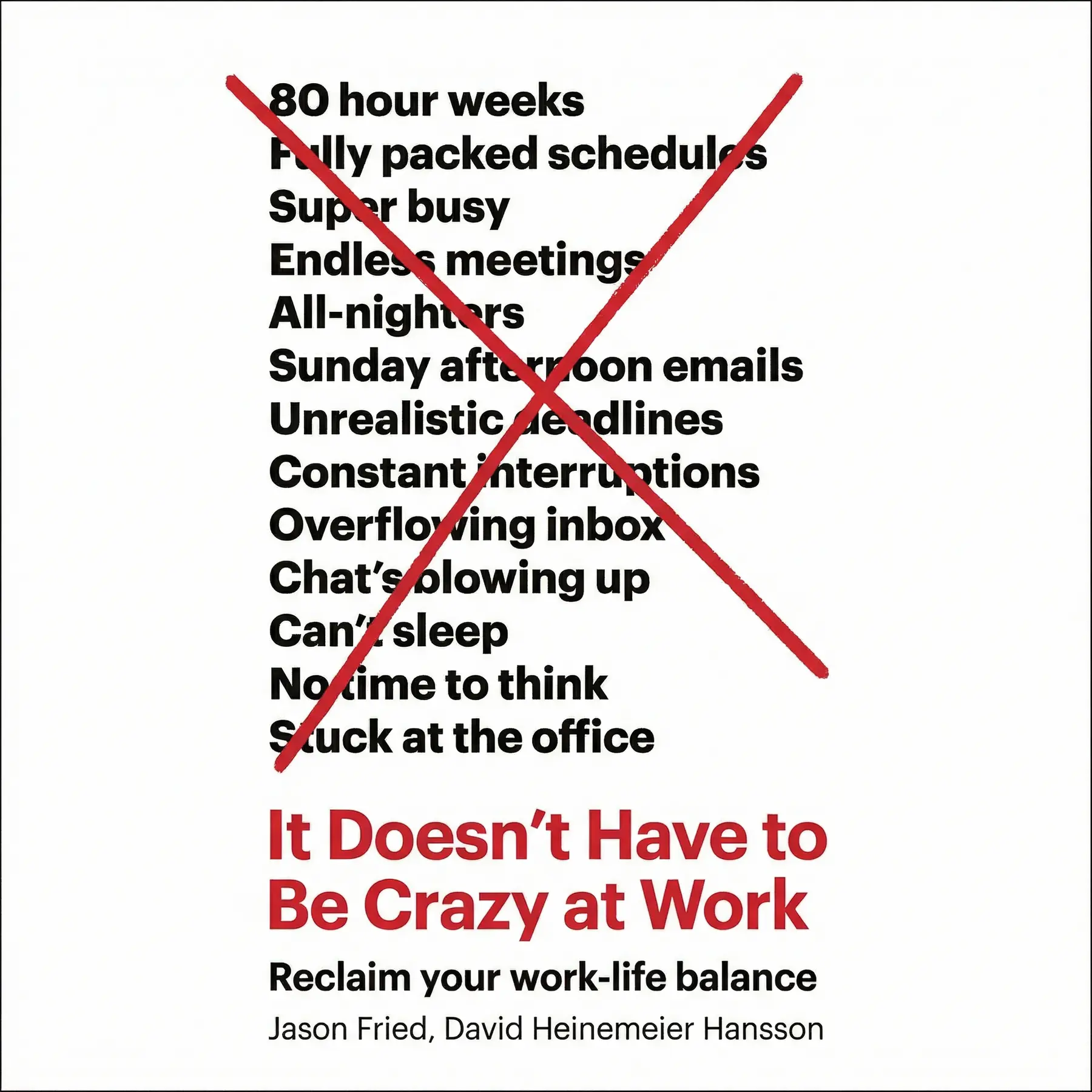
It Doesn’t Have to Be Crazy at Work
Discover how to escape the modern culture of workplace chaos. This summary explores practical strategies for building a calm, productive, and sustainable business environment without sacrificing your personal life or sanity.
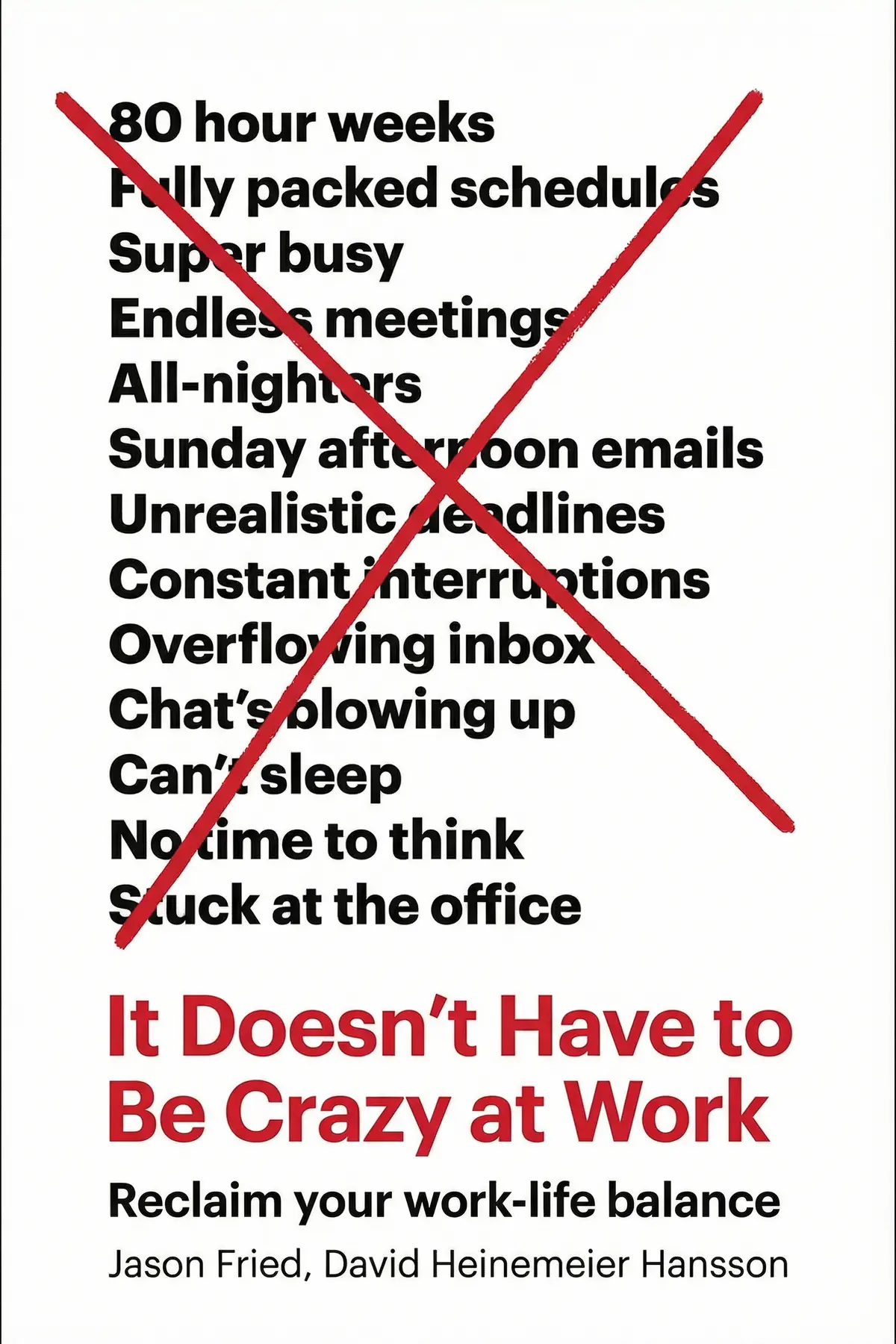
Table of Content
1. Introduction
1 min 55 sec
Have you ever noticed how the phrase “it’s crazy at work” has become a standard greeting? It’s almost as if we use our level of stress as a proxy for our importance. Somewhere along the way, the modern professional world decided that being perpetually overwhelmed, sleep-deprived, and tethered to a smartphone was the only path to success. We’ve entered an era where seventy-hour workweeks are worn like a badge of honor, and the constant hum of anxiety is just considered the background noise of a career. But what if this isn’t just unpleasant? What if it’s actually a sign that the system is broken?
In this summary of It Doesn’t Have to Be Crazy at Work, we’re going to look at the philosophy of Jason Fried and David Heinemeier Hansson, the founders of the software company Basecamp. They’ve spent years pushing back against the ‘hustle’ culture that dominates industries from Silicon Valley to Main Street. They argue that the ‘crazy’ we experience isn’t an inevitable part of doing business; it’s a choice made by organizations that don’t value their most precious resources: time and attention.
Over the next few minutes, we’ll explore how to dismantle this culture of chaos. We’ll look at why you should stop viewing your competition as an enemy to be destroyed and why calling your coworkers ‘family’ might actually be a red flag. Most importantly, we’ll see that a profitable, successful business can—and should—be a calm one. The throughline here is simple: work doesn’t have to be a grind that consumes your life. By making deliberate choices about how we communicate, how we set goals, and how we protect our focus, we can reclaim our work-life balance and do better work in the process. It’s time to move past the glorification of busy-ness and discover the power of enough.
2. Reframing the Organization as a Product
2 min 08 sec
Think of your company as a piece of software that can be debugged and improved to ensure its users—the employees—can work without frustration.
3. Dismantling the Cult of Excessive Effort
2 min 21 sec
Success is rarely the result of brute-force labor; true innovation often flourishes in environments that respect rest and intellectual breathing room.
4. Protecting the Rarity of Human Attention
2 min 06 sec
The traditional workday is often fragmented into tiny shards of time; reclaiming productivity requires treating an employee’s focus as a precious, finite resource.
5. The Dangers of the Workplace Family Narrative
2 min 03 sec
Calling a company a ‘family’ can be a manipulative tactic used to blur boundaries and encourage unhealthy personal sacrifices for the sake of the business.
6. Calming the Chaos of Deadlines and Feedback
2 min 12 sec
Shift your focus from rigid ‘dreadlines’ to flexible project scopes, and replace high-pressure presentations with thoughtful, written communication.
7. Managing Risk Through Calculation and Action
1 min 59 sec
Avoid the stress of both reckless gambling and over-cautious paralysis by taking small, reversible risks and learning from real-world results.
8. Cultivating Calm Within Your Locus of Control
2 min 06 sec
Regardless of your position, you have the power to create a ‘calm zone’ by choosing how you respond to demands and how you treat those around you.
9. Conclusion
2 min 15 sec
As we reach the end of our journey through the principles of a calm workplace, it’s worth reflecting on the central question: what are we actually working for? If our careers are meant to provide us with the means to enjoy our lives, why do we so often allow them to consume our lives instead? The ‘crazy’ that we’ve come to accept as normal is not an immutable law of nature. It’s a habit, and habits can be broken.
Throughout this summary, we’ve seen that the path to a better workplace involves protecting our time as if it were a physical asset. It involves seeing through the manipulative language of ‘family’ and ‘war’ that keeps us tethered to our desks. It means accepting that an eight-hour day is actually quite long if we stop fragmenting it with interruptions. And it reminds us that being ‘profitable’ and being ‘calm’ are not mutually exclusive; in fact, they are often two sides of the same coin. A company that is not constantly in a state of emergency is one that can make better decisions, build better products, and keep its best people for decades.
The most important takeaway is that you have more agency than you might think. Whether you are the CEO or a new hire, you can begin to model the behavior you want to see. Stop celebrating the late nights. Start respecting the quiet hours. Choose the written word over the unnecessary meeting. By refusing to participate in the ‘crazy,’ you start to build a new standard—one where excellence is achieved through focus and intention, not through exhaustion.
So, as you step back into your professional world, try a small experiment. Tomorrow, don’t tell anyone how busy you are. Instead, aim to have a day that is so quiet and productive that you can leave at your scheduled time without a single regret. Because at the end of the day, work is just work. Your life, your health, and your peace of mind are the real metrics of success. Reclaim your balance, protect your time, and remember: it really doesn’t have to be crazy at work.
About this book
What is this book about?
Modern work culture is often defined by a frantic pace, endless meetings, and the glorification of burnout. In this summary, we explore a different philosophy—one where 'crazy' is not a badge of honor but a sign of systemic failure. The authors argue that productivity does not require sixty-hour weeks or constant connectivity. Instead, it requires a protective stance toward employee time and a fundamental shift in how we view company growth. You will learn why treating your company like a product can help you fix cultural 'bugs,' why the metaphor of 'company as family' is often deceptive, and how to reclaim the eight-hour workday. By focusing on calm rather than chaos, businesses can achieve better results and higher employee retention. This guide provides a roadmap for leaders and individuals who want to foster a workplace that respects boundaries, encourages deep work, and prioritizes long-term health over short-term intensity. It’s a promise of a more rational, peaceful way to achieve professional success.
Book Information
About the Author
Jason Fried
David Heinemeier Hansson is a co-founder of the software firm Basecamp. He is a prominent voice in the tech world, having created Ruby on Rails, the influential programming framework used by major platforms like Airbnb and Twitter. He is also a New York Times best-selling author known for his books Rework and Remote. Jason Fried is the co-founder and president of Basecamp. Together, they have pioneered unconventional business practices that prioritize simplicity and employee well-being over traditional corporate growth metrics.
Ratings & Reviews
Ratings at a glance
What people think
Listeners find this book captivating and straightforward, offering valuable observations and concrete suggestions that encourage fresh ways of thinking. Furthermore, the writing gives useful strategies for building an efficient and concentrated workplace, with one listener highlighting the way it allows for dedicated chunks of time for quality output. Also, listeners value the clear, direct tone and the relaxed method of managing the equilibrium between professional and personal life.
Top reviews
Game
Finally got around to reading this manifesto for the modern office, and it feels like a long-overdue exhale for anyone trapped in a 60-hour-a-week grind. The authors ditch the typical corporate jargon to explain how they’ve built a 'calm' company by focusing on the protection of time and the elimination of fake urgency. I particularly resonated with the 'library rules' for the office; the idea of making the workplace a sanctuary for deep, uninterrupted work is transformative. While some might say it's easy to preach from their successful position, the no-nonsense style makes it hard to argue with the logic of prioritizing sanity over senseless growth. It’s an engaging read that offers a blueprint for a productive environment without the burnout. Every manager who thinks 'crunch time' is a badge of honor needs a copy of this on their desk immediately.
Show moreYongyut
Wow. This was exactly the reality check I needed after feeling like I was drowning in 'urgent' emails and useless Slack threads. The authors make a compelling case that 'crazy' shouldn't be the default state of a functioning business. Their 'budget vs. appetite' approach to projects is a revelation for anyone who has suffered through the trauma of missed deadlines and scope creep. I loved the emphasis on getting people out of the office rather than trapping them there with free snacks and ping-pong tables. It’s a brave manifesto that respects the human being behind the employee. The prose is clean, direct, and completely devoid of the usual corporate fluff that plagues this genre. This isn't just a book about business; it's a guide for regaining your sanity and your life. I’ve already started implementing 'office hours' and the peace of mind is immediate.
Show moreViolet
Ever wonder if the constant 'hustle' is actually producing anything of value? Jason Fried and DHH provide a resounding 'no' in this refreshing guide. They’ve managed to distill complex organizational psychology into simple, actionable insights that anyone can apply. The idea that your company is your most important product is a brilliant way to frame cultural development. By focusing on creating a quiet, focused environment, they show that productivity doesn't require brute force or midnight oil. Not gonna lie, I was skeptical about the no-goal policy at first, but the logic of 'doing the best work we can right now' is actually quite liberating. The book is engaging, visually clean, and provides a much-needed counter-narrative to the Silicon Valley obsession with infinite growth. It’s easily the most sensible business book I’ve read in years.
Show moreAubrey
This book should be mandatory reading for every CEO in the tech industry. It cuts through the nonsense of modern work culture like a hot knife through butter. I especially loved the section on how 'benefits' are often just traps to keep you in the building longer; paying for an actual vacation instead of a catered dinner is such a more respectful way to treat staff. The writing is incredibly efficient—no padding, just pure, actionable advice on every page. It provides a blueprint for a productive environment where people can actually get their work done during the day so they can go home and be humans in the evening. Creating a 'calm' company isn't just a nice idea; it's a competitive advantage that attracts the best talent. Short, powerful, and utterly necessary for our times.
Show moreArnav
Why do we treat stress like it's a necessary ingredient for success? This book challenges that exact assumption with a refreshing, minimalist approach to management. The concept of 'library rules' is probably the most practical advice I’ve encountered for reclaiming focus in an open-office nightmare. By treating time as a finite resource rather than something to be 'hacked,' the authors provide a clear path toward a more sustainable work-life balance. I appreciate the blunt, no-fluff writing style, even if it feels a bit repetitive in the middle sections. Some of the ideas, like never setting long-term goals, seem a bit extreme or perhaps slightly dishonest given their market position, but the core message remains powerful. If you're tired of the 'hustle' culture and want permission to just do good work and go home, this is for you.
Show moreSombat
The chapter on 'saying no' changed how I view my daily calendar entirely. Fried and Hansson argue that a 'yes' to one thing is a 'no' to a thousand others, which is a perspective shift most of us desperately need. The book is structured into very short, two-page chapters, making it incredibly easy to digest during a commute or a lunch break. While I found the section on 'office hours' for experts to be a brilliant way to balance mentorship with productivity, I did find myself wanting more outside examples. Everything is framed through the lens of Basecamp, which makes it feel a little like a long-form recruitment brochure at times. Still, the underlying principles of protecting employee attention and respecting the 40-hour week are ideas that deserve to be spread. It’s a straightforward, punchy guide that cuts through the usual business BS.
Show moreRafael
After hearing so much hype about the 'Basecamp way,' I finally dove into this. It’s an incredibly quick read that offers some of the most sensible advice on office productivity I’ve seen. Rebranding the office as a 'library' where silence is the default is a total game-changer for deep work. However, I have to agree with other reviewers that the absence of employee voices makes the whole thing feel a bit one-sided. We hear a lot about how great these policies are from the founders, but what do the developers actually think? There are also some odd contradictions regarding when to communicate and when to go dark that could have used more detail. Despite that, the central message—that work doesn't have to be crazy—is something I’m taking to heart. It’s an insightful, mind-opening book that provides a much-needed alternative to the 'burnout as a badge of honor' culture.
Show moreEye
As someone who has followed the Basecamp blog for years, much of the content here felt like a repackaged collection of their previous essays. To be fair, the central premise that we should stop chasing growth at any cost is vital and necessary in today’s toxic tech landscape. However, the tone often drifts into a territory of arrogance that is difficult to ignore. Fried and Hansson write from a position of immense privilege, running a highly profitable subscription business with no external deadlines, yet they rarely acknowledge how their specific model allows for this 'calm.' The advice on 'budgeting' instead of 'estimating' is genuinely insightful for software teams, but the lack of actual data or employee testimonials leaves the book feeling a bit thin. It’s a quick, punchy read, but it lacks the depth of a rigorous business study.
Show moreRin
Picked this up on a recommendation, but it’s a bit of a mixed bag for me. On one hand, the tactical advice regarding small teams and protecting focus time is absolute gold for any tech lead. On the other hand, the delivery feels incredibly condescending at points. The authors seem to believe they've discovered a secret that the rest of the world is too stupid to see, ignoring the fact that many of us work in industries with external regulators or client-driven deadlines. The contradiction between saying 'don't talk to anyone' and 'collaborate effectively' isn't really addressed in a satisfying way. Truth is, it reads more like a manifesto of their personal preferences than a universal guide. I appreciated the quick format and the 'library rules' concept, but I finished the book feeling like I’d been lectured by someone who doesn't understand my actual job constraints.
Show morePrapaiwan
Look, I really wanted to love this, but the authors are living in a bubble that doesn't exist for 99% of workers. While the dream of a 'calm' office is lovely, the advice feels dismissive of anyone who doesn't have the luxury of a 15-year-old profitable software company. They claim they don't do long-term planning, yet they've been working together for over a decade? It feels disingenuous. Also, their stance on remote work and meetings is so extreme it becomes impractical for teams that actually need high-bandwidth collaboration to innovate. The writing is snappy, but the lack of a bibliography or any real research makes it feel like a series of anecdotes rather than a serious business strategy. They even mention they never took VC money, yet a quick search shows investment from Jeff Bezos—so the transparency is a bit selective. Frankly, it’s a bit obnoxious to hear two millionaires tell people that 'hustling' is just a choice.
Show more
Readers also enjoyed

A Bigger Prize: How We Can Do Better Than the Competition
Margaret Heffernan

A Year with Peter Drucker: 52 Weeks of Coaching for Leadership Effectiveness
Joseph A. Maciariello
Acting with Power: Why We Are More Powerful Than We Believe
Deborah Gruenfeld
AUDIO SUMMARY AVAILABLE
Listen to It Doesn’t Have to Be Crazy at Work in 15 minutes
Get the key ideas from It Doesn’t Have to Be Crazy at Work by Jason Fried, plus 5,000+ more titles in English and Thai.
- 5,000+ titles
- Listen as much as you want
- 7-day free trial
- Cancel anytime







