
It Doesn’t Have to Be Crazy at Work
Jason Fried
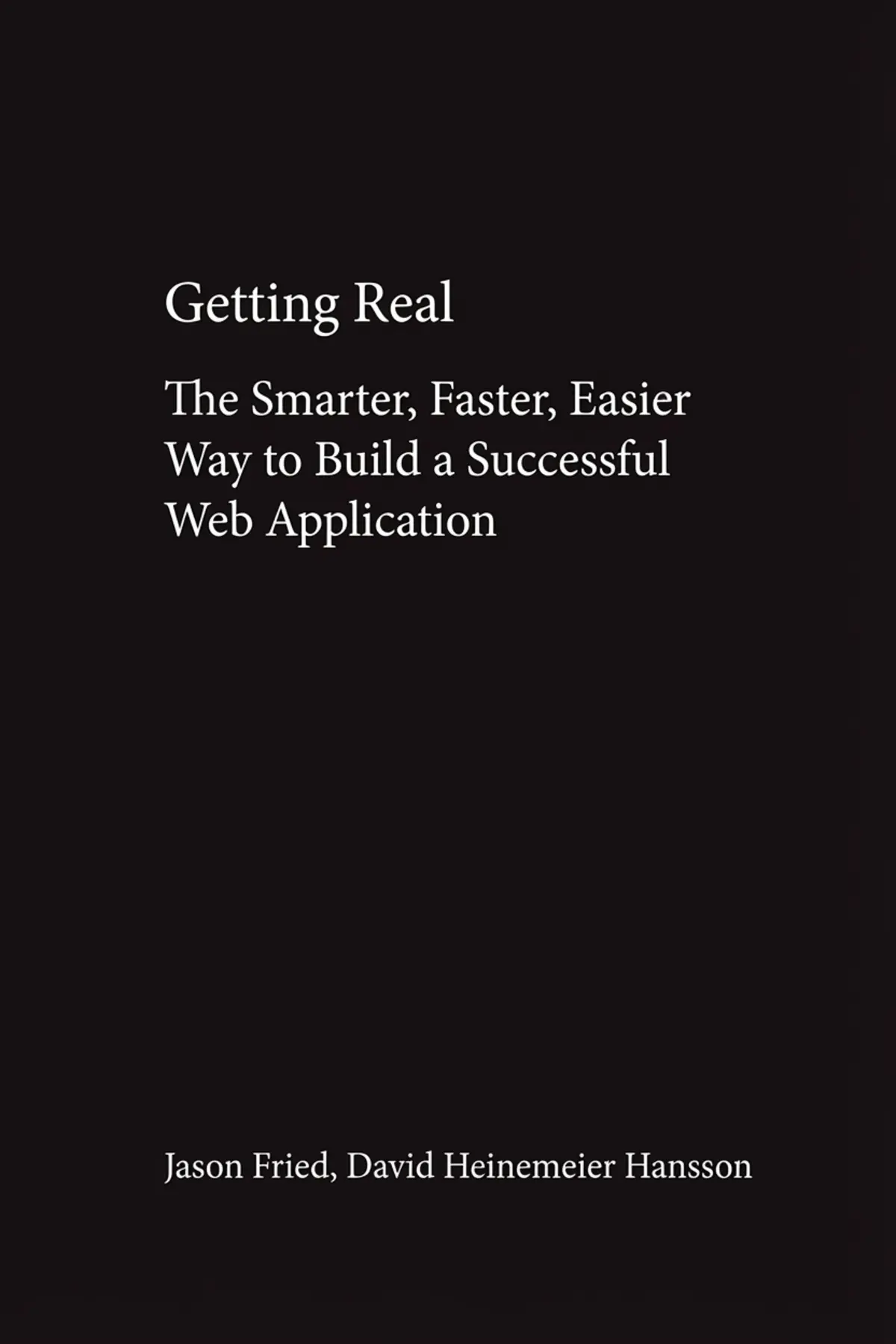
Getting Real challenges traditional business wisdom by advocating for simplicity and speed. It offers a blueprint for building successful products by staying lean, focusing on essentials, and prioritizing the user experience over corporate bloat.
1 min 28 sec
In the world of business, there is a traditional path that almost everyone expects you to follow. You start with a massive business plan, you seek out millions in venture capital, you hire a huge team of specialists, and you spend years developing a ‘perfect’ product behind closed doors. But what if that path is actually a recipe for failure? What if the secret to building something truly great isn’t doing more, but doing significantly less?
This is the core philosophy behind Getting Real. It is a mindset that values simplicity, speed, and agility over the bloated processes of the corporate world. Instead of getting lost in abstract theories, this approach focuses on what is tangible and immediate. It’s about building a business that is lean enough to pivot and smart enough to know that ‘more’ is often just a distraction from ‘better.’
Through this summary, we are going to explore how to strip away the fluff that kills most startups. We will look at why you should be your own first customer, why a team of three is often more powerful than a team of thirty, and why saying ‘no’ is the most important skill an entrepreneur can possess. Whether you are a designer, a marketer, or an executive, the principles of Getting Real offer a refreshing and effective way to approach modern product development. By the end, you’ll see that the most successful companies aren’t necessarily the ones with the most resources, but the ones that are the most real about their goals, their constraints, and their customers.
1 min 41 sec
Forget market research and complicated surveys. The most successful products often start with a single person trying to solve a personal frustration they face every single day.
1 min 44 sec
Mass creates inertia, and in the business world, inertia is a silent killer. Discover why staying small gives you a massive advantage over the corporate giants.
1 min 50 sec
Without a clear throughline, your product will wander into mediocrity. Learn how to define your big idea and stick to it without getting lost in the weeds.
1 min 55 sec
Productivity isn’t about how many hours you sit at a desk; it’s about how many of those hours are spent in ‘the zone.’
1 min 51 sec
When building a startup, a specialist is a luxury you can’t afford. Why you should look for ‘T-shaped’ people who bring more than just one skill to the table.
1 min 46 sec
A great product isn’t defined by what you put in, but by what you leave out. Learn the power of building ‘half a product’ to ensure excellence.
1 min 41 sec
The code might be the engine, but the interface is the car. Find out why you should design the user experience before you write a single line of logic.
1 min 50 sec
Getting people to try your product shouldn’t feel like an obstacle course. Learn the tactics for a smooth release and low-cost promotion.
1 min 13 sec
As we wrap up this journey into the principles of Getting Real, it’s clear that success in the modern business world isn’t about having the most resources—it’s about having the most focus. We’ve seen that the best products aren’t built by giant committees with endless budgets, but by small, dedicated teams who are willing to say ‘no’ to the unnecessary and ‘yes’ to the essential.
By building for yourself, you ensure that your product has a soul and solves a real problem. By staying small, you maintain the agility to move faster than your competitors can think. By prioritizing the interface and the user’s immediate experience, you ensure that your product is useful from day one. And by removing friction from your launch and marketing, you allow your product’s quality to speak for itself.
The most important takeaway is to stop overthinking and start doing. Don’t wait for the perfect moment or the perfect feature set. Launch something small, launch it soon, and then listen to your users. The real world is the best teacher you will ever have. So, embrace your constraints, talk to your customers like a human being, and keep things simple. It’s time to stop dreaming about ‘someday’ and start getting real.
Getting Real serves as a practical guide for anyone looking to launch a product in the modern marketplace without getting bogged down by traditional, heavy-handed business practices. It moves away from the idea that more features, more staff, and more funding lead to success. Instead, the book promises a path toward profitability and relevance by embracing constraints and keeping things simple. The core philosophy centers on the idea of being 'real'—which means focusing on actual software and user interfaces rather than abstract charts or massive documents. By staying small and agile, businesses can react to changes faster than their larger competitors. The book provides a step-by-step mindset for building what is necessary, ignoring the noise of the competition, and launching products that people actually want to use because they solve real problems simply and effectively.
Jason Fried is a co-founder of 37signals, a web development company. David Heinemeier Hansson is a partner at 37signals and the creator of the Ruby on Rails programming framework.
Jason Fried
Jason Fried
Jason Fried
Listeners consider this title an efficient read that delivers actionable guidance for business and development. They value the high-quality writing, with one listener highlighting the brief phrasing and the lean 200-page layout. Listeners describe the work as motivational, with one saying it encourages them to get stuff done, and they feel it is a truly valuable use of time.
Wow, this was exactly the kick in the pants I needed to stop over-engineering my side project and actually launch something. Fried and Hansson have a way of stripping away all the corporate fluff and focusing on what actually moves the needle for a user. Their mantra of building 'half a product, not a half-ass product' has completely changed how I look at my feature roadmap. To be fair, the book is quite opinionated and can come across as a bit arrogant at times, especially regarding outside funding. But if you want to get real about shipping code, there’s no better guide than this sparse, punchy collection of essays. It’s practical, it’s fast-paced, and it’s genuinely inspiring for anyone who values execution over endless planning.
Show moreThe chapter on blank slate design alone makes this book worth the price of admission. Most teams focus on the 'ideal state' of their app, but Fried and Hansson remind us that the first impression happens when the screen is empty. It’s a masterclass in empathy for the user experience. I found the 'Getting Real' philosophy to be a perfect entry point into agile and lean concepts without the confusing jargon. Not gonna lie, I was skeptical about their 'no specs' rule at first, but after seeing how much time we waste on documentation, I’m starting to come around. This is an essential read for anyone who wants to build software that people actually enjoy using. It’s fast, punchy, and incredibly practical.
Show moreThis is less of a book and more of a manifesto for the modern era of lean development. It rejects the 'more is better' culture that ruins so many great applications. I love how they emphasize that the interface is the product, not just a skin you slap on at the end of a project. By focusing on the 'real'—HTML mockups over static sketches—you find the friction points much faster. It’s an empowering read that makes you feel like you don’t need a massive team or millions in VC funding to make a dent in the universe. If you’re tired of bloated specs and endless meetings, this book will be your new favorite tool. It's concise, opinionated, and absolutely essential for the DIY entrepreneur.
Show moreFinally got around to reading this classic, and it’s surprising how well most of the design advice has aged. The core argument that 'copywriting is interface design' should be required reading for every product manager and designer out there. I love the focus on the 'blank slate' stage where most users actually decide if your app is worth their time or not. My only gripe is that it feels a bit dated in its absolute rejection of specialized roles; being a generalist is great, but sometimes you need an expert. Despite that, the book is written with a concise clarity that makes it impossible to put down. It’s a quick 200-page blast of common sense for the software world.
Show moreEver wonder why your software projects always blow past their deadlines? This book offers a radical solution: fix your time and budget, then flex your scope. It’s a simple concept that most managers are terrified to implement, but the authors make a compelling case for why it’s the only way to stay sane. In my experience, the 'just-in-time' decision-making process they describe prevents so much wasted effort on problems that might never even happen. The text is organized into short, punchy two-page themes that make it easy to digest during a commute. While some of the 'bootstrapping' talk feels like it belongs in a very specific niche, the project management wisdom is universal. It’s a solid 4-star guide for anyone building digital products.
Show morePicked this up on a flight and finished it before we touched down. It’s easily the most efficient business book I’ve ever encountered, valuing your time as a reader above all else. The advice on skipping the 'lorem ipsum' and using real data during the design phase is something I'll be implementing immediately. I’ve spent too many hours looking at beautiful mockups that fall apart the moment actual content is added. The book is sparse, but every page contains an actionable insight or a sharp quote that sticks with you. It might not be a deep dive into technical architecture, but it’s a masterclass in product thinking. Highly recommended for busy people who hate long-winded theory.
Show moreAfter hearing about 37signals for years, I finally dug into this book, and I was pleasantly surprised by how applicable it is. I work in corporate training, not software, yet the ideas about shrinking timelines and cutting out 'stuff that doesn't matter' hit home. We often spend months planning programs that could have been prototyped in a week. The authors' take on 'flexible scope' is a game-changer for project management in any field. I particularly liked the section on treating your product like a person with a distinct voice and personality. It’s a refreshingly honest look at how to get things done without the usual corporate bloat. A few sections are definitely too tech-heavy, but the core message is universal and inspiring.
Show moreAs a developer working in a large enterprise, I found the advice here a bit of a mixed bag. The authors champion a 'stay small' mentality that feels incredibly refreshing if you're drowning in meetings, yet much of it seems unfeasible for complex systems. Frankly, the idea that you should just build for yourself and the market will follow is a dangerous oversimplification for most B2B sectors. However, the sections on designing for 'blank states' and the importance of copywriting in UI were absolute gold nuggets. It’s a breezy 200-page read that challenges your assumptions, even if you can’t apply every single tip. I’d recommend it as a mental palate cleanser, but don’t expect a comprehensive roadmap for a global startup.
Show moreLook, the philosophies here are basically the 'Bonsai Tree' method of business—deliberately stunting growth to keep things manageable. If you’re an entrepreneur who wants to stay small and self-funded, this is your Bible, but it's not for everyone. The authors seem to abhor the idea of scaling or finding experts, which feels like a recipe for eventual burnout for most founders I know. That said, I can’t deny that the 'Less is More' approach to features is a vital lesson for the industry. The writing style is incredibly direct and avoids the usual business book fluff, which I truly appreciated. It’s a provocative read that will either make you nod in agreement or grit your teeth in frustration.
Show moreNot what I expected based on the massive hype surrounding 37signals. While there are a few decent nuggets about interface design, most of the book felt like a collection of overly simplistic platitudes. Telling people to 'just build for themselves' ignores the reality of market research and user needs for 90% of the software industry. It’s easy to give this advice when you already have a successful product, but for a new startup, it feels dangerously narrow. The tone is quite dismissive of anyone who doesn't follow their specific path of bootstrapping and staying tiny. If you’re looking for actionable, nuanced business strategy, you’re better off looking elsewhere. It’s a very quick read, but ultimately lacked the depth I was hoping for.
Show more
Hamilton Helmer
Duncan Clark
AUDIO SUMMARY AVAILABLE
Get the key ideas from Getting Real by Jason Fried, plus 5,000+ more titles in English and Thai.







