
15 min 30 sec
Leisure: The Basis of Culture
By Josef Pieper
Josef Pieper explores how the modern obsession with constant productivity has destroyed the true meaning of leisure, arguing that rest and contemplation are actually the essential foundations of a flourishing human culture.
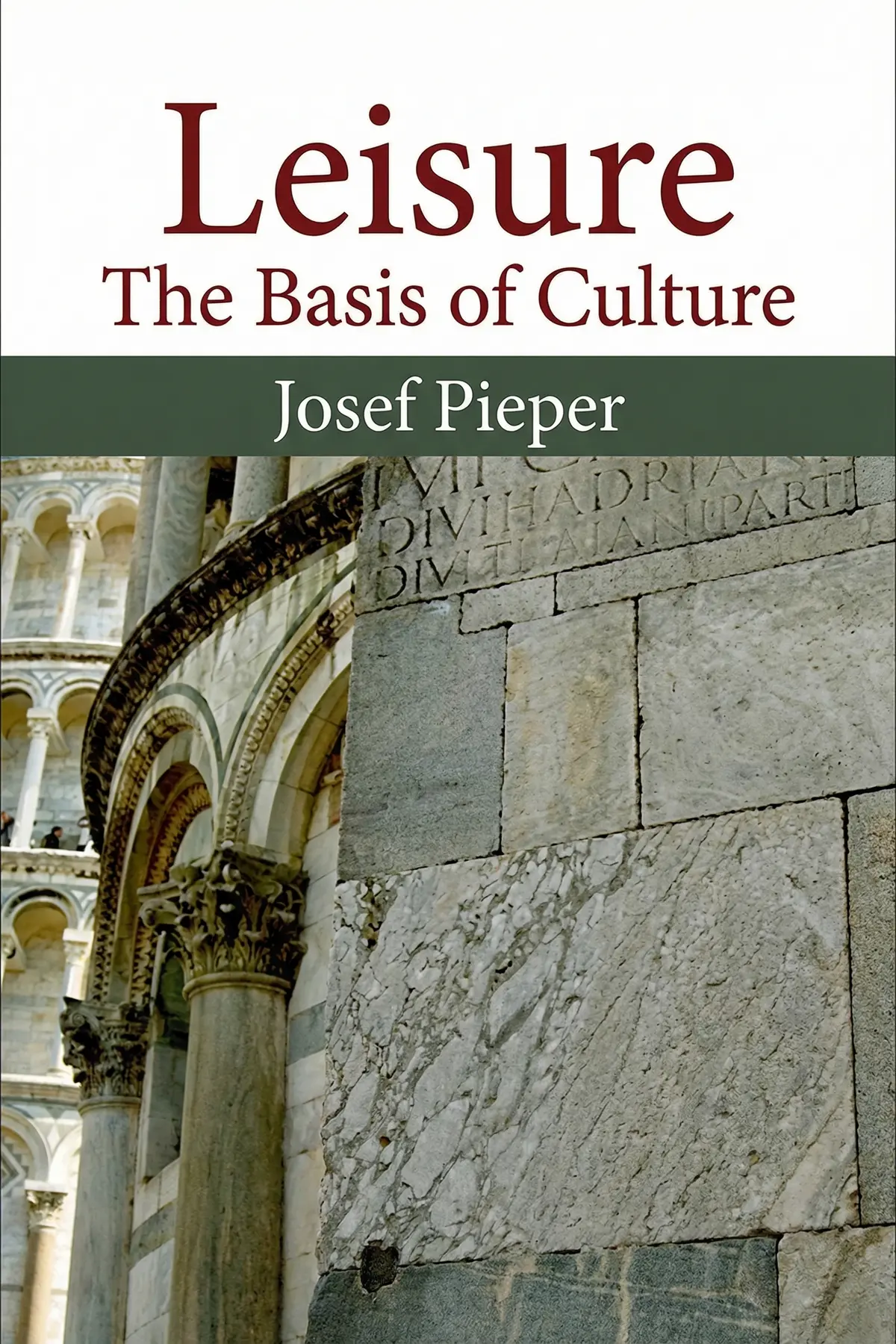
Table of Content
1. Introduction
1 min 42 sec
In the modern era, the rhythm of our lives is almost entirely dictated by the clock and the calendar. For most of us, the day is split into a predictable pattern: we wake up, we labor for eight or more hours, and then we have a few precious hours of ‘off-time’ before we collapse into sleep to prepare for the next day’s requirements. This cycle is so ingrained in our culture that we rarely stop to ask if there is another way to exist. We have become a society of ‘total work,’ where our identity and our value are inextricably linked to how much we produce.
But what if we’ve lost something vital in this exchange? What if the time we spend outside of the office isn’t actually ‘leisure’ at all, but just a maintenance period for our productivity? In this exploration of Josef Pieper’s landmark book, we are invited to reconsider the very foundation of how we spend our days. We are going to look back at the wisdom of the ancient Greeks to see how they viewed the relationship between effort and ease, and we will discover how our modern definition of rest has become dangerously narrow.
Pieper’s throughline is clear: leisure is not just a luxury for the elite, nor is it a synonym for laziness. Instead, it is the essential condition that allows culture to exist. Without true leisure, we are not fully human; we are merely tools in a grand economic machine. Over the next several minutes, we will unpack why we feel so guilty when we aren’t being ‘useful,’ why we have forgotten how to truly celebrate, and how we can begin to reclaim the silence and stillness necessary for a life of meaning. It’s time to look beyond the cubicle and rediscover the basis of human culture.
2. The Historical Inversion of Work and Leisure
2 min 21 sec
Discover how ancient philosophers viewed labor as a means to an end, rather than the center of human existence, and how our modern vocabulary hides this truth.
3. The Commercialization of the Mind
2 min 37 sec
Explore why the modern world treats thinking as an act of labor and how we have lost the ability to simply ‘be’ in the presence of truth.
4. The Moral Prejudice Against Ease
2 min 26 sec
Uncover why we feel guilty when we aren’t busy and why our society has come to view struggle as the ultimate sign of virtue.
5. Breaking the Chains of the Proletarian Identity
2 min 26 sec
Learn why the struggle for leisure is not just an individual issue, but a social necessity that affects everyone from the executive to the laborer.
6. The Spiritual Roots of True Rest
2 min 26 sec
See how the loss of the ‘sacred’ has turned our weekends into mere recovery periods and how we can find the soul of leisure again.
7. Conclusion
1 min 32 sec
As we reach the end of this journey through Josef Pieper’s vision of leisure, we are left with a powerful challenge to the way we live. We have seen how our modern world has inverted the natural order, placing work at the center of our identity and relegating leisure to a mere footnote of recovery. We have explored how this ‘total work’ mindset has colonized our minds, our morals, and our social structures, leaving us restless and spiritually thin.
But the path forward is also clear. Reclaiming leisure is not about finding more hours in the day; it’s about changing our internal orientation. It’s about recognizing that our value is not found in our ‘output’ or our ‘efficiency.’ It is found in our ability to be still, to be receptive, and to celebrate the simple fact of our existence. It’s about remembering that we work so that we can have leisure—not the other way around.
As you move back into your daily routine, try to find small ways to practice this ancient art. Find a moment where you can simply ‘be’ without needing to achieve anything. Look at the world with the eyes of ‘intellectus’ rather than the analytical gaze of ‘ratio.’ Give yourself permission to enjoy something that is completely ‘useless.’ By making these small shifts, you are doing more than just resting; you are participating in the vital work of building a culture that is truly human. You are rediscovering that leisure is not a break from life—it is the very basis of a life worth living.
About this book
What is this book about?
In our fast-paced modern world, we often view leisure as a mere break from the grind—a way to recharge our batteries so we can return to work more efficiently. However, Josef Pieper’s seminal work, Leisure: The Basis of Culture, argues that this perspective is entirely backward. Drawing on ancient Greek philosophy and medieval theology, Pieper demonstrates that leisure is not the servant of work, but its master. It is the silent, receptive state of the soul that allows for true contemplation, celebration, and the worship of the divine. This summary explores how the post-war shift toward a society of 'total work' has transformed us into 'workers' first and human beings second. It examines the distinction between active observation and receptive contemplation, challenging the modern belief that something only has value if it is difficult or productive. By reclaiming the original meaning of leisure, we can escape the cycle of constant labor and rediscover the spiritual and intellectual activities that give life its deepest purpose and meaning.
Book Information
About the Author
Josef Pieper
Josef Pieper lived from 1904 to 1997 and established himself as a prominent German philosopher. His intellectual career was deeply rooted in the traditions of Western thought, specifically the works of Thomas Aquinas and Plato. Throughout his life, he shared his insights into the human condition as a professor of philosophical anthropology at the University of Münster, where he explored the intersections of faith, reason, and culture.
Ratings & Reviews
Ratings at a glance
What people think
Listeners find this philosophical work quite insightful, with one listener noting that it offers a lucid depiction of contemporary society. They also value the heartening message, with one listener mentioning feeling inspired after every chapter, and believe it is truly worth the effort. Furthermore, the text receives praise for its take on rest, with one review highlighting how it reverses our standard concept of leisure. However, reactions to the readability are mixed, as one listener found the book difficult to parse.
Top reviews
Pracha
This slim volume packs an intellectual punch that most modern self-help books couldn't dream of landing. Pieper effectively flips our current understanding of leisure on its head, arguing that it isn't just 'time off' from a grueling job but the very foundation of human culture. Truth is, I felt inspired at the end of each chapter because he validates the 'useless' pursuit of philosophy as something essential to our nature. He writes with a post-war German gravity that makes his critique of 'total labor' feel incredibly urgent even today. It is an uplifting experience to realize that our worth isn't tied to productivity or some frantic hustle. If you want a clear description of why modern society feels so hollow, this is the definitive text. It requires focus, but the intellectual reward is immense.
Show moreLuckana
Rarely does a book change your fundamental perception of a single word, but 'Leisure' does exactly that. Pieper explains that leisure is a receptive attitude of mind and a contemplative beholding of reality, rather than just hitting the beach or snowboarding. Not gonna lie, his argument that eliminating religion cuts the heart out of culture was a bold pill to swallow, but he defends it with such grace. The way he connects leisure to divine worship and celebration is beautiful and provides a much-needed corrective to our secular, work-obsessed era. I found the sections on 'wonder' to be particularly moving and deeply insightful. This isn't just an academic exercise; it’s a manual for reclaiming your soul from the machinery of the workaday world. Every page offers a new reason to stop and think.
Show moreArnav
Each chapter left me feeling strangely quieted and deeply inspired to reclaim my own humanity from the gears of the modern world. Pieper’s central thesis—that leisure is the basis of culture because it allows us to contemplate Things As They Are—is a revelation. I’ve read plenty of books on mindfulness, but none have the philosophical depth or the cultural bite of this monograph. He successfully argues that when we view everything through the lens of utility, we lose the capacity for joy and festive celebration. The truth is, we are more than just social functionaries or workers; we are beings meant for wonder. This book is an excellent example of critical thinking that challenges both sides of the economic spectrum. It is well worth the effort for anyone feeling the weight of endless drudgery.
Show moreUbolrat
While the first essay on leisure gets all the glory, the second monograph on 'The Philosophical Act' is equally essential for understanding Pieper’s vision. He describes philosophizing as stepping beyond the workaday world to engage with the totality of existence, which is a breath of fresh air. Frankly, the way he links the ability to wonder with the capacity for true leisure is brilliant. He shows that we can only be bored if we have lost the spiritual power to be leisurely in the first place. This book flipped my understanding of 'free time' entirely. It’s not about doing nothing; it’s about being open to everything. For a book written decades ago, its critique of the 'worker' mentality feels like it was written about our current social media-driven hustle culture. It’s absolutely essential reading.
Show moreYuki
After hearing so much about Pieper’s critique of 'total labor,' I finally dove into this 1947 classic. The book is actually two distinct monographs, and while the first is more famous, both offer a profound rebuke of our obsession with being 'useful.' Look, the prose is definitely dense in that traditional German philosophical style, which makes the readability a bit of a mixed bag for a casual reader. However, his insights into how we’ve replaced true contemplation with mindless entertainment are stinging. I particularly appreciated his discussion on 'acedia' or spiritual sloth, which he links to our inability to simply be still. While I found some of his theological assertions a bit leap-of-faith heavy, the core message is salubrious. It’s a challenging read that demands you slow down, which is ironically exactly what the book advocates for.
Show moreFang
Is it possible that our obsession with productivity is actually a form of spiritual despair? Pieper argues exactly this, suggesting that 'total labor' is a grim prospect that leads to inner impoverishment and a loss of wonder. Personally, I found his definition of leisure as an 'effortless' act of celebration to be the most compelling part of the book. It’s a radical idea to suggest that the best things in life are those we don't 'work' for but simply receive. The historical context of post-war Germany adds a layer of poignancy to his rejection of mindless slavery to the state or the market. While the writing style is occasionally dry, the underlying sentiment is incredibly uplifting. It makes you realize that being 'useless' in the eyes of the world is often a prerequisite for being truly human.
Show morePan
Pieper’s argument that leisure is not simply 'vacation time' feels like a much-needed slap in the face for our current society. We often mock others for their work ethic, yet Pieper suggests this obsession is merely an expression of our own moral and spiritual poverty. I found his analysis of how we've turned even our 'hobbies' into forms of work to be incredibly accurate. My only real gripe is that he avoids the economic realities that make leisure impossible for so many people today. He speaks of it as a spiritual capacity, which is true, but ignores the 'human foundations' like a living wage that Aristotle noted were necessary. Still, the book provides a clear and necessary description of the sickness affecting our modern souls. It's a profound, if occasionally elitist, look at what it means to live well.
Show morePim
If you feel like you're drowning in a sea of emails and 'deliverables,' stop what you are doing and read this immediately. Pieper reminds us that the best parts of being human—art, philosophy, and love—cannot be justified by their 'usefulness' to society. I was particularly struck by his point that leisure is a form of silence that is a prerequisite for apprehending reality. It’s an insightful look at how we’ve traded our spiritual development for economic efficiency. To be fair, some of the Hegelian 'spirit' talk got a bit dense for me, but the overall message is clear and incredibly salubrious. It’s a book that demands a slow pace, ironically forcing you to practice the very leisure it describes. A truly definitive rebuke of the productivity trap that defines our lives.
Show moreSupachai
To be fair, the concepts here are groundbreaking, but the prose is a dense thicket that requires several passes to hack through. I struggled with how Pieper presents massive theological assertions as if they were self-evident truths without providing the rigorous grounding you'd find in someone like C.S. Lewis. He stands firmly in the tradition of German Idealism, which makes his discussion of 'spirit' feel a bit airy and intuitive at times. I agree that our society is obsessed with productivity to a fault, yet I found his rejection of the 'useful' to be slightly hyperbolic. It's an important conservative critique of the Cold War era, but it lacks a certain practical bridge to modern life. If you aren't already well-versed in philosophy, you might find this more frustrating than inspiring.
Show moreKamol
Gotta say, I have mixed feelings about this one despite its high reputation among conservative intellectuals. On one hand, Pieper offers a biting and necessary critique of the 'total labor' state that resonates deeply in our age of burnout. On the other hand, the readability is quite challenging, and his arguments often feel like they are floating in a vacuum of high-altitude abstraction. He laments the decline of leisure and worship but then suggests these things cannot be humanly manufactured, which leaves the reader in a bit of a stalemate. It’s a brilliant analysis of the symptoms of our cultural decline, but the 'cure' remains somewhat elusive and tethered to a specific religious worldview. I appreciate the insights, but I left the book feeling more intellectually stimulated than practically helped. It’s worth reading, but keep your dictionary close.
Show moreReaders also enjoyed
A Guide to the Good Life: The Ancient Art of Stoic Joy
William B. Irvine
A Little History of Philosophy
Nigel Warburton
A Theory of Justice
John Rawls
Anarchism: A Very Short Introduction
Colin Ward
AUDIO SUMMARY AVAILABLE
Listen to Leisure in 15 minutes
Get the key ideas from Leisure by Josef Pieper, plus 5,000+ more titles in English and Thai.
- 5,000+ titles
- Listen as much as you want
- 7-day free trial
- Cancel anytime







