
15 min 46 sec
Made to Stick: Why Some Ideas Survive and Others Die
By Chip Heath, Dan Heath
Explore why some ideas flourish while others fade away. This guide breaks down the six core principles of stickiness to help you create messages that are memorable, impactful, and ready to spread.
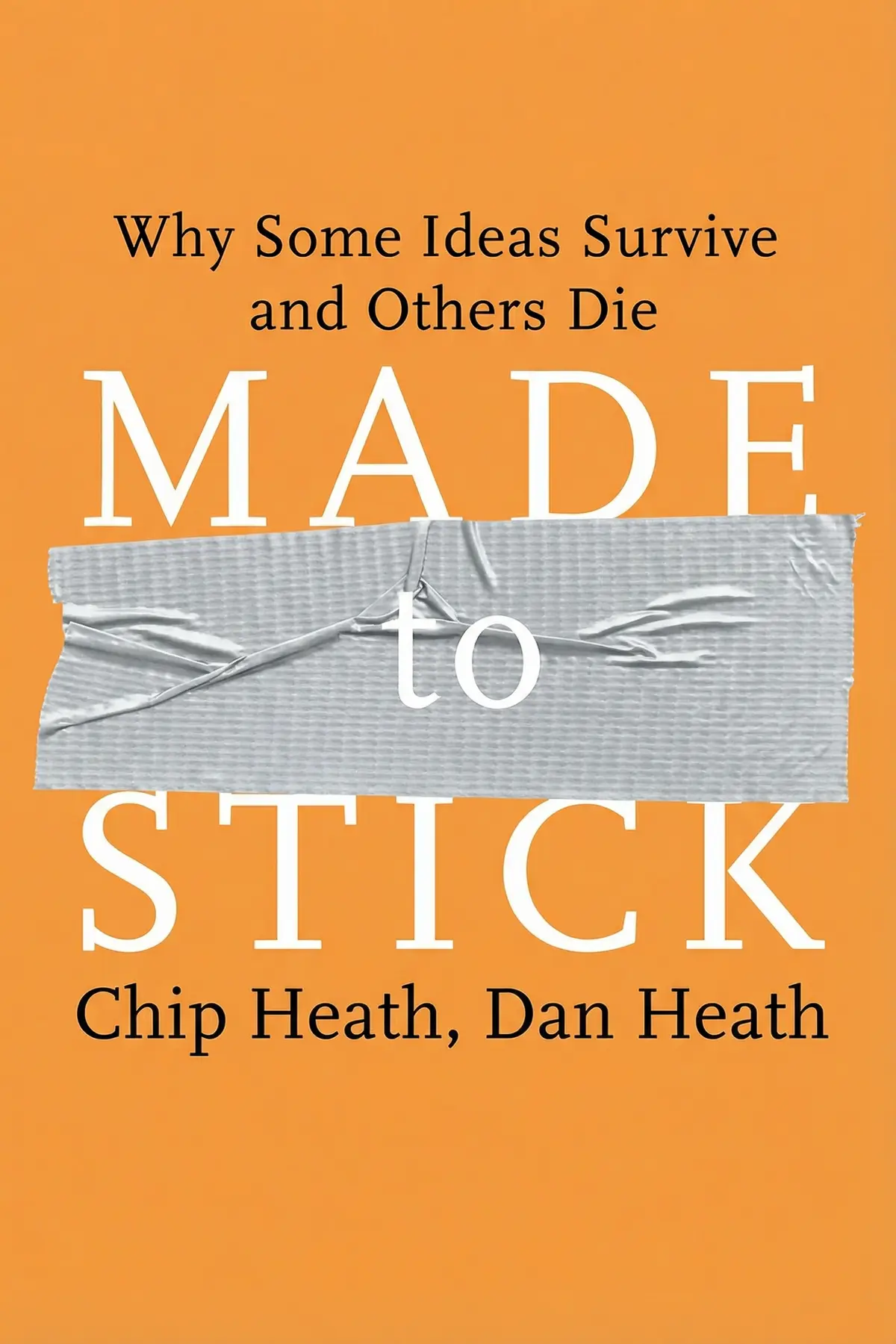
Table of Content
1. Introduction
1 min 38 sec
Why is it that a completely fabricated story about dangerous objects hidden in children’s Halloween candy can cause a nationwide panic, while a scientifically proven health warning about cholesterol often goes ignored? We live in a world where magnificent insights frequently gather dust in filing cabinets, yet rumors and urban legends spread with the speed of a wildfire. This discrepancy suggests that the success of an idea isn’t solely dependent on its truth or its inherent value. Instead, success depends on whether the idea is ‘sticky.’
To be sticky, an idea must be two things: it must be memorable, and it must be something people feel compelled to share. If a message doesn’t stick, it can’t be acted upon, and it certainly won’t change the world. Think about the way health advocates once tried to warn the public about the dangers of movie theater popcorn. For years, they released dry, academic data stating that a medium bag contained thirty-seven grams of saturated fat. No one cared. The number was too abstract. It didn’t stick.
Then, they changed their approach. They stopped talking about grams and started talking about meals. They told the public that a single bag of theater popcorn had more artery-clogging fat than a full bacon-and-eggs breakfast, a Big Mac with fries for lunch, and a complete steak dinner—all added together. That image was vivid, horrifying, and impossible to forget. It stuck, it spread, and it forced the entire film industry to change its cooking methods. In the pages ahead, we will explore the specific framework you can use to give your own ideas that same level of staying power, moving through the essential principles that turn a simple thought into a lasting legacy.
2. Finding the Essential Core
1 min 42 sec
Discover why the most effective messages are those stripped of every unnecessary detail, allowing the most vital truth to shine through.
3. Breaking Through the Autopilot
1 min 30 sec
Learn how to grab attention by disrupting the brain’s natural tendency to ignore the routine and the expected.
4. Closing the Curiosity Gap
1 min 26 sec
Understand the psychological pull of unanswered questions and how they can be used to keep an audience engaged until the very end.
5. The Power of Concrete Language
1 min 39 sec
Discover why abstract concepts fail to stick and how using sensory, real-world descriptions can make your message unforgettable.
6. Establishing Immediate Credibility
1 min 39 sec
Explore how to make your ideas believable without relying solely on titles or degrees, using internal evidence and relatable facts.
7. Invoking Emotional Responses
1 min 39 sec
Learn why appealing to the heart is often more effective than appealing to the head when you want to inspire action.
8. Appealing to Self-Interest
1 min 29 sec
Discover the most important question every audience asks and how to answer it to ensure your message is received.
9. The Narrative as a Mental Simulator
1 min 41 sec
Uncover why stories are the ultimate delivery vehicle for ideas, acting as a training ground for the human mind.
10. Conclusion
1 min 23 sec
The journey to making an idea stick is not about having a high IQ or a massive marketing budget. It is about understanding the psychological framework that allows information to bypass our filters and take root in our memories. Throughout this exploration, we have seen that the most successful messages consistently follow the SUCCESs formula. They are Simple enough to be understood, Unexpected enough to grab attention, Concrete enough to be remembered, Credible enough to be believed, Emotional enough to be cared about, and told as a Story that provides a path to action.
When you sit down to craft your next pitch, email, or presentation, don’t just ask yourself if the information is correct. Ask yourself if it sticks. Are you burying your core message in too much detail? Are you relying on abstract jargon that only an expert could love? Are you assuming people will care just because the data is there? By consciously applying these six principles, you can ensure that your insights don’t just gather dust. You can transform your communication into something that resonates, survives, and ultimately, changes the way people think and act. Remember, the world is full of great ideas that never went anywhere because they didn’t stick. Don’t let yours be one of them. Use the framework, find your core, and tell a story that people can’t help but pass on.
About this book
What is this book about?
Have you ever wondered why urban legends travel around the globe in days while important internal company memos are forgotten in minutes? It turns out that stickiness is not an accident of birth; it is a result of specific communication traits. This summary explores the psychological mechanisms that make certain concepts stay with us long after we first hear them. You will learn how to strip an idea down to its essential core without losing its meaning, how to bypass the brain’s tendency to ignore the familiar, and why concrete details always outperform abstract theories. By applying the SUCCESs framework—Simplicity, Unexpectedness, Concreteness, Credibility, Emotions, and Stories—you can transform your communication from easily ignored background noise into powerful, actionable insights that resonate with any audience.
Book Information
About the Author
Chip Heath
Chip Heath is a professor of organizational behavior at Stanford University. He holds a BSc in industrial engineering and a PhD in psychology. His brother Dan Heath is an academic, consultant and founder of the publishing company Thinkwell, which takes a new, didactic approach to writing textbooks.

Ratings & Reviews
Ratings at a glance
What people think
Listeners find the book very accessible and beneficial for professional development, packed with valuable research-backed observations. Furthermore, the text is loaded with relevant anecdotes demonstrating why narrative is crucial for crafting memorable concepts, and listeners like the straightforward, coherent structure. They also prize its ability to make communications more powerful and essential for ensuring audiences retain shared thoughts, acting as an excellent resource for bettering one's speech and writing.
Top reviews
Aim
Finally got around to reading this after seeing it on every must-read business list for the last decade. The SUCCES framework is incredibly intuitive, though the book ironically feels a bit longer than it needs to be to prove its own point about simplicity. I loved the section on the Curse of Knowledge because it perfectly explains why experts are often terrible teachers. By using vivid stories instead of dry data, the Heath brothers show exactly how to bypass our natural tendency to overcomplicate things. The framework works for leaders in any industry who want to improve their influence. It’s a game-changer for anyone in a leadership role who needs to get a team aligned without losing them in the weeds of technical jargon. Even if you think you’re a good communicator, this will make you realize how many of your ideas are currently slipping through the cracks.
Show moreRatchanee
Ever wonder why urban legends like the kidney heist spread like wildfire while your carefully crafted business strategy is forgotten five minutes after the meeting? This book answers that question with a brilliant, research-driven framework that challenges the way we think about information transfer. The Heath brothers have a gift for making complex psychological concepts feel accessible and even fun to learn. I was especially struck by the gap theory of curiosity, which suggests we need to open a hole in people's knowledge before we fill it. It’s a simple shift in perspective, but it makes a massive difference in how you approach public speaking or even just sending an email. The tone is conversational yet authoritative, making it one of the few business books that I actually enjoyed finishing. It’s not just for marketers; it’s for teachers, parents, and anyone who wants their words to carry weight.
Show moreNatchaya
The chapter on Concreteness alone makes this book worth the price of admission. We spend so much time talking in synergies and strategic alignments that we forget how to talk to actual human beings. Chip and Dan Heath provide a brilliant antidote to this corporate fog by showing how to ground ideas in the real world. I loved the story about the teacher who used a brown-eyed experiment to teach children about discrimination; it was simple, emotional, and unforgettable. The book is structured in a very logical way, making it easy to flip back and find specific tips when you’re in a rush. If you are serious about improving your communication skills and making your ideas more impactful, this is an essential addition to your library. It’s one of the few books that actually lives up to its own title by being truly sticky for the reader.
Show moreSavannah
As a marketing manager, I found the breakdown of how to craft a message both refreshing and immediately applicable to my daily work. The authors argue that a message must be simple, unexpected, concrete, credible, emotional, and told through a story—the famous SUCCES acronym. I particularly appreciated the Sinatra Test concept for establishing credibility without relying on boring certificates or degrees. While some of the sections felt a bit dragged out, the actual research backing their claims is solid and provides a great foundation for professional communication. Truth is, we often rely too much on statistics that nobody remembers, whereas a story about Jared from Subway stays in the brain for years. It’s a helpful guide for cutting through the noise of modern corporate-speak and finding the core of what you're actually trying to say. This should be required reading for anyone struggling to make their pitches more impactful.
Show moreKek
After hearing about this from several sources, including Daniel Pink, I finally decided to dive into the audiobook version. What sets this apart from books like The Tipping Point is its focus on the internal structure of the idea itself rather than the external environment. The authors do a great job of explaining why sticky ideas don't require a massive marketing budget if they are designed correctly from the start. I found the section on Concrete details particularly helpful, as it explains how to move away from abstractions that confuse the audience. My only real gripe is that the acronym SUCCES feels a little bit forced, like they were trying too hard to be clever with the spelling. Regardless, the lessons are vital for anyone who needs to spread a message on a budget. The narration was excellent and kept me engaged through some of the more redundant chapters toward the middle.
Show moreWararat
Short, punchy, and surprisingly practical for a book based on academic research. The authors identify the Curse of Knowledge as the primary reason why most communication fails, which was a huge epiphany for my own writing. We assume others know what we know, and as a result, we speak in high-level abstractions that no one can actually visualize. This book provides a clear roadmap to fixing that mistake by emphasizing sensory information and human action over technical data. Personally, I found the unexpectedness chapter to be the most useful, as it shows how to break someone's guessing machine to get their attention. The layout is logical, the writing is clear, and the stories are memorable enough that they actually illustrate the principles they are teaching. It’s a solid resource that I’ll likely keep on my desk for reference when I’m drafting new campaigns.
Show moreMoon
Frankly, as a data-driven person, I was initially skeptical of the heavy emphasis on storytelling. However, the Heath brothers do a fantastic job of proving why stories are actually more credible in the human brain than a list of raw statistics. They argue that stories act as a sort of mental flight simulator, allowing the listener to practice a response to a situation. This idea alone changed the way I think about training and development within my organization. While the book leans heavily into advertising and non-profit examples, the core logic applies to almost any professional field you can imagine. The writing style is a bit American self-help, which might grate on some people, but the substance is definitely there. It's a great toolkit for anyone who needs to persuade others or make a lasting impression during a presentation.
Show morePear
Picked this up because a mentor recommended it, but I have mixed feelings about the overall execution. On one hand, the six principles are undeniably useful and serve as a fantastic checklist for any creative project. On the other hand, to be fair, the book is incredibly repetitive and could have easily been a long-form article or a short PDF summary. Some of the sports-related examples went right over my head, and the tech references are starting to show their age. However, the chapter on Emotions was genuinely insightful, particularly the idea that we care about individuals more than groups. It’s a decent guide, but it requires some patience to dig through the filler to get to the real gold. If you can stomach the textbook-style pacing, there is definitely enough value here to justify the purchase. Just don't expect a fast-paced thriller from cover to cover.
Show moreVimolwan
Not what I expected given the massive praise it receives in every business circle. To be honest, I found the whole thing a bit over-engineered and much longer than necessary to convey a few basic principles of communication. The SUCCES acronym is helpful, but the authors spend hundreds of pages repeating the same six words in slightly different contexts. It reminded me of a college freshman textbook—informative but occasionally hard to stomach because of the dry delivery. That said, the specific case studies, like the one about the Don't Mess with Texas campaign, were genuinely fascinating. If you’re a corporate advertising wannabe, you’ll probably love every page of this. For the rest of us, a high-quality summary might be enough to get the gist without the slog of the full text. It just lacks the rigor of more academic texts.
Show moreBook
This book was a redundant snooze that felt more like a bloated college textbook than a revolutionary business guide. It’s quite clear that the authors are doing their utmost to follow their own advice, but that makes the reading experience almost unreadably repetitive. They hammer the same points over and over until you feel like you’re being beaten over the skull with a blunt object just to ensure the idea sticks. The reading experience is incredibly dull for a book about interest. Honestly, I found most of the core concepts to be fairly common sense for anyone who has worked in advertising for more than a week. The examples, like the Palm Pilot, feel incredibly dated and made me wonder if the principles themselves are still relevant in the age of social media. If you want a more rigorous look at why ideas spread, look for something on memetics or psychology.
Show more
Readers also enjoyed
AUDIO SUMMARY AVAILABLE
Listen to Made to Stick in 15 minutes
Get the key ideas from Made to Stick by Chip Heath, plus 5,000+ more titles in English and Thai.
- 5,000+ titles
- Listen as much as you want
- 7-day free trial
- Cancel anytime







