
17 min 59 sec
Making Sense of Chaos: A Better Economics for a Better World
Explore a revolutionary perspective on economics that replaces rigid, outdated models with the principles of chaos theory. Discover how agent-based modeling provides a realistic understanding of our complex, interconnected global financial systems.
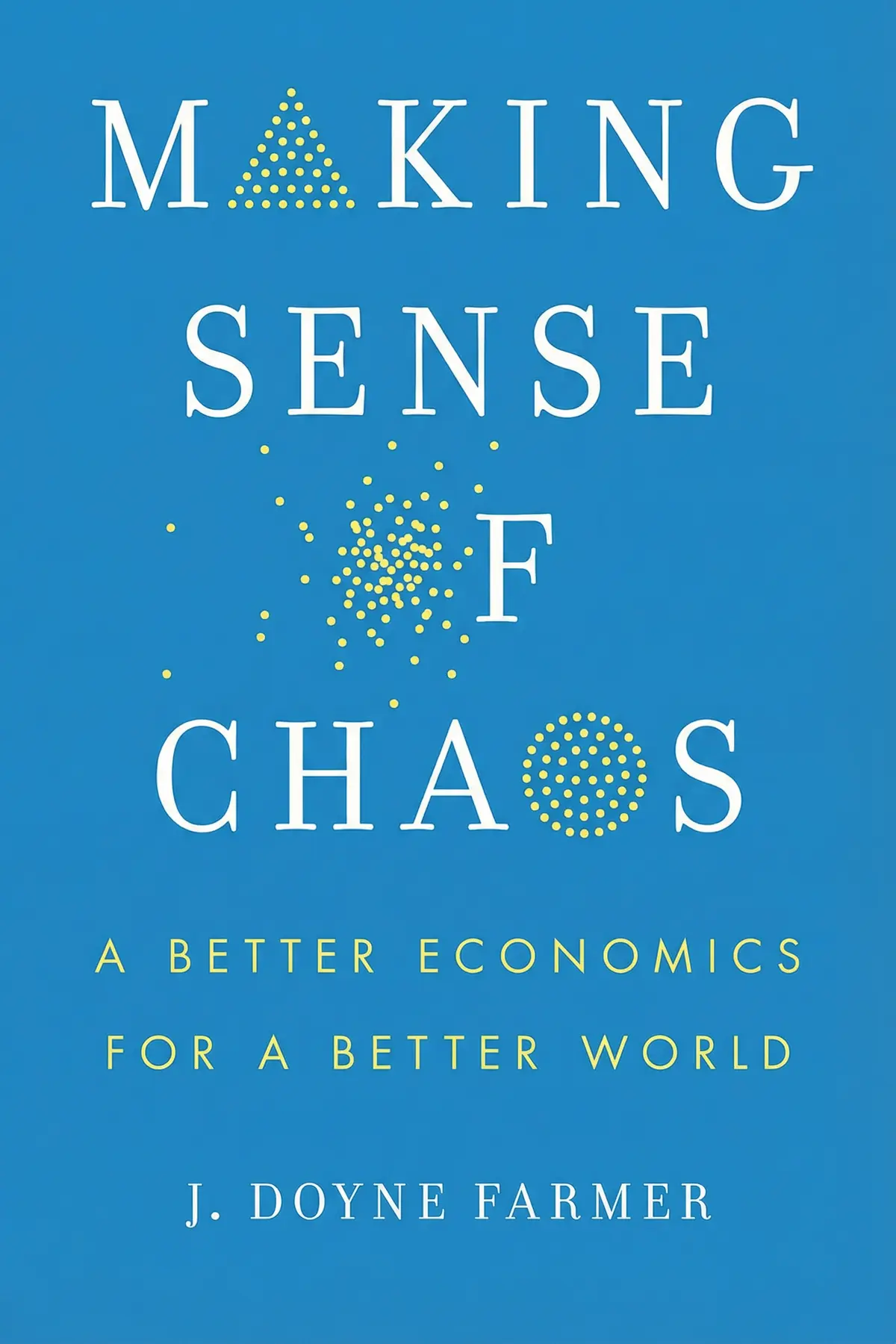
Table of Content
1. Introduction
1 min 45 sec
We often think of the economy as a massive, clockwork machine—a system where, if you turn the right gears of interest rates or taxes, the outcome will be predictable and stable. But as anyone who lived through the 2008 financial crisis or the sudden shifts of the global pandemic knows, the economy frequently behaves less like a machine and more like a wild, unpredictable storm. This is where the traditional rulebooks begin to fail us. They are built on assumptions that were developed in a simpler time, long before our world became as digitally linked and environmentally fragile as it is today.
In this exploration of Making Sense of Chaos, we are going to look at why the old ways of thinking are hitting a dead end and what the future of economic science looks like. We are moving away from the idea that markets are always in perfect balance and toward a view called complexity economics. This is a field that doesn’t just tolerate the messiness of human behavior; it embraces it. It uses the power of modern computing to simulate the world as it actually is, not as we wish it to be.
Over the next several segments, we will discover how J. Doyne Farmer is applying the principles of chaos theory—a field usually reserved for physics and weather patterns—to the world of finance and social policy. We will see how individual actions, like an ant in a colony, can lead to massive global shifts. We’ll learn how these new models can help us predict everything from the impact of automation on jobs to the best path for a green energy transition. By the end, you’ll see how a new kind of economics can help us navigate a world that often feels like it’s spinning out of control.
2. The Myth of Universal Balance
2 min 24 sec
Traditional economics assumes markets naturally find a perfect balance, but real-world experience suggests that stability is the exception rather than the rule in global finance.
3. The Economy as a Living Ecosystem
2 min 35 sec
By viewing the financial world through the lens of biology, we can see how individual interactions create complex, large-scale behaviors that no single person controls.
4. Simulating Reality with Agent-Based Models
2 min 27 sec
Instead of relying on rigid math equations, new computational tools allow us to create digital twins of the economy to test how individual choices impact the whole.
5. The Reality of Human Decision-Making
2 min 22 sec
Humans don’t behave like logic-driven computers; instead, we rely on mental shortcuts and social cues that define the true rhythm of the market.
6. The Anatomy of Financial Instability
2 min 25 sec
Crises are not always caused by external disasters; often, they are the result of internal feedback loops and the risky tools we use to manage money.
7. Charting the Path to a Sustainable Future
2 min 22 sec
New economic models provide a roadmap for the green energy transition, helping us predict and manage the complex shifts in labor and technology.
8. Conclusion
1 min 39 sec
As we reach the end of our look at J. Doyne Farmer’s work, the central message is clear: the economic tools of the past are simply not sharp enough to cut through the complexity of the 21st century. We have moved beyond the age where we can pretend that the market is a self-correcting machine that always finds its way back to a perfect balance. Instead, we must embrace the reality that our economy is a chaotic, interconnected, and deeply human ecosystem.
The good news is that we are entering a new era of ‘conscious civilization.’ For the first time in history, we have the data and the computing power to build digital laboratories where we can test our ideas. We no longer have to treat our citizens like lab rats in a massive, real-world experiment. Whether it’s curbing inflation, preventing the next housing bubble, or ensuring that the move to green energy doesn’t leave entire communities behind, complexity economics gives us a way to see around the corner.
This isn’t just a shift for academics and policymakers; it’s a shift in how all of us think about the world. It’s a call to recognize our interconnectedness and to realize that the ‘shocks’ we feel are often the result of the systems we ourselves have built. By demanding better models and more transparent data, we can move toward a future where the economy serves humanity’s well-being rather than the other way around. The chaos is real, but as we’ve seen, it is also something we can finally begin to make sense of.
About this book
What is this book about?
Making Sense of Chaos introduces a transformative framework for understanding the modern economy through the lens of complexity science. For decades, traditional economic theories have relied on the concept of equilibrium—the idea that markets naturally find a stable balance through rational behavior. However, as global crises and climate change have demonstrated, the real world rarely follows these predictable paths. J. Doyne Farmer argues that our current economic tools are no longer sufficient for a world defined by rapid technological shifts and deep interconnectedness. The book promises a new way forward by treating the economy as a dynamic ecosystem rather than a predictable machine. By utilizing agent-based models—simulations that track the interactions of individual people and firms—we can better predict emergent behaviors like market crashes and unemployment spikes. This approach allows policymakers to test potential interventions in a digital laboratory before applying them to the real world. Ultimately, Farmer shows how this new economic toolkit can help us navigate the transition to green energy, address growing inequality, and build a more resilient global society.
Book Information
About the Author
J Doyne Farmer
J. Doyne Farmer is a pioneering economist known for his work in developing complexity economics and agent-based modeling. His research explores how complex systems and computational models can enhance our understanding of economic dynamics and improve policy-making. Farmer teaches at the Oxford University Institute for New Economic Thinking and is a founding member of the Santa Fe Institute.
Ratings & Reviews
Ratings at a glance
What people think
Listeners value the work's credible case for Complexity Economics and find it informative, while one listener mentions that it offers an accessible overview of scientific methods for addressing intricate issues. The material earns favorable remarks, including one listener who characterizes it as an engaging experience. Listeners have varied opinions regarding the author's background and expertise.
Top reviews
Kek
Finally got around to reading Farmer's take on complexity, and it's a breath of fresh air for anyone exhausted by the rigid, unrealistic assumptions of mainstream economics. Truth is, the 'rational agent' model has always felt like a convenient fiction, but Farmer provides a rigorous alternative through agent-based modeling. He makes a compelling case that our economy is a chaotic, non-linear system where small shocks can lead to massive cascades. I particularly enjoyed the sections on how these models were applied to real-world scenarios like the COVID-19 pandemic, proving their practical utility over abstract formulas. While some parts felt a bit brief, the overarching vision of a computer-simulated economic science is incredibly persuasive. It’s rare to find a book that challenges foundational dogmas while remaining accessible to someone without a PhD in math. This should be required reading for policy makers who are still stuck in the 20th century.
Show moreTeng
Wow. This book effectively dismantles the 'utility maximizer' myth that has dominated economic thought for decades, replacing it with a far more plausible framework of bounded rationality. Not gonna lie, I had several 'Aha!' moments when Farmer explained why symmetric New Keynesian frictions fail to align with actual human psychology or the downward rigidity of prices. The way he weaves his personal journey from physics and gambling into the broader context of complexity science makes for an incredibly engaging narrative. It’s refreshing to see someone admit that the world is too messy for simple formulas and that we need the brute force of simulations to see the truth. The section on nuclear energy costs was a surprising but welcome confirmation of how these models can expose real-world inefficiencies. Highly recommended for anyone who suspects that the experts don't actually have a handle on how money moves.
Show moreSiriporn
In the landscape of economic literature, this stands out as a genuinely revolutionary text that prioritizes empirical reality over theoretical elegance. The author's transition from physics to finance provides him with a unique vantage point to call out the 'rational expectations' school for its lack of predictive power. I was particularly impressed by the evidence presented regarding the impact of COVID-19, which served as a perfect stress test for his modeling techniques. It's high time we acknowledge that small perturbations in a chaotic system can have oversized effects, a concept that standard economics simply cannot compute. While the tone is occasionally dismissive of mainstream thinkers, it's hard to blame him given how consistently those thinkers have failed to foresee major market collapses. This is a brilliant, forward-thinking piece of work that finally brings economics into the age of the supercomputer.
Show moreYulia
This book is a revelation for anyone tired of 'standard' models that seem to ignore how people actually behave in the real world. By treating the economy as a complex system rather than a machine in equilibrium, Farmer opens up a whole new way of thinking about policy and prediction. I loved the comparisons to Gleick’s work on chaos; it feels like the natural evolution of that science applied to the social sphere. The truth is, we have the computational power now to model individual agents, so why are we still sticking to aggregate formulas from the 1950s? His writing is accessible without being patronizing, and the anecdotal evidence from his own career adds a layer of authenticity that many academic books lack. It’s a bold, essential read that makes a very plausible case for a total overhaul of the way we teach and practice economics.
Show moreWoravit
Picking this up after reading Orrell's work was a great decision, as Farmer provides the 'what next' that I felt was missing from previous critiques of the field. He doesn't just tear down the old guard; he builds a credible, simulation-based path forward that feels tailored for the age of big data. I was fascinated by the idea that small, non-linear interactions are the primary drivers of market volatility, rather than just external 'shocks' as traditionalists claim. The book manages to be both a memoir of a fascinating career and a rigorous argument for a new scientific paradigm in finance. Though it can be heavy going in the middle sections, the payoff is a much deeper understanding of the inherent fragility of our global systems. It’s a remarkable achievement that manages to be both intellectually demanding and deeply rewarding for the persistent reader.
Show moreFah
As a student of physics, I've always been skeptical of how economists ignore the inherent instability of human systems in favor of elegant equilibrium equations. Farmer bridges this gap beautifully by applying chaos theory to fiscal realities, though he occasionally prioritizes his personal history over deep technical explanations. To be fair, his background in beating casinos with wearable computers is fascinating, but I found myself wanting more 'nitty-gritty' details on the simulation architectures themselves. The book shines when it critiques the 'cargo cult' nature of modern economic awards and points toward a future defined by computational power. It’s a bit lighter on the math than some might expect, acting more as a manifesto than a textbook. However, the clarity with which he explains why standard models fail during crises makes it worth every minute of your time.
Show moreChatchai
Doyne Farmer takes a massive swing at the economic establishment here, and for the most part, he connects with a powerful, data-driven argument. My only real gripe is that the book spends a disproportionate amount of time on beating the stock market, which felt less impactful than the chapters on climate change or systemic risk. Personally, I found the discussion on how agent-based models could inform environmental policy to be the most vital part of the work, yet it felt slightly rushed compared to the gambling anecdotes. Despite that, the writing is clear, frequently funny, and manages to make high-level chaos theory feel intuitive rather than intimidating. He successfully argues that the economy is a non-linear beast that requires a totally different set of tools than what is currently taught in most MBA programs. It’s a necessary critique of a field that has been stagnant for far too long.
Show moreErn
Ever wonder why the economy feels so unpredictable? Farmer argues it's because we're using the wrong map, relying on static formulas instead of dynamic simulations that account for human error and heterogeneity. In my experience, most economic books are dry and detached, but this one has a pulse, driven by the author's clear passion for overturning the status quo. He does a great job of explaining how heuristics and bounded rationality create a much more realistic picture of market behavior than the 'perfect knowledge' models of the past. Some of the chapters on the stock market dragged a bit for my taste, and the lack of concrete climate suggestions was a minor letdown. Still, the core message—that we must embrace chaos to understand it—is handled with enough wit and clarity to keep you turning the pages. It’s a solid 4-star read.
Show moreRafael
The premise is solid, but the execution felt like a missed opportunity to truly revolutionize the reader's understanding of complexity economics. Frankly, the narrative gets bogged down in academic status-seeking and disparaging remarks about mainstream peers, which distracted from the actual science of agent-based modeling. I was hoping for a deep dive into the mechanics of his group's simulations, yet I received a whistle-stop tour that often skimmed over the most interesting technical hurdles. It reads more like a long-form essay that was stretched into a full-length book without adding the necessary depth to justify the page count. If you’ve already read Gleick or Orrell, much of the foundational theory here will feel like a repetitive retread of familiar concepts. It’s an okay introduction for a complete novice, but anyone looking for serious math will walk away feeling slightly underwhelmed.
Show moreJoy
Look, I really wanted to love this because the idea of complexity economics is so appealing, but the book is frustratingly superficial and poorly structured. It felt like a disjointed collection of anecdotes and claims rather than a rigorous defense of agent-based modeling or a cohesive narrative. The author seems more interested in settling old academic scores than in explaining the actual mechanisms that make his simulations superior to traditional DSGE models. To be fair, the stories about his early days with wearable computers are entertaining, but they don't help me understand the actual 'chaos' of a modern global economy. It’s a passable introduction if you know nothing about the subject, but it lacks the depth required for anyone with a background in data science. It could have been a brilliant 30-page paper; as a book, it’s mostly just filler and repetitive critiques.
Show moreReaders also enjoyed
1929: Inside the Greatest Crash in Wall Street History--and How It
Andrew Ross Sorkin
23 Things They Don’t Tell You About Capitalism
Ha-Joon Chang
A Little History of Economics
Niall Kishtainy
A Splendid Exchange: How Trade Shaped the World
William J. Bernstein
AUDIO SUMMARY AVAILABLE
Listen to Making Sense of Chaos in 15 minutes
Get the key ideas from Making Sense of Chaos by J Doyne Farmer, plus 5,000+ more titles in English and Thai.
- 5,000+ titles
- Listen as much as you want
- 7-day free trial
- Cancel anytime







