
Drinking Water: A History
James Salzman
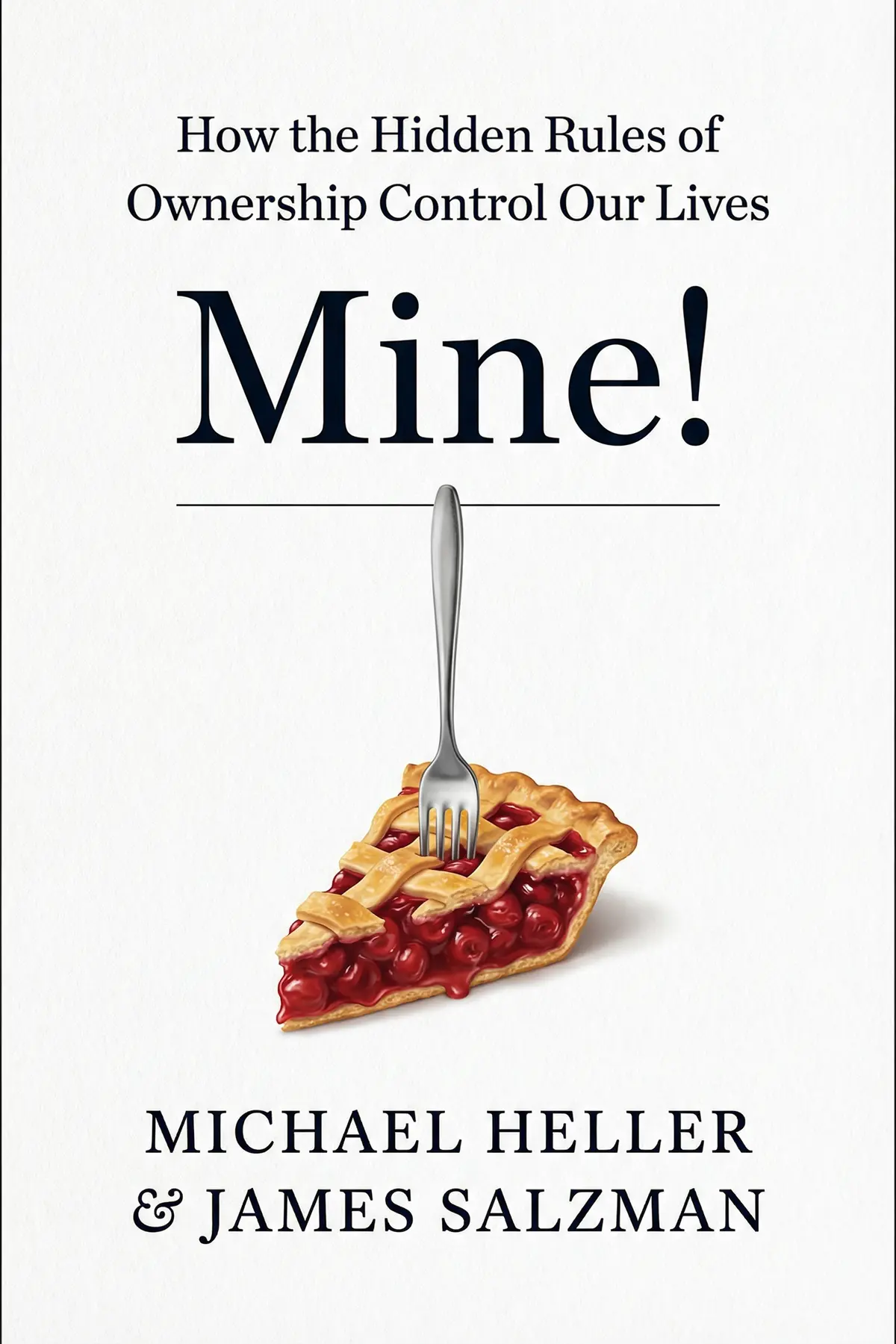
Discover the hidden social and legal frameworks that define ownership. Mine! reveals how everyday rules about property—from airplane seats to digital books—are designed to influence our behavior and shape society.
1 min 42 sec
One of the very first words any human learns to speak is “mine.” Watch a group of toddlers for five minutes and you will inevitably hear it shouted with fierce conviction over a toy truck or a shared crayon. We think of ownership as an instinct, a natural law that is as obvious as the air we breathe. But as we grow up, the simple rules of the playground get replaced by a complex, often invisible web of legal and social structures that dictate who gets what and why. Whether it is the data on your phone, the reclining space on a flight, or the right to a seat in a crowded theater, the rules are constantly being rewritten by those in power.
In this exploration of ownership, we are going to pull back the curtain on these hidden frameworks. We often assume that owning something is a fixed, permanent reality. In truth, ownership is a story we tell to manage conflict and distribute resources. It is a tool of social engineering designed to nudge us toward certain behaviors, often without our conscious knowledge. By the end of this journey, you will see that the things you think you own might not be yours in the way you imagine, and that the claims we make—based on being first, working hard, or simply holding onto something—are constantly in competition with one another.
We will look at how companies like HBO and Disney use ownership to maximize their profits, how squatters can legally take over expensive homes, and why the most valuable real estate in the world might be the space right above your house. This is a journey through the six fundamental stories of ownership and how they shape the world we live in today. Let’s dive into the hidden rules that govern almost everything in our lives.
2 min 32 sec
Businesses and governments don’t just follow ownership rules—they design them to steer our actions and maximize their own strategic advantages.
2 min 30 sec
The classic rule of first-come-first-served is being replaced by sophisticated systems that allow the wealthy to pay their way to the front.
2 min 33 sec
Physical possession and legal ownership are not the same thing, and the lines between them are becoming increasingly blurry in the digital age.
2 min 19 sec
We often believe that hard work justifies ownership, yet the law frequently allows people to reap the benefits of someone else’s toil.
2 min 17 sec
From the air above our homes to the space behind our airplane seats, the rules of what is ‘attached’ to our property are constantly shifting.
2 min 07 sec
The question of whether we can sell our own body parts reveals the deep tension between market efficiency and human dignity.
2 min 11 sec
The rules of inheritance and trusts allow the wealthy to project their ownership across generations, often bypassing the limits of time and taxes.
1 min 45 sec
The world of ownership is far more complex than a toddler’s simple cry of “mine.” As we have seen, the rules that govern our property are not fixed in stone; they are carefully crafted stories designed to solve social problems, generate profit, and manage the friction of living in a crowded world. Whether it’s the strategic sharing of passwords, the hidden queues at a theme park, or the centuries-long reach of a South Dakota trust, ownership is a form of social engineering that touches every aspect of our existence.
We have explored the six fundamental claims of ownership: who was there first, who is holding it, who worked for it, what it is attached to, our rights over our own bodies, and the legacy we leave behind. Each of these claims has its own logic and its own set of winners and losers. The most important takeaway is that these rules are always up for debate. When someone tells you that something is “just the way it is,” they are usually ignoring the fact that someone, somewhere, made a choice about how that resource should be owned.
By becoming aware of these hidden rules, you gain the power to navigate the world more effectively. You can see through the illusions of the marketplace, better protect your digital and physical assets, and participate more fully in the conversations that shape our society. Ownership is not a natural law—it is a choice. And by understanding the stories of “mine,” you are better equipped to help decide what the ownership of the future should look like. Use this knowledge to look at the world around you with new eyes, and remember that every time you say “mine,” you are participating in a legal and social tradition that defines who we are and what we value.
Have you ever wondered who truly owns the space behind an airplane seat? Or why a digital book you bought can suddenly vanish from your device? Mine! explores the unseen rules of ownership that govern our daily lives. Authors Michael A. Heller and James Salzman explain that ownership is not a natural fact but a choice made by society to manage scarce resources. The book breaks down the six core claims we use to justify ownership: first-come-first-served, possession, labor, attachment, self-ownership, and inheritance. By examining real-world examples—ranging from South Dakota’s secret banking systems to the legal battles of squatters in Colorado—the authors show how ownership is a tool used by governments and corporations to engineer our behavior. Understanding these stories is the key to navigating the modern economy and reclaiming control over the things we value most.
Michael A. Heller and James Salzman are two of the world’s leading experts on the laws of ownership. Heller serves as the Lawrence A. Wien Professor of Real Estate Law at Columbia Law School and is the author of The Gridlock Economy. Salzman is the Donald Bren Distinguished Professor of Environmental Law, holding joint appointments at the UCLA School of Law and the UCSB Bren School of Environmental Science and Management. He has also authored the book Drinking Water.
James Salzman
Listeners find the book highly engaging and worth their time, offering excellent perspectives on property law. Furthermore, they value how it clarifies the roots of ownership rules and presents deliberate frameworks for evaluating possession. Additionally, one listener mentions that the work is especially useful for those outside the legal profession to grasp concepts of ownership.
"Mine!" is one of those rare books that makes you feel smarter about things you usually take for granted. The authors explore the six pathways of ownership—like first-come-first-served and labor—through incredibly diverse examples. I was particularly struck by the section on heir property and how "ownership design" has led to significant land loss for Black families in the South. It’s not just a book about stuff; it’s a book about power, inequality, and how we’ve structured our society. Frankly, the chapter on Alaska’s "catch share" strategy for halibut was the most interesting thing I’ve read all year. Every non-lawyer should read this to understand the invisible strings being pulled.
Show morePicked this up for a book club and was pleasantly surprised by how much conversation it generated. We spent an hour just arguing about the ethics of "parking chairs" and the way Tennessee handles the publicity rights of dead celebrities like Marilyn Monroe. The authors have a gift for taking complex legal jargon and turning it into a narrative that flows like a novel. Look, property isn't just about deeds and titles; it’s about who gets to use what and why. The discussion on HFC-23 molecules and the global carbon market was eye-opening and frankly a bit terrifying. This book gave me a whole new vocabulary for the conflicts I see in my daily life.
Show moreThis book is a masterclass in making the mundane fascinating. Who knew that the way we mail credit card payments to South Dakota was the result of specific legal maneuvering to gut usury laws? Heller and Salzman explain the origins of these rules so clearly that you’ll never look at a "buy now" button the same way again. The sections on "labor" and intellectual property, specifically Disney’s lobbying efforts, were particularly enlightening. It’s a very easy way to understand how property law affects our lives without us even noticing it. I’ve already recommended this to three colleagues who work in project management. Truly a great insight into how we decide who owns what.
Show moreAs someone who works in the airline industry, the seat reclining debate hit very close to home! I love how the authors use that specific, relatable conflict to launch into a much broader discussion of legal principles. The book moves quickly and the writing is sharp, making it accessible even if you have zero background in law. I found the chapter on "self-ownership" and the ethics of selling blood versus kidneys to be particularly thought-provoking. It’s full of interesting stories that stay with you long after you close the cover. This isn't just for lawyers; it's for anyone who has ever said the word "mine" and wondered what it actually meant.
Show moreEver wonder why you can't recline your seat on a plane without causing a minor war? Heller and Salzman take that everyday annoyance and peel back the layers of property law in a way that’s genuinely accessible. I picked this up thinking it would be dry, but the stories about everything from the "I Have a Dream" speech copyright to the way Disney protects Mickey Mouse were fascinating. It’s a brilliant look at the hidden rules that govern how we interact with the world around us. To be fair, some of the legal theory gets a bit dense in the middle, but the real-world examples usually pull it back. It really changed how I view the "buy" button on digital media.
Show moreAfter hearing a podcast interview with the authors, I had high expectations for this exploration of ownership. It mostly delivered. The way they break down the "attachment" rule—how owning land used to mean owning everything to the heavens and down to the core—is masterfully done. I appreciated the nuance regarding how different states, like California vs. New York, handle inheritance and community property. My only gripe is that it feels very US-centric, though they do touch on German and Irish history briefly. It’s an entertaining read that provides a thoughtful process for analyzing why we claim things are ours. It definitely makes you rethink your relationship with your digital Kindle library.
Show moreA good compendium about different facets of ownership, though I felt it focused too much on breadth over depth. The examples, from "Deadliest Catch" regulations to the partitioning of family farms, are well-chosen but briefly explored. I would rather it had gone a little more in depth on the economic impacts rather than just describing legal outcomes. In my experience, books like this work best when they provide a single, strong thesis, but here it felt more like a list of "did you know?" facts. It's a solid read for a plane trip, but it might feel a bit lightweight if you've already studied property law in any formal capacity.
Show moreThe premise of this book is fantastic, but I felt like it skimmed the surface of too many topics without enough deep dives. I loved the opening teaser about airline seats, yet once we got into the Texas oil proration and South Dakota usury laws, it felt a bit like a rapid-fire lecture. If you've never thought about property law, this is an excellent primer. However, as someone who reads a lot of non-fiction, many of these examples felt familiar from other pop-economics books. Not gonna lie, I was hoping for more original research rather than a compendium of famous legal cases. It’s well-written and engaging, just a little thin on new insights for me.
Show moreNot what I expected based on the hype. I thought this would be a deep dive into the psychology of possession, but it’s mostly legal anecdotes. While the history of the Irish Potato Famine was interesting, the overall tone felt a bit scattered. It jumps from airline seats to oil fields in Texas without much cohesive transition. Truth is, I found the writing style a bit dry after the first few chapters. It’s a decent collection of law school "fun facts" but lacks a central, driving argument. It serves as a fine introduction for someone totally new to the field, but seasoned non-fiction readers might find it repetitive.
Show moreFinally got around to reading this and it's a remarkably easy-to-digest look at property rights. The comparison between how different countries manage underground resources—like Japan and Chile vs. the US—was a highlight for me. It really highlights how arbitrary some of our "natural" laws actually are. The discussion on "fractionation" and the loss of Black-owned land was a somber but necessary part of the narrative. Personally, I found the "marriage menu" idea for community property to be a brilliant suggestion for future policy. However, I found the pacing a bit uneven towards the end, and some chapters felt like they ended right when they were getting good.
Show more
William J. Bernstein
Yanis Varoufakis
Andrew Ross Sorkin
Ha-Joon Chang
Niall Kishtainy
AUDIO SUMMARY AVAILABLE
Get the key ideas from Mine! by Michael A. Heller, plus 5,000+ more titles in English and Thai.







