

17 min 35 sec
Nail It then Scale It: The Entrepreneur’s Guide to Creating and Managing Breakthrough Innovation
Nail It then Scale It provides a strategic framework for entrepreneurs to validate their business ideas through customer feedback before investing in growth, ensuring products solve real problems and achieve market fit.
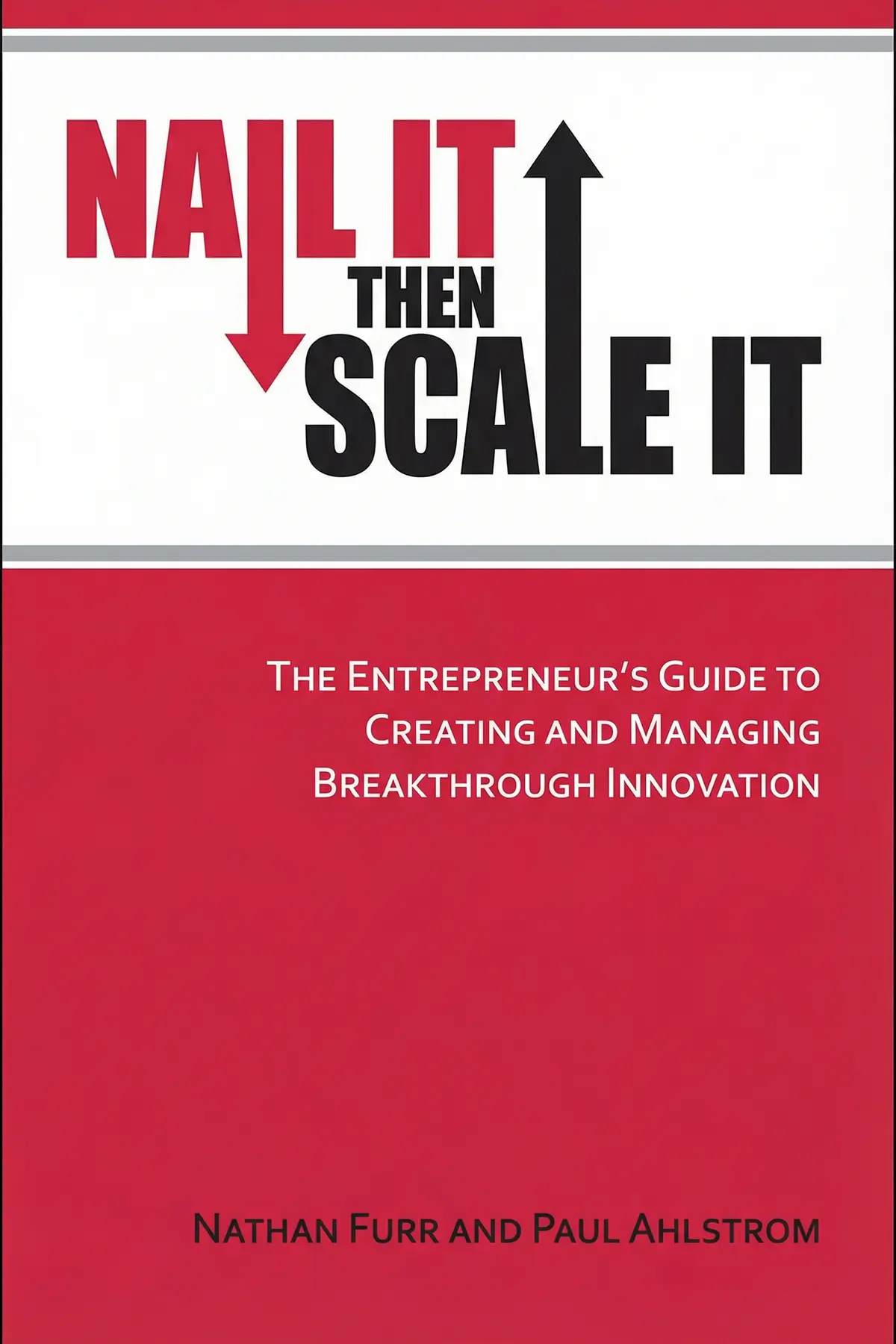
Table of Content
1. Introduction
1 min 48 sec
Imagine for a moment that you have just come up with a concept for a product that you are certain will change the world. You can see the sleek design, you can imagine the marketing campaign, and you are ready to pour every cent of your savings and every hour of your time into making it a reality. In the traditional world of business, this passion is often celebrated. We are told to move fast, break things, and scale as quickly as possible. But what if that very rush to grow is the reason so many brilliant ideas end up in the graveyard of failed startups?
This is the core challenge addressed in our summary of Nail It then Scale It. The reality of the entrepreneurial world is that passion, while necessary, is not a substitute for market validation. Many founders fall into the trap of building a solution for a problem that doesn’t exist, or at least one that customers aren’t willing to pay to solve. They focus on the ‘scale’ before they have ‘nailed’ the fundamental mechanics of their business. This leads to a tragic waste of capital, time, and talent.
Throughout this exploration, we are going to look at a different way to build. Instead of the ‘ready, fire, aim’ approach that characterizes so many failed ventures, we will look at a disciplined, step-by-step process for identifying real market needs and refining a product through direct interaction with the people who will actually use it. We will cover how to spot the ‘pain points’ that signal a lucrative opportunity, how to innovate by building on what already exists, and how to know when it is finally the right time to hand over the reins and grow your company into a global powerhouse. This journey isn’t about tempering your ambition; it’s about giving that ambition a solid foundation so it doesn’t crumble under its own weight.
2. The Perils of Excessive Capital and the Trap of the Perfect Idea
2 min 25 sec
Discover why having too much money can actually lead to a company’s downfall and why your best idea might be your greatest liability.
3. Finding Success by Addressing Customer Pain
2 min 32 sec
Learn how to turn daily annoyances into profitable business opportunities by focusing on the friction points in a customer’s life.
4. Innovation Through Iteration and Observation
2 min 26 sec
Explore why being the first to invent something isn’t as important as being the first to truly understand how to make it useful.
5. The Power of Targeted Marketing and Customer Intelligence
2 min 03 sec
Uncover how a deep understanding of your customers’ decision-making process can save a company from the brink of bankruptcy.
6. Validating the Strategy Before Building the Infrastructure
2 min 29 sec
Learn the vital difference between a business idea and a repeatable business model, and why one billion dollars wasn’t enough to save a flawed plan.
7. Navigating the Metamorphosis of Growth
2 min 20 sec
Discover why the founder’s biggest challenge during scaling is often their own ego and why slow growth is sometimes the fastest path to success.
8. Conclusion
1 min 32 sec
As we reach the end of this exploration of Nail It then Scale It, the overarching message should be clear: the path to entrepreneurial success is a marathon of validation, not a sprint of growth. The world of business is full of people who had great ideas but failed to build great companies. The difference usually lies in the willingness to be wrong early and often. By prioritizing the needs and ‘pains’ of the customer over your own initial vision, you create a product that the market actually demands. By innovating on existing inventions and observing the real-world habits of your users, you find the competitive edges that others miss. And by having the discipline to refine your business model before you pour money into scaling, you ensure that your growth is built on solid ground.
As a final piece of actionable advice, consider the power of A/B testing in your own ventures. You don’t have to guess what your customers want. Instead, use quantitative methods to let them tell you. Take two versions of a product or a feature—Version A and Version B—and present them to different segments of your audience. By measuring their reactions and satisfaction levels in a structured way, you move from the realm of opinion into the realm of data. This simple practice encapsulates the entire philosophy we’ve discussed: it is about testing, learning, and refining until you have ‘nailed’ the solution. Once you have that foundation, the sky is the limit for how far you can scale.
About this book
What is this book about?
The central premise of Nail It then Scale It is that most startups fail not because they have bad ideas, but because they focus on scaling before they have truly 'nailed' their business model. Authors Nathan Furr and Paul Ahlstrom argue that the traditional entrepreneurial path—raising capital, building a product, and then looking for customers—is fundamentally flawed. Instead, they propose a sequence that prioritizes deep customer discovery and rigorous validation. This guide promises to lead founders through a series of checkpoints: identifying a genuine customer 'pain' or problem, developing a solution that specifically addresses that pain, and testing the market's willingness to pay. Only after these elements are proven should a company invest in massive expansion. By following this disciplined approach, entrepreneurs can avoid the common pitfalls of over-capitalization and market irrelevance, turning innovation into a predictable process for creating high-growth, sustainable businesses.
Book Information
About the Author
Nathan Furr
Nathan Furr is an esteemed professor and dedicated researcher specializing in the field of entrepreneurship. His academic work is grounded in practical application, as he has been personally involved in the launching and advising of numerous companies. Paul Ahlstrom is a seasoned entrepreneur who has founded several successful businesses. Beyond his own ventures, he has leveraged his deep industry expertise to manage and invest hundreds of millions of dollars into various startup enterprises.
Ratings & Reviews
Ratings at a glance
What people think
Listeners consider this a mandatory business read, offering useful guidance and hands-on suggestions relevant to any industry. The writing is easy to follow and direct, providing in-depth breakdowns of the NISI method along with various illustrative cases. They value the high return on investment, highlighting its ability to conserve time and capital, while one listener reports that it turned their company into a successful enterprise.
Top reviews
Boss
This book is the missing manual for anyone tired of burning through cash on ideas that nobody actually wants. Frankly, the NISI process isn't just a set of suggestions; it's a rigorous framework that demands you validate your assumptions before you spend a dime on scaling. While some might find the tone a bit like an academic textbook, the real-world utility of the five stages—pain, solution, strategy, model, and scale—is undeniable for a modern entrepreneur. I found the section on nailing the customer pain to be particularly eye-opening because it forces you to stop being in love with your own solution. It’s about the market, not your ego. If you're serious about not becoming another startup statistic, this is worth every penny of the investment.
Show moreDivya
Finally got around to reading this and it completely transformed how I look at my current business model. In my experience, most business books are 200 pages of fluff surrounding a single good idea, but Furr and Ahlstrom provide a comprehensive roadmap that covers everything from market risk to the final scale-up. The authors are clearly experts who understand that luck is not a strategy. The language is a bit formal, which can make it a slow read during the later chapters on strategy, but the insights are gold. It’s a must-read for anyone who wants to build something that actually lasts. Stop guessing and start validating with this guide.
Show moreIsabelle
After hearing so much buzz about the NISI framework in VC circles, I decided to see if the hype was real. It is. This book is a fantastic read that blends customer development and lean principles into a clear, compelling narrative for any founder. The phrase 'start with the customer and work backwards' is echoed throughout, and the authors provide the tactical tools to actually make that happen. Got some really good bits out of the market strategy section that I hadn’t considered before. While it's a bit of an easier-read textbook, the practical tips on avoiding premature scaling are worth their weight in gold. Definitely a resource to keep close.
Show moreMia
I've been searching for a way to validate my new product idea without losing my mind, and this book provided the perfect framework. It really moves entrepreneurship into the world of facts and validity rather than just gut feelings and guessing. The examples included are great; they illustrate the principles well and help break the monotony of what can sometimes feel like a dry reading experience. I especially liked how it addresses the 'how' of testing a solution through the NISI process. Even if you aren't planning to start a massive corporation, the logic here can be applied to any project. It’s an essential resource that saved me months of potential frustration.
Show moreMoon
Picked this up after a mentor recommended it as a companion to Business Model Generation. Truth is, the formatting is a bit distracting at times, and some of the examples feel a little dated in the fast-moving tech world. However, the core philosophy of 'nailing it' before you ever think about 'scaling it' is timeless wisdom that too many founders ignore. It provides a very detailed explanation of how to actually test your theories rather than just guessing in a dark room. You’ll save months of wasted effort by following the checklists provided in these chapters. It’s a solid resource that I’ll likely keep on my desk for reference during my next venture's discovery phase.
Show moreAey
Not what I expected, but in a very good way. Look, I’ve read a dozen books on entrepreneurship this year, and this one stands out because it actually provides a repeatable process rather than just vague inspiration. The authors break down the NISI stages with such clarity that you can start applying the tips to your project immediately after finishing a chapter. I particularly appreciated the focus on customer pain points; it’s a simple concept that is shockingly hard to execute correctly without a structured approach. My only gripe is that the formatting makes it feel a bit like a self-published manual rather than a premium business book. Regardless, the value for money here is incredible.
Show moreTawee
Ever wonder why brilliant ideas often fail to gain any traction in the real world? This book answers that question by highlighting the difference between a great invention and a viable business. I gotta say, the focus on 'nailing' the business model before spending capital on growth is a lesson every founder needs to learn early on. The detailed explanations of tech and market risks were particularly helpful for my current SaaS project. It’s a straightforward guide that doesn’t sugarcoat the difficulty of the process. Even though some of the language is overly formal, the step-by-step nature of the NISI process makes it easy to follow. Truly a practical toolkit for the modern age.
Show morePang
Honestly, I wish I had read this three years ago before I wasted a fortune trying to scale my first failed startup. The authors provide a surefire method for testing ideas that removes the reliance on pure luck or brute-force hard work. By focusing on the five pillars—pain, solution, strategy, model, and scale—you gain a much clearer picture of where your gaps are. The book is very clearly written, although it does get a bit monotonous during the long explanations of market strategy. To be fair, the depth of knowledge here is superior to most 'lifestyle' business books you find on the bestseller lists today. It’s a mandatory addition to any entrepreneur's library.
Show moreBun
As someone who has been in the tech space for a decade, I found the core concepts here a bit redundant. Not gonna lie, if you’ve already read 'The Lean Startup' or 'The Four Steps to the Epiphany,' you might find yourself skimming through several repetitive sections. The writing style is very droll and feels like it was written for a classroom rather than a fast-paced office environment. To be fair, the examples are decent and they do a good job of illustrating why premature scaling is the primary killer of young companies. It’s an okay summary of popular ideas, but it lacks the 'how-to' depth I was hoping for in the creation phase. Good for beginners.
Show morePing
Why does a book with such valuable insights have to be so incredibly difficult to actually read? The formatting is genuinely distracting, with long-winded, repetitive explanations that could have been half as long without losing any of the core message. Personally, I found the authors' tone to be a bit condescending at points, as if they are the only ones who understand how markets work. They tell you to 'nail the solution' but the actual steps to create that solution feel a bit like 'draw the rest of the owl.' It’s not a complete waste of time because the five-step framework is logically sound, but I expected much better production quality for the price.
Show moreFeatured in
Readers also enjoyed
7 Powers: The Foundations of Business Strategy
Hamilton Helmer
Alibaba: The House That Jack Ma Built
Duncan Clark
Bad Blood: Secrets and Lies in a Silicon Valley Startup
John Carreyrou
AUDIO SUMMARY AVAILABLE
Listen to Nail It then Scale It in 15 minutes
Get the key ideas from Nail It then Scale It by Nathan Furr, plus 5,000+ more titles in English and Thai.
- 5,000+ titles
- Listen as much as you want
- 7-day free trial
- Cancel anytime







