Progress: Ten Reasons to Look Forward to the Future
Johan Norberg
Johan Norberg examines how the history of human success is inextricably linked to openness. By embracing trade, immigration, and the exchange of ideas, civilizations have consistently reached new heights of prosperity and innovation.
1 min 38 sec
Imagine for a moment the very first trade in human history. It might have been something as simple as one person offering a sharp stone tool in exchange for a handful of dried berries. At that moment, something revolutionary happened: both individuals walked away better off than they were before. This simple act of exchange is the foundation of everything we call civilization. In this exploration of Johan Norberg’s work, we are going to look at the grand arc of human history through the lens of openness.
The core argument here is that human progress isn’t a straight line dictated by geography or luck, but rather a result of how willing we are to interact with those outside our immediate circle. We are living in a time when the world feels increasingly divided, where borders are tightening and the fear of the ‘other’ is rising. But if we look back at the last 300,000 years, a clear pattern emerges. Every time we have opened our doors to new ideas, new people, and new ways of doing business, we have experienced an explosion of innovation and wealth.
We will journey from the savannahs where our ancestors first learned to cooperate, through the golden ages of Islamic science and Chinese technology, to the Dutch shipping empire that set the stage for the modern world. Along the way, we’ll investigate the biological instincts that sometimes make us want to shut those doors, and why giving in to that fear is the surest way to invite decline. The story of human progress is, at its heart, the story of how we learned to be open. By the end of this journey, you’ll see why our future depends on our ability to maintain that openness, even when the world feels most uncertain.
2 min 08 sec
Humans didn’t become the dominant species through raw strength alone, but through a unique ability to pool knowledge and labor.
2 min 11 sec
The birth of the city was not just about safety; it was about creating a concentrated hub for the cross-pollination of ideas.
2 min 10 sec
While Europe languished in the Dark Ages, other regions flourished by keeping the doors of intellectual exchange wide open.
1 min 47 sec
Small and resource-poor, the Dutch Republic became a world power by becoming the most tolerant and immigrant-friendly nation on Earth.
1 min 53 sec
Contrary to common belief, global trade is not a game with winners and losers, but a system that expands wealth for everyone.
2 min 04 sec
Our ancient survival instincts often clash with the requirements of a modern, open society, leading to a fear of ‘the other.’
2 min 10 sec
Authoritarianism appeals to our desire for order, but its need for control is the ultimate enemy of the trial-and-error process of progress.
1 min 49 sec
While new technologies like the internet often cause temporary job displacement, they ultimately create far more opportunities than they destroy.
1 min 51 sec
The existential threats of our time, from climate change to pandemics, require a global sharing of knowledge that only openness can provide.
1 min 40 sec
As we reach the end of this journey through the history of human progress, the central theme is clearer than ever: openness is not just an economic policy or a political preference—it is the very engine of our evolution. From the moment our ancestors first threw stones together on the savannah to the interconnected digital world we inhabit today, our greatest leaps forward have happened when we chose to cooperate across boundaries.
We have seen that wealth and innovation don’t come from hoarding resources, but from sharing them. We’ve seen that the most prosperous societies in history, like the Dutch Republic or the Islamic Golden Age, were those that welcomed the ‘other’ and allowed for the free collision of ideas. And we’ve seen the heavy price paid by civilizations that turned inward, succumbing to the primal fear of outsiders and the false promise of the strongman.
The challenges we face today are immense, but the historical record gives us reason for hope. We are a species that thrives on connection. The instinct to close our doors may be part of our biological hardware, but our capacity for reason and our history of success through openness are our most powerful software. The next chapter of the human story is currently being written. It will be defined by whether we choose to retreat into the safety of the known or continue the brave experiment of looking outward. Human progress is a choice. By choosing to stay open, we ensure that our best days are still ahead of us. Let this be the throughline for your own thinking: in a world that often asks you to pick a side and build a wall, remember that the most successful path in history has always been to build a bridge.
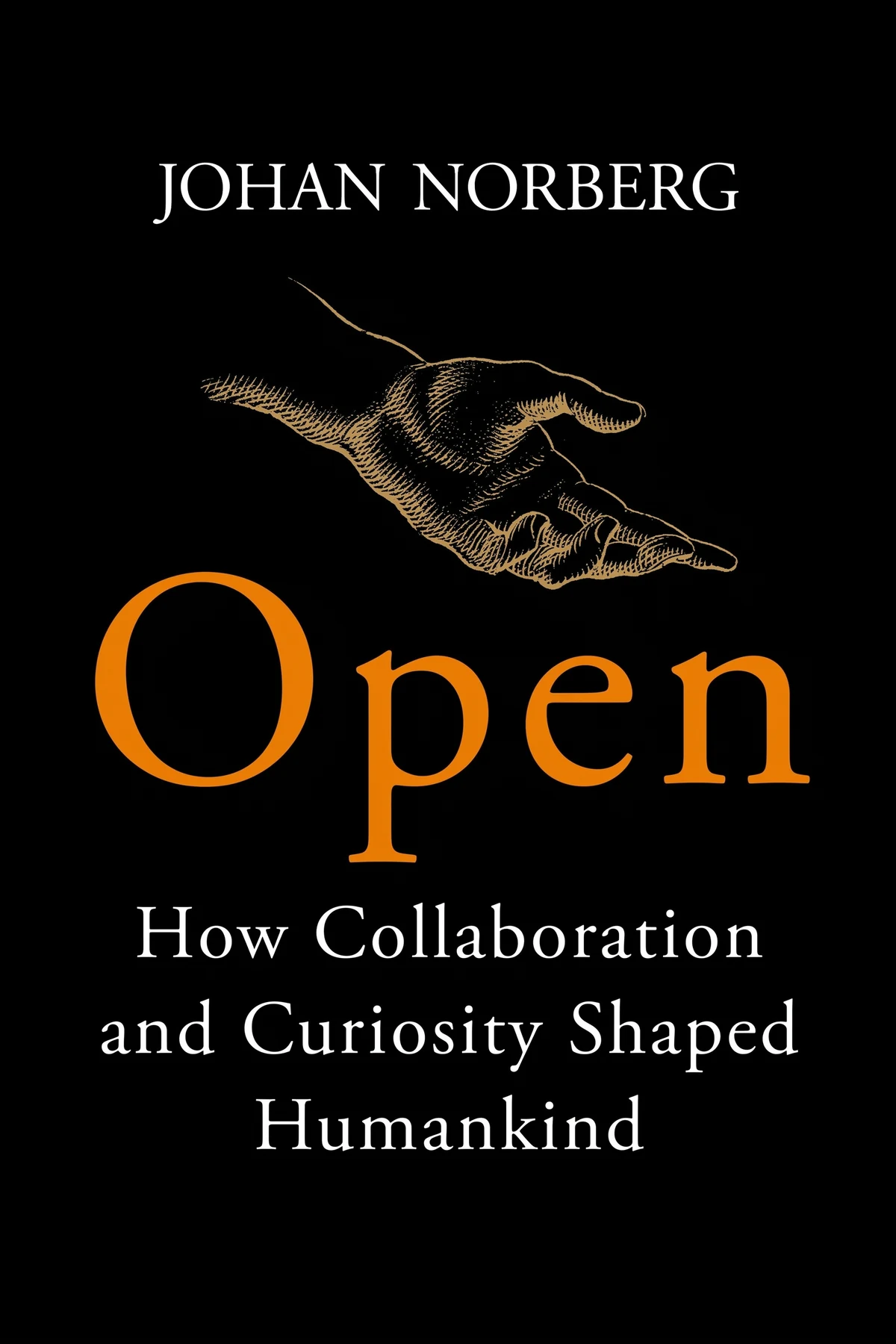
Throughout history, humanity has faced a recurring choice between closing off or opening up to the world. Open by Johan Norberg argues that our greatest achievements—from ancient Mesopotamia to the modern digital age—have always been the result of collaboration and the free flow of information. The book traces the rise and fall of empires, demonstrating that when societies embrace diversity and free trade, they flourish. Conversely, when they retreat into tribalism, protectionism, and authoritarianism, they inevitably stagnate. Norberg explores the evolutionary roots of our cooperative nature, showing how our ancestors used teamwork to survive and eventually thrive. He also delves into the psychological barriers that make us fear the unknown, explaining why we often lean toward 'closed' systems during times of crisis. Ultimately, the book offers a powerful defense of globalization and open society, suggesting that the solutions to today's most pressing challenges, such as climate change and economic instability, can only be found through more connection, not less.
Johan Norberg is a celebrated Swedish writer and speaker who serves as a senior fellow at the Cato Institute in Washington, D.C. His work frequently appears in major publications like the Wall Street Journal and HuffPost. Norberg’s previous book, Progress: Ten Reasons to Look Forward to the Future, was recognized as the Economist’s book of the year in 2016.
Listeners find the book to be thought-provoking, characterizing it as a manifesto for openness. They also value its high level of readability, with one listener describing the text as compelling.
Picked this up after reading 'Progress' and it's a stellar follow-up that explains why humanity thrives when we don't build walls. Norberg has this incredible ability to make complex historical shifts feel like a fast-paced narrative. The way he connects the Phoenician trade routes to modern economic success is nothing short of brilliant. Truth be told, I was worried it would be a dry academic slog, but it's actually an eminently readable defense of liberal society. He moves effortlessly from the Song Dynasty's innovation to the zero-sum fallacies of the modern era. While some might find his optimism naive, I found it to be a necessary sunshine story in a world that feels increasingly closed off. It's a compelling manifesto for anyone who believes that human ingenuity is our greatest resource. Highly recommended for history buffs and optimists alike.
Show moreThis book is essentially a manifesto for the modern era, reminding us that globalization isn't the enemy we’ve been told it is. Norberg’s writing is punchy and his research is deep, covering everything from hunter-gatherer evolution to the Dutch Republic. I was particularly struck by the 'Us and Them' section which explains how our tribal brains are easily manipulated by zero-sum thinking. It’s a bit of a reality check. We often think our current problems are unique, but the author shows how the same 'anticipatory anxiety' has plagued every major period of progress. Personally, I found the section on 'Open Minds' and the Republic of Letters to be the most inspiring part of the whole work. It’s a thick book, but it moves quickly because the prose is so clear. This is the kind of reading we need to combat the xenophobia popping up in today's politics.
Show moreTruth is, we live in an era of defensive crouches, and Norberg provides the perfect intellectual antidote. He describes these major episodes of progress called 'efflorescences' and shows how they are almost always cut short by people who fear change. Whether it's religious elites or workers with outmoded skills, the resistance to the 'new' is a constant in human history. I loved the section on 'Open Doors' and how immigration has historically been a engine for growth rather than a threat. He uses the American melting pot and the Mongols as examples to show how diversity leads to strength. The writing style is very accessible, almost like a long-form magazine article but with the depth of a scholarly text. It’s a solskenshistoria—a sunshine story—that we desperately need. If you're feeling pessimistic about the state of the world, give this a read. It will change your perspective on where we are headed.
Show moreAfter hearing Norberg on a podcast, I had to see if his writing was as compelling as his speaking, and I wasn't disappointed. This book is a tour de force of historical optimism. He manages to weave together evolutionary biology, behavioral economics, and ancient history into a single, cohesive argument for the open society. I found the section on 'Anticipatory Anxiety' to be particularly relevant to our current political climate. We are constantly told to be afraid of the future, but Norberg shows that innovation always faces resistance from those who stand to lose. The prose is elegant and the chapters are structured in a way that makes it easy to digest. It’s a refreshing change from the usual doom-and-gloom non-fiction. This is a book that celebrates human potential and the incredible things we can achieve when we simply stay open to new ideas.
Show moreAs someone who identifies as fairly left-wing, I didn’t expect to enjoy this as much as I did. In my experience, Cato Institute fellows can be a bit dogmatic, and Norberg’s gushing praise for Uber mowing down regulations made me roll my eyes. Never take down a fence until you know why it was put up, right? However, the author is an incredibly compelling writer and his central thesis about openness is hard to argue with. The way he traces progress through the lens of trade and immigration is masterfully done. I particularly liked the sections on how empires like the Persians succeeded by absorbing diverse traditions rather than crushing them. It’s a thought-provoking manifesto that challenged my cynicism about globalization. Even if you disagree with his libertarian methods, the historical survey of human achievement is well worth your time.
Show moreEver wonder why certain civilizations just suddenly stop innovating and start to decay? Norberg argues it’s the shift from openness to tribalism, and he uses some fascinating historical examples to prove it. The chapter on the Song Dynasty was a real eye-opener for me regarding how inward-turning policies can kill a golden age. To be fair, he definitely has a specific political agenda, and his belief that liberal capitalism is the 'pinnacle' of systems with no contradictions feels a bit much. Markets have real failures, like environmental degradation, that a few entrepreneurs can't just 'innovate' away. But despite those gripes, the book is varied and thoughtful. It’s one of those rare texts that makes you look at the evening news through a much longer historical lens. Sentence for sentence, it’s one of the most engaging non-fiction books I’ve picked up this year.
Show moreThe chapter on 'Us and Them' is worth the price of admission alone for how it breaks down modern identity politics. Norberg argues that we are hard-wired for tribalism, yet our greatest achievements only happen when we overcome those instincts. It’s a fascinating tension. The book is well-supported with historical data, tracing the 'efflorescences' of growth that occur when societies stop being afraid of the 'other.' I did find his take on the 'physical fallacy'—the idea that value only comes from manufacturing—to be particularly insightful for our digital age. My only real complaint is that he seems to think liberal capitalism is perfect. He literally writes that we can't produce a system with fewer contradictions, which is a pretty bold claim to make. Regardless of your politics, the historical anecdotes are varied and keep the pages turning. It’s a thoughtful, readable, and timely contribution to the global conversation.
Show moreFinally got around to reading this and the historical breadth is genuinely impressive. Norberg takes us from the ancient Greeks to the Industrial Revolution to explain why some societies flourish while others stagnate. The book's argument is well-supported: periods of openness lead to human achievement, while periods of conservatism and xenophobia lead to regression. I especially appreciated his take on 'cultural appropriation,' arguing that it's actually a form of openness that drives innovation. Gotta say, he has a lot more faith in small-scale entrepreneurial experimentation than I do, especially regarding climate change. He seems to think a carbon tax and 'openness' will solve everything. Despite that libertarian tilt, the book remains a thought-provoking and incredibly readable piece of work. It’s a great reminder that the 'good old days' weren't actually that good. We are better off when we are connected.
Show moreNot what I expected, though I did eventually finish it after a few stops and starts. Got about halfway through and realized the central message is basically just 'openness is good' repeated in different historical contexts. Don't get me wrong, Norberg is a talented historian, and his examples of the Roman and Ottoman empires are interesting. But after a while, the libertarian drumbeat gets a little repetitive. To be fair, the second half of the book on tribalism and identity politics is much stronger than the first. He has some really sharp insights into how social media amplifies our 'us versus them' instincts. Still, I felt like he glossed over the darker sides of the free market, like how 'openness' can sometimes lead to wealth concentration. It’s a decent read, but it didn't quite live up to the hype for me.
Show moreLook, I tried to keep an open mind, but the neoliberal bias here is just too thick to ignore. Norberg is a historian, but his Cato Institute roots show through in every chapter where he deifies the free market at the expense of everything else. He makes this bizarre claim on page 363 that it is not possible to produce a system with fewer internal contradictions than liberal democratic capitalism. That's a massive leap of faith that ignores environmental collapse and the atomization of labor. While the historical examples about the Phoenicians are occasionally interesting, the underlying 'all regulation is a wall' narrative feels incredibly one-sided. He gushes about Uber while ignoring the precariousness it creates for workers. It’s an easy read, sure, but it’s essentially a long defense of a very specific political agenda that hasn't worked for everyone. Not for me.
Show more

Yanis Varoufakis

Ben Macintyre

AUDIO SUMMARY AVAILABLE
Get the key ideas from Open by Johan Norberg, plus 5,000+ more titles in English and Thai.