

59 Seconds: Change Your Life in Under a Minute
Richard Wiseman
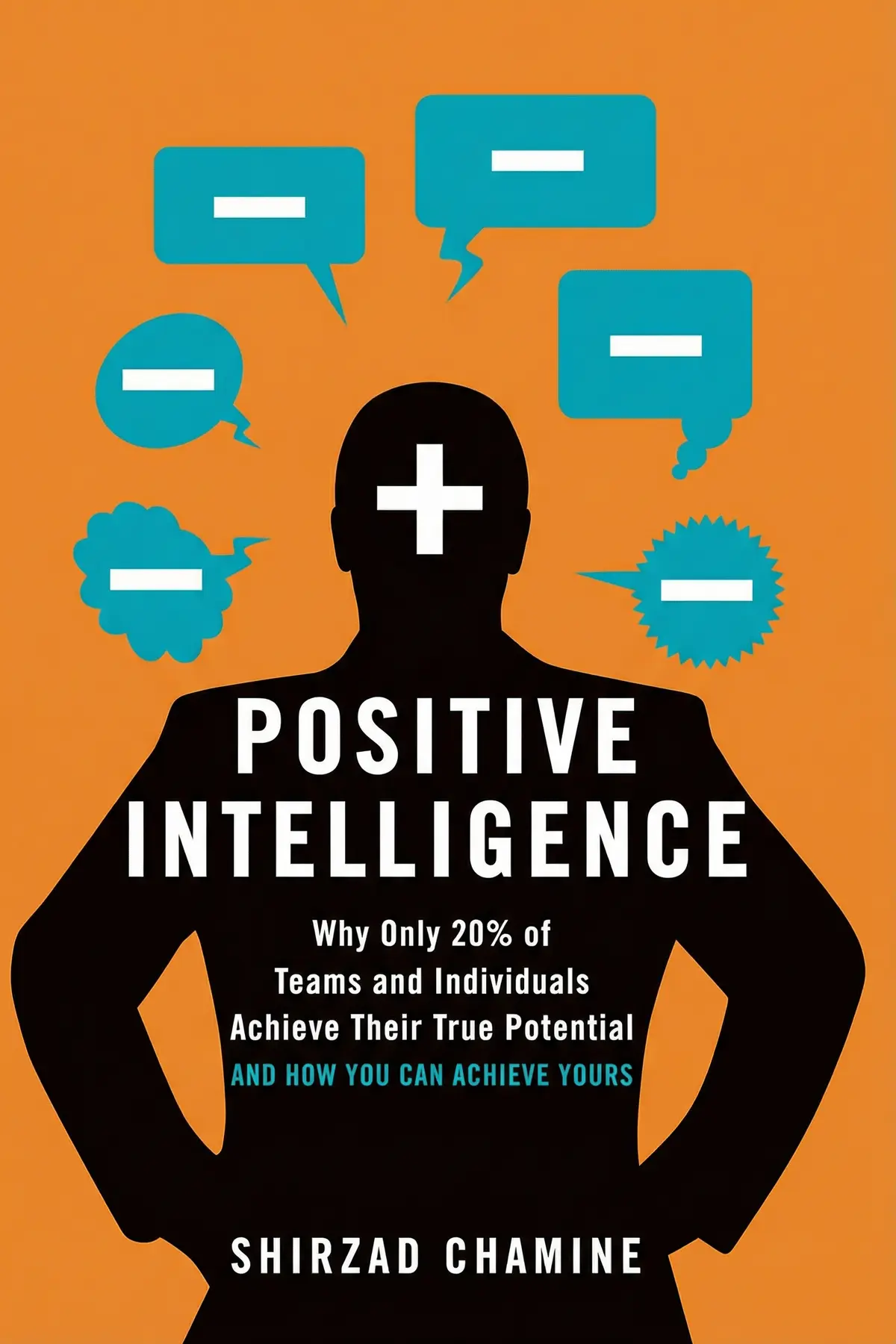
Positive Intelligence reveals how to silence internal critics and harness mental strength. By identifying Saboteurs and strengthening the Sage mindset, individuals and teams can unlock their full potential and achieve lasting happiness.
1 min 36 sec
Imagine your mind is a high-performance vehicle. For most of us, we spend our lives driving with one foot on the gas and the other firmly on the brake. We have the talent, the ambition, and the opportunities, yet we find ourselves stalled by self-doubt, anxiety, and a persistent sense of dissatisfaction. This internal friction isn’t just a character flaw; it is a measurable psychological state. In this exploration of Shirzad Chamine’s work, we are going to look at the concept of Positive Intelligence, or PQ.
PQ represents the percentage of time your mind is working in your favor. It’s the ratio of your internal friend to your internal foe. Most of the time, our brains are cluttered with voices that tell us we aren’t good enough, that the world is dangerous, or that we must be perfect to be loved. These are the Saboteurs. But there is another side to our mental architecture: the Sage. The Sage is the part of you that remains calm, clear-headed, and creative even in the face of a storm.
The journey we’re about to take focuses on three core pillars: weakening your Saboteurs, strengthening your Sage, and building your mental muscles through consistent practice. By the end of this summary, you’ll understand how to identify the specific mental habits that are holding you back and, more importantly, how to shift your brain’s chemistry to favor resilience and joy over stress and reaction. This isn’t just about feeling better; it’s about a fundamental shift in how you experience every moment of your life and how you interact with the people around you. Let’s dive into the mechanics of your mind and discover how to turn it into your greatest asset.
1 min 59 sec
Discover the biological roots of your internal conflict and why your brain’s survival instincts might be the very thing stopping you from succeeding in the modern world.
2 min 17 sec
Identify the specific mental villains that create stress and learn why ‘The Judge’ is the most dangerous ringleader of all.
2 min 20 sec
Learn how to access a deeper level of wisdom and clear-headed action by tapping into the Sage’s unique mental toolkit.
1 min 51 sec
Discover the simple 10-second exercise that can physically rewire your brain for higher intelligence and lower stress.
1 min 59 sec
See how raising your PQ can transform your professional life and your closest personal bonds into sources of strength.
1 min 13 sec
As we wrap up our journey through Positive Intelligence, the most important takeaway is that your mental state is not fixed. You are not destined to be a victim of your anxieties or your Judge. You have the biological and psychological tools to rewrite the script of your life. The path to your true potential is found in that thin margin of time where you choose to silence a Saboteur and listen to your Sage instead.
By identifying your primary Saboteurs, you take away their invisibility, which is their greatest weapon. By practicing your PQ reps, you build the physical neural pathways necessary for resilience. And by leaning into the five powers of the Sage, you transform every challenge into a stepping stone for growth.
Remember the 75% threshold. When your mind is working for you three-quarters of the time, you cross a tipping point where success and happiness become the norm rather than the exception. Start today. Name your Judge. Take ten seconds to feel the air on your skin or the weight of your body in your chair. These small, consistent steps are the building blocks of a life lived with clarity, purpose, and joy. You have the power to make your mind your best friend—and when you do, everything else begins to fall into place.
Have you ever wondered why talented, hard-working people often fall short of their potential or find themselves perpetually unhappy despite their success? Positive Intelligence addresses this paradox by exploring the internal battleground of the human mind. The book introduces the concept of PQ, or the Positive Intelligence Quotient, which measures the percentage of time your mind acts as your ally rather than your enemy. Through a combination of neuroscience, psychology, and performance science, the author demonstrates that our brains are often hijacked by 'Saboteurs'—entrenched mental habits like the Judge, the Controller, or the Avoider—that served us during childhood but now hinder our progress. The promise of this book is a practical framework to weaken these negative influences while strengthening the 'Sage' within. By engaging in simple, repeatable mental exercises, you can rewire your brain to handle challenges with less stress and more clarity. Whether you are leading a Fortune 500 company, navigating a difficult relationship, or simply seeking personal peace, this guide offers a roadmap to mental fitness and peak performance.
Shirzad Chamine is the former CEO of the world’s largest coach-training organization. He has trained managers and coaches in many of the Fortune 500 companies, as well as faculty at Yale and Stanford business schools. This is his first book.
Listeners find this book accessible and clear, viewing it as a necessary read for all. They praise the pragmatic strategy, with one listener remarking that it can be put to use in daily life right away. The text delivers deep perspectives on behavior and growth, enabling people to hit their milestones and better themselves. Listeners prize its transformative nature, as one noted it helped them pause and evaluate their past. It efficiently aids in stilling the mind and minimizing tension.
This book completely shifted my perspective on why I self-sabotage so frequently. I have always been my own harshest critic, but seeing that inner voice labeled as a 'Judge' helped me distance myself from those toxic thoughts. The concept of the 'Sage'—the part of us that handles challenges with empathy and curiosity—is a game-changer for anyone struggling with chronic stress. I particularly identified with the 'Hyper-Achiever' and 'Pleaser' saboteurs, which have dominated my career for years. The writing is accessible, and the advice is immediately applicable to daily life. I’ve noticed a significant drop in my anxiety since I started practicing the PQ reps, which are essentially micro-meditations you can do anywhere. It is rare to find a personal development book that is this practical. This is a must-read for anyone who feels stuck in their own head.
Show moreAs someone who has spent years in the corporate world, I’ve read my fair share of leadership books, but this one stands out for its clarity and ROI. Chamine distills complicated interpersonal dynamics into a framework that actually makes sense for teams. We often talk about 'soft skills,' but this book treats mental fitness as a hard metric that impacts the bottom line. The idea that we have 'mental muscles' that need regular exercise is a brilliant metaphor. I’ve started implementing the 10-second PQ reps before big meetings, and the difference in my focus is palpable. It helps me move from a place of judgment to a place of curiosity. The book is well-organized and provides a clear roadmap for personal growth. I’ve recommended it to several colleagues who are now seeing similar improvements in their stress levels and performance.
Show moreAfter hearing about Positive Intelligence on a podcast, I started practicing the techniques to manage my chronic stress and I am genuinely impressed. The author’s personal story about his own 'Judge' was moving and made the concepts feel very relatable. I’ve been doing the PQ exercises for three weeks now, and I can actually feel my brain shifting gears when I get triggered. I’m sleeping better and my blood pressure has actually gone down according to my last checkup. The 'Restless' and 'Victim' saboteurs were my biggest hurdles, but the book gave me the tools to catch them before they spiraled. It’s a very empowering read. It teaches you that you have a choice in how you respond to life’s challenges. I wish I had discovered this framework ten years ago; it would have saved me so much unnecessary heartache.
Show moreFinally got around to reading this and it’s arguably the most practical guide to mental fitness I’ve ever encountered. The concept of 'Positive Intelligence' as a quotient (PQ) that you can actually improve is brilliant. I loved the breakdown of the Sage powers versus the Saboteurs’ survivor brain. It explained so much about why I react the way I do under pressure. The 'Hyper-Rational' description was a mirror of my own worst habits, especially in how I distance myself from emotions. Chamine’s writing is clear and the exercises are short enough that even the busiest person can’t make excuses. It’s about building new neural pathways through consistent, tiny actions. This book doesn't just tell you to 'be positive'; it shows you exactly how to do the work. I’m already seeing a difference in my relationships and my overall sense of peace.
Show morePicked this up on a recommendation from my manager and found the 'PQ reps' surprisingly easy to integrate into a busy workday. The premise is simple: our minds are often our own worst enemies, and we need to train our mental muscles to shift from negative to positive responses. I love how the book breaks down the 10 Saboteurs, like the 'Controller' and the 'Avoider,' which makes it easier to spot them in real-time. My only gripe is that the terminology gets a bit jargon-y at times, and some of the stories feel a little too perfect. However, the core exercises are undeniably effective for grounding yourself during high-pressure situations. It’s a great tool for leadership development. I’ve already started using the assessment with my team to improve our communication and reduce friction. Definitely worth a read for the actionable strategies.
Show moreEver wonder if complex psychological issues can really be boiled down to ten little 'saboteurs'? While the framing is definitely simplistic, the effectiveness of the 'Yes, and...' exercise and the focus on the 'Sage' powers cannot be ignored. The book helps you realize that your inner chatter isn't actually 'you,' which provides a much-needed sense of relief. I found the 'Stickler' description particularly illuminating for my own habits. Even if the 'neuroscience' claims are a bit overblown, the mindfulness techniques are solid and rooted in established psychological principles. It’s an easy read, though it does get repetitive toward the middle chapters. I appreciated the concrete steps for quieting the mind. It’s not a magic cure, but it is a very useful manual for anyone looking to improve their mental well-being and productivity.
Show moreWow, the descriptions of the 'Avoider' and 'Hyper-Vigilant' types were so spot-on it felt like the author was reading my mind. I’ve always known I had these tendencies, but giving them a name took away their power over me. The book is a bit repetitive, and the 'New-Agey' lingo might turn some people off, but the results are hard to argue with. It’s essentially a modernized, more structured version of mindfulness meditation tailored for the business world. I appreciated the focus on the 'Sage' powers—Empathize, Explore, Innovate, Navigate, and Activate. These provide a great framework for problem-solving without the usual emotional baggage. While I wish there were more rigorous citations for the data mentioned, the practical impact on my daily happiness has been undeniable. It’s a solid resource for anyone looking to tame their inner critic.
Show moreIn my experience, most self-help books are 90% fluff, but this one actually gives you a workout plan for your brain. The truth is, the concepts aren't entirely new—it's mostly rebranding the inner critic and mindfulness—but the way it's packaged makes it much easier to execute. The assessment on the website is a great starting point to identify your primary saboteurs. I was surprised to find 'The Controller' at the top of my list, but once I saw it, I couldn't unsee it. The book is written in a very encouraging tone and is easy to digest. My only complaint is that it can feel a bit like an advertisement for the author's more expensive coaching pods. Regardless, the book itself contains enough information to start making changes on your own. It’s a practical guide for anyone wanting to quiet their mind.
Show moreBefore buying into the hype, I decided to look deeper into the author's scientific claims, and what I found was frankly disappointing. To be fair, Shirzad Chamine presents some interesting ideas about mental fitness, but the "neuroscience" branding feels like a total stretch. He is marketed as a neuroscientist, yet his background is actually in Electrical Engineering and Business, with only a brief stint in a PhD program he never completed. The book repeatedly cites groundbreaking research that simply doesn't exist in peer-reviewed journals. While I appreciated the descriptions of the 'Judge' and 'Saboteur' archetypes, it’s hard to trust a system built on such a shaky foundation of academic forgery. The prose is repetitive, and the constant upselling of his program left a bad taste in my mouth. If you can ignore the fake credentials, there might be some value here, but stay skeptical.
Show moreLook, the content in this book isn't necessarily harmful, but I cannot stand the intellectual dishonesty presented by the author. He claims his program is based on research with 500,000 participants, yet this data is nowhere to be found in any scientific database. Even more egregious is the way he misrepresents actual studies. For instance, he references Robert Zajonc’s work on facial muscles to claim that 'fake positivity' causes coronary heart disease, which is a total fabrication of the original study’s conclusion. The book is filled with these kinds of pseudoscientific leaps. He tries to dress up basic meditation as 'PQ Brain' technology to sell a coaching program. If you want real mindfulness, read Eckhart Tolle or Jon Kabat-Zinn instead. Don’t waste your money on a businessman pretending to be a neuroscientist through a veil of small forgeries and made-up jargon. It’s irresponsible.
Show moreRichard Wiseman


William B. Irvine
Andrew D. Thompson

Deepak Chopra
AUDIO SUMMARY AVAILABLE
Get the key ideas from Positive Intelligence by Shirzad Chamine, plus 5,000+ more titles in English and Thai.







