

20 min 19 sec
Simply Complexity: A Clear Guide to Complexity Theory
Explore the hidden patterns governing our world, from financial market crashes to the dynamics of dating. This guide demystifies complexity science, showing how collective interactions shape everything from traffic to warfare.
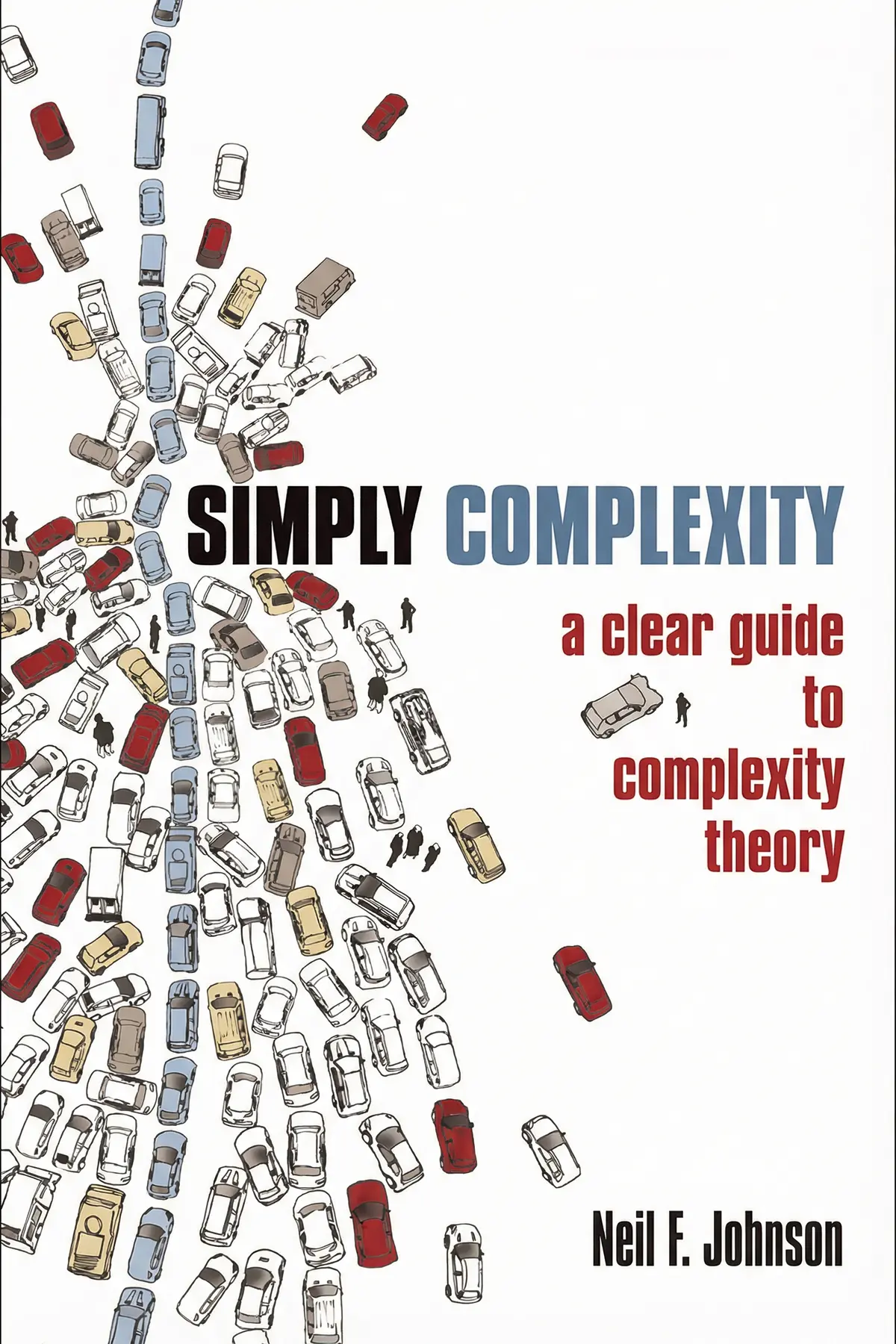
Table of Content
1. Introduction
1 min 43 sec
Every day, we find ourselves caught in the middle of systems that seem far too big and chaotic to understand. We see a sudden crash in the stock market that wipes out billions, a traffic jam that forms on a clear highway for no apparent reason, or a viral outbreak that leaps across continents in a matter of weeks. In the face of these events, traditional science often takes a reductionist approach. It tries to zoom in closer and closer, looking at the smallest possible components to find an answer. But what if the answer isn’t found in the individual parts? What if the most important thing is the way those parts dance together?
This is the core premise of complexity science. Instead of looking at a single person, a single cell, or a single car, it looks at the collection. It seeks to understand how universal patterns emerge when many different things interact. It’s a shift from looking at the ‘what’ to looking at the ‘how.’ By studying these interactions, we can find hidden connections between seemingly unrelated fields, like how a forest fire might behave similarly to a rumor spreading through a high school or how a tumor grows like a city expanding its borders.
In this journey, we are going to explore the throughline of collective behavior. We will look at why your individual personality might not matter as much as you think when you’re in a crowd, and why the most ‘sophisticated’ dating preferences don’t actually make it harder to find love. We will also see how the architecture of networks can be the difference between life and death in a medical setting. By the end of this discussion, you’ll have a new framework for understanding the messy, beautiful, and often predictable chaos of the world around us.
2. Defining Complexity through Collective Interaction
2 min 17 sec
What do a crowded financial market and a growing tumor have in common? The answer lies in how separate entities compete for the same limited resources.
3. Self-Organization and the Power of Feedback
2 min 06 sec
Discover how systems can seemingly ‘think’ for themselves, creating order and disorder without any central leader or master plan.
4. The Crucial Difference Between Complexity and Chaos
2 min 11 sec
While they are often used as synonyms, complexity and chaos are distinct concepts that represent different types of systemic behavior.
5. Why Individual Identity Fades in a Group
2 min 11 sec
In large populations, our unique personalities often matter less than we think, as group dynamics tend to normalize human behavior.
6. The Life-Saving Potential of Network Science
2 min 03 sec
By mapping the links between ‘nodes,’ we can better understand how everything from nutrients to deadly viruses moves through a population.
7. The Flaws of Traditional Market Predictions
2 min 00 sec
Standard financial models often treat price changes like coin flips, failing to account for the complex human interactions that trigger crashes.
8. The Complex Dynamics of Modern Dating
1 min 55 sec
Finding a soulmate is a classic example of competing for limited resources, but the math shows that being picky isn’t as bad as it seems.
9. Uncovering Universal Patterns in Warfare
2 min 06 sec
Conflict may seem like the ultimate form of chaos, but data reveals that different wars often follow remarkably similar mathematical patterns.
10. Conclusion
1 min 47 sec
We began this exploration by looking at the world as a series of disconnected, chaotic events, but complexity science has shown us that there is a deep, underlying order to the mess. Whether we are talking about the flow of traffic on a busy morning, the way a virus weaves through a population, or the sudden fluctuations of the stock market, we are seeing the same principles at work. It is a world driven by collective interaction, where the whole is always greater—and different—than the sum of its parts.
The throughline of this journey is that we are all ‘agents’ in various systems, and our actions, fueled by feedback, create the very reality we live in. We’ve learned that our individual differences often fade into the background when we join a crowd, and that the architecture of our networks can determine our health and safety. We’ve also seen that even in the most human of endeavors—like dating or warfare—there are universal patterns that transcend culture and history.
As you move forward, keep these insights in mind. In your financial life, remember that following the crowd and using the same models as everyone else can actually create the very instability you’re trying to avoid. In your personal life, don’t fear your own complexity or high standards; the system is vast enough to accommodate you. Most importantly, start looking for the connections. When you see a pattern in one area of your life, ask yourself if it might be a reflection of a larger, universal rule. Complexity science isn’t just a set of equations; it’s a new way of seeing, a way to find clarity in a world that often feels overwhelmingly complicated.
About this book
What is this book about?
Have you ever wondered why traffic jams appear out of nowhere or why financial markets suddenly collapse? These events aren't just random bad luck; they are the result of complex systems in action. This summary dives into the world of complexity science to explain how individual actors—whether they are drivers, stock traders, or even cancer cells—interact to create large-scale phenomena. It moves beyond traditional science, which often tries to understand the world by breaking it down into tiny pieces, and instead looks at the big picture of collective behavior. The promise of this exploration is a new lens through which to view your life and the world around you. You will discover how feedback loops drive change, why group behavior often cancels out individual quirks, and how understanding networks can actually save lives. From the secrets of finding a romantic partner to the predictable patterns found in modern warfare, you will see that the most complicated aspects of our existence often follow universal rules that we are only just beginning to decode.
Book Information
About the Author
Neil F. Johnson
Neil F. Johnson is a distinguished figure in the scientific community, currently serving as the head of the Complexity research group at the University of Miami in Florida. Before this role, he shared his expertise as a professor of physics at Oxford University. Throughout his career, Johnson has dedicated his research to examining a diverse array of real-world complex systems. He is the author of several influential works in the field, including Two’s Company, Three is Complexity and Financial Market Complexity, cementing his reputation as a leading voice in the study of collective behavior.
Ratings & Reviews
Ratings at a glance
What people think
Listeners find the text exceptionally clear and simple to follow, acting as a quality primer on complexity theory. Additionally, the content is quite educational, with one listener noting it addresses a broad array of subjects, and listeners value the engineering-centered perspective. However, the prose style draws varied feedback, as several listeners find the writing lackluster. Furthermore, one listener highlights that the book is free of complicated equations, making it accessible.
Top reviews
Thitiwan
Ever wonder why the stock market crashes or why traffic suddenly stops for no apparent reason? This book is a revelation because it connects the dots between seemingly unrelated phenomena using the lens of complexity science. Johnson’s approach is incredibly informative, covering a massive range of topics like the El Farol bar problem and the dynamics of modern warfare. It’s written with such clarity that you don't need an engineering degree to grasp the fundamental patterns he describes. Personally, I found the discussion on 'infobesity' and our digital habits to be a timely addition to the core science. It’s rare to find a science book that feels this applicable to daily life. Highly recommended for anyone wanting to see the 'hidden' order in our chaotic world; it truly changes your perspective.
Show moreRapee
This book should be mandatory reading for students entering any field related to systems or social research. Neil Johnson writes with a level of clarity that is truly refreshing in the world of academic science. He manages to depict the intuition behind complex systems so well that even someone without a technical background can follow along. The way he moves from the micro-level of individual decisions to the macro-level of global markets is nothing short of brilliant. I especially loved the focus on 'soft skills' and human connection in an age of information overload and infobesity. It’s a foundational text that will likely be cited for years to come. If you want to understand why simple solutions often fail in a complex world, start right here. It is wonderful.
Show moreTeng
A highly lucid explication of a topic that usually makes people’s heads spin. Johnson has a gift for making the invisible patterns of our lives visible. From the way we choose a date to the way a market crashes, he shows that there is a common thread of complexity running through everything. The book is free of the heavy equations that usually bog down these types of titles, making it accessible to a much broader audience. I found the graphics to be a huge help in visualizing how feedback loops and tipping points work in real-time. It’s a wonderful read that provides a much-needed Knowledge Dashboard for navigating our increasingly complex society. Truly an enlightening perspective on the modern world that I will be recommending to my colleagues.
Show moreTim
Neil Johnson has managed a rare feat: explaining complexity theory without drowning the reader in a sea of impenetrable equations. As someone who usually shies away from hardcore physics, I appreciated how the author focused on the 'soft' side of systems. He looks at everything from dating patterns to the way wars break out, showing that these aren't just random events. The graphics are helpful and keep the momentum going when the concepts get abstract. Truth is, it’s a perfect primer for a beginner. It might be a bit too basic for a math PhD, but for the rest of us, it’s a lucid window into how the world actually functions. I particularly enjoyed the section on social networks and how information flows through them in a non-linear fashion.
Show moreIsaiah
Finally got around to reading this, and it’s easily one of the most accessible science books on my shelf. Johnson takes an engineering approach that makes the abstract nature of complexity feel tangible and real. By stripping away the complicated equations, he allows the reader to focus on the underlying logic of how networks and markets evolve. I found the segments on war and social order particularly enlightening, as they challenge the idea that these systems are predictable or simple. Some might find the tone a bit too casual, but in my experience, that’s exactly what makes it such a great primer. It’s informative without being exhausting, which is a difficult balance to strike. A few more deep dives into the math would have been nice, but it's a minor complaint.
Show moreBella
The content itself is fascinating, yet I struggled with the author's prose throughout most of the chapters. There is no denying that Johnson knows his stuff, and his ability to explain complex systems through an engineering lens is commendable. However, the writing style is a bit of a mixed bag; it frequently feels disorganized or like a 'pre-book' that hasn't quite found its hook yet. I liked the examples regarding financial markets and dating, but the transitions between these topics felt jarring at times. Not gonna lie, I almost put it down halfway through because of the repetition of certain analogies. If you can get past the clunky delivery, there is a wealth of knowledge here about how small changes lead to massive shifts. It’s a solid effort that serves its purpose.
Show moreRoongsak
As someone who is just starting to explore complexity science, this was a helpful, if slightly flawed, jumping-off point. The book covers a wide range of topics, which is great for a bird’s-eye view, but it often sacrifices depth for breadth. I appreciated the lack of dense math, yet I felt like the author kept qualifying what complexity 'is' instead of showing it in action more frequently. Look, the examples are decent—traffic jams and financial mood swings are classic for a reason—but the 'hook' mentioned by other reviewers is definitely missing. It’s a very safe book that explains the basics well enough for a general audience. It’s perfect for a quick flight read if you want to understand the patterns in your social media feed or the news.
Show moreRania
Gotta say, I have mixed feelings about the 'engineering' style of this particular work. On one hand, it’s incredibly readable and avoids the gatekeeping often found in physics-adjacent literature. On the other hand, the prose can be quite dry, and the frequent analogies to the financial world started to wear thin by the end. The book is very informative and covers the essentials like networks and chaos theory, but it feels like it’s missing a soul or a central narrative drive. It’s a functional piece of writing that does its job without ever really soaring. For a primer, it's definitely adequate and provides a good set of further resources. Just don't expect to be moved by the writing style itself, which can feel a bit robotic.
Show moreParichat
To be fair, this felt a bit like an over-extended blog post rather than a comprehensive scientific text. Johnson tries to make complexity accessible, but for anyone with even a minor background in social science, it comes across as quite trivial. The book spends ages defining basic terms like chaos without ever diving into the meaty substance underneath. It is readable, sure, but the lack of mathematical depth left me wanting something more rigorous than just anecdotes about traffic jams. While the engineering perspective is unique, the writing style just didn't click for me. It felt repetitive, hammering home the same analogies about financial markets until they lost their impact. I was hoping for a more profound look at the math behind these phenomena, but it never arrived.
Show moreKaen
Not what I expected at all. Frankly, this book was a massive disappointment given the high praise it receives in some circles. It treats the reader like they have never encountered the word 'system' before, resulting in a text that feels incredibly shallow and repetitive. The author avoids any real mathematical rigor, which might appeal to some, but it left the core arguments feeling flimsy and unsubstantiated. I was looking for a deep dive into fractal geometry or quantum math, but instead, I got recycled anecdotes about traffic and dating that I could have found in a Sunday supplement. It lacks the fascinating hook needed to keep a seasoned reader engaged. Save your money and find a more substantial textbook if you actually want to learn the science of complexity.
Show moreReaders also enjoyed



A Life Decoded: My Genome: My Life
J. Craig Venter

A Planet of Viruses
Carl Zimmer
A Short History of Nearly Everything
Bill Bryson
A Thousand Brains: A New Theory of Intelligence
Jeff Hawkins

AUDIO SUMMARY AVAILABLE
Listen to Simply Complexity in 15 minutes
Get the key ideas from Simply Complexity by Neil F. Johnson, plus 5,000+ more titles in English and Thai.
- 5,000+ titles
- Listen as much as you want
- 7-day free trial
- Cancel anytime







