
19 min 36 sec
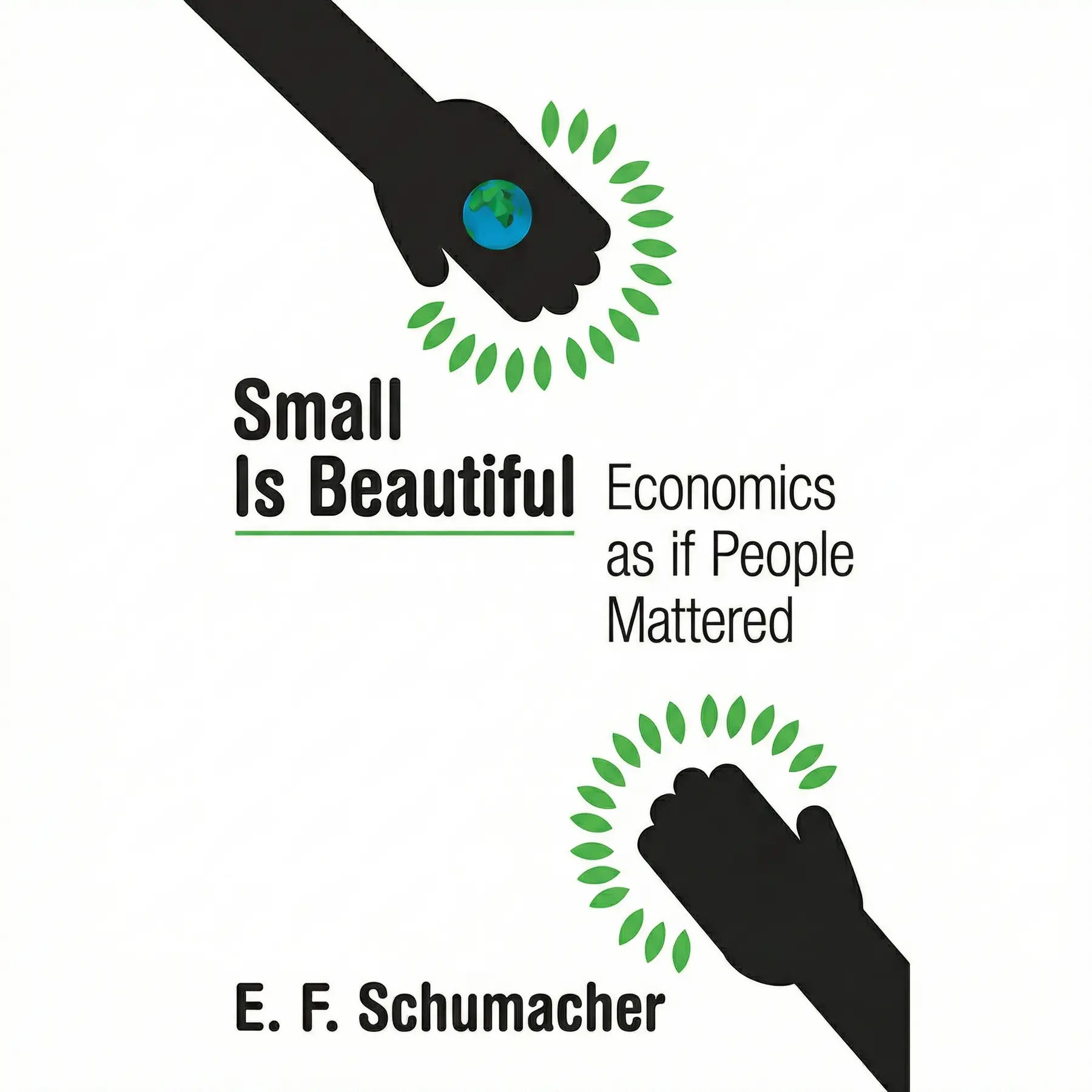
Small is Beautiful: A Study of Economics as if People Mattered
Small is Beautiful challenges the obsession with giant corporations and endless growth, proposing an economic model that prioritizes human well-being, environmental sustainability, and the restoration of meaning to daily work.
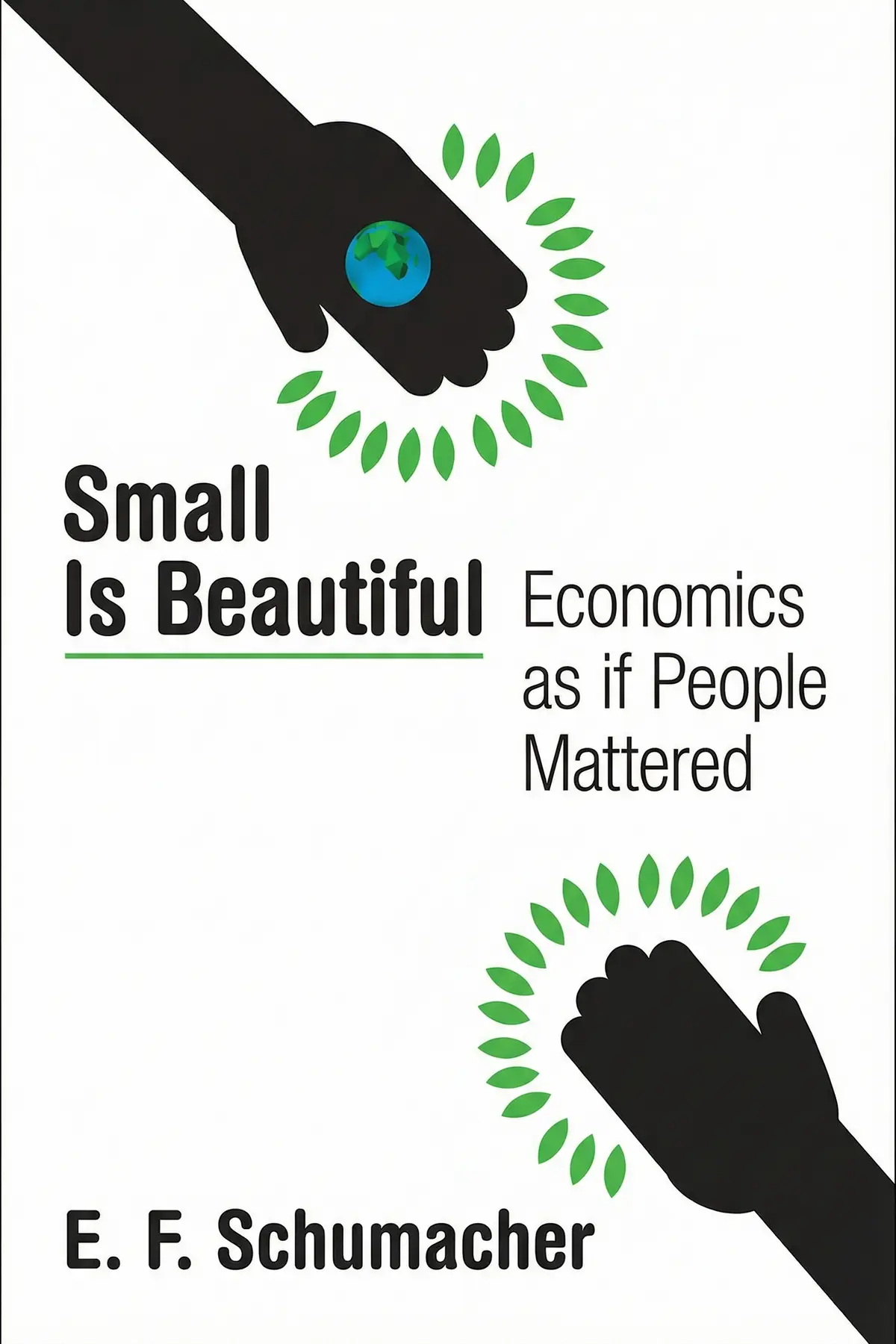
Table of Content
1. Introduction
1 min 46 sec
In the modern era, we are often told that the answer to every problem is more: more production, more consumption, and more growth. But what if this relentless pursuit is actually the source of our deepest crises? In his seminal work, Small is Beautiful, economist E. F. Schumacher invites us to pause and reconsider the very foundations of our global economic system. He suggests that we have built a world that is efficient at making money but remarkably poor at sustaining life.
The central throughline of this exploration is the radical idea that economics should serve humanity, rather than forcing humans to serve the economy. Schumacher argues that our current path is unsustainable because it treats the planet’s natural riches as a never-ending bank account and reduces the creative, living human being to a mere cog in a massive industrial machine. By shifting our focus from the ‘gigantic’ to the ‘small,’ we can begin to create a society that values permanence over consumption and people over profit.
Throughout this discussion, we will look at why the promise of universal prosperity is a dangerous illusion if it is built on greed and envy. We will examine how our education systems have drifted away from teaching wisdom, and why our technology often robs us of the satisfaction of a job well done. Most importantly, we will see how a shift toward decentralized, small-scale organizations can foster the creativity and loyalty needed to build a stable future. This is not just a critique of capitalism; it is a call to return to a scale where human beings actually matter. Let’s dive into how we might reconstruct our world by embracing the beauty of the small.
2. The Illusion of Infinite Resources
2 min 06 sec
We treat the Earth’s finite assets as if they were a daily paycheck, ignoring the reality that we are rapidly spending our planet’s fundamental capital.
3. Why Growth Does Not Guarantee Peace
2 min 00 sec
The common belief that global wealth leads to global stability is flawed when that wealth is built on the foundations of greed and envy.
4. The Trap of Economic Calculation
2 min 06 sec
When we judge every human action by its profitability, we lose sight of the priceless elements that actually make life worth living.
5. Education and the Pursuit of Wisdom
2 min 04 sec
True progress requires more than just technical knowledge; it demands a moral foundation that teaches us how to live well.
6. The High Cost of Nuclear Convenience
1 min 59 sec
Nuclear power is a prime example of choosing short-term economic gains while ignoring long-term, irreversible ecological dangers.
7. Reconnecting Work with the Human Spirit
1 min 58 sec
Technology was supposed to free us, but instead, it has largely replaced meaningful craftsmanship with repetitive and unfulfilling tasks.
8. Development for the Many, Not the Few
1 min 58 sec
Foreign aid often fails because it focuses on urban centers and money rather than supporting the rural majority and cultural structures.
9. Finding Freedom in Large Organizations
1 min 53 sec
Big businesses can only thrive if they manage to act like a collection of small ones, giving workers the autonomy and trust they need to be creative.
10. Conclusion
1 min 46 sec
The message of Small is Beautiful is more urgent today than ever before. We live in a world that is obsessed with scale, yet we are discovering that bigger is often more fragile, more destructive, and less fulfilling. E. F. Schumacher’s critique of modern economics serves as a powerful reminder that any system which ignores the health of the planet and the dignity of the person is ultimately doomed to fail. We cannot continue to treat our limited natural resources as an endless stream of income, nor can we continue to treat human beings as mere instruments of production.
The path forward requires a shift in our collective consciousness. We must begin to value the ‘uneconomic’—the things that don’t produce a profit but do produce a life worth living. This means reforming our education to prioritize wisdom and ethics, choosing technologies that empower rather than replace human skill, and focusing our development efforts on supporting small, local communities. It means recognizing that ‘enough’ is a better goal than ‘more.’
As you move forward, try to apply this perspective to your own life and work. Challenge the idea that every decision must be based on the bottom line. Look for ways to support local businesses, embrace simpler technologies, and find meaning in craftsmanship and community connection. By rediscovering the beauty of the small, we can begin the work of building an economy that serves the Earth and the people who call it home. The transition won’t be easy, but it is the only way to ensure a future that is sustainable, peaceful, and truly human.
About this book
What is this book about?
This summary explores the groundbreaking ideas of E. F. Schumacher, who argues that the modern obsession with consumption and profit is fundamentally unsustainable. The book critiques the Western economic framework, which treats the Earth's finite resources as infinite income and devalues the human spirit in favor of mechanization. Through a series of insightful perspectives, the text outlines why bigger is not always better. It promises a roadmap toward a more humane economy by re-evaluating our approach to technology, education, and international development. Readers will discover why fostering local, small-scale initiatives and prioritizing ecological health over GDP growth is the only way to ensure long-term peace and stability for humanity.
Book Information
About the Author
E. F. Schumacher
Ernst Friedrich Schumacher was a world-renowned economist and a protégé of the influential John Maynard Keynes. He utilized his deep expertise in the field during his twenty-year tenure as the Chief Economic Advisor to the UK National Coal Board, where he served from 1950 to 1970.
Ratings & Reviews
Ratings at a glance
What people think
Listeners find this work to be essential reading that broadens their economic perspective and offers brilliant insights. They value the non-traditional economic outlook and the emphasis on social justice, with one listener observing how closely it matches Catholic social principles. The text receives praise for its worth and focus on environmental longevity, as one listener points to its method for organizing a sustainable economy. While listeners admire how easy it is to read and its ability to spark deep thought, they do remark that the material is somewhat dated.
Top reviews
Sienna
Finally got around to Schumacher's masterpiece and I’m kicking myself for waiting so long. It offers a profound shift in how we view the 'religion of economics.' Rather than worshiping growth for growth’s sake, he argues for a system that actually serves human needs and fosters social equity. I was especially struck by how his arguments mirror Catholic social principles regarding the dignity of labor and the importance of localized community. In a world obsessed with AI and massive automation, his push for 'intermediate technology' feels more relevant than ever. Sure, some of the data from the early 70s is dated, but the metaphysical foundation is rock solid. It’s not just an economics book; it’s a manual for building a more sustainable and humane society. If you're tired of the 'bigger is better' mindset, this is the antidote.
Show moreAraya
This book should be required reading for every policy maker. Most economic theories treat the world like a giant machine, but Schumacher brings the focus back to human-scale reality. He argues convincingly that the constant cultivation of new needs is the antithesis of wisdom and freedom. Why are we working harder just to buy things that don't make us happy? I loved the focus on 'intermediate technology'—finding the middle ground between primitive tools and giant, soul-crushing machines. It aligns perfectly with my own views on sustainability and local resilience. While it’s been 50 years since it was first published, the call for a 'peace and permanence' economy is exactly what we need right now. It definitely deepened my perspective on global equity.
Show moreSebastian
Wow, it’s rare to find an economics text that feels so deeply personal and ethical. Schumacher doesn't just talk about numbers; he talks about the soul. He sees work as a creative necessity for the human spirit, not just a 'factor of production' to be minimized through automation. This perspective on dignified labor is something we’ve completely lost in the gig economy. I also found his critique of large-scale corporations to be spot-on. He proves that 'bigness' often leads to dehumanization and environmental ruin. The book is a beautiful blend of practical wisdom and spiritual insight, pulling from both Western and Eastern traditions. It’s a must-read for anyone feeling burnt out by the relentless pursuit of 'more' at the expense of the planet.
Show moreBond
In my experience, most business and economics books are dry, but this is a breath of fresh air. Schumacher understands that economics is a subset of ecology—something we too often forget. He dismantles the fallacy that infinite growth is possible on a planet with limited resources. What I found most valuable was his emphasis on social equity and aid for the 'developing world.' He argues for helping people help themselves through 'intermediate technology' rather than dumping high-tech, expensive equipment they can't maintain. It’s a vision of a world where human scale actually matters. Despite being written in 1973, it feels like it was written for the specific ecological and social crises we are facing today. Excellent insights all around.
Show moreNikolai
As an engineering student, I found the chapter where Schumacher dismisses the importance of science quite frustrating. He has this tendency to put down hard sciences while elevating the humanities as the only path to finding the 'meaning of life.' However, if you can look past that particular bias, the core message about technology is brilliant. He champions the idea that tools should be designed to help people work better, not just to replace them entirely. This 'Buddhist economics' perspective—valuing the person over the output—is a necessary challenge to our current corporate culture. Personally, I found the section on education to be incredibly thought-provoking, even if I disagreed with his tone. It’s an essential, albeit imperfect, read for anyone interested in sustainability.
Show moreCharlotte
Truth is, I have mixed feelings about the delivery, even though the message is vital. On one hand, it’s one of the founding texts of the environmental movement and makes excellent points about the finitude of natural resources. Schumacher rightly critiques the idea that we can have infinite growth on a finite planet. On the other hand, the writing style is incredibly declamatory. He often presents his own opinions as absolute certainties and treats statistics with a weird level of disdain. To be fair, he was writing in a different era, but his occasional comments on social roles feel a bit dusty. It’s an important historical document for understanding 'green' thinking, but you have to sift through some dated rhetoric to find the gems.
Show morePete
Picked this up because of the title and stayed for the fascinating alternative view of economics. Schumacher manages to weave together ecology, spirituality, and finance in a way that feels organic rather than forced. He isn't afraid to ask what 'progress' actually means for the average person. I particularly appreciated the chapters on the 'metaphysical foundation' of our society. He argues that no system stands on its own; it always reflects our basic outlook on life. It’s a bit of a dense read at times, and he does lean quite heavily on biblical and Buddhist references which might not be for everyone. Still, for anyone interested in structuring a sustainable economy that values people over profits, this is gold.
Show moreVimolwan
After hearing about Schumacher for years, I finally tackled this for its 50th anniversary. It’s amazing how many of his predictions about resource depletion and the hollowness of consumerism have come true. His 'Buddhist economics' chapter is easily the highlight for me. It shifts the goal from 'maximum consumption' to 'maximum well-being with minimum consumption.' That's a radical flip! My only real gripe is the tone. He can be quite preachy and dismissive of anyone who disagrees with his philosophical starting points. Look, I’m all for sustainability, but his rejection of modern statistics makes it hard to use his work in a modern policy debate. Definitely a thought-provoking read, though, and still very relevant to today's climate crisis.
Show moreOscar
The chapter on education really threw me off because it felt so ungrounded. Schumacher spends a lot of time on abstract concepts like 'levels of being,' but he never really gets down to concrete specifics. He seems more interested in writing a theological treatise than a book on economics. I agree with his premise that we are consuming our 'capital' (natural resources) as if it were 'income,' which is a vital distinction for sustainability. But the execution is just so uneven. One minute he's making a brilliant point about localized production, and the next he's rambling about biblical metaphors. It’s a foundational text for the green movement, sure, but it’s more of a philosophical manifesto than a rigorous economic guide. It hasn't aged particularly well in terms of presentation.
Show moreSupaporn
I really yelled at the pages during the science and statistics chapters. As a chemistry major, I found his dismissal of the scientific method to be incredibly arrogant and short-sighted. He claims only the humanities teach us 'the meaning of life,' which is a massive eye-roll moment for anyone who finds beauty and meaning in the physical world. Furthermore, his views on unemployment are archaic; he essentially implies that women should stay at home to 'fix' the labor market statistics. That’s not just dated—it’s sexist. While I appreciate the effort to save the world from over-consumption, such an effort deserves more academic rigor than this simplistic garbage. This was assigned for a symposium, and frankly, I'm just glad to be done with it. It's forgettable despite the hype.
Show moreReaders also enjoyed


Adults in The Room: My Battle With Europe’s Deep Establishment
Yanis Varoufakis
1929: Inside the Greatest Crash in Wall Street History--and How It
Andrew Ross Sorkin
23 Things They Don’t Tell You About Capitalism
Ha-Joon Chang
A Little History of Economics
Niall Kishtainy
AUDIO SUMMARY AVAILABLE
Listen to Small is Beautiful in 15 minutes
Get the key ideas from Small is Beautiful by E. F. Schumacher, plus 5,000+ more titles in English and Thai.
- 5,000+ titles
- Listen as much as you want
- 7-day free trial
- Cancel anytime







