
20 min 59 sec
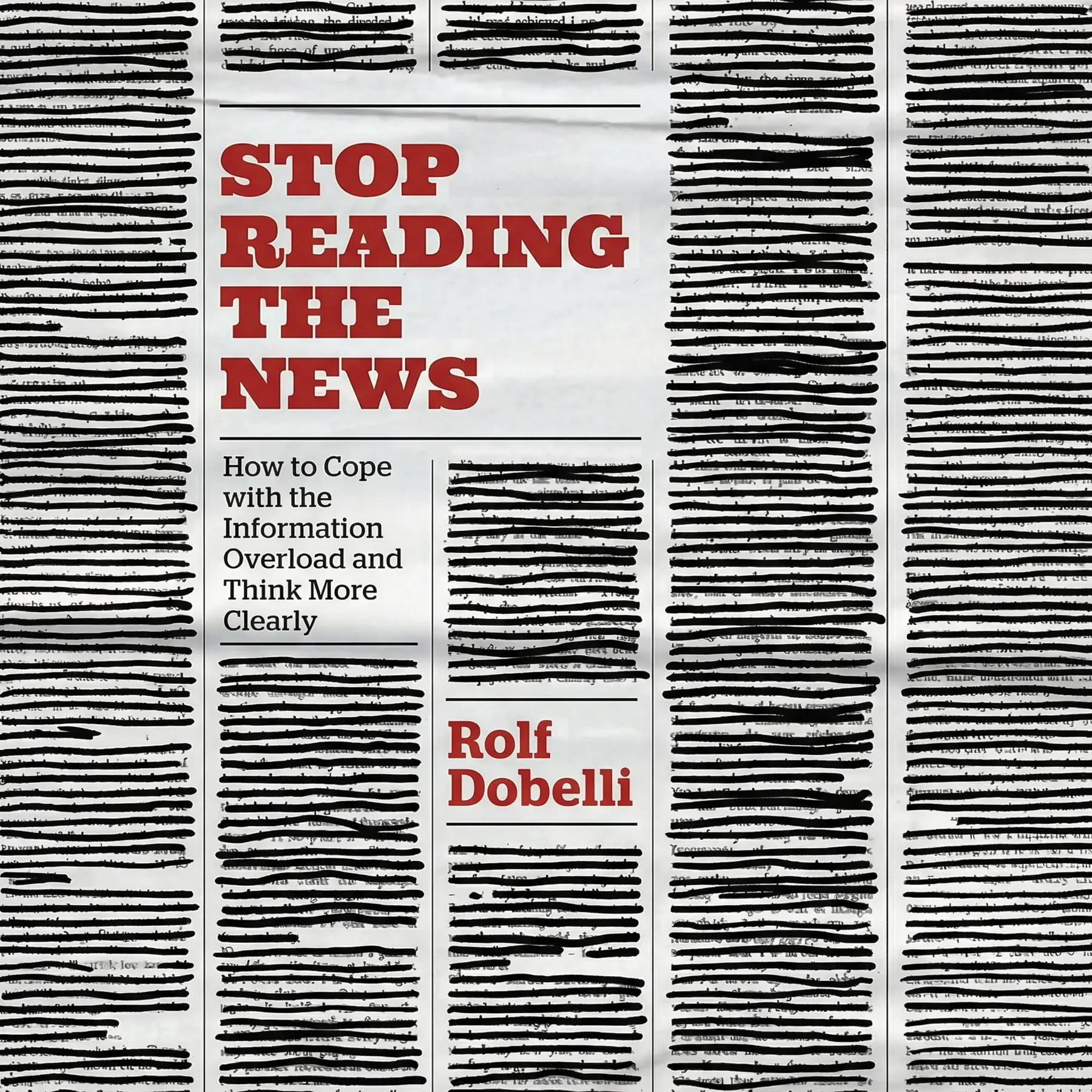
Stop Reading the News: A Manifesto for a Happier, Calmer and Wiser Life
By Rolf Dobelli
Stop Reading the News explores the detrimental impact of the modern information cycle on our mental health and productivity, offering a compelling argument for total news abstinence to regain focus and clarity.
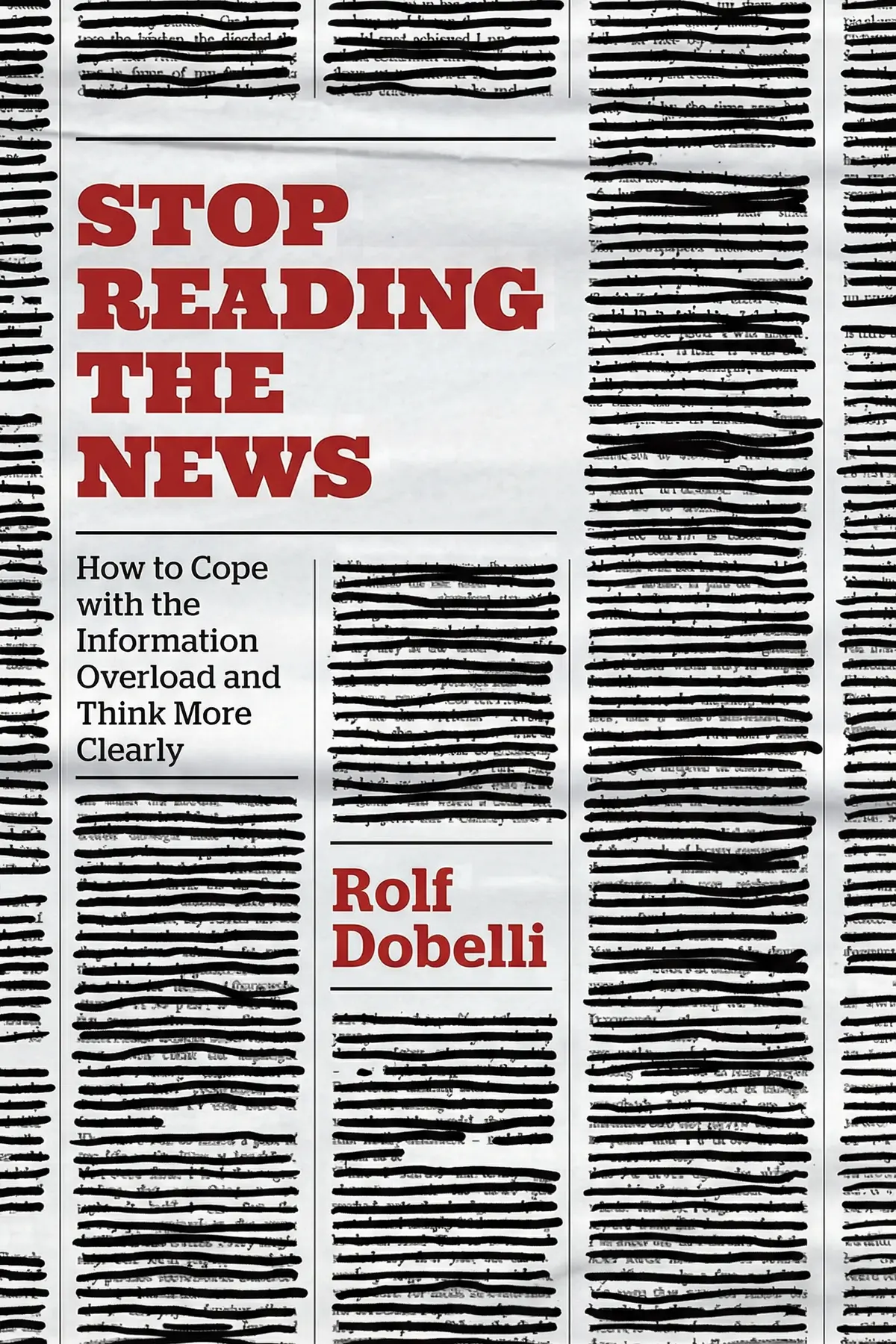
Table of Content
1. Introduction
2 min 20 sec
Imagine the very first moment of your day. Your eyes have barely adjusted to the light, and the world is still quiet, yet your hand is already reaching for your smartphone. Before you have even stepped out of bed or greeted your family, you are scrolling. You are consuming headlines about distant political upheavals, tragic accidents in places you’ve never visited, and the latest social media scandals. By the time you’ve finished your first cup of coffee, your mind is already heavy with the weight of the world’s problems—most of which you have absolutely no power to change.
This is the modern condition: a state of constant, low-level anxiety fueled by a relentless stream of digital information. We tell ourselves that staying informed is a responsibility, that it makes us better citizens, and that we need this information to navigate our lives. But what if the opposite were true? What if this habit is actually making us less capable of thinking clearly, less productive in our work, and significantly unhappier in our daily lives?
Stop Reading the News presents a radical and perhaps startling proposition: the news is essentially a toxin for the mind. It is a product designed to grab your attention through fear and novelty, rather than providing actual value or wisdom. The author, Rolf Dobelli, didn’t come to this conclusion lightly. He was once a self-confessed news junkie who believed that more information was the key to a more sophisticated life. However, his journey led him to realize that the deluge of snippets and bulletins was actually eroding his ability to concentrate and causing deep-seated mental fatigue.
In this discussion, we are going to explore why we have become so addicted to the news cycle and the profound ways it is reshaping our brains and our bodies. We will look at the history of the news industry to understand its true motives and dismantle the myth that following the news is necessary for a functioning democracy. More importantly, we will outline a strategy for breaking free from this cycle. By moving toward a life of radical news abstinence, we can reclaim our focus, deepen our expertise, and find a sense of calm that is impossible to maintain in the world of breaking alerts. This is a guide to silencing the noise so you can finally hear yourself think.
2. The Evolution of a News Addict
2 min 45 sec
Explore the author’s personal journey from a curious child in Switzerland to a high-flying professional overwhelmed by the digital information explosion.
3. Novelty Over Relevance
2 min 30 sec
Uncover why the news business prioritizes what is new over what is truly important, and how this business model hijacks our attention.
4. The Biological Rewiring of the Mind
2 min 24 sec
Learn how the habit of consuming news fragments our focus and physically alters the structure of our brains, making deep thought more difficult.
5. The Toxic Toll of Negativity Bias
2 min 21 sec
Understand why the news is overwhelmingly negative and how this constant exposure triggers a physical stress response that harms our health.
6. The Circle of Competence
2 min 08 sec
Learn why true success and clarity come from focusing on your specific areas of expertise rather than gathering superficial knowledge on a global scale.
7. The Path of Radical Abstinence
2 min 11 sec
Discover the practical steps to breaking your news addiction and how to replace shallow information with high-quality, long-form content.
8. Democracy and Real Journalism
2 min 19 sec
Examine why democracy thrives on deep thought and investigative reporting rather than the fast-paced, shallow cycles of modern news.
9. Conclusion
2 min 01 sec
As we come to the end of this exploration, it’s worth reflecting on the life you could lead if you decided to step away from the digital noise. Imagine a day where your focus is entirely your own. You wake up and your mind is clear, unburdened by the tragedies and trivialities of the previous night. You spend your morning working on projects that truly matter to you, diving deep into your circle of competence with a level of concentration you haven’t felt in years. When you interact with others, you bring a sense of calm and perspective, rather than the frantic energy of someone who has just consumed a dozen distressing headlines.
The message of Stop Reading the News is not about becoming ignorant or indifferent. It is about recognizing that our attention is our most valuable resource, and it is currently being exploited by an industry that does not have our best interests at heart. By choosing radical abstinence, you are making a conscious decision to value wisdom over information, and depth over speed. You are choosing to protect your mental health and your physical well-being from a cycle of stress that serves no productive purpose.
To put these ideas into practice, start with the thirty-day challenge. Clear the path by removing the temptations from your devices. But also, change the way you interact with the people in your life. Instead of asking friends if they’ve ‘heard the news,’ try asking them to tell you about something they know deeply. Seek out the experts in your life and listen to their long-term perspectives. You will find that these conversations are far more enriching than any debate over a fleeting headline.
Ultimately, the world is a complex and often beautiful place, but we cannot see that beauty or understand that complexity if we are constantly peering through the distorted lens of the news. When you stop reading the news, you don’t lose the world; you actually find it. You find the time to read the books that matter, the energy to help your neighbors, and the clarity to build a life of purpose. Take the leap into the quiet. You might be surprised at how much you’ve been missing while you were busy staying ‘informed.’
About this book
What is this book about?
We live in an era of constant updates, where every tragedy and political shift is delivered instantly to our pockets. This book challenges the assumption that staying informed through the news is a civic duty or a personal benefit. Instead, it argues that news is a toxic substance that fragments our attention, triggers chronic stress, and provides a distorted view of reality. Through a combination of personal narrative and psychological insights, the book promises a path to mental liberation. It explains how the business model of modern media exploits our evolutionary biases and how our brains are physically altered by the constant barrage of short-form information. By following a plan of radical abstinence, readers are shown how to reclaim their time, deepen their concentration, and focus on their true circles of competence, ultimately leading to a more meaningful and productive life.
Book Information
About the Author
Rolf Dobelli
Rolf Dobelli is a Swiss author and businessman, born in Lucerne in 1966. He began his career in the literary world as a novelist in 2003 with the publication of Fünfunddreissig. However, he achieved his greatest recognition for his non-fiction writing, particularly the globally successful work The Art of Thinking Clearly. In addition to his writing, Dobelli is an entrepreneur who co-founded getAbstract in 1999, a company dedicated to publishing book summaries and article abstracts.
Ratings & Reviews
Ratings at a glance
What people think
Listeners find the writing captivating and mentally stimulating, with one listener noting it helped them quit news consumption entirely. However, the work has drawn complaints for being unreadable and having pages out of sequence.
Top reviews
Witthaya
This book acts like a bucket of cold water for the digital age. Dobelli uses a sharp metaphor comparing news to sugar and books to actual nutrition, which really resonated with my recent feelings of burnout. I have been mindlessly scrolling for years, but this provided the push I needed to finally delete my news apps. Some chapters are admittedly quite short and a bit repetitive, yet the core message about protecting your 'circle of competence' is vital. If you’re feeling constantly riled up by things you can't control, give this a chance. It’s not perfect, but it is highly thought-provoking and engaging.
Show moreHannah
Ever wonder why you feel anxious after five minutes of checking the morning headlines? Dobelli explains that our brains are simply not wired for the constant stream of global tragedies that we have zero power to influence. Since finishing this, I have completely stopped watching the news and replaced that time with long-form biographies and technical books. My concentration has improved significantly and I feel much more at peace. To be fair, he wrote this before the pandemic, so some of his 'breaking news doesn't matter' logic feels slightly dated now. Regardless, the mental clarity I've gained is worth the price. It is truly life-changing.
Show moreOn
Finally got around to this manifesto and I'm glad I did. It is a refreshing, albeit radical, take on how we consume information in the 21st century. The chapters are very short, which makes it easy to digest, though the author would probably prefer I read a massive textbook instead! I found his arguments about news killing creativity and reinforcing hindsight bias to be particularly strong. It’s a very engaging read that challenges the modern assumption that being 'informed' is a moral duty. If you're tired of the constant outrage cycle, this book offers a viable way out. I feel much lighter now that I've stopped scrolling.
Show moreManee
Picking this up felt like a necessary intervention for my attention span. Dobelli argues that news is a toxic distraction that inhibits deep thought, and frankly, looking at my own productivity, he’s right. I appreciate the focus on long-form journalism and textbooks over the 'infotainment' that dominates our screens today. However, the book does feel slightly dated since it was written before the pandemic when breaking news actually became a matter of survival. I don't agree with every extreme conclusion, but the shift in perspective is worth it. It’s a fast read with very short, punchy chapters that get straight to the point.
Show moreSamroeng
After hearing so much about Dobelli’s other work, I had high expectations for this manifesto. The book is incredibly thought-provoking and makes a compelling case for why news is the 'sugar' of the information world. I especially liked the sections on how 'availability bias' ruins our ability to assess real risks in our lives. We worry about plane crashes but ignore our blood pressure. My only gripe is that it feels a bit 'boomer' in its dismissal of social media’s ability to highlight marginalized voices. Still, I’ve cut my news consumption by 90% since reading it and I don't feel less informed, just less stressed.
Show moreArt
Truth is, I’ve reduced my news intake significantly over the years, so this book confirmed many of my own suspicions. The author is a businessman, and it shows in his efficient, no-nonsense writing style. He correctly identifies that journalists are under pressure to churn out 'eye-catching' headlines for clicks, often at the expense of the truth. This 'churnalism' is exhausting. While I think he’s too extreme in saying we should avoid all news, his points about protecting our 'circle of competence' are brilliant. It's a quick read that will make you rethink your relationship with your smartphone. I definitely felt more productive after putting it down.
Show moreThanakorn
Frankly, the premise is excellent but the execution left me wanting more. I agree with the author that news makes us passive and miserable by constantly highlighting tragedies we can’t fix. But his repetitive use of 'dear reader' felt like he was trying too hard to be an 18th-century novelist. It got under my skin after the tenth time. The truth is that while the book is engaging, it’s also quite repetitive; he could have easily condensed these 160 pages into a long-form essay. It’s a decent starting point for a digital detox, just be prepared for some condescending lectures along the way.
Show moreKru
Not what I expected from a book about productivity. On one hand, the author is right that we spend too much time on 'disaster porn' that adds nothing to our lives. On the other hand, the writing is quite repetitive and he generalizes like mad throughout the middle chapters. Some of his advice is just impractical for the average person who needs to know if a local law is changing or if a road is closed. He sounds like someone who wants to live in the 1800s. I’d recommend it for the unique perspective, but don't take his 'cold turkey' advice as gospel. Just be more selective.
Show moreKet
Frustrating experience because the physical copy I received actually had pages out of order, making the second half almost unreadable. Even putting the manufacturing issues aside, the author’s tone is incredibly patronizing and feels quite superior. He repeats the same few arguments for 160 pages without offering much in the way of peer-reviewed research or nuance. While I agree that 'churnalism' is a problem, his demand for a total cold-turkey ban is unrealistic for anyone who wants to remain a functional member of society. It feels like a high school debate performance rather than a serious philosophical work. I expected better from the author.
Show moreAva
Look, I wanted to like this, but the author’s privilege is just too loud to ignore. He suggests that we should just ignore the news and let 'other people' tell us if something important happens. Who are these other people if everyone follows his advice? Also, claiming that consuming news is 'unintentionally supporting terrorism' is an absurd logical fallacy that made me want to throw the book across the room. It’s a very idealistic view that only works if you’re wealthy enough to not be affected by policy changes. There are some good points about mental health hidden in here, but they’re buried under a mountain of arrogance.
Show more
Readers also enjoyed
A Guide to the Good Life: The Ancient Art of Stoic Joy
William B. Irvine
A High-Performing Mind: Strengthen Your Mind and Live Your Best Life
Andrew D. Thompson
Abundance: The Inner Path to Wealth
Deepak Chopra
59 Seconds: Change Your Life in Under a Minute
Richard Wiseman
AUDIO SUMMARY AVAILABLE
Listen to Stop Reading the News in 15 minutes
Get the key ideas from Stop Reading the News by Rolf Dobelli, plus 5,000+ more titles in English and Thai.
- 5,000+ titles
- Listen as much as you want
- 7-day free trial
- Cancel anytime







